Friday, March 19, 2021

Springtime on Mykonos ain't New Jersey


Saturday––Jeff


Spring officially arrives this weekend at the farm. It’s still wintry here, which means snow at times, but more often we’ll see chill rains working away at washing all but patches of hard-packed icy snow from the pastures. Daffodils are tentatively poking their shoots out from soft sunny spots in otherwise hard ground, and though temperatures bounce between the 30s and 50s (0-10C), hardy March winds knock the feel of the cold down ten degrees from thermometer readings.  Still spring definitely is on its way to pastoral northwestern New Jersey.


I like springtime here, but I’ll particularly miss seeing it this year in Mykonos. Now is when nature goes into full bloom on the island, giving it a blanket of green covered in red, yellow and purple wildflowers.  Most will be gone by the advent of tourist season.  It is a picture of the island few tourists ever get to see.


In that mindset, I thought I’d share some of my memories of springtime on Mykonos through this pictorial view of past such times there and on its neighboring island of Delos.  Of course, some things have changed—notably the original Naxian Lions of Delos have moved inside the Museum, replaced by copies to endure the elements.  The photographs are from the files of the master collector of all things visual Mykonian, Dimitris Koutsoukas.  Enjoy.


––Jeff


A DEADLY TWIST, Chief Inspector Andreas Kaldis #11 coming April 6th

“Engrossing…gorgeous”—Library Journal, starred review

“Vivid…travel buffs will be enchanted.”—Publishers Weekly

“Ingenious plot twists…delicious description”—Booklist

 “Like visiting old friends”—Kirkus Reviews

“Great characters, an intriguing story line and a wonderful setting”—Deadly Pleasures Mystery Magazine, A-rating.


Thursday, March 18, 2021

A salute

Stanley - Thursday

I have been watching 'the world's greatest deliberative body', as the U.S. Senate likes to call itself, with some interest since the change in government. I was mildly encouraged by the fact that some Republicans thought that President Trump had behaved in a manner unbefitting a president and voted to remove him from office. Not enough, in my opinion, but at least some. I hoped that the chaos of January 6 and Biden's promise of a more bipartisan approach to government would result in the Senate being more functional than during the previous four years.

The Senate in action


Of course, I was wrong. Despite over 60% of Americans approving of Biden's COVID relief bill, every Democrat voted for it and every Republican voted against it. 

From my perspective, there were two interesting outcomes. 

The less interesting of the two (because it was predictable) was that Republicans immediately accused Democrats in general and Biden in particular for jettisoning bipartisanship. They shed many a crocodile tear for what could have been. However, from what I read and heard, bipartisanship for a Republican senator means some Democrats should go over to the right, while no Republicans head left. One would think members of this august body would understand the meaning of BI in BIpartisan. Probably a vain hope.


More interesting was the presence of a viable third party for the first time I can remember. It could be called the Joe Manchin party. In a senate equally split between the two main parties, the conservative Democrat was able to wield substantial influence on the final bill. The mere possibility that he would abstain or vote against the bill forced the Democrats to water down what they proposed. Even though I preferred the original bill, I liked the fact that negotiation had taken place - not between Democrats and Republicans, but between the Democrats themselves.

Joe Manchin of West Virginia

I don't believe for a nanosecond that all Republicans were against the bill, even though they voted against it. Similarly, I'm sure there were Democrats who thought the original bill went too far in some places, but would have voted for it had they been asked to.

More negotiations took place because of Manchin than would have taken place if all the remaining senators remained wedded to their parties.

I am a strong believer in a political system that has more than two parties. In the United States, a third party that worked to balance the budget while providing support to the most needy in the country would attract enough support to influence policy out of proportion to its size. Both Democrats and Republicans would have to woo this party in order to pass any legislation. 

Since spending time in Denmark, I have become an admirer of the Radikale Venstre party or Danish Social Liberal Party. (Radikale Venstre means Radical Left, literally translated.) 

I like it because it doesn't really want to win enough seats to be asked to form a government. It prefers to sit in the middle of the political spectrum (despite its name) so it can influence policy by choosing to lean left or right as it deems fit. Co-operation is a primary belief of the party. So even though it is small (just under 9% of the vote in 2019), it offered to side with the Social Democrats to form a government only if they would make changes to the previous government's strict immigration policies. 

Sofie Carsten Nielsen - leader of the Radikale Venstre party

The politics of a multi-party state are fascinating, and I highly recommend the very entertaining Borgen television series for an authentic look at how the Danish parliament works.

Birgitte Nyborg wins a shocking victory!

I am not optimistic that a third party of any clout will emerge in the United States. The system is rigged in favour of a two-party system, and a third party would dilute the power of the financial supporters and PACs. Now, we couldn't allow that to happen, could we?

So, in the absence of a third party, I salute Joe Manchin, even though he's too conservative for my liking.


Wednesday, March 17, 2021

COVID DISPARITIES ARE GLOBAL

 Kwei--Wednesday


COVID-19 has exposed deep-seated health inequities

Established disparities in American health care have been widely exposed by the COVID-19 pandemic on multiple levels. 

DeathsPacific Islander, Latino, Indigenous and Black Americans all have a COVID-19 death rate of double or more that of White and Asian Americans, who experience the lowest age-adjusted rates. 

Hospitalizations: Black, Hispanic, and American Indian and Alaska Native (AIAN) people were roughly five times higher than that of White people in 2020.


TestingTesting sites in and near predominantly Black and Latino neighborhoods are likely to face greater demands than those in predominantly White areas, contributing to longer waits. There are also increased travel times to testing sites for people of color. 

VaccinationsAs of March 1, 2021, CDC data show that among US vaccinated subjects in whom race/ethnicity was known, Whites have received the lion's share of full vaccinations so far.


(CDC Data)

In Georgia, 69% of vaccinations were received by White people, while they make up 52% of the population, and in Nevada, nearly two-thirds (63%) of people who have been vaccinated are White, while they make up less than half (48%) of the total state population.


Global 
imbalance 

    But if you think the US is the only country plagued with such disparities, think again. It has been occurring in other parts of the world, but the criteria of privilege may not run along the same lines as in this country. Elsewhere, it's often a case of income and influence--"whom you know." In Ghana, a well-off someone I know called up eighteen of his closest relatives to instruct them to show up at the family home for a session of Oxford/AstraZeneca vaccinations administered by a privately hired nurse, all necessary paperwork provided. 

    As early as April, 2020, Russia's elites were given first crack at the Sputnik V COVID-19 vaccination

    While these reports are within countries, the world as a whole reflects the imbalances as well. In this map showing the progress of vaccinations globally from December 2020 to March 15, 2021, the gaps in vaccination are quite clear: parts of Central Asia and the continent of Africa are sadly lacking.


    In the world's battle against microbes, including SARS-COV-2, it is important to remember that no one is safe until everyone is safe. In typical shortsighted and selfish fashion, the developed countries will probably forget this. Covax is part of the collaborative effort of the WHO and Access to COVID-19 Tools (ACT)-Accelerator, which brings together governments, scientists, businesses, civil society, and philanthropists and global health organizations like the Bill & Melinda Gates Foundation to make distribution of vaccines equitable worldwide. It's under Covax that Ghana and other African countries have received their shipment of vaccines. Ironically, Bill Gates is still a favorite target of conspiracy lore surrounding COVID-19 in Africa and all over the world. 


    In the midst of all this inequality, alarming European trends in COVID-19 spread in the midst of vaccine inefficiencies show us that, along with the rise of virus variants, SARS-CoV-2 isn't done with us yet. 

    Tuesday, March 16, 2021

    A horse butcher in Paris


    Monsieur Jacques Leban owns and runs Boucherie Chevaline at 89 rue Cambronne in Paris. Situated in the 15th arrondissement on a busy shopping street he has a stalwart clientele and received the Viande 1er choix, a prestigious medal for quality meat.
    Yes, French people still eat horse meat. While I'm a vegetarian and avoid butcher shops, his business is part of a past that I write about.  There's a history here and you can see below the old milk cans - when the dairy cart and later truck would bring in fresh milk from dairies just outside Paris. Also hanging are the leather horse collars - perhaps used for teams of horses - that led carriages, delivered coal, vegetables, furniture and you name it before cars and trucks. 
    Here is Monsieur Leban leaning over his chopping counter, preparing cuts of meat
    Notice the meat hook that a side of beef or cow would hang on.
    There was a crowd of shoppers and he was busy; taking orders, cutting and whacking, then tying up the order with white waxed paper and string. Old School.

    I came back another day when he found time to give me five minutes. He expressed no surprise that I wanted to know his and his shop's history.  He'd worked in the abbatoir - not far away - butcher house that is now Parc Georges Brassens. He remembers as a young man the cattle coming in to Paris on the train via le petit ceinture, an abandoned rail track and cattle getting nervous from the smell of blood. How people ate fresh meat, vegetables and fruits and shopped every day. I didn't ask his age, but he works daily in the shop and looks in his 80's or 90's. He said that when he started as a horse butcher there were five hundred or so. Then it went down to about forty. Now it's only horse butchers including him in Paris. 

    Monsieur Leban didn't know it but he became pivotal for a plot point and quite saucy - no pun intended - in my next book. I hope when I can get back to Paris, to give him a copy! Most of all I hope he'll still be there.


    Cara - Tuesday 

    Monday, March 15, 2021

    Historic Moment for African Girls

    Annamaria on Monday

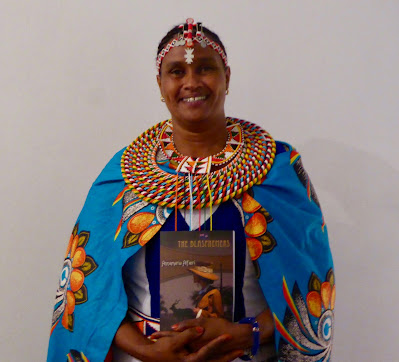
    In order to write the first two books in my Africa series, I had to spend countless hours over several years researching the cultures and history of Kenya.  But it was not until I started work on the third, The Blasphemers that I learned about the treatment of young girls.  It horrified me.  All the more so because, though British missionaries had been combatting it since 1906, among some groups, it was still common practice.

    Then three years ago - just as The Blasphemers was launching, I met a grassroots warrior against FGM and forced marriage, a Samburu woman who is a teacher and gifted leader and organizer.  The Samburu are a branch of the Maasai tribe, which has clung to its old ways with remarkable tenacity.  In some ways this is a good thing, but its treatment of girls is criminal, and progress against these hideous practices has, until now, been spare.

    But good news came in the past two weeks. Here is the text of an email that I received from Sarah on 22 February:


    Declaration to End FGM in Samburu


    Hi Patricia.

    How are you and how are things the going?


    We are doing well. The pandemic is slowing down and not many cases are reported.

    Am still planning for a phone call or a skype with your friends soon when I get the appropriate signal area.


    In June 2019 our president made a commitment to end FGM by 2022.

    The coming Tuesday 2nd March the Samburu community—elders, women, girls, boys, leaders and Kenya’s President Kenyatta will make a historic Declaration to end FGM and Child marriage among the Samburu community.


    Girls and women can help take the message of ending FGM to their fellow students and youth. I am looking into a future free FGM.


    This event takes place at Kisima centre in Samburu 90km from where we live.

    It will be officiated by President Kenyatta.


     I have mobilized 10 girls and 10 women to take them to the event. Am therefore requesting for some funds to enable me, the girls and the women to attend this historic event.


    A message over the weekend corrected the date.  President Kenyatta had postponed the event to coincide with Kenya’s celebration of international Women’s Day over the following weekend.  The meeting would be on Friday, March 5. With strict instructions from me to send us LOTS of photos, Sarah went into high gear.  Here is her report on what happened at the event: 


    Hello Patricia,

    I am glad to report back that we made a successful trip to Lake Kisima to attend a historic declaration to end FGM and early child marriage among the Samburu community which was officiated by the President of Kenya.


    Please find some of the attached pictures in the document. Thank you and may God bless you and your friends.


    Lots of love,


    Sarah Lesiamito


    After breakfast, going to venue, awaiting president


    The shuttles we hired for transportation


    Elders who signed the Anti-FGM Agreement on behalf of the community


    Local Administrators who attended the occasion with us


    One of the surgeons that we took with us to the historic declaration to end FGM

    (AA Comment: I believe this is an enkamuratani, a woman who performs FGM.  I think

     it was brilliant of Sarah to bring her along.)


    With the school-going girls


    Me and one of the local leaders talking to the girls


    Women awaiting the President’s arrival


    Arrival of the President


    The President, local leaders, and the community (Kenyatta is in khaki)


    Screen shot of Sarah’s final submission regarding the event


    I am so proud of Sarah, of how she took advantage of the opportunity, of her leadership and organizational instincts.  The declaration of this month is a huge step forward, but its implementation will be a test and a challenge.  I will be conferring with Sarah on her progress and her needs, and will find ways to support her efforts. I have formed a group of highly capable women who will be joining in this work.


    It is a privilege and a joy for me to have a small role in this effort.  The smiles on the faces of girls free to stay in school, to have their own dreams, and at least a chance at making them come true! They make me do the happy dance.  I was the first woman among my own female forebears who had an opportunity to follow such a path. I credit my mother with that change.  She was not allowed to dream for herself.  She dreamed for me.  


    I don't know how much of the 21st Century I will see, but in this way and in many others, it seems to be bringing women out of the shadows, away from the second-class position we have so long occupied.  I believe I am looking at the Century of the Woman. All the world will be better off if I am right.  Of that I am certain.

    Sunday, March 14, 2021

    Rite of Spring

     --Susan, every other Sunday


    Seasonal foods are one of the (admittedly, countless) things I love about living in Japan. 


    An autumn dinner in Yuasa, Wakayama Prefecture

    Everything from restaurant menus to grocery stores, and even the items on display at conbini (Japan's omnipresent, supercharged convenience stores) changes radically with the turning of the year--and not just quarterly. 

    Some of the older, more traditional restaurants and teahouses recognize 24--and in extreme cases, 72--different seasons in every year. These exceptionally detailed seasons relate to the relative positions of the earth and sun, and have an impact on which crops are most "in season" at any time of year.

    The components of this traditional breakfast (it's a savory meal in Japan)
    change weekly--if not more often.

    This week (March 14) falls near the middle of Keichitsu, which is the seasons "where hibernating insects awaken and show themselves." (Fortunately, this does not include cicadas--which get their own season, in early July.)


    Winter breakfast. No bugs allowed.

    March is also the time when Japanese people turn their thoughts--and palates--from ume (plum) blossoms to their more internationally-renowned counterparts: the sakura. And, as always, where the thoughts of Japanese people go, the menus follow.

    Sakura - Ueno Park, April 2019

    March is "all-sakura-all-the-time" season when it comes to specialty foods--some of which are admittedly stranger than others. Unfortunately, as my son will gladly tell you, far too many sakura-flavored items "taste like a mixture of cough syrup and soap."

    However, since I'm on a year-long quest to sample a new food every day for a book I'm writing about culinary adventures in Japan, it seemed like a good opportunity to see whether I could bust the myth that sakura flavored foods are merely soap-and-cough-syrup-flavored hype and see whether any are actually delicious.

    As it turns out, the task was easier than expected. Here are just a few of the sakura treats on offer in Tokyo this year--and I can happily confirm that (to my great surprise) most of them were actually quite tasty:


    Sakura Dacquoise - more salty than sweet, and vaguely soapy,
    but it did have bits of real sakura blossom in it.
    Probably won't buy it again, but I'm glad I tried it.

    At the conbini - Starbucks "sakura milk with strawberry jelly"
    For the record, this one DID taste like soap.

    Sakura Okoshi - a traditional snack made with puffed rice and peanuts.
    Very light, naturally floral flavor. 10/10 will eat annually.

    "Sakura latte with warabimochi" (bracken root dumplings)
    The least artificially colored, and one of the tastiest of the bunch. 
    Also, I love warabimochi.

    It wouldn't be Japan without a sakura kit-kat.
    Did NOT expect to like this--file it under "biggest surprise"
    because it was actually pretty good.

    The undisputed winner so far: sakura blossom and white chocolate scone from a local bakery
    Yes, that's a real pickled flower on top, and there were more inside.

    Starbucks is famous for its seasonal offerings in Japan.
    This is the "sakura-berry Frappuccino"
    Unlike the mass-produced conbini offering, this one is actually quite tasty.

    Sakura season has just begun here in Japan--the first large areas of blossoms were sighted in Kyushu last week, and at last report, Hiroshima Prefecture's cherry trees have begun to bloom as well. The trees here in Meguro (southern Tokyo) are setting buds, and I'll be watching them like a hawk on my daily walks from point on, though I don't expect to see them blooming for another two weeks or so.

    The sakura-flavored-food season will continue to surge through the sakura bloom, and die off just as quickly when the blooms are gone--by mid-April at the latest. At that point, the summer treats will start to appear. 


    But, for the moment, cherry blossoms reign supreme.  

    So, tell me: cherry blossom foods. Are you in, or is this one a pass for you?