Showing posts with label Russia. Show all posts

Saturday, March 1, 2025

I Asked This Question Three Years Ago: Is Our World at War?


Jeff–Saturday
  

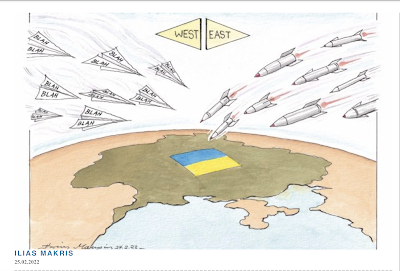
Three years and two days after Russia INVADED Ukraine on February 24, 2022, I wrote the following introduction to a post titled, "Is Our World  at War?":


I think everyone would agree that the world is a very different place today than it was one  week day ago. 24/7 news coverage of Russia invading Ukraine [and live coverage of yesterday's White House confrontation] has driven that home to American audiences. But how do Europeans see the war?  For that I turned to Ekathimerini, the newspaper of record in Greece, and found three interesting stories directly bearing on the topic. The first is an opinion piece by Nikos Konstandaras, titled,“A Geopolitical Earthquake:” 


History’s tectonic plates are shifting. No one knows the magnitude, depth or duration of the earthquake caused by Russia’s invasion of Ukraine on Thursday. What is certain is that our world is changing. We will either see a strengthening of the system of global government and Russia’s retreat (and consequent loss of great power status), or we will enter an era of absolute fluidity and danger, with neither laws nor principles. February 24, 2022, did away with the illusion of a collective understanding, in which powerful countries maintained balance with each other, kept to certain rules, avoiding confrontation even when they disagreed over important issues. 


When a nuclear power and permanent member of the UN Security Council invades a neighbor, with arguments that are aimed more at convincing its own citizens than the international community, this is a direct threat to the global system of governance and to the principles of behavior that developed after World War II. The Russian president is fully aware that his actions can open the gates of hell, issuing a direct threat that “anyone who would consider interfering from the outside… will face consequences greater than any you have faced in history. All relevant decisions have been taken. I hope you hear me.” It is clear that, after this statement, there is no return to the world that we knew. Either the international community will get its act together and stop Vladimir Putin, or we will enter a period of instability and barbarism, where those who can will tread all over international law at the expense of the weak. The last time such circumstances prevailed, Europe was led to 1939.


The last decades do not inspire optimism. The United States often set a bad example with unilateral actions, autocratic regimes have taken hold in many countries, liberal democracy is under fire, the UN has been weakened. But disaster is not a given. Putin faces two insurmountable obstacles: His country, with a population of 144 million and GDP of 1.5 trillion dollars, is not as powerful as he considers himself to be; the only great power that could support him, China, has invested in stability and development. With the United States and the European Union putting on a united show, with China looking after its own interests, Putin – though always dangerous – will be on his own.


Picking up on that point is Stathis N. Kalyvas, Gladstone Professor of Government at the University of Oxford, with his observation on what Greece’s stance on the Ukrainian crisis should be:

Russian aggression is justified with geopolitical excuses: It feels surrounded after losing a large geographical zone over which it once held complete sway. Such analyses usually also contain some reference to the catastrophe that befell Russia with the collapse of communism and the trauma that caused.

But a closer look at the situation in Russia reveals that it is less at risk from being surrounded than it is from other factors: Its economy is overly reliant on energy (with the production of oil and natural gas accounting for some 40% of its economy), its demographics are nosediving (its population shrank by a million between 2020 and 2021 alone), and its young and educated people are migrating in droves. Politically, it is a combination of an old-school autocratic regime that openly stomps on individual freedoms and an oligarchic economic structure with all the traits of a mafia.


The real threat, therefore, lies within its own borders. Regardless of the mistakes made by the United States from 1990 onward, Russia could have chosen to take a different path, similar to that of the European countries that were once part of the Soviet bloc, just as Ukraine is trying to do.


So, the real issue is about politics and principles. On the one hand, we have an autocratic power that is employing methods harking back to Austria or Czechoslovakia in 1938 and behaving toward its neighbors like a colonialist. Vladimir Putin himself even wrote that the Russians and Ukrainians are one people, a position rejected by the vast majority of Ukrainians. On the other hand, we have a nation that is trying to get ahead and threatening nobody in the process, by adopting modern political and economic practices. The situation is crystal-clear and there should be no hesitation whatsoever about what stance Greeks must take.


In reporting on the Greek government’s position
, Ekathimerini wrote:

Greece’s Prime Minister Kyriakos Mitsotakis told an emergency summit of NATO countries on Friday that Revisionism is the main threat to world peace and should not be tolerated, no matter where it comes from. 


The Prime Minister stressed that Russia’s aggressive actions violate international law and are a blow to European and international security and stability.


He reiterated the Greek position on respect for the territorial integrity, sovereignty and independence of all countries, and condemned in the strongest possible terms the Russian revisionist actions that run counter to those values.


With so much of the sane world of the same mind…albeit each nation facing differing potential political and societal consequences, the question on everyone’s mind is simply this: NOW WHAT?


Two years have passed without my finding an answer to that question. Perhaps well have one by next week. But don't bet on it.


–Jeff

Saturday, February 26, 2022

Is Our World at War?


Jeff–Saturday


I think everyone would agree that the world is a very different place today than it was one week ago.  24/7 news coverage of Russia invading Ukraine has driven that home to American audiences. But how do Europeans see the war?  For that I turned to Ekathimerini, the newspaper of record in Greece, and found three interesting stories directly bearing on the topic. The first is an opinion piece by Nikos Konstandaras, titled,“A Geopolitical Earthquake:” 


History’s tectonic plates are shifting. No one knows the magnitude, depth or duration of the earthquake caused by Russia’s invasion of Ukraine on Thursday. What is certain is that our world is changing. We will either see a strengthening of the system of global government and Russia’s retreat (and consequent loss of great power status), or we will enter an era of absolute fluidity and danger, with neither laws nor principles. February 24, 2022, did away with the illusion of a collective understanding, in which powerful countries maintained balance with each other, kept to certain rules, avoiding confrontation even when they disagreed over important issues. 


When a nuclear power and permanent member of the UN Security Council invades a neighbor, with arguments that are aimed more at convincing its own citizens than the international community, this is a direct threat to the global system of governance and to the principles of behavior that developed after World War II. The Russian president is fully aware that his actions can open the gates of hell, issuing a direct threat that “anyone who would consider interfering from the outside… will face consequences greater than any you have faced in history. All relevant decisions have been taken. I hope you hear me.” It is clear that, after this statement, there is no return to the world that we knew. Either the international community will get its act together and stop Vladimir Putin, or we will enter a period of instability and barbarism, where those who can will tread all over international law at the expense of the weak. The last time such circumstances prevailed, Europe was led to 1939.


The last decades do not inspire optimism. The United States often set a bad example with unilateral actions, autocratic regimes have taken hold in many countries, liberal democracy is under fire, the UN has been weakened. But disaster is not a given. Putin faces two insurmountable obstacles: His country, with a population of 144 million and GDP of 1.5 trillion dollars, is not as powerful as he considers himself to be; the only great power that could support him, China, has invested in stability and development. With the United States and the European Union putting on a united show, with China looking after its own interests, Putin – though always dangerous – will be on his own.


Picking up on that point is Stathis N. Kalyvas, Gladstone Professor of Government at the University of Oxford, with his observation on what Greece’s stance on the Ukrainian crisis should be:


Russian aggression is justified with geopolitical excuses: It feels surrounded after losing a large geographical zone over which it once held complete sway. Such analyses usually also contain some reference to the catastrophe that befell Russia with the collapse of communism and the trauma that caused.


But a closer look at the situation in Russia reveals that it is less at risk from being surrounded than it is from other factors: Its economy is overly reliant on energy (with the production of oil and natural gas accounting for some 40% of its economy), its demographics are nosediving (its population shrank by a million between 2020 and 2021 alone), and its young and educated people are migrating in droves. Politically, it is a combination of an old-school autocratic regime that openly stomps on individual freedoms and an oligarchic economic structure with all the traits of a mafia.


The real threat, therefore, lies within its own borders. Regardless of the mistakes made by the United States from 1990 onward, Russia could have chosen to take a different path, similar to that of the European countries that were once part of the Soviet bloc, just as Ukraine is trying to do.


So, the real issue is about politics and principles. On the one hand, we have an autocratic power that is employing methods harking back to Austria or Czechoslovakia in 1938 and behaving toward its neighbors like a colonialist. Vladimir Putin himself even wrote that the Russians and Ukrainians are one people, a position rejected by the vast majority of Ukrainians. On the other hand, we have a nation that is trying to get ahead and threatening nobody in the process, by adopting modern political and economic practices. The situation is crystal-clear and there should be no hesitation whatsoever about what stance Greeks must take.


In reporting on the Greek government’s position
, Ekathimerini wrote:


Greece’s Prime Minister Kyriakos Mitsotakis told an emergency summit of NATO countries on Friday that Revisionism is the main threat to world peace and should not be tolerated, no matter where it comes from.


The Prime Minister stressed that Russia’s aggressive actions violate international law and are a blow to European and international security and stability.


He reiterated the Greek position on respect for the territorial integrity, sovereignty and independence of all countries, and condemned in the strongest possible terms the Russian revisionist actions that run counter to those values.


With so much of the sane world of the same mind…albeit each nation facing differing potential political and societal consequences, the question on everyone’s mind is simply this: NOW WHAT?


Perhaps I’ll have that answer for you next week.


–Jeff

Wednesday, March 17, 2021

COVID DISPARITIES ARE GLOBAL

 Kwei--Wednesday


COVID-19 has exposed deep-seated health inequities

Established disparities in American health care have been widely exposed by the COVID-19 pandemic on multiple levels. 

DeathsPacific Islander, Latino, Indigenous and Black Americans all have a COVID-19 death rate of double or more that of White and Asian Americans, who experience the lowest age-adjusted rates. 

Hospitalizations: Black, Hispanic, and American Indian and Alaska Native (AIAN) people were roughly five times higher than that of White people in 2020.


TestingTesting sites in and near predominantly Black and Latino neighborhoods are likely to face greater demands than those in predominantly White areas, contributing to longer waits. There are also increased travel times to testing sites for people of color. 

VaccinationsAs of March 1, 2021, CDC data show that among US vaccinated subjects in whom race/ethnicity was known, Whites have received the lion's share of full vaccinations so far.


(CDC Data)

In Georgia, 69% of vaccinations were received by White people, while they make up 52% of the population, and in Nevada, nearly two-thirds (63%) of people who have been vaccinated are White, while they make up less than half (48%) of the total state population.


Global 
imbalance 

    But if you think the US is the only country plagued with such disparities, think again. It has been occurring in other parts of the world, but the criteria of privilege may not run along the same lines as in this country. Elsewhere, it's often a case of income and influence--"whom you know." In Ghana, a well-off someone I know called up eighteen of his closest relatives to instruct them to show up at the family home for a session of Oxford/AstraZeneca vaccinations administered by a privately hired nurse, all necessary paperwork provided. 

    As early as April, 2020, Russia's elites were given first crack at the Sputnik V COVID-19 vaccination

    While these reports are within countries, the world as a whole reflects the imbalances as well. In this map showing the progress of vaccinations globally from December 2020 to March 15, 2021, the gaps in vaccination are quite clear: parts of Central Asia and the continent of Africa are sadly lacking.


    In the world's battle against microbes, including SARS-COV-2, it is important to remember that no one is safe until everyone is safe. In typical shortsighted and selfish fashion, the developed countries will probably forget this. Covax is part of the collaborative effort of the WHO and Access to COVID-19 Tools (ACT)-Accelerator, which brings together governments, scientists, businesses, civil society, and philanthropists and global health organizations like the Bill & Melinda Gates Foundation to make distribution of vaccines equitable worldwide. It's under Covax that Ghana and other African countries have received their shipment of vaccines. Ironically, Bill Gates is still a favorite target of conspiracy lore surrounding COVID-19 in Africa and all over the world. 


    In the midst of all this inequality, alarming European trends in COVID-19 spread in the midst of vaccine inefficiencies show us that, along with the rise of virus variants, SARS-CoV-2 isn't done with us yet. 

    Saturday, January 25, 2020

    And Now for a Break from Impeachment News...


    Jeff—Saturday

    For those of you wondering what’s going on in Greece these days—as if anyone in the US media seems to care about what’s happening outside Washington, DC—here’s a quick primer.

    +          The Turks and Greeks are at each other’s throats, the Turks claiming rights to Greek islands and energy resources.


    ATHENS – Greece’s Foreign Ministry immediately rejected claims by Turkish Foreign Minister Mevlut Cavusoglu who said there are “gray zones” in the Aegean as Turkey is moving to claim waters off Greek islands and in the Continental Shelf.

    “The legal status of the Aegean and of (the Aegean) islands is clearly determined by international treaties and there is no room for dispute,” Greece’s Foreign Ministry said, adding that Turkey’s interpretation of the UN Law of the Sea is “unfounded” and “illegal.”
    “Greece has chosen the path of international legality,” the ministry said, urging Turkey to do the same, although Turkey doesn’t recognize the Law of the Sea unless invoking it in its favor against Greece and Cyprus, where Turkish ships are drilling for oil and gas.
    Speaking to CNN Turk, [Cavusoglu] said that, “There are islands whose sovereignty has not been established” either in the Treaty of Lausanne or in the 1947 Paris Peace Treaty. Turkish President Recep Tayyip Erdogan doesn’t recognize the Lausanne treaty that set borders between the countries and openly covets the return of some Greek islands.
    —The National Herald.
    +          The Turks have allied themselves with one-side in the battle for control of Libya, and the Greeks are siding with the other.

    ATHENS – Greek Prime Minister Kyriakos Mitsotakis and Libyan Gen. Khalifa Hifter, who leads a rival force in his country that’s battling a United Nations-recognized government, sided with each other in a meeting where both want to thwart Turkish ambitions.
    Their sit-down came just ahead of a European Union meeting in Berlin to talk about how to deal with Libya where the fighting in the oil-rich country has the international community worried it could come apart.
    Mitsotakis, upset that Greece was excluded from the meeting despite Turkey and Libya signing a deal dividing the seas between them, with Turkey claiming waters off Greek islands and planning to drill for energy off Crete, said he would veto any agreement in Berlin that doesn’t reject that seas pact. 
    —The National Herald.
    +          Turkey, a key transit point for Russian natural gas into Europe, is being faced down by a new alliance formed by Greece, Cyprus, and Israel to conduct gas drilling in the waters off Cyprus.

    Cyprus, Greece, Israel

    Cyprus President Nicos Anastasiades, Greek Prime Minister Kyriakos Mitsotakis and Israeli Prime Minister Benjamin Netanyahu attended in Athens Thursday the signing ceremony for the accord to construct the Eastern Mediterranean natural gas pipeline…

    The accord comes just as tensions are increasing in the region after Turkey’s contentious agreement that delineates maritime borders with Libya and affirms claims to areas of the Mediterranean the pipeline may cross. The three signatory countries all oppose the deal.

    Israel’s cooperation with Cyprus & Greece “adds to security and prosperity in the region” and “we are not turning against any other country,” Netanyahu said. 

    —Houston Chronicle

    +          Refugees are once more streaming onto Greece’s Eastern Mediterranean islands through Turkey, and conditions in Greece’s refugee camps are going from horrible to only God knows where.

    AP/Petros Giannakouris

    In 2019 74,600 people arrived, 50 per cent more than last year. They are mostly families with children from Afghanistan and Syria. 59,700 arrived on the islands and 14,900 at the land border.
    Conditions in the islands’ reception centres are now dangerously overcrowded with 36,400 people sharing the space and services intended for 5,400.
    —Relief Web, quoting UNHCR Fact Sheet
    +          Will America back Turkey or Greece? is the question on the minds of most Greeks.


    ATHENS – Fear there could be conflict with Turkey over the Aegean and East Mediterranean and a rekindling of a refugee crisis is high on the minds of worried Greeks with a poll finding those issues vexing them.
    Some 62 percent of those surveyed by the Pulse firm for SKAI TV said they were worried about Turkish provocations that have included violation of air space and Turkey’s drilling for oil and gas off Cyprus and planning to do the same off Crete after signing a deal with Libya dividing the seas between them…
    But they didn’t like the way that Germany, the United States and the European Union are responding. The US has a military cooperation deal with Greece but President Donald Trump backs Erdogan and the EU has given Greece press statements of support only…
    A surge in some 50,000 more migrants and refugees coming to Greece after New Democracy was elected, most to already overwhelmed Greek islands, found Greeks divided over how it is being handled.
    The government said it would speed asylum application processing as well as deportations back to Turkey, which has allowed human traffickers to keep sending refugees and migrants to Greece after they had gone to Turkey first, fleeing war and strife in their homelands.
    —The National Herald
    +          Domestically, with the far left out of power, protesters are returning to in-your-face, confrontational political protest, and being met with Greece’s new center-right government’s “the rules are different now” approach.  

    Reuters/Costas Baltas

    ATHENS (Reuters) - Greek police fired teargas … at students protesting against the shutdown of a prominent Athens university that authorities raided at the weekend to confiscate materials they said were typically used in violent demonstrations.
    It was the first time police and protesters had clashed inside university premises since the Conservative government’s abolition of academic sanctuary earlier this year…
    Leftist parties say the concept of academic sanctuary, which prohibited security forces from entering universities, protected students’ freedom of expression. But the government, which came to power in July, said it had been a cover for lawlessness.
    —Reuters
    +          The fiscal crisis remains front and center in the minds of many Greeks.

    A near decade-long economic crisis that created an exodus of some of Greece’s top and youngest talents, unable to find work or fed up with a clientelist system holding them down and rewarding political friends stripped the country of skills the New Democracy government wants back…

    Under the ambitious scheme, dubbed Rebrain Greece, returning recruits will be guaranteed at least two years employment, the first of which will be financed by the state by 75%. Highly skilled professionals and scientists aged between 25-40 will be targeted first off…

    About 470,000 Greeks have left the country since 2008 when hiring freezes started popping up in anticipation of economic woes that really hit hard in 2010 when the then-ruling and now-defunct PASOK Socialist government sought the first bailout of 110 billion euros ($123.33 billion.)

    Signs of wariness remain, however, Greeks who’ve been burned by broken promises of volatile governments hedging their bets for now and about 40 percent who left it was goodbye for good even if there’s a recovery.

    —The National Herald

    +          Tourism is up once again, drawing all sorts from around the world to join in a feeding frenzy for tourist cash, especially on price-is-no-object destinations such as Mykonos and Santorini.


    Passenger traffic at Greek airports reached 65.4 million in 2019, breaking all previous annual records.
    According to the statistics of the Civil Aviation Authority, in the January-December period of 2019, there was an increase of 5% in the air traffic of the country, with the total number of passengers travelling in January-December 2019 reaching 65,385,004. In the same period of 2018, 62,292,191 passengers were transported, meaning the number was up by 3,092,813.
    A 3.7% increase was also recorded in the total number of flights to Greek airports, reaching 538,956 (of which 213,098 domestic and 325,858 foreign), compared to the corresponding period of 2018 where 519,548 flights were operated.
     —Protothema
    [Mykonos] ranks first, along with Santorini, in terms of hotel visitor satisfaction for 2019 in the so-called Mediterranean “premium” destinations with competing destinations in Sardinia, St. Tropez and Ibiza.

    —Protothema

    +          The Greek Parliament has elected the nation’s first female President, a largely ceremonial role, but still a first.

    Greek President Katerina Sakellaropoulou


    —Jeff

    Jeff's 2020 Speaking Engagements and Signings (in formation):

    Thursday, March 12-Sunday, March 15, 2020 
    San Diego, CA
    LEFT COAST CRIME—San Diego Marriott Mission Valley
    Panels yet to be announced

    Monday, March 16, 2020, 11AM-2PM
    Saddlebrooke, Arizona 85739
    FRIENDS OF SADDLEBROOKE LIBRARIES 
    30th Anniversary Authors Luncheon
    SaddleBrooke Clubhouse
    40010 S. Ridgeview Blvd.
    Author Speaking and Signing

    Thursday, June 4--Sunday, June 7, 2020
    BRISTOL, UK
    CRIMEFEST—Mercure Bristol Grand Hotel

    Panels yet to be announced
