Sunday, September 17, 2017

Sometimes, You Must Get Lost to Be Found.

-- Susan, every other Sunday

Jeff's Saturday post resonated with me more than usual this week--so much so that I changed my own post to ride his coattails piggyback on the resonance he started.

If you haven't read his post, Whose Life Do You Wish to Live, go read it and come back.

I'll wait.

It took me more than 40 years to embrace the person I am inside, and I had to go halfway around the world, and lose myself, to do it.

Iga castle, Iga-Ueno, Japan


Like many writers, I often felt like a misfit toy. I was happier in worlds of my own creation than in the real one, where I felt I never quite belonged.

I sat in my room and created adventures to replace the ones I lacked the courage to pursue any other way.

And then, in the summer of 2015, I boarded a plane with my family and flew to Japan on a research trip that would change my life.

The Great Buddha at Nara - even bigger in real life than I'd imagined.

After years of devouring mountain climbing books, I finally stood at the peak of one I actually climbed.

Summit marker at Mt. Mizen - my first Japanese mountain.

After decades of gazing in awe at National Geographic photographs of Japan's iconic Great Torii, I took my own.

The entrance to a sacred space.

In fact, I took a whole lot more than one.

A dream come true, and a calling found.

I had never felt so close to any place, or so certain that I'd made the right decision in writing about Japan. Wherever I stood, whatever I saw, the country sang to my heart and inspired my soul.

When the time came for me to go home, I watched the landscape fall away with longing, nose to the airplane glass and wishing desperately to return.

Me, watching Japan fall away beneath the plane.

The following year I returned--this time, alone. I screwed my courage to the sticking place and did what I never dared to do . . . I traveled the length of the country by train, staying in new hotels and thousand year-old temples.

I watched the sun rise over the rice fields of Shikoku:

Dawn in Tokushima

and the moon rise over the alps.

Moonrise in the old post town of Magome.


I hiked on the Tokaido and Nakasendo - feeling the weight of history where tens of thousands of feet had walked -- and wandered the paths of Okunoin, where 250,000 people lie in silent, peaceful graves.

Okunoin, Mount Koya, Japan

To my surprise, I never once felt lost or homesick, even though I'd never gone so far or spent so long alone. Each morning felt like a new adventure, each night the end of a lovely dream. The more I hiked, and climbed, and saw, the more I understood that this ... the life I'd been too scared to live, the world I'd been too scared to see ... this was the life that I'm supposed to live.

The gateway to adventure, and to home.

Instead of feeling separate, I felt a part of something, close to something, in a way I'd never been. I love my family, my friends, and my home, but I also felt the need, the call, to share this lovely country and its history through my stories (and through photographs, as often as I can).

Autumn at Okunoin.


I always knew I would love Japan--I've loved its history, language, and culture since childhood, and that hasn't changed. If anything, it's merely spread to my son . . . a generational love.

My son and me at Ginkakuji (the Golden Pavilion) in Kyoto.

What I didn't expect is that traveling there--a place I expected to feel lost--would leave me feeling found.

I'm not sharing this to brag about myself (or Japan, though if you like what you see, I do encourage you to go), but rather to issue an invitation to anyone else out there who's feeling lost, or scared, or powerless. The world is big, and wild, and terrifying, but it's also ancient, beautiful, and beckoning. Sometimes, you have to step outside your comfort zone to find yourself.


Not all who wander are lost, indeed. And sometimes, you need to get lost to find the place where you belong.


Saturday, September 16, 2017

Whose Life Do You Wish To Live?


Jeff—Saturday

The other day, as I sat in a chic harborside eatery, staring out beyond an armada of luxury yachts across a blissfully calm Aegean sea, I found myself thinking of the meaning of life. 


Cue the violins.

I live on an island where temporal things matter.  Big time.  The island’s very existence depends on nurturing a sense in the hearts and minds of the hordes drawn there each summer that our very being is defined by what we possess or consume. The right table in the right restaurant, the right row of beach beds on the right place on the right beach, the right watch, the right late night club, the right bikini—or the right bikini wearer—all matter in the eyes of those who keep track of the things that determine your position in the governing pecking order.


Then I thought a bit longer.  About other places I’ve lived: big, medium, and small cities, farm and academic communities, chic apartment buildings and shacks.  They all use different measures, but inevitably the same dynamic is at work everywhere.  Perhaps it’s what you do, where you live, where you (or your children) go to school, what you wear, what you drive, what courses you teach, your publisher, what ranks or distinctions you’ve obtained, but in some way or another they factor into the calculations of those who keep track of your position in their particular pecking order.


And I’m talking now about decisions made once the broader categories of race, religion, ethnicity, political party, and gender have been resolved.

Let’s face it folks, we live in world where categorization is a fact of life.  Jeffrey the writer occupies a different position than Jeffrey the New York City lawyer.  Annamaria the chef, a different position than Annamaria the stripper. Caro the comic a different position than Caro the sincere (okay, so my examples aren’t perfect).

The bottom line is, to be truly free you must be happy in your own skin doing what you want to do.  There will forever be persons out there judging you by their standards, and if you invest in playing by their rules, you will end up living someone else’s view of your life instead of living your own.   


A word of warning to those who might think this is a curse of the capitalist class:  Anarchists can be just as ruthless—if not more so—in determining the status of their adherents in the “anti-isms” rankings of their disparate pecking orders.


As Davy Crockett once said, “Be true to yourself and you shall not fear from any man [or woman…other than Annamaria or Caro, of course].” 

Now back to staring out to see/sea.

Coronets please.

—Jeff

Friday, September 15, 2017

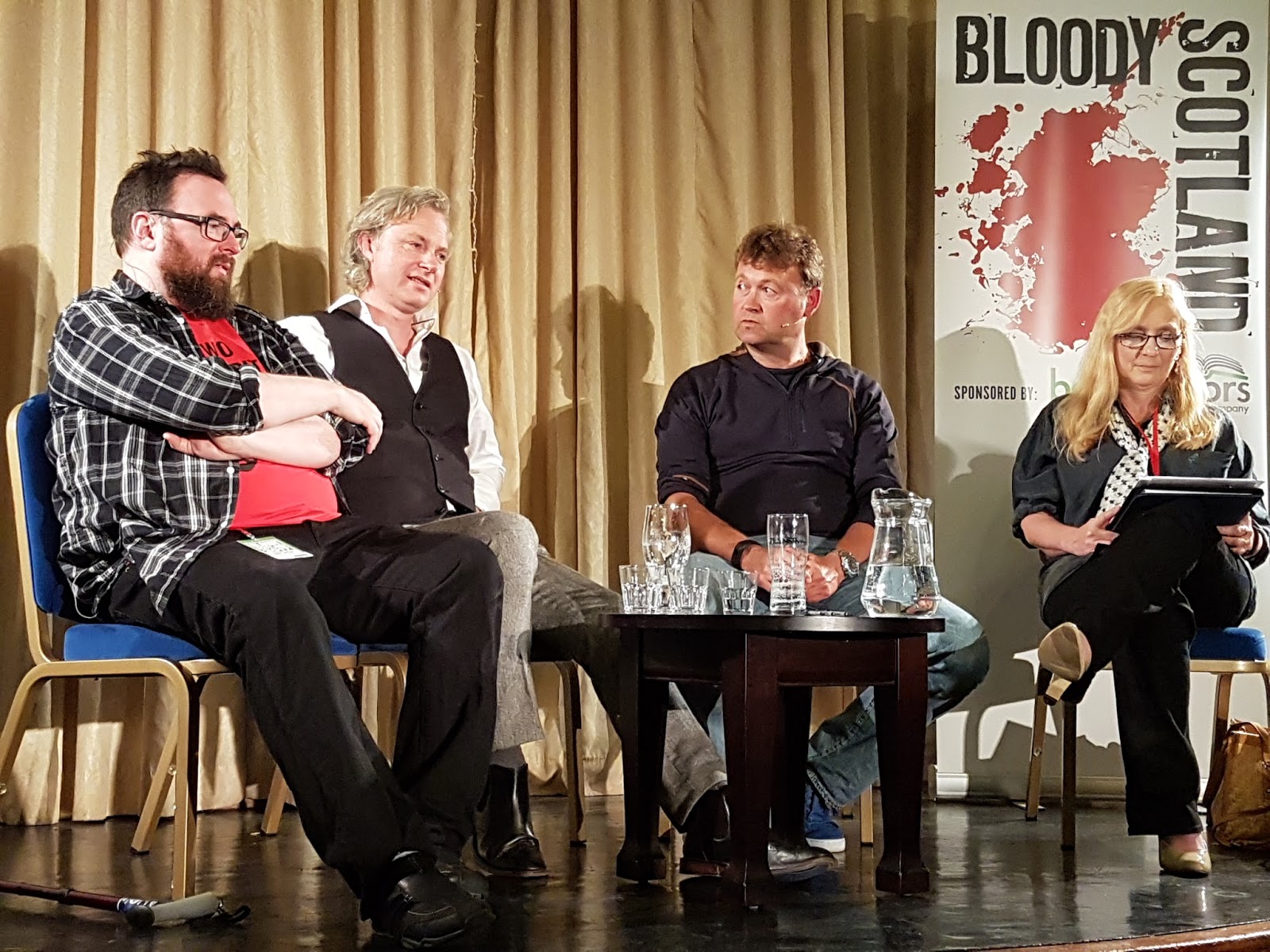
Bloody Scotland Flanuerette

I was very busy the week before Bloody Scotland and couldn't get there before this....


Obviously the Scots won the football. Again.
If we hadn't there wouldn't have been any pics.

Action packed action.
Well some men running after a ball. Slowly.


Simon T to Simon K 'Nae luck mate that's water.'


I think they were both trying to translate my wit and wisdom.

Simon K 'Stop right there Scotty. A quick fire round. The  past tense of  'dive' is.... errr.... 

dived!

doven?

doved?

Haylen is muttering under his beard, 'Are we getting paid for this? We bloody better be!'

Simon K pondering the question, Justin Bieber or Taylor Swift? Which one does the planet need least?

Searching for a really difficult question. 

Consulting one of last years panellists...


how many of these blondes can you name?


those two wondering...

what I am going on about.
 I was declining the verb to foutter.


                                               blonde 3 explaining the concept of a normal American..


me explaining the concept of thermal underwear to the californian three...

a famous crime writer with a tea cosy on his head

Another crime writer explaining why his pal has a tea cosy on his head...


some crime writers, a les paul and two microphones....
what could possibly go wrong


Caro Ramsay 15th Sept 2017


Thursday, September 14, 2017

The Bakhshali Manuscript or Much Ado About Nothing


 Michael - Thursday


I admit that I stole the second half of the title from the article the appeared in The Guardian today (that you can read HERE). It seemed too good to miss. The article is about some recent work on an ancient Indian text called the Bakhshali manuscript which is written in a form of Sanskrit on multiple pieces of tree bark. It seems to be some sort of training manual for traders. It’s quite impressive in its scope, including problems (posed in verse) in arithmetic, algebra, and geometry. The solutions are given as well (and are correct). And many of the numbers in the text contain zeroes, which are indicated by heavy dots, showing placeholders in a number position that should be 0. So what?

Section of the Bakhshali manuscript


Number systems have been around for a very long time, of course. Most cultures developed some way of representing numbers (if they wrote things down at all). We’re all familiar with the Roman system that is used to this day, in a rather pretentious fashion, for the year. It’s a horrible system, involving a few symbols and then implied addition and subtraction from them—for example IX is one less than ten, so nine, while XI is one more than ten so eleven. Some scholars have speculated that the lack of a decent number system was a not insignificant problem for the Roman Empire. The ancient Greeks—often put forward as the originators of modern mathematics— had no concept of zero and had philosophical concerns about how nothing could be something.

In fact, the western world was in no way the leader in mathematics historically. That honor belonged to other cultures and the Indian subcontinent has a strong claim. Around 700 AD when an Indian astronomer had formalized the numeral zero, and the concept was introduced to Europe, it was dismissed. Why have a number for nothing? Why would you want to count nothing? It was like writing IIIIIV! What was the point? The point was that it now allowed the sort of number system we have today, where any number can be written in a way in which its value is obvious in powers of ten (or two if you prefer that as computers do) and on which we can do arithmetic easily. (Try the sum MMMXIV + MCLIX.)


Since this is now so obvious to us, why was it ever hard? The idea of nothing, and the understanding that if you have five sheep and sell five sheep then you have none left was always obvious. But why a symbol? It really isn’t that obvious at all. Why write down that you have 0 sheep? You simply don’t have any! Children don’t find this easy, by the way.  Zero and negative numbers are confusing things when you first meet them.

What has happened recently is that the Bakhshali manuscript has been radiocarbon dated with surprising results. Firstly, the text is not a part of one document at all, but bits of different ones hundreds of years apart. Were they part of some sort of ‘mathematics library’ that collected the material together? How did a part of that collection end up buried near the village of Bakhshali in what is now Pakistan? Dan Brown could make something of this, I’m sure. But the really interesting part, at least to people interested in the history of mathematics, is that one section of the document dates to around 300 AD. That’s about 500 years earlier than the current oldest document using a zero symbol as a digit in a decimal number representation. Looks pretty certain now that we owe essentially everything we do these days with numbers to the people of the Indian subcontinent.

Wednesday, September 13, 2017

The Horrible New Face of Clowns

Sujata Massey


As noted recently in The Washington Post, now is a bad time to be afraid of clowns.
Because they are everywhere.

Pennywise the Dancing Clown features in the film It, based on Stephen King’s famous book. And when I tuned into the FX program American Horror Story Season 7, I found more than one very twisted, homicidal clown. Later this year, a film called Behind the Sightings releases that is inspired by alleged menacing clown appearances in 2016.

This coming Saturday, September 15, 2017, clown-styled people will be gathering to protest in Washington, D.C. These self-described “Juggalos,” who first organized in appreciation of a band called Insane Clown Posse, are protesting their classification as a gang by the FBI and US Department of Justice. The Juggalos claim that people with Juggalo clothing, makeup and paraphernalia have gone on criminal watchlists, lost jobs, and more. After looking at their photos, it appears most of the Juggalos are not in full clown drag, but enjoy elements of clown makeup and clothing. 

So when did clowns become rightening enough to get the government involved?

It seems a journey centuries in the making. Early clowns appeared in Europe and Asia as court jesters or buffoons. They were mainly jokers and not necessarily dressed to obfuscate their identities. These clowns played a role in government—not just to entertain royalty and their vistitors, but to sometimes provide inside information. Then came circuses--with exotic animals often led by trainers in clown costumes, and clowns onstage and in parades and at children's parties. A clown seemed like shorthand for fun. 

In the 1960s, a clown with a bright red wig became an upbeat symbol for McDonalds hamburger chain. Ronald McDonald, and a small cast of cartoonish friends were designed to make children beg their parents to stop at the restaurant's trademarked Golden Arches. 


However, the longtime, happy go lucky McDonalds clown image became tainted when subversive Japanese filmmakers made short film clips purporting to be commercials showing a Ronald McDonald character stalking young women in their homes. These images went viral and resulted in McDonalds downplaying Ronald.

This corporate action is striking, because Ronald McDonald houses provide overnight shelter for the families of sick children are all over the United States--sometimes for weeks at a time. And inside many hospitals, amateur and professional clowns regularly visit children on the wards. The World Clown Association supports traditional clown work in circuses and in parades and service activities aimed at military veterans and senior citizens. They have spoken against nonprofessionals using a clown image to frighten the public.


I don't suffer from fear of clowns, which has a formal name: coulrophobia. I grew up of age when clowning was highly popular, and in fact evolved into a huge 1970s fad for mimes with beautifully painted faces. The greatest pantomime of all, a Frenchman named Marcel Marceau, performed in white face. Seeing a picture of Marceau in his skinny outfit with top hat and fabric flower triggered pleasant memories for me. 

I grew up to witness my own children’s natural discomfort with people covered up in outsized costumes, whether they were familiar Sesame Street characters or clowns. I get it. If you see someone who doesn’t have the skin or hair or hands of a person, and whose face is fixed into a false, colorful grin, your brain registers alarm. A face that doesn’t react with empathy or other expressions feels unsafe.


I imagine that the people who dressed up as clowns and appeared near playgrounds and on the edges of woods in 2016 and other recent times enjoyed carefully putting on makeup and costume and becoming something unrecognizable. There is a real power when one transforms the everyday appearance.  If you’ve ever changed your appearance for a wedding, dance, job interview, military occasion or religious event, you may have had this feeling of becoming bigger and bolder than your usual self.

Former Trump advisor and current Breitbart News executive chairman Steve Bannon labelled white supremacists as "clowns"--notwithstanding the fact that many of these so-called clowns are followers of his right wing website.

The irony is that on Saturday, Sept. 16, Trump supporters will rally on the Mall in Washington very close to where the Juggalos have their permit. Any resulting interactions may become a circus--but I doubt there will be happy laughter. 

Tuesday, September 12, 2017

Crossing fingers for the archives and la Roquine

This post is from last December since I'm on a plane to Paris. I'm going to search for the official police records (ie. charges, police blotter if they still exist) on la Roquine, Katia the redhead or Lucienne Goldfarb bordello Madame, as she's been called. This time I'm going to archives that supposedly have records and files sealed since 1948 that have recently been declassified.
Wish me luck.

 Is there a difference between marzipan and almond paste? Aren't they both from almonds? And why did a man, I've never met, leave me a book with a friend in Paris. A book, that I'd heard had been pulled by the publisher? How were copies even available?
To backtrack, years ago I'd heard about Lucienne Goldfarb, aka Katia la Roquinne (the redhead), who owned a Parisian bordello, was a police informer, opera aficionado, had friends in high places and was an alleged Jewish traitor to the resistance. This came from an interview with Paulette Sarcelle, a female Resistant who'd been caught and survived a camp. Paulette knew Lucienne, as she was called then, in Paris when Lucienne and Paulette were members of the Jewish communist worker cell of the FTP-MOI. This cell was betrayed and the members executed, which is described in the quoted article below by Madeleine Meyer. Paulette grew visibly upset telling me Lucienne Goldfarb had written an autobiography with such blatant lies that the surviving Resistants were able to finally have the publisher pull the book. But here in my hands was the book, published in 1976, which consisted of Lucienne talking about her life after 1947, how she'd worked for love, respected the police and informed for them. Opera was her passion. She worked for no one but her girls and her clients and had bought a hotel by herself at 10bis rue Debarcadere. An infamous address, it seems and yet when I went there in 2014, it was closed. The cafe owner across the street shrugged, 'she lived there upstairs for years, fell down and is in a retirement home.' She intrigued me. Did she betray her friends? Did nothing stick to her because of her work for the police and close ties to Roland Dumas below - formerly in the Ministry and a high powered attorney. But until this book came into my hands, I'd found nothing, until Lucienne popped back up in the news a week later. All this within two weeks of each other.
 She'd retired and sold her hotel/bordello and the hotel reopening is trading on her name and the notoriety. This is her in 2014.
How could Lucienne deny her past? Yet she had refused to speak about it. Here's what Madeline Meyer said in an article in Libèration: Madeleine Meyer, shows an old class picture. In it the face of a teenage girl with curly hair is surrounded in black pencil. "She was called Lucienne." A redhead, round. "She began to say she wanted to engage in the Resistance," Madeleine says, "she was actually trying to infiltrate." On March 23, 1943, the special brigades carried out their first raid against the network of young Jews of the FTP-MOI of Paris. 57 people were arrested. Since 1943, the survivors of which Henri Krasucki, future secretary-general of the CGT, accused Lucienne Goldfarb of being the informer to the police. In 1943, nobody was suspicious of Lucienne in their working class district. Her father, arrested in 1941, was deported in 1942. Her mother and brother have just been taken to Drancy. She is 18 years old. "The street was a little schtetel (Jewish village)," recalls Simon Rayman, arrested with the Manouchian group in October 1943. All the young people know. The Communists are numerous. Lucienne goes to find Ginette, a friend of school, tells him that she wants to enter a resistance group to avenge her deported relatives. "It worried me," said Adams Rayski at Liberation. "The next day, I was followed from my apartment. Later arrested." A few days before the roundup, Madeleine Meyer and her parents were visited by a police officer. "He said he was a police inspector and that our apartment had been denounced by Lucienne Goldfarb." The next day, Madeleine saw two German officers come out of a carriage, accompanied by a red-haired girl. "My aunt said to me: but here she is, La Lucienne," she remembers. After the war, Henri Krasucki filed a complaint against the policemen who tortured him in the police station of Puteaux, but also against Lucienne Goldfarb. Nothing happened. For the police, she quickly became a high placed informer and untouchable. Now after forty years it's gone from brothel to chic hotel that opened in late June. I'm still wondering why this book landed in my hands Cara - Tuesday