Showing posts with label seahorses. Show all posts

Sunday, May 29, 2016

Sunday ... Under the Sea

-- Susan, every other Sunday

It's been a while since I took you on a visit "under the sea" to my aquarium, and since Jeff's latest dispatch from Greece has me in a summery mood, this seems like as good a time as any to take you on the shortest journey possible: approximately two feet to the left of where I sit as I type this post.

Here's the view:

The view from my writing desk.

I've had The Reef (a 60 gallon marine "show tank" - meaning it's almost as tall as it is long) since December 2010, and quite a few of the current inhabitants have been with me almost that long.

My watchman goby, Max (actually "Emperor Maximus Angryfish I"), was the very first fish on the reef and remains one of the most opinionated.
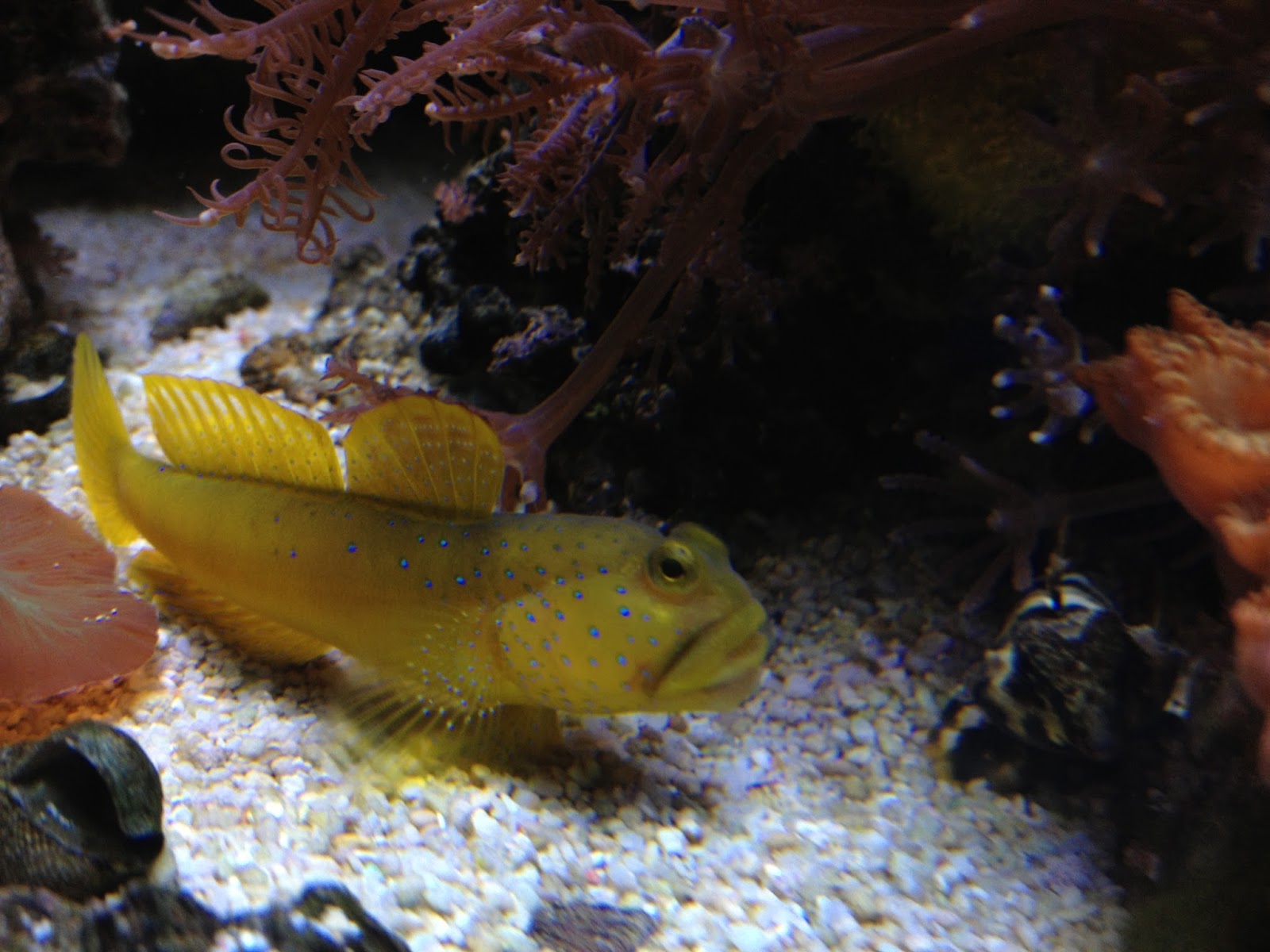
Emperor Max disapproves of your shenanigans.

If you ask him, he'd tell you his territory consists of "all the light touches" -- but for defensive purposes, he only gets truly feisty if someone attempts to invade the cave on the left side of the reef.

Max, defending his castle.

When that happens, all bets are off.  

The oldest corals in my tank are a lovely pink Kenya Tree:

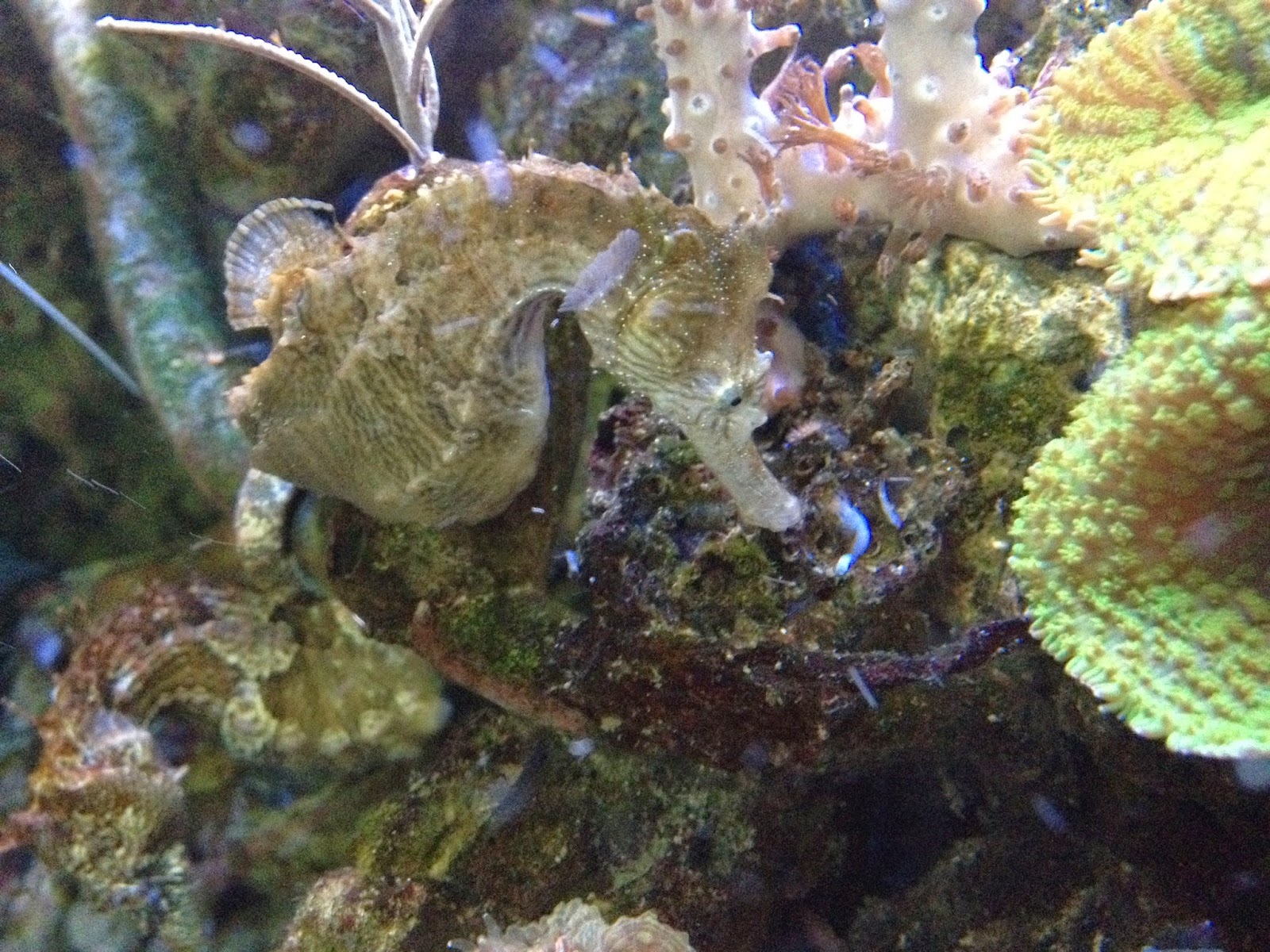
Look carefully - there's a seahorse hitched to its base.
... and a colony of Tubastrea - common name "sun coral" - that has not only survived, but reproduced at a rate that's rare in captivity.

The parent is at center frame. The one at the top is an offspring.

Most of the other sun coral colonies in the tank are "children" of that initial frisky sun.

Sun coral babies, attached upside down to the filter motor.

While the Kenya Tree is photosynthetic (like a plant, although it's actually classified as an animal), the sun coral uses its tendrils to capture meaty foods, which it consumes through the mouths located at the center of each polyp. Mine get a mixture of live phytoplankton, oyster eggs, and (defrosted) frozen mysis shrimp--delivered nightly by eyedropper.

The "stars" of the reef don't live as long as the corals and most of the other fish. Hippocampus erectus--common name "Lined Seahorses"--live only 3-4 years, on average, and my tank is currently home to its third generation of seahorse-kind.

Moya - a male, in a rare moment out in the open.

I buy my seahorses from a breeder in Florida that raises them entirely in captivity. They arrive via FedEx overnight delivery, and need to be picked up at the FedEx office to minimize the time they spend in the box.

Which means that every few years, I get the joy of walking into a FedEx shipping office and telling the clerk I've come to pick up live seahorses -- a statement that never fails to startle whoever is working behind the counter.

This is what the seahorses look like when they arrive, at 3-4 months old:

Approximately 2.5" long. Cute as buttons.

And this is what they look like two years later:

Vega, a female. Adult length: 8"

Moya, close up.

Keeping a seahorse reef requires choosing only tank mates--fish and coral--that won't sting, pinch, harass, or upset the seahorses. Not an easy task, but not as difficult as you might imagine. While I'm limited mostly to "soft" corals and peaceful fish that hug the reef and avoid the water column at the center of the tank, that still leaves a wide variety of corals, fish, and invertebrates to choose from.

Porcelain crabs are peaceful creatures, no matter what the pincers tell you.

One of my favorite non-fish, non-seahorse tank inhabitants is Oscar, the abalone. (Extra points if you get the joke before you read the caption on his photo.) I've had him for almost three years now, and he's grown from a three-inch baby to a nearly ten-inch creature my husband refers to as the "living booger."

My abalone has a first name, it's O-S-C-A-R...

Unfortunate nickname aside, I find Oscar fascinating. Abalone have light-sensing organs, and excellent senses of smell, but they don't see well (in fact, they're almost blind). Despite this, and their tiny brains, Oscar has learned that I supplement his diet of living algae by clipping sheets of dried seaweed to the top of the aquarium, and I can tell when he's hungry because he heads to the top of the tank and wanders around the rim, sticking his snout above the water level, looking for the seaweed clip. When he finds it, he'll scrape the remnants off and wait beside it until I notice him hovering there and add more food.

Oscar, enjoying his seaweed.

Not too bad for a sentient booger.

Obviously, I could go on at length, but I'll leave it there for now, but we'll visit again in a few more weeks, and I'll tell you more about the odd and lovely things I get to see on the reef.

Red-legged hermit, checking the seahorses' food bowl for treats. Yes, they eat from bowls.


Sunday, March 20, 2016

Weeble, The Horse Who Lived

-- Susan, every other Sunday

Murder is everywhere, but today I’d like to offer a story that proves that hope is, too.

The story of Weeble.

Weeble, the night he joined the reef.

 I have a seahorse reef in my office, beside my writing desk:

The reef.

 Since 2010, I’ve kept seahorses and live corals, along with a few invertebrates and a couple of specialty fish. Seahorses have some special needs, and do best in a reef that’s tailored for them, so everything in my reef “plays nicely” with these odd and curious creatures that essentially drop dead at the smallest scratch.

In December 2014, I purchased four baby seahorses from a breeder in Florida (I don’t like taking them from the wild). Three arrived in good condition but one had an infection in his tail.

The sick little guy spent several weeks in a curled, miserable state on the bottom of a hospital tank. The last half-inch of his tail (the part seahorses use to grip and hang on to things) fell completely off, leaving the bone exposed. 

Normally, once a fish assumes "the position"...well, it's bad.

He couldn't swim upright, and barely ate, and I accepted the inevitable… 

...but this little seahorse didn't get the memo.

One Friday evening about a month into the little seahorse’s ordeal, my son came home from college for the weekend and asked for an update. When I told him the seahorse was still alive, he asked what I’d named it. I told him I wasn't planning to name it because I didn't want to get attached.

My son asked me if that was really fair.

"He's fought so hard," he said, "and he's so small. If he dies, and his life consists of nothing but this struggle, is it fair that he never even got to have a name?"

***

The following morning, my son asked "How's Weeble doing?"

It took me a minute to make the connection. "You named the seahorse Weeble?"

He smiled. "Exactly. Because he wobbles, but he won't fall down."

Miraculous as it seems, the minute Weeble got a name he started to recover. He started sitting vertically. His tail healed. (He'll never re-grow the part he lost, but he figured out how to use his stump of a tail to make a reasonably solid hitch.) Two weeks later, I put him into the reef, and the other seahorses gathered around him to welcome him into the herd.

Weeble (front) and Magellan (who also has special needs--but that's a story for another day)

Fourteen months later, Weeble remains a healthy, happy seahorse, and has no idea he's different from the others in any way.

Stumpy tail, but determined attitude.

Wherein lies a lesson: Sometimes, the lion’s share of success (or the seahorse’s, as the case may be) is simply refusing to accept the odds.

WHO's not going to make it?

 Everyone has those short-tailed days when life has left you broken on the bottom, belly up and in despair. Sometimes, all the strength that's in you doesn’t seem enough to wiggle upright.


But sometimes, all it takes is the refusal to surrender and the determination to manage one more meal, one more day, and little by little your strength returns until you’re swimming along with strength you never knew you had.


Sunday, April 26, 2015

My writing space: The View From the Reef


Many writers have offices that overlook a garden, a peaceful yard, or a stand of trees. We tend to surround ourselves with inspiring views (at least, whenever we can) -- in many cases, they help to keep our thoughts in the pages and our butts in the chair.

That said, the view from my desk can get a little distracting.

Directly to the right of my desk, within arm's reach, sits a sixty-gallon aquarium full of seahorses and corals.


The Reef, April 2015

I've always loved the coral reef, with seahorses and their kin my special favorites. I had freshwater tanks for years, but shied away from reefs because I thought salt water tanks too difficult to keep and maintain. In 2010, my father died, and my husband encouraged me to take a little of his estate and do something I'd always wanted to do. He thought I would honor my father best by using a bit of that money to fulfill a dream, instead of paying bills.

(Have I mentioned my husband's a keeper?)

I mulled the thought over until December, until I remembered how much my father shared my love of the ocean and the various creatures that lived within its depths.

It took you HOW long?

Decision made: I wanted a reef. And not just a reef, but a seahorse reef -- which, as I learned, required some special planning. Seahorses are lovely, exotic creatures, and more intelligent than most people realize, but they're also not the brightest bulbs on the reef. Like toddlers, they grab at everything, so aquarium keepers have to "seahorse-proof" the reef to ensure that nothing will grab, pinch, sting, or molest the curious, delicate creatures who star in the space.

Baby seahorses: lovely and accident-prone.

It's not as easy as you might think.

Five years later, I'm raising my second group of seahorses. (The species I raise, Hippocampus erectus, lives only 4-5 years.) I've learned a lot in the process, and I think my dad would be glad that I made the decision to invest in a reef. It's more than a hobby--it's an obsession--but one that gives me many happy hours (and quite a few photos to share on my Facebook feed).

Seahorses have long, involved courtships and bond in pair-relationships that often last for the seahorses' entire lives. Male seahorses have "pouches" beneath their bellies, where the female deposits the eggs during a lovely mating dance. After fertilization, the male experiences a true pregnancy--including labor and contractions before delivery--which takes about 20 seconds and results in the live birth of up to 500 baby seahorses.

Don't believe me?

Here's a video of my second male seahorse, Ghillie, giving birth to a brood of babies.


The female who passes through the frame at about the 15-second mark is his mate, Ceti, who seems to be thinking, "That looks like a personal problem to me...catch you later."

Ghillie died a few weeks ago, but I thought I'd introduce the "new crew" who you might be seeing here from time to time.

The females:

Vega, the large black female.


Kirin (top)...showing Vega who's the REAL boss of the reef.

and Weeble (named because she wobbles, but she won't fall down.)

(Weeble is new to those who follow me, and my reef, on Facebook...expect to hear more about her in the days to come).

The males:

Rygel (spelling changed from "Rigel" when we learned he was male)

And the ever-hungry Moya.

and finally, little Magellan:

Magellan - the miracle horse.

Magellan is a special-needs seahorse born without the "snick"--the mechanism most seahorses use to feed. His disability keeps him smaller than the others, and impacts the way he eats, but he's a happy, inspiring fellow even so.

Seahorses might appear calm and peaceful, but they're carnivores (ambush predators, in the wild), and their oddity appeals to the parts of me that appreciates the strange, exotic, and dangerous.


Expect to hear (and see) more in the weeks to come...

--- Susan the Seahorse-Keeper

Sunday, February 15, 2015

Killers on the Reef

I came to Murder is Everywhere in part because I write mystery novels set in samurai-era Japan -- but my "prime directive" also included my hobby: life on the reef.

A writer's life doesn't have enough distractions, so I also have a 60-gallon marine (salt water) seahorse reef, which sits beside my writing desk.

How's that for a distraction?

Seahorses are one of nature's strangest predators. They have no fangs--no teeth at all--no claws, no spikes, and no poison.


Instead of arms and legs, they have only four tiny fins for locomotion (the smallest of which is really only a rudder).

Not as easy as it looks.

And yet, in the wild, they eat only live, meaty foods: small shrimp and crustaceans foolish enough to swim or wander near the seahorse's hiding place,

See horse? He sees you.

or which the seahorse manages to "dive bomb" in midwater.

Dive! Dive! Dive!

In many places, seahorses are endangered in the wild, so my seahorses are all captive-bred, from a breeder in Florida. I have six at the moment:

Ghillie, the oldest, who I've had since he was a baby. He's a four year-old male, and he's even had babies once himself. (Now he's the self-styled protector of little Magellan.)

Big Ghillie, little Magellan - buddies.

Kirin and Vega are five months old - I got them at Christmastime, 2014:

Kirin (front) and Vega (behind) eating from a feeding station.

along with Magellan, who's the same age as Kirin and Vega, but much smaller (we'll discuss his issues another time).

Magellan: small but determined.

Finally, Rigel (top) and Moya - who arrived last week.

Rigel and Vega, hanging out on the reef.

In the wild, seahorses are territorial ambush predators. Their eyes move independently, like a chameleon's, and seahorses also possess the ability to change their colors and patterns at will. Most of the time, they opt for colors that blend into the environment, but when mating or communicating with one another, they can (and do) turn any color.

Vega, "blushing" to get Ghillie's attention.

(Ghillie tends to favor pink and mauve when he's in the mood.)


The title "murder on the reef" most likely made you think of sharks, or other dangerous creatures from below. Adjusted for size, the seahorses and other syngnathids--the sea dragon and the pipefish--are actually far more aggressive, and ruthless, than many creatures people fear far more.

Hang around...these guys will be back in coming weeks.


-- Susan ... on a bloody Valentine's Sunday under the sea.