Many writers have offices that overlook a garden, a peaceful yard, or a stand of trees. We tend to surround ourselves with inspiring views (at least, whenever we can) -- in many cases, they help to keep our thoughts in the pages and our butts in the chair.
That said, the view from my desk can get a little distracting.
Directly to the right of my desk, within arm's reach, sits a sixty-gallon aquarium full of seahorses and corals.
 |
| The Reef, April 2015 |
I've always loved the coral reef, with seahorses and their kin my special favorites. I had freshwater tanks for years, but shied away from reefs because I thought salt water tanks too difficult to keep and maintain. In 2010, my father died, and my husband encouraged me to take a little of his estate and do something I'd always wanted to do. He thought I would honor my father best by using a bit of that money to fulfill a dream, instead of paying bills.
(Have I mentioned my husband's a keeper?)
I mulled the thought over until December, until I remembered how much my father shared my love of the ocean and the various creatures that lived within its depths.
 |
| It took you HOW long? |
Decision made: I wanted a reef. And not just a reef, but a seahorse reef -- which, as I learned, required some special planning. Seahorses are lovely, exotic creatures, and more intelligent than most people realize, but they're also not the brightest bulbs on the reef. Like toddlers, they grab at everything, so aquarium keepers have to "seahorse-proof" the reef to ensure that nothing will grab, pinch, sting, or molest the curious, delicate creatures who star in the space.
 |
| Baby seahorses: lovely and accident-prone. |
It's not as easy as you might think.
Five years later, I'm raising my second group of seahorses. (The species I raise, Hippocampus erectus, lives only 4-5 years.) I've learned a lot in the process, and I think my dad would be glad that I made the decision to invest in a reef. It's more than a hobby--it's an obsession--but one that gives me many happy hours (and quite a few photos to share on my Facebook feed).
Seahorses have long, involved courtships and bond in pair-relationships that often last for the seahorses' entire lives. Male seahorses have "pouches" beneath their bellies, where the female deposits the eggs during a lovely mating dance. After fertilization, the male experiences a true pregnancy--including labor and contractions before delivery--which takes about 20 seconds and results in the live birth of up to 500 baby seahorses.
Don't believe me?
Here's a video of my second male seahorse, Ghillie, giving birth to a brood of babies.
The female who passes through the frame at about the 15-second mark is his mate, Ceti, who seems to be thinking, "That looks like a personal problem to me...catch you later."
Ghillie died a few weeks ago, but I thought I'd introduce the "new crew" who you might be seeing here from time to time.
The females:
 |
| Vega, the large black female. |
 |
| Kirin (top)...showing Vega who's the REAL boss of the reef. |
 |
| and Weeble (named because she wobbles, but she won't fall down.) |
(Weeble is new to those who follow me, and my reef, on Facebook...expect to hear more about her in the days to come).
The males:
 |
| Rygel (spelling changed from "Rigel" when we learned he was male) |
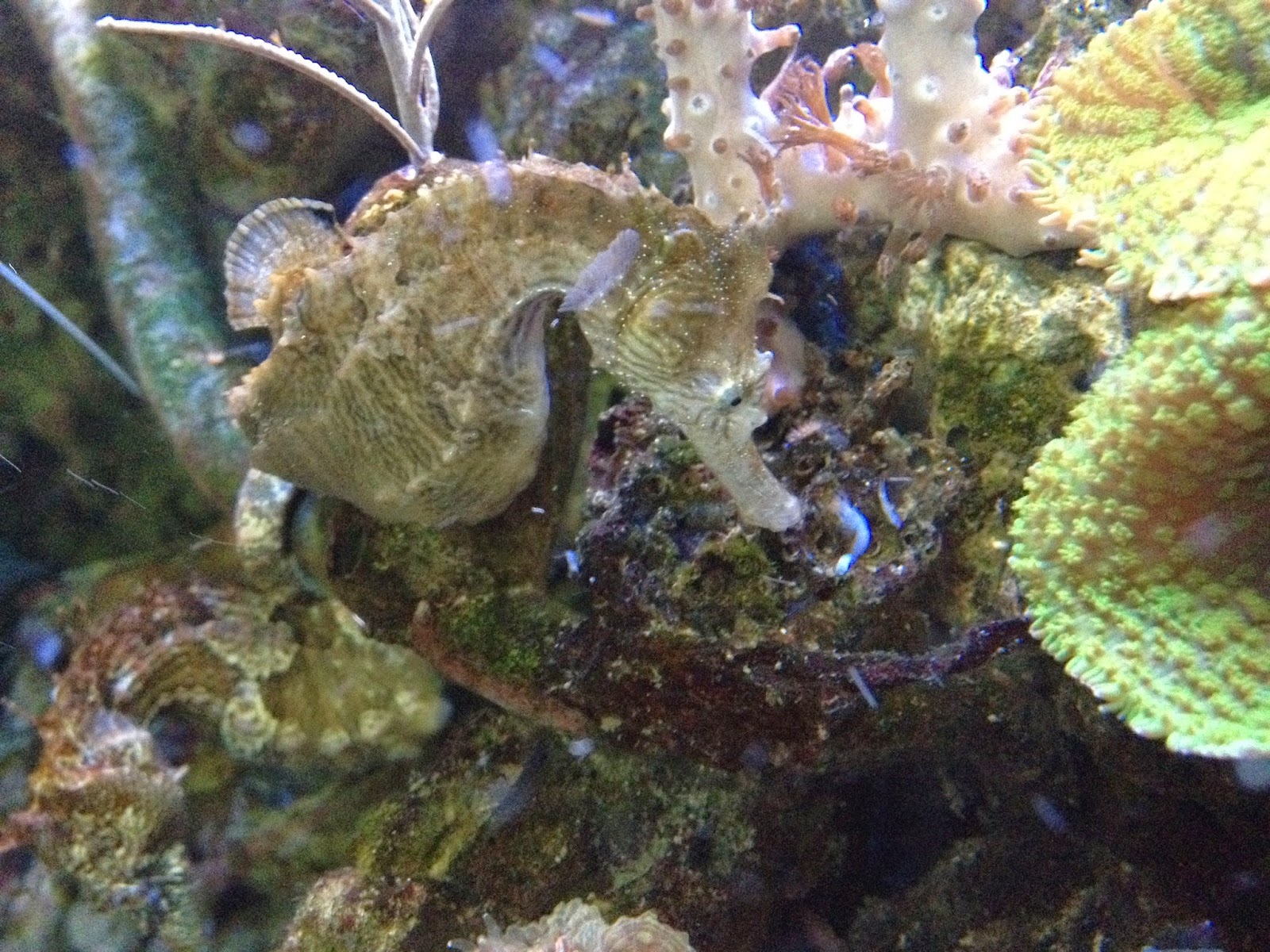 |
| And the ever-hungry Moya. |
and finally, little Magellan:
 |
| Magellan - the miracle horse. |
Magellan is a special-needs seahorse born without the "snick"--the mechanism most seahorses use to feed. His disability keeps him smaller than the others, and impacts the way he eats, but he's a happy, inspiring fellow even so.
Seahorses might appear calm and peaceful, but they're carnivores (ambush predators, in the wild), and their oddity appeals to the parts of me that appreciates the strange, exotic, and dangerous.

Expect to hear (and see) more in the weeks to come...
--- Susan the Seahorse-Keeper