Showing posts with label monsoon. Show all posts

Wednesday, October 5, 2022

Rainy Season Redux

 Sujata Massey


It's been raining for approximately one week in Maryland. First came the side-effects from Hurricane Ian, and now we are in the windy grip of a Nor' Easter. So much rain is tedious, but  getting my head wet on a dog walk is nothing compared to the situations suffered by those farther south in the US, and in Pakistan, where thirty percent of the landmass has been swallowed by water. All this rain got me thinking about my own experiences with monsoons in India. Therefore, I'm sharing (and updating) a blogpost from 2016, when I visited India in the rainy season for book research.


It's raining all the time, but the monkeys don't seem to care.

From the trees and on the ground, they were clearly on the job, watching the comings and goings of people like me to the hill towns of the Sahyadri mountains southeast of Mumbai. Slowly, I ate a piece of the peanut brittle, taking note of how these bonnet macaques seem to be working in teams to keep the local stray dogs from getting close to me--and my food. A friend warned me that monkeys can get mad enough to grab things out of your hand--even non-edible things, like camera and cell phones. This was the reason my shots are a bit distant. 


It was necessary to come here because of my book-in--progress The Satapur Moonstone, a 1921 mystery set in a princely state in the Sahyadri Mountains. To understand the setting, I  planned an excursion to visit hill stations, the elevated areas that offered cool respite to the British administration during India's hottest months. I was happy to get a reservation at Veranda in the Forest (now known as Dune-Barr House) a historic British hotel almost 170 years old. It's the oldest hotel in Matheran, a hill station that still doesn't have paved roads and thus has escaped much modern tourist development. I'd heard it would be a five-kilometer trek from the car park to my lodgings.   Because of it being uphill, going on horseback was recommended.  


The horseback ride was slow and waterlogged, but Namdev, my driver from Mumbai, was kind enough to accompany me. A male guide lead us and two teenage boys held the horse's reins--either to reassure us, or because the horses really didn't want to make the trip. It was over an hour of slow, careful plodding through a jungle of twisted trees and thick-hanging mist. I have seen enough Indian horror movies since this trip to realize that a demon could have dropped from a tree at any moment. 


It felt reassuring to reach the former home of retired British Army Captain Harry Barr. Going through the impressive gate, I found there were only a few other guests, due to the weather--and they were not chatty like the characters in Agatha Christie novels. My most frequent communication was with  a red-beige stray who haunted the grounds, always begging for something to eat.


The veranda was wrapped in plastic to help protect the furniture


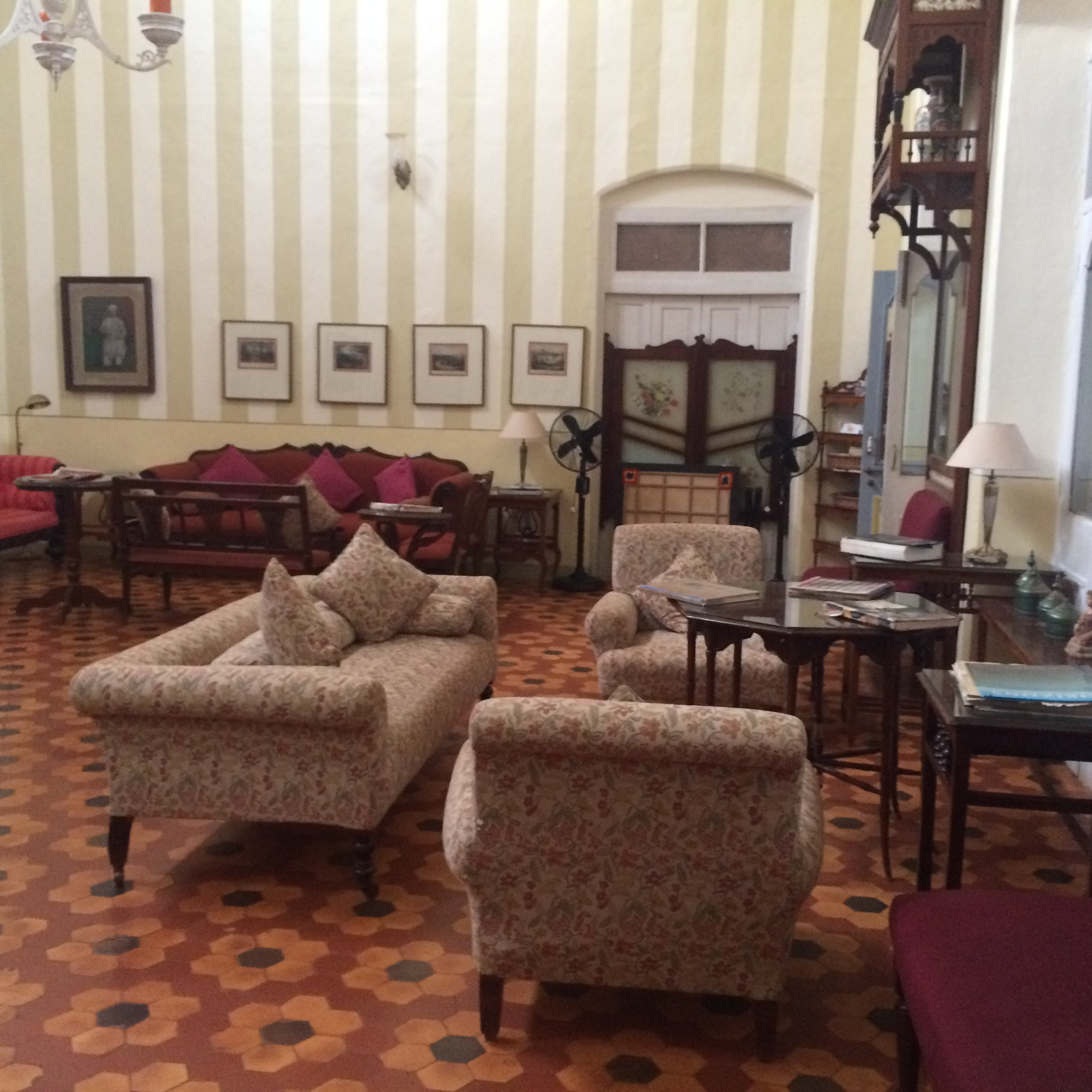
The house, which features a thirty-foot ceiling in the sitting room, and only slightly lower ceilings in the rest, was constructed to lessen the impact of torrential rain.  


The deluge made it a very inside kind of holiday--albeit one without any television, radio or wi-fi. The furniture didn't look like it had been updated in decades, and in this case, it was a good thing. I wanted to sleep on the same kind of bed that my heroine, Perveen Mistry would have done. What a delight the masterfully hand-crafted furnishings were: left over from the Victorian and Edwardian eras. In the drawing room, I sat briefly on tallest bench I ever encountered--and with such a grand mirror and top to it. In the end, I thought the piece was a carpenter's desire to try to have his work live up to the scale of the place.


After my first twenty-four hours in Matheran, the rain fell so hard and constantly that it soon became the most irritating noise. But at least I could while away the hours in the old hotel, drawing out an architectural layout that would become the plan for my fictitious Circuit House, the place occupied by a British civil servant where Perveen Mistry visits and learns about the area--while rain falls.  


The rain stopped for only about 2 hours during my four-day stay in Matheran. To take advantage, I rushed out with another woman staying at the bungalow. Still, the mists did not left--and because of the plateau-like structure of the hill station, you can't really roam around without danger of slipping, or maybe even  falling over the edge into a dam. 


A friendly local man was working at tightening up the wall of the dam with extra stones. H told us that stones are taken out of the dam wall during every rainy season to allow water to spill into the lake and not flood the land. Because rainy season was drawing to an end, he was returning the wall to its normal state and happy about the coming change. 


But this wasn't happening anytime fast. In the half-week I spent in Matheran, 
I always fell asleep listening to the relentless rain only to be jarred awake by thunder, then get back to dreaming, and ultimately awaken to another rainy day. As I wandered the hotel, I understood what it might mean to be confined to a place to months on end because rain meant that the paths down the mountain were washed out. At least there was electricity, so I could sit in my dreamy nineteenth century bed, working away at my draft. I had a dry roof over my head. And one misty morning, the horse and his groom arrived at the hotel, and it was time to descend the hill, meet Namdev, and get back to Mumbai. 


And although the rain was still falling, I didn't feel quite as wet behind the ears.  


Thursday, September 10, 2015

India in the monsoon


I've been fortunate to be in the same writing group as my guest, Sujata Massey - and what a benefit it's been to Michael and me.  Her comments and insights and suggestions have been invaluable.


Sujata, born in England to German and Indian parents, is the author of the delightful Rei Shimura series, the last of which, the eleventh by my count, Kizuna Coast, takes place in the aftermath of an earthquake and tsunami. 


Recently Sujata has shifted her focus and wrote a rag-to-riches story, The Sleeping Dictionary set in the mid-1900s, which tells of a young peasant girl trying to achieve independence both for herself and for her country.  It gives readers a great insight into an Indian mind while India was striving to free itself from Britain.


The Ayah's Tale is a novella also set in the mid-1900s in which an Indian woman picks up a book written by an English war hero and writer, who was a young boy she cared for when she was an ayah (nanny).  Holding the book in her hand brings back a flood of memories.


And coming out in November is the latest of Sujata's Indian novels - this one titled India Gray, which is a poignant adventure set on the 1945 battlefront of Assam.


If you've not read Sujata's works, I recommend them highly.  

Stan - Thursday
________________________________________


My plan to visit India this past July through August struck most of the friends, relatives and seasoned travellers I knew as dubious.

Unless you’re staying in the cool hill country, summer in India is either hot and hellishly dry in the northwest (New Delhi, which I have experienced twice in such conditions), or hot and wet (Mumbai, Kolkata and the rest of the country). As I planned my trip in May, I tried not to react to news stories about “India’s worst heat-wave in recorded history,” which had caused the deaths of more than a thousand. This year, India had its highest recorded summer temperature—44 Celsius, or 117 Fahrenheit degrees.

But India’s summer actually ends in June or July, depending on the state you’re in. What comes straight afterward is monsoon, for periods as short as two months or long as five.

India’s rainy season sweeps upwards from the Indian Ocean into Kerala in early June, continuing a northward deluge. In mid-July, a second monsoon system rolls across the Bay of Bengal and into upper northeast India. Because I needed to visit five cities in India, it seemed an irresistible to do it once through the blur of raindrops. I was tired of reading about monsoons, but not really knowing what the atmospheric power felt like. I was also interested in the way life changed, beyond the use of umbrellas. Bollywood movies present the rainy season as a very romantic time, as shown below in a still from the film Monsoon Wedding.


We arrived at 3 a.m. in Kochi (formerly known as Cochin,) a port city in Kerala, and were quickly wetted in a search for the waiting hotel van. It rained until shortly after lunch, when we departed our hotel for a long ride into rubber tree country. On cue, the rain stopped and people strolled the streets, making Sunday afternoon visits with umbrellas tucked under their arms. Riding through twisting small-town lanes lined with emerald-green bushes and tall grasses, I couldn’t imagine a better definition of verdant, until we got on the mountain roads, passing groves of trees and waterfalls.

Kerala is best-known for its interconnected lakes and canals called The Backwaters; 300 miles of water. Of course, one would want to be by the water in the rainy season. From our small resort in the hamlet of Punamadda, we risked bad weather and committed to a four-hour boat journey on an overcast day. When it began to raining after two hours, the sound was like music on the roof of the canopy covering our kettuvallam.


And there were a lot of people out used to getting wet, such as the gigantic band of guys training in the Backwaters for the upcoming national snakeboat racing competition.


After Kerala’s cool, rainy relaxation of Kerala, I didn’t expect much rain in Udaipur, Rajasthan, where monsoon was said to have limited powers. Upon arrival in mid-July, the air was hot and heavy, and the cabbie confirmed there had been just a few scattered showers to date. But just as we were schlepping ourselves from reception at the Shiv Niwas Palace Hotel, lightening cracked the sky, thunder boomed, and the heavens opened.           


I was soaked after going at top speed through the palace courtyard in the picture, but was enchanted once we reached our suite, got onto the covered balcony and saw the rain pounding Lake Pichola. Then the sky filled with flocks of birds—thousands of them—huge and active. It was like a scene from Hitchcock’s The Birds. The next day, a local explained that they hadn’t been birds but bats celebrating the onset of the monsoon. Fortunately, they flew for us the next evening as well. But the only time we got close to them was when they slept the day away in the big, sprawling trees of Udaipur. 


Whilst in Udaipur, we read in the news that the other monsoon had swept up from the Indian Ocean into the Bay of Bengal and Kolkata. We touched down ourselves a week later and learned what a heavy monsoon felt like in a city: an obstruction that you ran from, rather than a heavenly show. However, a day of rain was an an excellent excuse for shopping and movies in a city that provides both in abundance. At the rainy days continued in Calcutta, I caught more of the rhythms of monsoon living. People were fearful of a higher risk of viruses and diseases, given the side effects of flooding on produce and the water supply. 

During monsoon, many Indians avoid street food and raw produce. However, the moisture in the air makes it a more favorable time for Ayurvedic treatment, something I’d begun in Kerala. I was intrigued to learn that the fenugreek powder sprinkled on my head after my massage and oil treatments was done to prevent my catching cold. Masala chai and ginger tea are favored beverages for maintaining good health in the monsoon, and delicious.

Toward the end of our time in Kolkata, we got word of a cyclone named Komen on its way. This storm, which arrived on the Saturday morning of our departure, turned out to be the Monsoon Moment we would never forget. Water was rising on city streets, in some areas as high as people’s thighs. Would we make it to the airport without the car stalling?


Thanks to the elevation of our SUV and a calm driver, we made it to the airport without incident. Later we were horrified to learn that more than a quarter million people in the area were dislocated by flooding. About100 people drowned in Kolkata alone, and many more in rural areas.

Even though it had been just two weeks, my family and I felt like monsoon veterans by the time our Jet Airways flight landed in Mumbai. Maharastra’s capital city, formerly known as Bombay, is located on the southwest coast, so it gets hit hard like big cities near water. Mumbai’s people had suffered a week of very heavy flooding in June, forcing the temporary shutdowns of the train system and closing businesses and schools. But we’d come after the water had drained out. It was August, and the rain clouds were almost gone. Staying in the peaceful Bandra Bandstand neighborhood on the edge of the Arabian Sea, we encountered many strong winds, but not so much rain. There was also the renewed pleasure of seeing rain on the water, all the while knowing the city was somewhere behind me.

I’d thought I just wanted to experience India’s monsoon once…but I don’t think that’s how it will turn out.