Showing posts with label rain. Show all posts

Wednesday, October 5, 2022

Rainy Season Redux

 Sujata Massey


It's been raining for approximately one week in Maryland. First came the side-effects from Hurricane Ian, and now we are in the windy grip of a Nor' Easter. So much rain is tedious, but  getting my head wet on a dog walk is nothing compared to the situations suffered by those farther south in the US, and in Pakistan, where thirty percent of the landmass has been swallowed by water. All this rain got me thinking about my own experiences with monsoons in India. Therefore, I'm sharing (and updating) a blogpost from 2016, when I visited India in the rainy season for book research.


It's raining all the time, but the monkeys don't seem to care.

From the trees and on the ground, they were clearly on the job, watching the comings and goings of people like me to the hill towns of the Sahyadri mountains southeast of Mumbai. Slowly, I ate a piece of the peanut brittle, taking note of how these bonnet macaques seem to be working in teams to keep the local stray dogs from getting close to me--and my food. A friend warned me that monkeys can get mad enough to grab things out of your hand--even non-edible things, like camera and cell phones. This was the reason my shots are a bit distant. 


It was necessary to come here because of my book-in--progress The Satapur Moonstone, a 1921 mystery set in a princely state in the Sahyadri Mountains. To understand the setting, I  planned an excursion to visit hill stations, the elevated areas that offered cool respite to the British administration during India's hottest months. I was happy to get a reservation at Veranda in the Forest (now known as Dune-Barr House) a historic British hotel almost 170 years old. It's the oldest hotel in Matheran, a hill station that still doesn't have paved roads and thus has escaped much modern tourist development. I'd heard it would be a five-kilometer trek from the car park to my lodgings.   Because of it being uphill, going on horseback was recommended.  


The horseback ride was slow and waterlogged, but Namdev, my driver from Mumbai, was kind enough to accompany me. A male guide lead us and two teenage boys held the horse's reins--either to reassure us, or because the horses really didn't want to make the trip. It was over an hour of slow, careful plodding through a jungle of twisted trees and thick-hanging mist. I have seen enough Indian horror movies since this trip to realize that a demon could have dropped from a tree at any moment. 


It felt reassuring to reach the former home of retired British Army Captain Harry Barr. Going through the impressive gate, I found there were only a few other guests, due to the weather--and they were not chatty like the characters in Agatha Christie novels. My most frequent communication was with  a red-beige stray who haunted the grounds, always begging for something to eat.


The veranda was wrapped in plastic to help protect the furniture


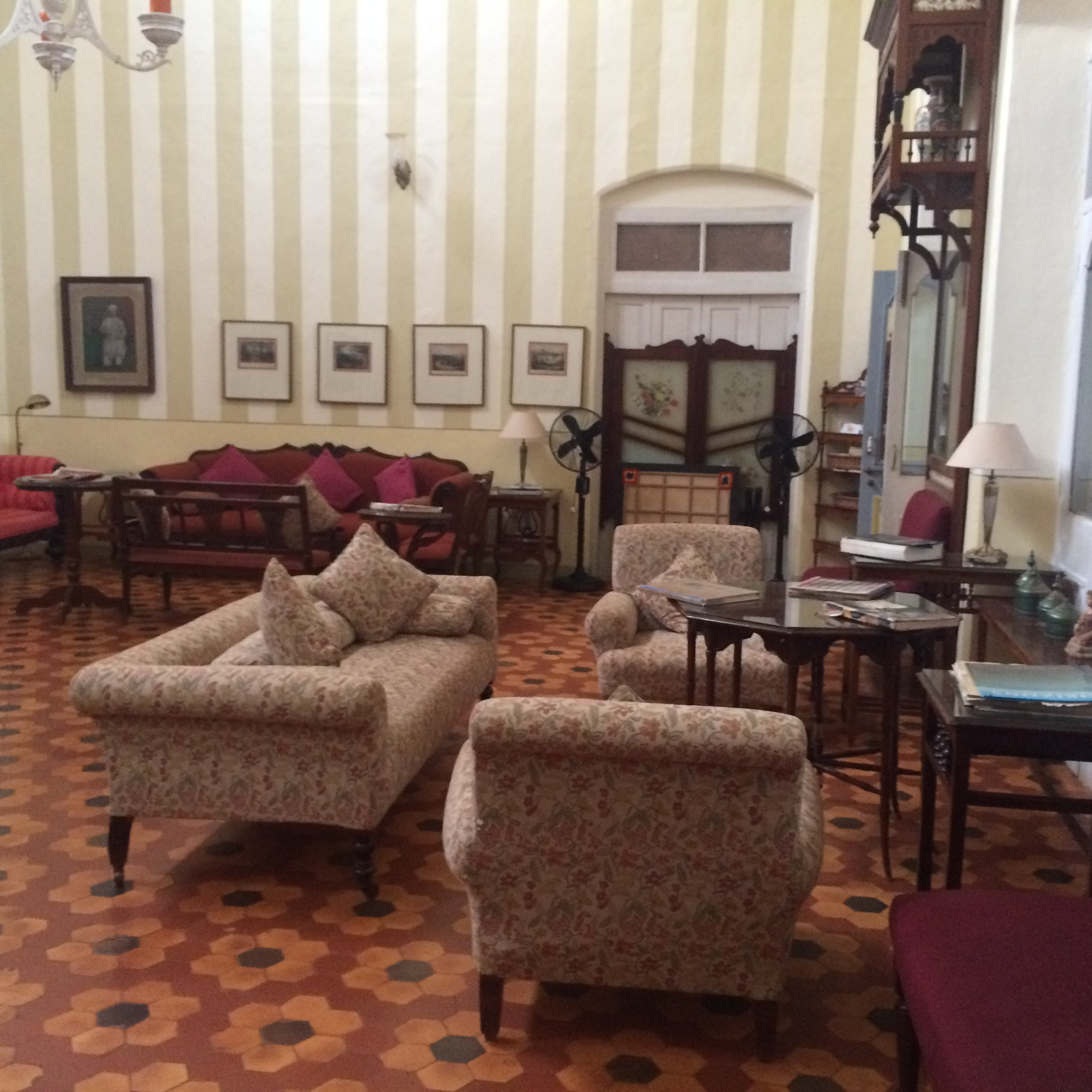
The house, which features a thirty-foot ceiling in the sitting room, and only slightly lower ceilings in the rest, was constructed to lessen the impact of torrential rain.  


The deluge made it a very inside kind of holiday--albeit one without any television, radio or wi-fi. The furniture didn't look like it had been updated in decades, and in this case, it was a good thing. I wanted to sleep on the same kind of bed that my heroine, Perveen Mistry would have done. What a delight the masterfully hand-crafted furnishings were: left over from the Victorian and Edwardian eras. In the drawing room, I sat briefly on tallest bench I ever encountered--and with such a grand mirror and top to it. In the end, I thought the piece was a carpenter's desire to try to have his work live up to the scale of the place.


After my first twenty-four hours in Matheran, the rain fell so hard and constantly that it soon became the most irritating noise. But at least I could while away the hours in the old hotel, drawing out an architectural layout that would become the plan for my fictitious Circuit House, the place occupied by a British civil servant where Perveen Mistry visits and learns about the area--while rain falls.  


The rain stopped for only about 2 hours during my four-day stay in Matheran. To take advantage, I rushed out with another woman staying at the bungalow. Still, the mists did not left--and because of the plateau-like structure of the hill station, you can't really roam around without danger of slipping, or maybe even  falling over the edge into a dam. 


A friendly local man was working at tightening up the wall of the dam with extra stones. H told us that stones are taken out of the dam wall during every rainy season to allow water to spill into the lake and not flood the land. Because rainy season was drawing to an end, he was returning the wall to its normal state and happy about the coming change. 


But this wasn't happening anytime fast. In the half-week I spent in Matheran, 
I always fell asleep listening to the relentless rain only to be jarred awake by thunder, then get back to dreaming, and ultimately awaken to another rainy day. As I wandered the hotel, I understood what it might mean to be confined to a place to months on end because rain meant that the paths down the mountain were washed out. At least there was electricity, so I could sit in my dreamy nineteenth century bed, working away at my draft. I had a dry roof over my head. And one misty morning, the horse and his groom arrived at the hotel, and it was time to descend the hill, meet Namdev, and get back to Mumbai. 


And although the rain was still falling, I didn't feel quite as wet behind the ears.  


Thursday, March 1, 2018

News: bad, good, and unexpected.

Stanley _ Thursday

Two weeks ago, my report came from Ingwelala - my place in the bush - which was experiencing a drought every bit as severe as Cape Town.  There were few animals and some birds.  For the first time in the thirty odd years I've been going there, we didn't even see an elephant.

The only good news at the time was that President Zuma had resigned, which, according to one of the mechanics in the local garage, meant that the rains would come.  He was right!  In both Cape Town and Ingwelala, rain fell.  Not vast quantities, but more like 10 mm.  But rain.  And wet.

I had promised to dance in the rain when it came, but I broke my promise under great pressure from Mette because the prolonged, hacking cough I was experiencing had worsened.

 And then, one night, one of the most frightening things I'd ever experienced happened to me.  I awoke with a coughing fit, but couldn't breathe.  I couldn't inhale through mouth or nose.  I jumped out of bed, coughing, spluttering, wheezing, croaking.  Gasping for breath.  Eventually, I found I could inhale slightly through my nose.  And for the next few minutes, alternated between coughing uncontrollably and slowly inhaling through my nose.

It was frightening.  It was exhausting.

To cut a long story short, Mette and I cut our three-week stay in the bush down to one week, and caught the first flight back to Johannesburg.  From the airport straight to a doctor's appointment, where I learnt I had pneumonia.

Gasp!
Armed with antibiotics, foul-tasting syrup, probiotics, nasal inhalator, and nebuliser, I spent the next week at some friends' home - he a doctor.  The worst part, other than not being able to breathe, was that I couldn't sleep, even when sitting up.  For days, I had a snatch of sleep here, a snatch there.  And I was too scared to take a sleeping pill in case one of my can't-breathe episodes happened and I didn't wake up.  What a way to go!

All this a reason for not having a proper blog today, for which I apologize.  We are back in Cape Town.  I am still coughing, but without the breathlessness of last week,  And I'm optimistic that I am well on the way to being fully healthy.

PS.  There was a very exciting blog in the UK today, which I knew nothing about until a tweet landed on my desk.  You can read it here.

Thursday, February 1, 2018

Water, water, ev'rywhere


One of the earliest popular songs I can remember is Tommy Steele’s Water, water, everywhere,” released in 1957.  I did not know at the time that it was taken from Samuel Taylor Coleridge’s Rhyme of the Ancient Mariner.

The song starts:

So well, it’s water, water, ev’rywhere,”
And not a drop to drink.

You can listen to it here.

The reason this song popped into my mind is that today Cape Town goes to Level 6B water restrictions, despite being surrounded by the Atlantic Ocean.  The drought in the area is the worst in over one hundred years, and the dams are nearly depleted.  And since this is a winter-rainfall area, no meaningful rain is expected until June or July at the earliest.  And, of course, we may have a fourth winter with no rain.

Here are some pictures of the largest of the dams: Theewaterskloof Dam.


Day Zero – the day when the city runs out of water – is now April 16.

Of course, there is a massive case of finger pointing as to who is to blame for lack of preparations.  In reality, the municipal government, the provincial government, and the national government are all to blame.  The local and provincial governments blame the national government because it is in charge of water resources.  They say the national government is playing politics with the only province that is run by the opposition Democratic Alliance party.  It is from the national government that the city of Cape Town buys its water.  The national government says the other two entities are to blame for lack of planning.

Meanwhile the city is running out of water.

So, what do Level 6B water restrictions entail?

First, each person is now limited to using 50 litres of tap water every day.  That is approximately 13 gallons.  Here is a graphic showing normal usage.


Mette and I believe we are well under this target already.  We shower in less than a minute with water-on to wet, water-off to soap, and water-on to rinse.  In addition, we stand in a large, blue bucket to collect the water, which we then use to flush the toilet.  We think we use about 8 or 9 litres per shower.  We also only shower when the neighbour’s dog won’t walk through the door due to our body odour.  Not quite!  But certainly not every day unless we play golf or tennis or the outside temperature is in the mid-thirties.


Everywhere you go, you see Cape Town’s toilet mantra:

If it’s yellow, let it mellow.
If it’s brown flush it down.”

We reckon we normally flush three, and at most four, times a day at present, which means our shower water is insufficient.  We have to use some tap water.  Heaven forbid one or both of us should get the runs.  We’d have to fly and stay with Michael in Johannesburg.

We also save on laundry and dish-washing as we only do that every other day or so.  We don’t have a dog, so that saves a litre!  Daily hygiene takes about two litres instead of three (due to flow-restricting filters on all the taps), and Mette drinks bottled water brought in from elsewhere in the country.  Another two litres saved.  And I've been forced to drink wine and beer.

Few sporting facilities allow any showering – because of smart-asses who think they are saving water by showering elsewhere.  Of course, what they are really doing is trying to save money, as the price of water has gone up from R30 ($2.50) per 6000 litres to R146 ($12).  Over-use is charged at punitive rates.

Level 6B restrictions require agricultural enterprises to use 60% less water than used in 2015.  There is no filling of swimming pools, washing of cars, or watering of plants with a hose.  Any water used for plants comes out of the 50-litre allocation.

When Day Zero arrives, all tap water will be shut off, and 200 collection points will be set up around the city for people to get up to a maximum of 25 litres per day per person.  Needless to say, there are enormous logistical issues with this, as well as for people without transportation or confined to their homes.  I expect tempers to be frayed.

Supermarkets are stocked to the roof with bottled water, and when stocks run out, people queue for hours awaiting shelves to be restocked.  Personally, I think this is a bit extreme since we are still ten weeks away from Day Zero.  Today, I saw a man in a big Jeep go into our local supermarket and buy a trolley-full of water.  I watched as he opened the back of his vehicle to load his water.  The inside was nearly full already.  He had obviously been going from one shop to another to stock up.

So, what is being done?  The city is trying to commission a number of desalination plants.  The problem is that they will be small ones that may produce a million litres a day – not much for a city of 4 million people.  Bigger ones will come on line at some stage.  Water aquifers are also going to be tapped, and running streams that currently empty into the sea will be diverted and used.

It is interesting, since Cape Town was Dutch for so many years, originally there were canals in town, just like Amsterdam.  They were eventually filled in or walled off, but some still have water flowing.  There are also tunnels that are now untapped.  It is estimated that 20 million litres of water flow into the sea everyday through these canals and tunnels.  Apparently, one goes right underneath the Houses of Parliament.

One of the tunnels under the city


Last week, the huge ocean liner Queen Mary 2 arrived in Cape Town, which made me wonder whether the city was going to have to top up its water tanks.  That would be a lot of water since there were probably around 4000 people on board.  It turns out that the ship has its own desalination plants - three in fact - that can produce nearly two million litres a day.  I suggested that the city should hijack the ship and appropriate the plants, but Cunard, the owner, didn't like the idea.

For a moment the other day, I thought the city was going to drill for water in Table Bay, right in front of our apartment.  Two drilling rigs showed up within hours of each other.  They've moved off now, so they are probably here for a service in Cape Town harbor.


If all of this wasn’t bad enough, three other things make it worse.  First, the drought is not restricted to Cape Town.  Large swaths of the country are in similar drought situations.  Second, as always, there are people who don’t pull together – they continue using water and are willing to pay for it.  And third, as you would expect, there are groups of self-appointed vigilantes shaming or reporting others for violating the restrictions.

Watch this space.  It could get nasty.

Some good has come from the crisis.  Most people now realize that they can get by on far less water than they've become used to.  I think that this new behavior will continue when water becomes more available.  

And there are no mosquitos this summer.

There are also unwelcome consequences of the water situation, namely tourism is down, as are property prices.

As far as I know, no city has ever run out of water.  It is a sobering experience to realize how dependent we are on nature to provide some of our essentials.  It is even more sobering to realize that we may not get rain this year, or the next, or the next.  Gasp.