Showing posts with label kaiseki. Show all posts

Sunday, July 4, 2021

A Kaiseki Dinner in Iwate, Japan

 -- Susan, every other Sunday


Japanese food has become so popular around the world that words like "sushi," "yakitori," and "bento" have entered the popular lexicon (and not only in American English, but elsewhere too).

That said, one of the oldest and most culturally significant Japanese cooking styles--the formal, seasonal, coursed cuisine known as Kaiseki Ryori ("kaiseki" for short), is far less familiar outside Japan. It's a pity, too, because a proper kaiseki meal is a feast for all five senses, and an experience I wish everyone could experience at least once.


Private dining room for kaiseki, Yusen Shidate

I won't go into kaiseki's pedigree and history in depth (if you're interested, I'll have a post on it on my blog in the next few weeks); for now, it's sufficient to explain that it evolved over centuries, starting with shojin ryori (temple cuisine), developing further as part of Kyoto's ancient tea ceremony culture, and finally becoming an art and a discipline in and of itself. 

TL;DR: kaiseki is a centuries-old form of serving a seasonal meal in small courses, each of which complements the others, which aims to tell a unique, sensory story in food, celebrating both the season and the local ingredients from the area where the meal is prepared and served.   

Regrettably, I can't take all of you physically to Japan to eat kaiseki, but I can share a spectacular kaiseki meal I experienced last winter at Yusen Shidate, a traditional onsen ryokan (hot spring inn) in Iwate Prefecture, five hours north of Tokyo in Honshu's Tohoku region.

Setting is an important part of kaiseki meal, and traditional ryokan serve kaiseki course by course, either in the visitor's guest room or in a private dining room, in both cases at a table that has a view of a garden or other natural setting.  Yusen Shidate uses private, one-table dining rooms with a view of the river and forest beyond:

Dinner View, Yusen Shidate

Courses are brought to the table one or two at a time, with the pace set by the guest--but not discussed. A skilled kaiseki server will gauge the guest's progress and bring the courses at precisely the pace required to ensure the guest always has a course to enjoy, but slow enough to ensure that the diner is not rushed through the experience. (For this reason, a kaiseki meal can often take 90 minutes or longer--the meal I'm sharing here took almost two hours from start to finish.)

I should mention, before we start, that Yusen Shidate kindly adjusted the menu to accommodate my allergy to fish. (Technically, to fish oil, which is why I can eat shellfish, but not finned fish.) The traditional version of this meal would have included at least one fish course, and the sashimi dish would likely have included raw fish as well as shrimp and scallops.

That said...let's begin our meal.

Kaiseki always begins with an appetizer course, known as zensai or sakizuke. At Yusen Shidate, the appetizer course was served simultaneously with the second course, known as hassun, which customarily evokes and pays homage to the season in which the meal is served. 
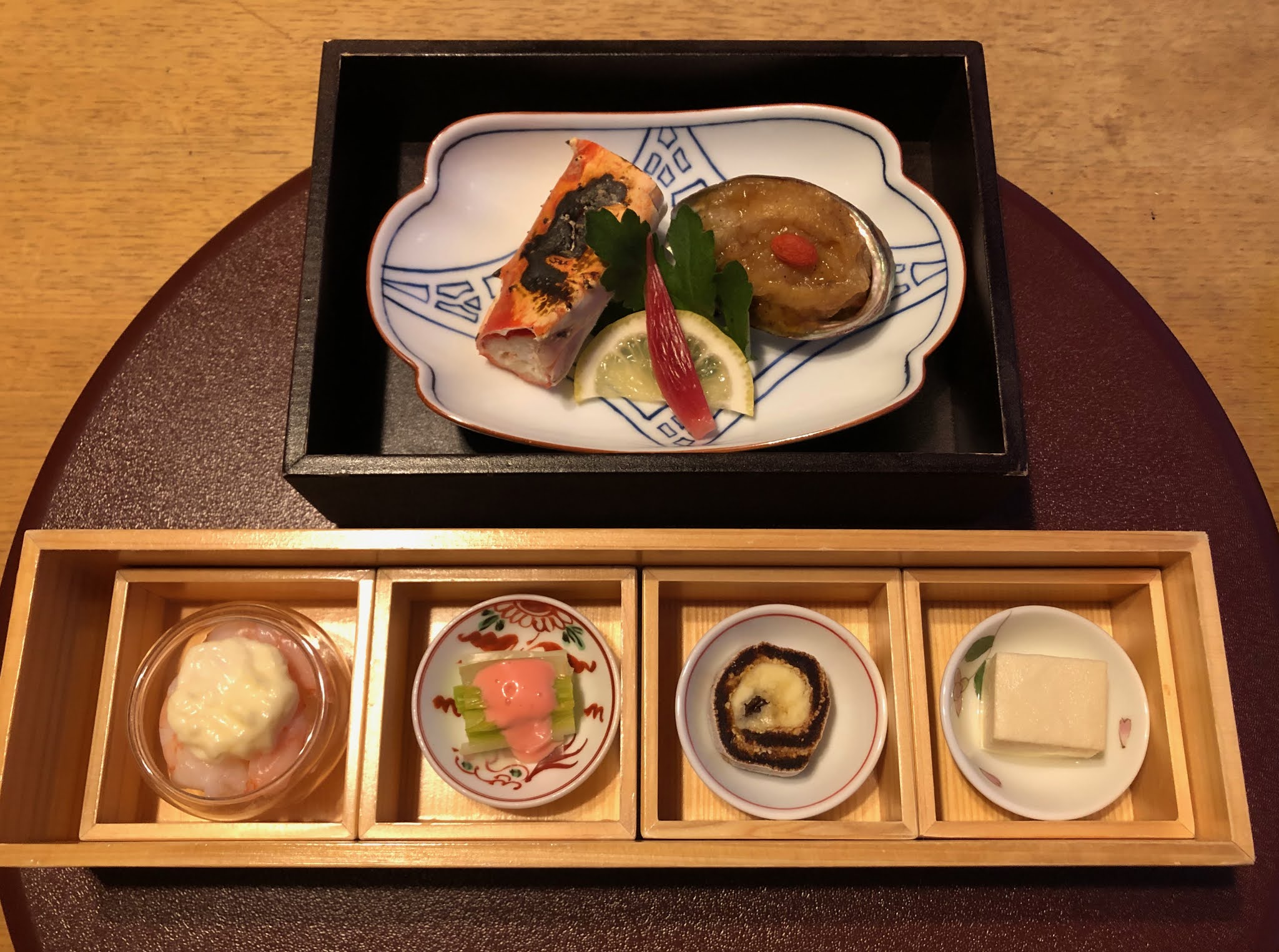
zensai and hassun

You can already see why I called kaiseki a feast for all five senses. Zensai traditionally consist of no more than a single bite, and are served in groupings that range from three to nine different dishes, each of which will showcase different colors, textures, and flavors. Each one is also an individual work of art.

Below, from left to right: Iwate shrimp with house-made mayonnaise, asparagus with house dressing, butter-fig roll, and house-made tofu.
 
zensai

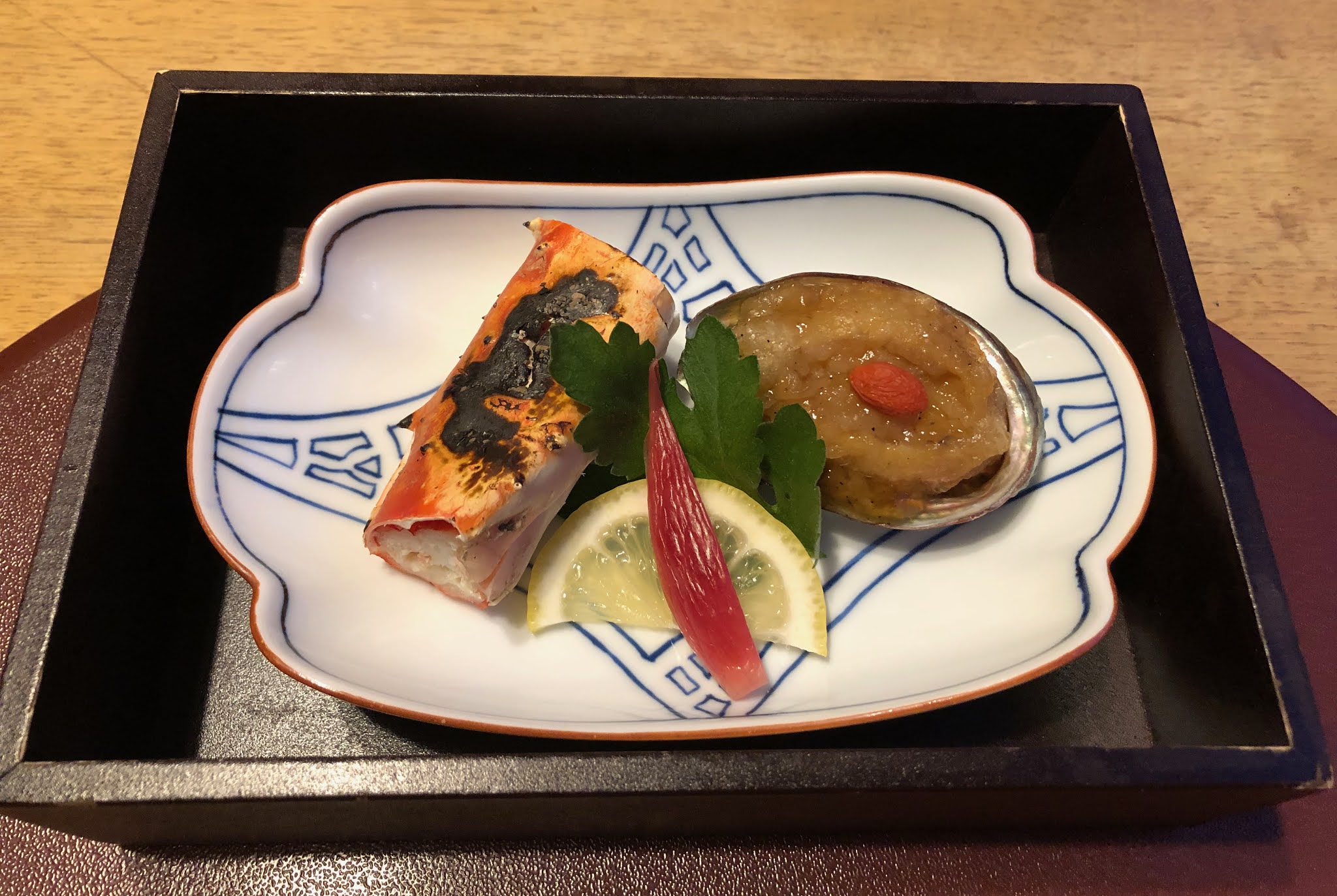
Hassun is an important dish, because it sets the stage for the meal to come. I ate this meal last February, so it carried a strongly winter theme--as well as a reminder that Iwate, which borders the Pacific Ocean, is known for its fresh, delicious seafood. The dish below is snow crab grilled over locally-produced Iwate charcoal (with no sauce or seasoning other than salt, to ensure the flavor and texture of the crab shines through) and a whole grilled abalone topped with miso. 

hassun - winter in Iwate

The dish below was a fifth zensai, served separately: a tofu mousse topped with a gelee of seasonal vegetables.
bonus zensai...

Most Japanese dishes are exceptionally flavorful, but not heavily seasoned--and most traditional ryokan do not put salt or pepper on the table. Conceptually, the chef is supposed to have seasoned each dish perfectly before it is brought to the table, making condiments unnecessary--and during my years in Japan, I've found that's true. I have never needed or wanted to season any dish while eating a kaiseki meal.

The one exception to this is wasabi--a Japanese root similar to horseradish, which is used to season certain dishes (most notably, sushi and sashimi, but it's used for beef and other courses too). Most of the time, we see wasabi in pre-grated form (and when you do, note that it's not 100% real wasabi, but rather wasabi mixed with horseradish, because true wasabi loses its heat within minutes of being grated). The most traditional kaiseki service often includes the wasabi root itself, so the diner can grate it immediately before use.

Wasabi and a traditional ceramic grater

The next course to arrive will be sashimi--more accurately, mukouzuke, or seasonal sashimi. (A note: in the West, it's common to use the term "sushi" as a catch-all for raw fish dishes, but strictly speaking, "sushi" involves raw fish or other ingredients served on rice, whereas sashimi involves raw meat, usually thinly sliced, but not served on or with rice. Kaiseki meals sometimes incorporate both, but the most traditional forms are served with sashimi rather than sushi.)

That evening at Yusen Shidate, my sashimi course involved a pair of perfect prawns and sliced raw scallops. Sometimes people flinch at the idea of raw shrimp, but I adore them. The good ones (like these) practically melt in your mouth, and taste very sweet, without any "shrimpy" or fishy taste, and no aftertaste at all.


prawn and scallop sashimi


Nimono comes next--a course consisting of vegetables simmered in broth with meat or tofu. On this night, the nimono course involved a purely fish-based dish, so the ryokan substituted a non-simmered, non-fish option: a crab claw salad, Iwate style.

not kimono, but delicious anyway

The simmered course is traditionally followed by a soup course--and this one, I could eat. The dish below contains a shrimp and lobster broth with fresh snow crab and a variety of seasonal vegetables.

the soup course

Getting full? Hopefully not, because we're still only about halfway done.

After the soup, the diner receives the centerpiece(s) of the kaiseki meal--a grilled dish and/or a specialty dish like a hot pot or other "cooked at the table" specialty. Depending on the number of courses being served, these may or may not be separate dishes. In my case, the shiizakana (specialty dish) was grilled Iwate beef (a specialty form of wagyu beef produced from Japanese shorthorn cattle--and one of the only forms of wagyu that doesn't come from Japanese black cattle). It came to the table sizzling on the scorching hot rock beneath it.

Beef. It's what's for dinner.

At this point, the meal begins to wind down. The dishes get smaller and lighter (though no less flavorful or beautiful) as we head toward the end of the meal. The next traditional course, mushimono, translates "steamed dish"--and the most traditional steamed dish is chawanmushi--shown below--an egg-based savory steamed custard filled with vegetables or seafood. On this night, the chawanmushi featured mushrooms and leeks.


mushroom and leek chawanmushi

Wanmono, or the "lidded/covered dish" comes next--in this case, a beautiful soup-like stew filled with locally-grown soba, local pork, and vegetables:


stewed soba

In the most extravagant kaiseki meals, the lidded dish is followed by a vinegar-based vegetable dish called sunomono. However, on this night, the meal did not include that course, and proceeded directly to the very traditional soup-rice-pickles combination shown below. Steamed white rice (which is not topped with soy sauce, or anything else, in a traditional Japanese meal, as the rice itself is of such high quality that it tastes delicious plain), miso soup (at Yusen Shidate, enhanced with yet more snow crab, as a reminder of the fact that I was in Iwate), and house-made tsukemono, or pickles--three dishes customarily served together, along with tea, to close out a sumptuous feast.

The almost-last three courses

But no feast would be complete without dessert, and kaiseki ryori does not disappoint. Kaiseki desserts customarily feature fruit--which in a snowy Iwate winter means winter melon, a strawberry (they're a winter fruit in Japan--a fact that surprised me when I first moved here), a bite-sized matcha mousse cake, and a tiny scoop of delicately-flavored sherbet.

Dessert

By the time the meal was finished, the sun had set, but the view remained spectacular.


The pictures above don't do justice to the wide variety of lovely aromas, diverse textures, and truly special tastes the meal contains, but I hope they do make you eager to come to Japan and experience kaiseki for yourself. 

Incidentally, a lot of people see photos like this and comment on the amount of food involved in a traditional kaiseki meal. However, the portion sizes are much smaller than those commonly served in Western restaurants. If you look closely, you'll see that most of the dishes actually contain somewhere between one and five bites of food--much less than an entree in a Western restaurant.

That said, I won't lie: it can be quite a challenge to eat it all. (This is another reason for the leisurely pace of service--to allow the diner the time to enjoy and appreciate the food at a slower pace.)

So...yes or no? Is a kaiseki experience on your to-do list?


Sunday, February 2, 2020

Kaiseki: a Japanese Feast for the Eyes and Palate

--Susan, every other Sunday

Kaiseki (会席) is an elaborate, ancient, and highly celebrated Japanese cooking style involving multiple small, elaborate courses served sequentially on separate trays.

Modern kaiseki draws on a multitude of rules and traditions, many of which date back to 9th century court cuisine, 12th century shojin ryori (Buddhist temple cuisine), and the tea kaiseki cuisine that accompanied formal tea ceremonies in 15th century Kyoto.

It's one of the world's most intricate cooking styles, and the meals themselves are spectacularly beautiful and delicious. In many places, kaiseki is also served in a private dining room, to ensure that nothing distracts the diner from full enjoyment of the meal.

A traditional kaiseki dining room at KAI Nikko


A traditional kaiseki meal features between seven and twelve courses. Each course highlights a different cooking style, with colors, textures, and seasonal ingredients all playing vital roles in the chef's selections. Each course is served individually, in sequence, on a separate tray, and the dishes from the preceding course are removed from the table.

Let's walk through a semi-typical kaiseki meal that I enjoyed last autumn at the KAI Nikko Resort on the shore of Lake Chuzenji, three hours north of Tokyo.

The appetizer course begins with a bite-sized local or seasonal offering, artfully arranged and designed to prepare the diner for the meal to come. (It plays a similar role to the amuse-bouche in French cuisine.) In winter, that might mean balls of mochi (pounded glutinous rice) mixed with puree of local vegetables to give the chewy rice different colors and a hint of extra flavor:

A beautiful beginning - chewy mochi with a hint of fresh, local vegetables 


Next, a soup - sometimes served chilled in summer. In winter, it's usually a warm, clear broth (the miso soup comes later) with fish or tofu and delicate seasonal vegetables.

Vegetable broth with local tofu, radish, and "rolls" made with carrot and green bean, wrapped in thinly sliced radish
With the stomach and taste buds properly warmed-up, the next tray often contains "assorted delicacies" - one or two-bite offerings arranged on a decorative tray. This is often served in tandem with the sashimi course - which, in my case, is often made from konjac (a root vegetable) that does a fairly good impression of raw fish (at least from a textural perspective).

The "assorted delicacies" - presented, as always, in style.


Sashimi course (on the upper left) and Assorted delicacies on the right.
The assorted delicacies at this meal included (clockwise, from the "midnight" position): zunda (sweetened soybean paste), green beans with miso, pan-fried pork tenderloin, tempura mushrooms, black soybeans, and - in the center  - boiled peanuts with mustard miso sauce.

The "sashimi" stand-in: firm konjac jellies with edible flowers.
From assorted delicacies, the meal moves on to a vinegared dish or a steamed dish (some kaiseki meals have both, served as separate courses) - in my case, that meant local yuba (which literally translates "tofu skin" but is actually the skimmings of tofu milk, a delicious and high-protein substitute for the fish that normally stars in this type of course).

Yuba with a soy-miso vinegar sauce
A grilled dish or tempura often follows next. In my case, that meant seasonal vegetables flash-fried to perfection in a delicate, crispy batter. Kaiseki focuses on quality and delicacy, so the dish contained only three perfect bites: a stalk of baby corn, a green bean, and a slice of sweet potato. The little dish on the lower left is the customary complement: powdered salt combined with matcha (powdered green tea). It may sound odd, but it's actually a delicious accent, perfect for bringing out the flavors of the vegetables.

Kaiseki tempura
By this time, it's normal to start feeling full . . . but the main event is yet to come. Kaiseki's "main course" comes near the end of the meal, and usually features a local specialty, either fish or meat, either grilled or steamed.

My meal in Nikko featured paper-thin slices of steamed wagyu (high quality Japanese beef) and a box of vegetables, steamed separately to preserve their flavors and crisp textures.

Beef . . . it's what's for dinner.

The small bowl on the lower right holds a yuzu (Japanese citrus)-soy dipping sauce for both the meat and the vegetables.

The rice (lower left) and tsukemono (pickles) in the orange dish at the center are the traditional end to a kaiseki meal. Miso soup (not pictured) is also served. The type of pickles also vary by town and region. In Nikko, the offerings included umeboshi (pickled plum) and pickled garlic.

Traditional Japanese pickles: plum (left) and garlic (right)
No good meal is complete without dessert, and kaiseki is no exception. Here, as with the other courses, portion size is small, but at this point a little is more than enough! Sugar did not arrive in Japan until after kaiseki's foundations were well-established, so traditional meals generally feature fruit-based desserts--sometimes, simply a few pieces of perfectly selected fruit, sliced in beautiful ways and arranged like a work of art.

In Nikko, dessert reflected a slightly more modern sensibility: a vanilla cream custard (with a texture similar to flan) topped with a chutney made from local strawberries (a specialty of Tochigi prefecture).

Dessert - small but mighty (delicious)
With those three perfect bites, the meal came to a sweet and satisfying end.

I should mention, in closing, that this meal omits an enormous element of most kaiseki: fresh local fish. Since I'm allergic to fish of all kinds, the chef at KAI Nikko graciously substituted non-fish dishes for me. Many restaurants and ryokan can cater to certain allergies, with advance notice, so if you have dietary issues, it may still be possible for you to experience true kaiseki too.

What do you think? Would you give it a shot, if you had the chance?