Showing posts with label Vittorio Alfieri. Show all posts

Monday, March 28, 2016

The Countess of Albany

Annamaria on Monday

My post last week about my Alfieri family name drew a number of admiring responses from the men of MIE about the amour of the great italian poet Vittorio Aflieri.  That lady is interesting for more reasons than her hairdo.  So here she is:


Princess Louise of Stolberg-Gerden had a hard life before she met the dashing Vittorio.  She was born in 1752 in Mons, then the Austrian Netherlands (now Belgium).  Her linage was extremely swanky, but she had two big problems when it came to being a high-tone European princess.  For one thing, her family was poor and became even worse off when her father died in battle while fighting on the Austrian side in the Seven Years' War.  Even worse than that, her family was Catholic--which severely limited the main chance for any princess then (or now for that matter): wedlock.  With the patronage of Empress Maria Teresa, Louise was able to secure the best anyone could manage for her--a place in the Convent of St. Waudru in Mons.  This was where she had to stay until she received an offer of marriage.

The convent where Louise stayed until Charlie proposed


To our ears, the proposal that came might seem quite advantageous.  She was to wed one of the most famous Catholic Royals of her age: Bonnie Prince Charlie aka Charles Edward Stuart aka The Great  (actually not so great) Pretender.  Yes, him--the Jacobite claimant to the thrones of England and Scotland.

Charlie in his palmy days


Grandson of James II of England, Charlie was born in Rome, educated there and in Bologna.  Lots of swell people around Europe, including Louis XV of France, thought Charlie's daddy was the rightful King.  Louis, of course, was also taking side bets that the Stuarts' harrying of the ruling Protestants could only be good for France.

Backed by the Frenchies, Charlie invaded Scotland in an effort to restore his papa to the throne, had some early success, and then practically single handedly--through stupid strategies--lost the Battle of Culloden.  (An aside: The Crown commander, "Stinking Billy" Duke of Cumberland, doesn't come off any better.  He was as vicious as Charlie was dumb.)

Anyway, Charlie got out of Scotland in one piece and spent the next couple of decades in exile, drinking, seducing women, and keeping his delusions alive.  At some point, someone hit on the idea that if Charlie got married to a nice Catholic girl, the pope would support his pretension to his granddad's throne.  They went looking for Miss Right, and they found Louise.

The regal couple were married by proxy on the 28th of March 1772.  A few weeks later, they met up face to face in Italy and renewed their vows.  Charlie was 52; Louise was 20!

The groom at Louise's wedding

They moved to Rome, and he set out trying to make a baby.  When his efforts didn't pay off after two years, the pope and his other powerful allies lost interest in him.  Louise found herself--not the Queen of England and Scotland as she had been led to expect, but just a sad princess married to a disappointed old man with no pretensions to glory, who had turned nasty into the bargain.

Charlie took up drinking, spouse abuse, and the comfort of various mistresses.  He moved himself and his wife to Florence and changed their titles to Count and Countess of Albany.  Shortly thereafter, Count Vittorio Alfieri entered Louise's life and within two years of meeting, they secretly became lovers.  Ten years later, after many attempts to get away from the violent Charlie, Louise--through the good offices of King Gustav of Sweden--was granted a decree of separation, which gave her a legal right to live away from her no-longer-bonnie prince.


As time went on, word leaked out about her relationship with the Italian poet.  Little by little, members of the European aristocracy began to shun Louise.  By 1787, the couple abandoned the subterfuge and began to live together openly--in Paris and in Florence.  Even after Charlie died, they continued to stay together without the blessing of the Church.

Home Sweet Home


The Salon

In their palazzo in Florence, Louise became hostess of a famous salon attended by the leading intellectual and artistic lights of the era.

Louise and Vittorio stayed together until he died.  Louise buried him the Church of Santa Croce, between Michelangelo and Machiavelli.


She lived on in Florence for another nineteen years.  Her tomb is nearby his.


Viva L'Amore!

Monday, March 21, 2016

Why I Have Two Names

Annamaria on Monday

Many people know that Annamaria Alfieri is not my real name.  Legally, I am Patricia King.  So why did I take another name and put it on the covers of my novels?  And how did I choose what that name would be?

Well, first of all Patricia King is very common name.  There are 2950 of us in the USA, according to the 2010 census.  I have been confused with other women by the name and they have been confused with me--quite annoyingly years ago when one was booked on the same flight as I and she changed her ticket.

After Never Work for a Jerk landed me on the Oprah Winfrey show, another Patricia King wrote me to say that her college classmates had tuned in, thinking the Patricia King in question was going to be her.  She had a trip planned to New York and invited me to have breakfast with her at the University Club, where she would be staying.  I showed put at the appointed time and told the man at reception that I was there to meet Patricia King.  He checked his guest registry and nodded.  "Whom may I say is calling?"

"Patricia King," I answered, and immediately realized what would ensue.

"No," he said.  "What is your name?"  At which point he turned into Bud Abbot and I into Lou Costello.

These days, the most prominent author named Patricia King is a televangelist.  In fact her website says in huge letters, "Patricia King, TELEVANGELIST/ENTREPRENEUR."  If you Google "Patricia King," you get 97,600,000 hits in .51 seconds.  The first 16,000 or so pages are mostly her, not me.  I didn't like the odds against anyone ever finding me in that tsunami.  And did I want the author of my novels to be confused with the star of "Everlasting Love: God Has a Spouse for You" on GODTV?  Not really.

I needed a distinctive name.  One that could have its own url.  It would also be nice to sport one that had some romance to it.

And choosing what to call myself gave me a chance to honor my female forebears: bright women who never had my opportunities for education or outlets for their considerable talents.  So I chose “Annamaria Alfieri”—my mother’s first name and her mother’s maiden name.  My pseudonym also brings me back to my Italian heritage.

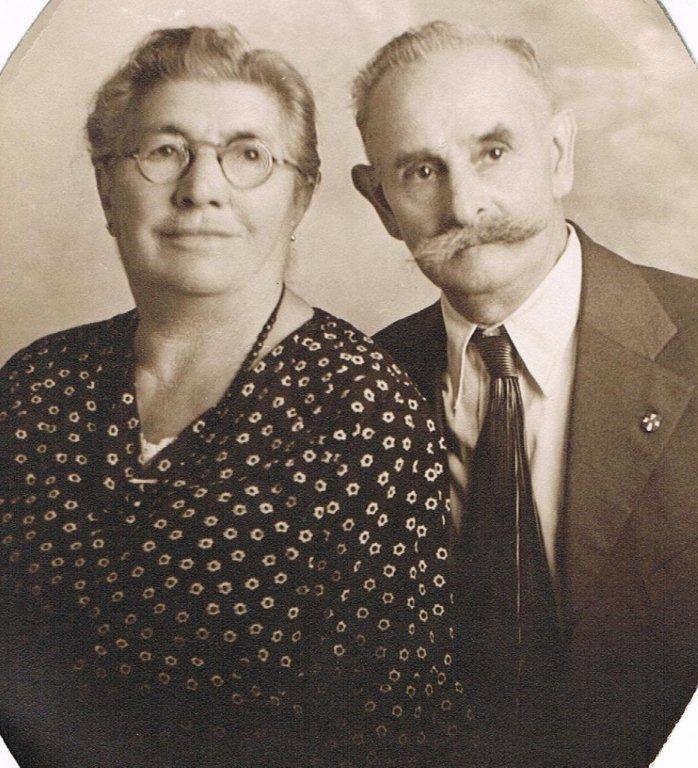
Here they are: those women whose names I took.  Above, Sabina Maria Alfieri Pisacane, (left in white, with a cousin of hers).  She was called Marietta and was NOT the quintessential Italian grandmother.  There was a lot of tiger in that mother of eight children.

And here is Annamaria Pisacane Puglise on the day of her wedding to my father, Sam.


A couple of years after my first novel was published, I was rummaging in a file of family information and mementoes, looking for my father’s birth certificate when I came across memory cards for my great grandparents.  What a lovely surprise to realize that my maternal great grandmother, who was just “Nonna” in the family, was named—guess what?  Anna Maria Alfieri.  This makes sense, since there is a strong Southern Italian tradition of naming children after their grandparents.  My mother must have been named after her.  


Here she is, the original Anna Maria Alfieri with her husband, Francesco Alfieri.  She and her oldest daughter, Sabina, were both illiterate, as was Sam’s mother.  How amazing that I, the granddaughter of illiterate women, got to be an author.  And what a satisfaction to be able to honor them in the process.

When  Italian friends heard of my name choice, they assumed I was pilfering the name of the greatest Italian writer of the 18th Century:  Vittorio Alfieri.


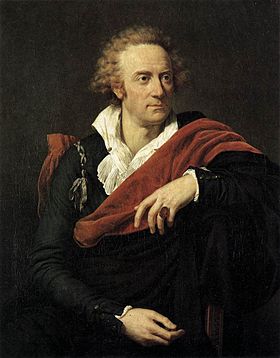
Here is his portrait, which hangs in the Uffizi.

Count Vittorio Alfieri (16 January 1749 – 8 October 1803) was a playwright and is considered the founder of modern Italian drama.

Alfieri was born in the beautiful small city of Asti in Piedmont. His father died when he was very young, and after his mother’s remarriage, he was sent away to the Academy of Turin. His greatest interests were literature, especially ancient Greek plays, and horses. His enthusiasm for equestrian exercise lasted the rest of his life.

After a year in boarding school he went to live with an uncle, who took charge of his education, but who also died within a few years. At age fourteen, having inherited great wealth from his father and uncle, he was free to focus on his third great pursuit: travel – he wandered all over continental Europe and England, looking for an ideal place to live and falling in love with married women. His peccadilloes caused at least one aristocratic divorce. His greatest love was Princess Louise of Stolberg-Gerdern, the wife of Bonnie Prince Charlie. Their love affair began in Rome in 1778 and continued there and in Florence for the rest of his life. He had a Byronic persona, which shows in this portrait painted by David’s pupil François-Xavier Fabre in Florence in 1793. Fabre also painted this portrait of Louise, also known as the Countess of Albany.


Once Alfieri’s first play “Cleopatra” was performed, in Turin in 1775, he was hooked on writing for the theater and continued to produce his verse plays until he died. In the process he transformed Italian drama from stilted set pieces to naturalistic, gripping portrayals of life.


He is buried in Florence’s magnificent Church of Santa Croce, resting place of some of the greatest Italian intellectual lights including Galileo, Ghiberti, Machiavelli, and Rossini. I took this picture of his tomb. On either side of him on the south wall of the church are the tombs of Michelangelo and Machiavelli.  The tomb of Princess Louise is also nearby!