Showing posts with label Patricia King. Show all posts

Sunday, August 31, 2025

But Not For Me

Annamaria on Monday

It's time for Bouchercon, but not for me.


I was all set to go when disaster struct.  I won't go into all the gory details but it started with a lot of pain, and halfway through the ordeal I was attacked with a knife.  OOPs.  Please excuse me.  I sound like an over dramatic writer of crime fiction. What really happened was that a surgeon very skillfully, removed my appendix.

Today, on the third day after the surgery, I am battling its aftermath, exacerbated by my peculiar physical responses to the world at large.


In post-op condition, my tummy looks as if a team of fully grown Clydesdales stomped on it all the way to Milwaukee. Suffice it to say,  I am disoriented, distracted, dysfunctional, and generally speaking, all around displeased, disconsolate, disgruntled, disturbed, and discontent.

Here is an anecdote about how I got here that I hope will amuse you.  Cross your fingers.

I remained in the hospitalI an extra day after the operation, and then the surgeon gave me my get-out-of-jail free card. (Well not exactly free.)  I headed home.

That afternoon I was doing pretty well. But then, by the next day as the anesthesia medication wore off, I was in a lot of pain. Of course, all of this was happening on a holiday weekend at the end of summer. A time when anybody who could had abandoned NYC for the beach or the mountains. My doctor, I believe, is in the mountains. Eventually, I was able to be in touch with him, and during that conversation, I thought we concluded that he would order a heavy duty pain med so I would have it, in case I needed it. I know that we did agree that, based on my body's proclivity to overreact, I would start with a half a pill.

The next day (yesterday), I was distracted by friends phoning, visiting, and other delightful communications from those I love. But by early this morning, I was ready for that pain medication. A friend went at 9 AM to the pharmacy to pick up the painkillers for me. When she got back, she had two over-the-counter items that the doctor had also recommended, and a very special painkiller. Here it is:


Yes! According to the pharmacy, my doctor had prescribed - for intense post-surgery pain for a grown-up woman in her 80s, children's cherry, flavored Tylenol.

I was absolutely sure that this was wrong, but the people at the pharmacy, three of whom who spoke to me, insisted that they had sent me exactly what my doctor ordered. No use arguing.

I called his answering service and asked them to page him.  When I explained, the woman on the phone insisted that the doctor had left strict orders that he did not want to be paged for people who needed a prescription. I was certain that he meant this for people who just need a refill. But there was no way I could convince her. Finally, it occurred to me that I had to offer her a different excuse. "I really need to talk to my doctor. Please page him. I am in a lot of pain."

That worked.  She asked me my name, and my date of birth – which is St. Patrick's Day 1941. The snippy woman then said, "My mother was born on St. Patrick's Day in 1940." Suddenly, she was treating me as if I was a nice person like her mother. Imagine that.


I thanked her profusely. A few hours afterward, I got a call from him. Somehow I had misunderstood. We had settled that we would see how things went and IF I needed, he would then call the pharmacy. Eventually, one of my friends went to pick it up.  I am hoping for a good night's sleep.  Wish me luck!

Monday, May 16, 2022

Scene of the CrimeFest.

Annamaria on Monday

Had I been in attendance at Crimefest this year, I am sure that today I would be posting happy descriptions of the festivities.  And praise for Zoe's stint as Toastrix.  That gig of hers was originally scheduled for 2020, and I was signed up to go, but...  (No explanation needed I am sure.)

In anticipation of my second trip to Bristol, I had even devised a Toastrix tiara for Zoe to wear. 


 Now that I have seen what she wore on Saturday evening, I know that glitzy crown would have gone very well her ensemble.  Alas, I am left with only vicarious enjoyment and bittersweet memories of my one and only Crimefest so far.  Here they are, along with Jeff's introduction of fortunate me on the Monday when I joined this merry tribe.


A bit of background and a brief introduction…

Martin Luther’s quotation, “I can do no other,” succinctly sums up our buddy Leighton Gage’s motivation for putting one hundred and ten percent into everything he writes.  No where is that pledge to his readers more evident than in his seven Mario Silva novels, called “top notch…controversial and entirely absorbing” by The New York Times and “a world class procedural series” by The Wall Street Journal. 

It is Leighton who by his example inspires each of us to bring our A-game to every MIE post, every day, every week.

Keep it fresh, keep it strong is Leighton’s motto, and that’s precisely what’s guided him to a decision we all deeply regret, but fully understand.  Leighton is a writing master who refuses to give his readers anything less than his absolute best work, something he believes he cannot do while confronting his current health problems.  He has decided to step down as a regular MIE contributor so that he may concentrate on his recovery efforts.  Our hopes and prayers are with Leighton and Eide and we look forward to seeing him back here with us soon.

Another Martin Luther quote comes to mind at this moment: "Even if I knew that the world would go to pieces, I would still plant my apple tree."

That, too, has Leighton written all over it, for even as he faces serious personal challenges he’s taken the time to plant a strong new tree in his Monday slot by personally selecting who shall occupy his place.  In the words of The Washington Post, Annamaria Alfieri writes exotic South American tales that “glitter” “as both history and mystery.” Her debut novel, City of Silver, was called by some “one of the best first novels of the year” (Deadly Pleasures Magazine) and her second, Invisible Country, was compared to “the notable novels of Charles Todd” (Kirkus Reviews).  Blood Tango (coming June 25, 2013 from St. Martin’s) is Annamaria’s latest novel and imagines the murder of an Evita Perón lookalike amid 1945 Buenos Aires.

Annamaria is a person of many talents, so much so that she needs two names.  As Patricia King she’s written five books on business subjects, including Never Work for a Jerk (featured on the Oprah Winfrey Show), and her current Monster Boss.  As Pat King, she’s also serving her second term as President of the New York City Chapter of Mystery Writers of America.

It is with great pleasure I welcome our new colleague, Annamaria Alfieri, to Murder is Everywhere.  We’re all proud, especially Leighton. - Jeff


CrimeFest Headquarters Hotel

As we say in New York, I didn’t know from Bristol. I had made a brief stop there years ago while touring the west of England, but true New Yorker that I am, all I did on that occasion was visit the Clifton Suspension Bridge, because I had heard it looked like the Brooklyn Bridge.  

Clifton Bridge
Brooklyn Bridge
It does, but without the cathedral-like quality, and definitely without Yonas Schimmel’s Knish Bakery within walking distance.   


So, while I was in the town for CrimeFest, before the Murder is Everywhere crowd arrived to buy me drinks, I took myself on a walking tour.  Threatening weather held at bay that Wednesday so I had a comfortable stroll, following the Michelin Green Guide itinerary, which started and ended just a few minutes from my hotel.

Warehouses converted into condos along the river

From the Norman Arch, my path skirted @Bristol, the science museum, and crossed Pero’s Bridge.  It’s a bascule bridge, a term I didn’t know.  It means the span moves, using counter weights, to open the channel for boat traffic.  In this case, the weights were designed to be modern sculptures.  

Norman Arch
Pero's Bridge

I was surprised to learn that the bridge was named after a slave, but then, on the other side of the canal, at the M Shed Museum, I learned of Bristol’s connection to the slave trade.  It turns out that though the town was first settled in the 10th Century and was England’s second largest city in the Middle Ages, it did not thrive economically until its 17th and 18th century residents made huge fortunes in the slave trade.   The museum’s exhibition, in its own form of counterbalancing, juxtaposes the slaving history with that of modern citizens’ political activism.


The Old Town Walk then took me through lovely Queen Square and along cobbled King Street with its 18th and 19th century warehouses, a 17th century alms house, and Llandoger Trow—a historic pub, where I stopped off for fish and chips.

Queen Square
King Street
The Llandoger Trow

The next monument was St. Stephen’s Church, with its beautiful tower.  On that Wednesday afternoon the way in was to go into a café and then through a door marked exit to find the sanctuary.  One of the memorials of local merchants was decorated with a jaunty modern addition.

St. Stephen's Tower

Ancient merchant remembered
Corn Street was once a precinct of traders and money exchangers, but now the building houses a collection of small stalls selling finger food and general touristy grot.

Corn Street
St. Nicholas Market

The Church of John the Baptist straddles a medieval gate of the city and has an interesting interior, but it can’t hold a candle to the grand finale of the tour—Bristol Cathedral.  There has been a church on its site for a thousand years.  The 14th Century English Gothic structure was first named for St. Augustine and renamed in the Reformation.   A sign over a donations box said it takes £2 per minute to maintain it.  I paid my share on my way out.

Bristol Cathedral
Bristol Cathedral interior
That evening, Michael phoned and ended my lonely rambling by inviting me to a delightful dinner with Bill and Toby Gottfried.  By Thursday, the others arrived and the festivities already reported here got underway.  It was my first CrimeFest.  I hope not miss it in the future.

Stanley, Annamaria, Jeff, Caro, Yrsa, Michael

Annamaria—Monday


Monday, March 21, 2016

Why I Have Two Names

Annamaria on Monday

Many people know that Annamaria Alfieri is not my real name.  Legally, I am Patricia King.  So why did I take another name and put it on the covers of my novels?  And how did I choose what that name would be?

Well, first of all Patricia King is very common name.  There are 2950 of us in the USA, according to the 2010 census.  I have been confused with other women by the name and they have been confused with me--quite annoyingly years ago when one was booked on the same flight as I and she changed her ticket.

After Never Work for a Jerk landed me on the Oprah Winfrey show, another Patricia King wrote me to say that her college classmates had tuned in, thinking the Patricia King in question was going to be her.  She had a trip planned to New York and invited me to have breakfast with her at the University Club, where she would be staying.  I showed put at the appointed time and told the man at reception that I was there to meet Patricia King.  He checked his guest registry and nodded.  "Whom may I say is calling?"

"Patricia King," I answered, and immediately realized what would ensue.

"No," he said.  "What is your name?"  At which point he turned into Bud Abbot and I into Lou Costello.

These days, the most prominent author named Patricia King is a televangelist.  In fact her website says in huge letters, "Patricia King, TELEVANGELIST/ENTREPRENEUR."  If you Google "Patricia King," you get 97,600,000 hits in .51 seconds.  The first 16,000 or so pages are mostly her, not me.  I didn't like the odds against anyone ever finding me in that tsunami.  And did I want the author of my novels to be confused with the star of "Everlasting Love: God Has a Spouse for You" on GODTV?  Not really.

I needed a distinctive name.  One that could have its own url.  It would also be nice to sport one that had some romance to it.

And choosing what to call myself gave me a chance to honor my female forebears: bright women who never had my opportunities for education or outlets for their considerable talents.  So I chose “Annamaria Alfieri”—my mother’s first name and her mother’s maiden name.  My pseudonym also brings me back to my Italian heritage.

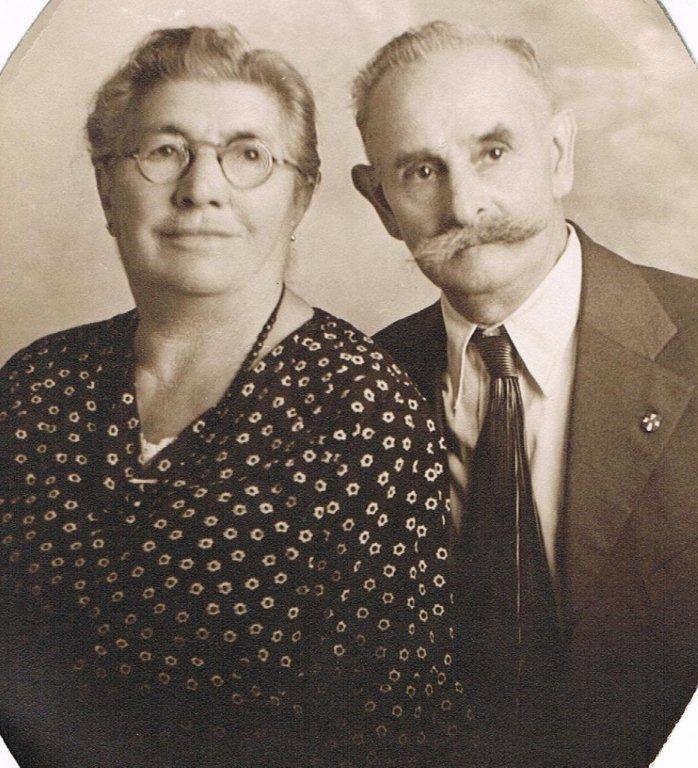
Here they are: those women whose names I took.  Above, Sabina Maria Alfieri Pisacane, (left in white, with a cousin of hers).  She was called Marietta and was NOT the quintessential Italian grandmother.  There was a lot of tiger in that mother of eight children.

And here is Annamaria Pisacane Puglise on the day of her wedding to my father, Sam.


A couple of years after my first novel was published, I was rummaging in a file of family information and mementoes, looking for my father’s birth certificate when I came across memory cards for my great grandparents.  What a lovely surprise to realize that my maternal great grandmother, who was just “Nonna” in the family, was named—guess what?  Anna Maria Alfieri.  This makes sense, since there is a strong Southern Italian tradition of naming children after their grandparents.  My mother must have been named after her.  


Here she is, the original Anna Maria Alfieri with her husband, Francesco Alfieri.  She and her oldest daughter, Sabina, were both illiterate, as was Sam’s mother.  How amazing that I, the granddaughter of illiterate women, got to be an author.  And what a satisfaction to be able to honor them in the process.

When  Italian friends heard of my name choice, they assumed I was pilfering the name of the greatest Italian writer of the 18th Century:  Vittorio Alfieri.


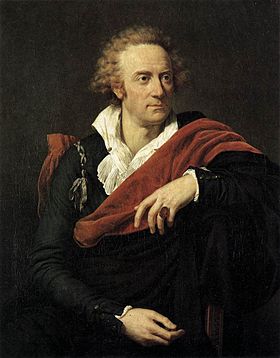
Here is his portrait, which hangs in the Uffizi.

Count Vittorio Alfieri (16 January 1749 – 8 October 1803) was a playwright and is considered the founder of modern Italian drama.

Alfieri was born in the beautiful small city of Asti in Piedmont. His father died when he was very young, and after his mother’s remarriage, he was sent away to the Academy of Turin. His greatest interests were literature, especially ancient Greek plays, and horses. His enthusiasm for equestrian exercise lasted the rest of his life.

After a year in boarding school he went to live with an uncle, who took charge of his education, but who also died within a few years. At age fourteen, having inherited great wealth from his father and uncle, he was free to focus on his third great pursuit: travel – he wandered all over continental Europe and England, looking for an ideal place to live and falling in love with married women. His peccadilloes caused at least one aristocratic divorce. His greatest love was Princess Louise of Stolberg-Gerdern, the wife of Bonnie Prince Charlie. Their love affair began in Rome in 1778 and continued there and in Florence for the rest of his life. He had a Byronic persona, which shows in this portrait painted by David’s pupil François-Xavier Fabre in Florence in 1793. Fabre also painted this portrait of Louise, also known as the Countess of Albany.


Once Alfieri’s first play “Cleopatra” was performed, in Turin in 1775, he was hooked on writing for the theater and continued to produce his verse plays until he died. In the process he transformed Italian drama from stilted set pieces to naturalistic, gripping portrayals of life.


He is buried in Florence’s magnificent Church of Santa Croce, resting place of some of the greatest Italian intellectual lights including Galileo, Ghiberti, Machiavelli, and Rossini. I took this picture of his tomb. On either side of him on the south wall of the church are the tombs of Michelangelo and Machiavelli.  The tomb of Princess Louise is also nearby!


Monday, March 7, 2016

You can’t judge a book…

Annamaria on Monday

Here are the beginning lyrics to old R&B song:

You can't judge an apple by looking at the tree,
You can't judge honey by looking at the bee,
You can't judge a sister by looking at the brother,
You can't judge a book by looking at the cover.
Oh can't you see, oh, you misjudged me.
I look like a farmer but I'm a lover,
You can't judge a book by looking at the cover.

Caro’s post last week about strange titles made me think about how, a few times, my publishers changed the titles of my books.  Most of the time, they turned out to be right.  But there have been a couple of instances when the publisher tried to get me to change the title and I refused:  Notably for my best selling book every—Never Work for a Jerk.  They wanted me to call it HOW to Work for a Jerk, because they thought that a more positive spin might be more appealing.  I debated the point.  And I won.

On the other hand, I have almost never won a battle about a cover.  Almost. 

Generally, publishers, not writers, get to choose the cover art.  Sometimes we are happy, sometimes not. Except for folks like James Patterson and Mary Higgins Clark, authors have little, if anything, to say about book cover design.

This rule is not confined to fiction. My nonfiction went through similar choices. Never Work for a Jerk started with a jackass in a business suit, a splendid choice in my estimation.


But the paperback publisher thought the design too staid. They came up with something much more lively.  I doubt Dell was right about that, because when Barnes and Noble acquired the rights for their own edition, they went back to the jackass cover.


The foreign rights publishers had their own ideas.


Only once did I try to influence what a nonfiction book looked like. Both my agent and I tried our very best to put the kibosh on the cover for Monster Boss. Except for the fake tear, it looks to me like the cover of procedures manual on water heater repair.  But the publisher would not budge.  Would this catch your eye?


When it came to my novels, I was thrilled when saw the original cover for City of Silver. I had dreamed what it might be many times. During the long years of looking for an agent for the book and then waiting while it worked its way through the publication process, I imagined what the published book would look like. I had, in my mind's eye, the cover of a favorite history used in my research.  When my editor asked me for cover ideas, I sent this image of the whole dust jacket, including the spine and the back cover:


The final design for the novel surpassed all my expectations. It was totally beautiful to me, perhaps because it was my first novel. But it really is a lovely physical specimen of a book. (By the way, its interior is also a knockout. The front pages and the chapter beginnings are all designed to look like a seventeenth century book. What a gorgeous touch!)


Then, when Felony and Mayhem Press acquired the paperback rights, Maggie Topkis, the publisher, thought the original cover too staid for what she considered a lively story. She decided to replace it with a cover she thought did the story justice.


When I first saw the new design, it was so different from its predecessor, I was nonplussed. But everyone I asked liked it a lot.  And I knew that Maggie had had twenty years experience as a bookseller, which meant she had watched what readers reached for.   Sometimes the most aesthetically pleasing is not the most alluring to potential book buyers.


Invisible Country’s cover is a knockout.  It never made it into a paperback edition, so here is the only cover it’s ever had.

With Blood Tango, I had a fright on my hands.  The originally cover artist never completed the job.  His replacement came up with this:


It looked to me like a cheesy romance cover.  It said nothing about it being a historical novel, nothing about the darkness of the mystery or the glamor of the historic character who is central to the story—Evita.   I put my foot down.   In the end, they sent me a different cover, with a historic picture of Buenos Aires.  I showed it to my daughter.  She liked the photo but said the cover needed a woman on it.  She was so right.  I asked them to insert a blonde woman in the picture and to give her a red dress.  They did. 


 Then came the African series.  Africa is the MOST photogenic place on earth.  Have you ever noticed how travel companies that deal worldwide always have images of Africa on their promotional materials.  What’s on the walls of photographic equipment stores world wide?  Africa!  An alluring cover was a foregone conclusion. 

I loved the original cover of Strange Gods.


But once again, I am thrilled to say, Felony and Mayhem acquired the paperback rights, and Maggie went for a more striking cover image.


She also created great fanfare for the paperback’s launch last weekend at Left Coast Crime, including a Strange Gods t-shirt and making the Strange God the official cocktail of convention.  Needless to say, I was thrilled about that!

And now we are aiming to launch the second in the series, The Idol of Mombasa at Bouchercon in New Orleans in September.


This post is a whole lot of shameless self-promotion.  MIE’s rules allow us one such entry each year.  I forewent my turn at SSP in 2015 because I had no new book last year.  I collected on that rain check today.   I will have more to say about The Idol closer to the launch date.