Showing posts with label Truth and Reconciliation Commission. Show all posts

Thursday, April 5, 2018

Winnie Madikizela-Mandela 1936 – 2018

Michael - Thursday

Winnie Madikizela-Mandela

Monday saw the passing of another milestone in South Africa with the death of Winnie Madikizela-Mandela, first wife of Nelson Mandela. She is mourned not only as a struggle icon, but as someone who fought tirelessly for women’s rights and recognition in South Africa.
In some ways, she had an even harder life than he did.  While he was in jail, she was left alone to bring up the children and to carry on the struggle against the apartheid regime. Arrested multiple times and held in solitary confinement—or much worse treatment—she was eventually banned and exiled to house arrest in the country town of Brandfort in the Orange Free State, a place where she had no relatives or support and where she was only permitted to have at most two visitors at a time. She was closely watched. On one occasion three relatives visited unexpectedly, and afterwards she was hauled to the police station for disobeying the banning order.

Amazingly, the government didn’t realize that what it was doing was creating another martyr to the cause by treating her so viciously, and she became a leader of the ANC in exile just as much as the men and woman in Zambia and on Robben Island.
"The years of imprisonment hardened me,” Winnie Madikizela-Mandela said of herself. “Perhaps if you have been given a moment to hold back and wait for the next blow, your emotions wouldn't be blunted as they have been in my case. When it happens every day of your life, when that pain becomes a way of life, I no longer have the emotion of fear. There is no longer anything I can fear. There is nothing the government has not done to me. There isn't any pain I haven't known.”
It is hard to imagine that sort of Kafkaesque life not for days or weeks or months or years, but for decades. Is it surprising that it taught her to hate, and that she would reach for any tool to drive the struggle forward? For her, without any doubt, the end justified the means. And the means eventually included her own reign of terror, including the infamous ‘necklacing’ where people—almost invariable blacks—condemned as collaborators or for other ill-specified crimes were summarily executed by having a tire full of petrol set alight around their necks. She was behind the so-called ‘Mandela United Football Team’—a group of young thugs who enforced her decisions. In a strange way, by stripping her of everything (eventually even her children), the government had given her a type of absolute power—and you know what they say about that.
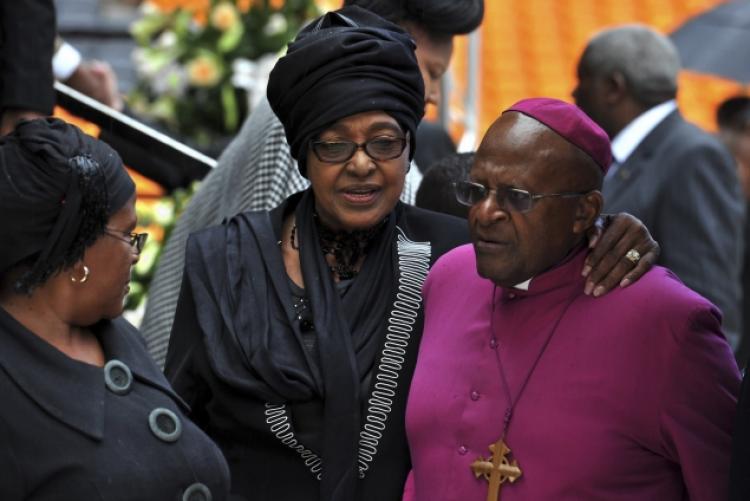
Archbishop Emeritus Desmond Tutu called Madikizela-Mandela “a defining symbol of the struggle against apartheid” and although she was highly critical of his inclusive politics, Tutu said in a statement on Monday that “her courageous defiance was deeply inspirational to me”.
Their meeting at the Truth and Reconciliation Commission was less inspirational. Questioned about the murders that had resulted from her wielding of the Football Club, she was unrepentant, saying that she regretted nothing, and would do the same again if faced with the same circumstances. But with Tutu’s gentle insistence, she eventually conceded that, at a certain point, “things went badly wrong.”
How could she do otherwise? It was her whole life she was being asked to justify, not merely her actions. This was a woman who felt she had earned the right not to be judged by other people.
The chairman of the prestigious Nelson Mandela Foundation, Njabula Ndebele, tried to sum it up this way:
“All South Africans are indebted to Mama Winnie, whether they acknowledge it or not. From the witness of her life, we knew we could stand tall; we knew also we could falter and stumble. Either condition was an affirmation of life.”

Thursday, October 16, 2014

What a man!

It is a cliché to say the world is in a mess.  In reality, there is too much going on for my head to keep track of – ebola, ISIS, the US elections, plunging stock markets, beheadings, politicians.

So here is a little good news about a remarkable man, with a will of steel and a most infectious laugh.

Last week Desmond Tutu celebrated his 79th birthday and, at the same time, retired from public life.

He is up there with Nelson Mandela as one of my heroes.  The path he took was totally different from Mandela’s, even though they shared the same goal – a democratic South Africa.

Mandela chose the political route to try to attain freedom.  Tutu chose the pulpit.

In the early 1960s, Tutu received his Bachelor and Master degrees in Theology from the City College London, after which he returned to South Africa where he worked for the Anglican Church in various roles, culminating in being appointed the first Black Bishop of Cape Town.


Ever since I can remember, Tutu was a thorn in the government’s side.  Obviously, during the years of apartheid, he was outspoken against the practice of legalized discrimination, but he was also adamantly and simultaneously against the US’s policy of constructive engagement and the African National Congress’s increasingly violent stance.

He acknowledged that sanctions would hurt the poor most of all, but argued that at least their suffering would have a purpose.  And he argued that violence begets violence and that a violent overthrow of the apartheid government would not be in the best interests of the country.


It is likely that his strong position in favour of non-violence may have kept him from being jailed by the apartheid government, which needed no legal basis for incarcerating opponent.

Throughout his career, Tutu championed human rights, and has been active in many different areas.  He has campaigned to fight HIV/AIDS, tuberculosis, poverty, racism, sexism, homophobia and transphobia.

In recognition of his activities, he received the Nobel Peace Prize in 1984; the Albert Schweitzer Prize for Humanitarianism in 1986; the Pacem in Terris Award in 1987; the Sydney Peace Prize in 1999; the Gandhi Peace Prize in 2007; and the Presidential Medal of Freedom in 2009. 

Amazing!

Throughout his life, he’s been a gadfly, not only when the apartheid regime was in power, but even today as he criticizes the ruling ANC government for spinelessness and lack of morality.  He is driven by principles and is unafraid of going after anyone or anybody who violates them.


Recently, for example, President Jacob Zuma denied the Dalai Lama – not for the first time - a visa to enter South Africa to attend the first gathering of Nobel laureates in Africa.  There were to be 14 laureates, gathering to honour Nelson Mandela and twenty years of democracy in South Africa.  They cancelled the meeting.


Tutu lambasted the government for kowtowing to pressures from the Chinese government, who regard the Dalai Lama as a terrorist.  Tutu said he was "ashamed to call this lickspittle bunch my government".

Commission – a body constituted after the fall of apartheid.  Its purpose was to have people of all political persuasions, who had committed crimes, such as murder and sabotage, address the commission, admit their guilt, and express remorse.  Usually this also included coming face to face with the families of those who had been killed or maimed.


If the commission felt that the perpetrator had expressed genuine remorse, he or she was forgiven and no charges could thereafter be brought.

What a civilized thing to do!  Oh, that more countries took this approach rather than the age-old approach of revenge.

If you ever have the chance to watch the PBS documentary on the Truth an Reconciliation Commission, do so.  I guarantee you’ll cry for its entire length, first at the barbarism people can perpetrate, then at the power of forgiveness.

Happy birthday Tata Tutu.  May you live for many more years.  May your tongue remain sharp.


Stan – Thursday.

Saturday, December 7, 2013

Nelson Rolihlahla Mandela: July 18, 1918 - December 5, 2013. Rest in Peace.


“No one is born hating another person because of the color of his skin, or his background, or his religion. People must learn to hate, and if they can learn to hate, they can be taught to love, for love comes more naturally to the human heart than its opposite.”


It is very difficult for me to describe or explain the emotional attachment I have to Nelson Rolihlahla Mandela, known as Madiba, an honorific that is the name of the clan from which he comes – the Madiba clan of the Xhosa people.

I was one of millions who cried when TV showed his release from 27 years of incarceration on February 11, 1990.  And I am one of millions crying now.

Madiba triggers emotions in me that are normally very private.  He embodies so many characteristics that I admire: courage of conviction, patience, vision, tolerance, compassion, and humour. And, of course, dignity.

"During my lifetime I have dedicated my life to the struggle of the African people. I have fought against white domination and I have fought against black domination. I have cherished the ideal of a democratic and free society in which all persons live together in harmony with equal opportunities. It is an ideal which I hope to live for and see realized. But if needs be, it is an ideal for which I am prepared to die."

He has been able to set aside, at least in public, what one would expect from someone who had been jailed for 27 years by an undignified, bigoted, oppressive regime.  He has shown no anger, bitterness, no desire for revenge, and no need for retribution.

Instead, when he became president, together with the remarkable Bishop Tutu, he fashioned the Truth and Reconciliation Commission, which encouraged the perpetrators of heinous crimes on both sides of the apartheid fence to confess their crimes publicly, often in front of the families of the people whom they had killed or maimed.  And if they confessed, showed remorse, and asked for forgiveness, they were forgiven.

Remarkable.

Madiba and Bishop Tutu embrace

Every time PBS shows its documentary on the Truth and Reconciliation Commission, I try to watch it.  It is a most moving insight into the depths of inhumanity and cruelty that people can sink, as well as the heights to which people can soar. 

All areas of conflict in the world could learn from this, rather than devolving into endless cycles of revenge and persecution.

Madiba believed for there to be a peaceful transition in South Africa - something that few people expected - all South Africans needed to feel included, feel wanted.  Before and during his Presidency, he encouraged the citizens of South Africa to bury the awful past and to work together for a future that included everyone. To create the Rainbow nation that is South Africa.

To unite the multiple ethnic groups of South Africa, it was decided that the new South Africa should have eleven official languages: Afrikaans (the language of apartheid), English, Ndebele, Northern Sotho, Sotho, Swazi, Tswana, Tsonga, Venda, Xhosa, and Zulu.  Less than 2% of the population have as their first language one that is not an official language.

The new, haunting national anthem, Nkosi sikelel’ iAfrica (Lord Bless Africa), replaced the old one, Die Stem (The Call or The Voice), which was always sung in Afrikaans - the language of the oppressor.  The new anthem is also a model of inclusivity.  The first verse is in Xhosa and Zulu, the second in Sotho, the third in Afrikaans, and the fourth in English.  The Afrikaans stanza is from the hated, old national anthem.

You can listen to the new anthem here - you will hear the language changing. 

One of the most emotional moments, probably for all South Africans, came in 1995, the year after the country became democratic.  For years South Africa had been isolated from international sport.  In 1995, the Rugby World Cup was held in South Africa to celebrate the arrival of democracy.  And South Africa won the title.  But it was not just winning that was emotional for a sports-crazy nation long starved of good competition.  It was the presence of Madiba, dressed in a Springbok (the national team) rugby jersey, sporting the number of the Afrikaans captain.  Rugby has always been dominated by Afrikaners – and to have a black president embrace the game and literally the white players was completely unexpected.  It defused potential opposition and welded people together.  (The movie Invictus captures these moments very well.  It is well worth watching.)


Then Madiba did what most politicians should do, but don’t.  After one term as President, he said it was time to leave.  To leave the country to be led by others.  Even though I believe the country would now be better off had he stayed for two terms, I have the greatest respect for his decision.

I found the following photos and quotes on ABC's Good Morning America on Yahoo.com.  They speak more eloquently than I can.


From what I have read, Madiba, although a private person, was also someone who enjoyed physical contact - kissing, embracing, and hugging.  South Africa's Mail and Guardian newspaper has put together a short slideshow of Madiba with some of his more famous huggees!

Close to my heart was Madiba's commitment to education:
"Education is the most powerful weapon which you can use to change the world."
And to children.

You can honour Mandiba’s belief in children through the Nelson Mandela Children’s Fund by donating here to help construction of a new Children's Hospital in Johannesburg.

Please be generous.
"It is my deepest conviction that the children should be seen and heard as our most treasured assets. They are not ours to be used or abused but to be loved and nurtured and encouraged to engage in life to the full extent of their being, free from fear.
The dream to build a child-centered society is a permanent mandate for the Fund to share with its local and global partners. The difference the Fund makes should see it contributing to the remaking of our world to be more familiar with the smiles of children than their tears."
