
Michael - Thursday
 |
| Winnie Madikizela-Mandela |
Monday saw the passing of another
milestone in South Africa with the death of Winnie Madikizela-Mandela, first wife
of Nelson Mandela. She is mourned not
only as a struggle icon, but as someone who fought tirelessly for women’s rights and
recognition in South Africa.

In some ways, she had an even harder
life than he did. While he was in jail,
she was left alone to bring up the children and to carry on the struggle
against the apartheid regime. Arrested multiple times and held in solitary
confinement—or much worse treatment—she was eventually banned and exiled to house
arrest in the country town of Brandfort in the Orange Free State, a place where
she had no relatives or support and where she was only permitted to have at
most two visitors at a time. She was closely watched. On one occasion three
relatives visited unexpectedly, and afterwards she was hauled to the police
station for disobeying the banning order.

Amazingly, the government didn’t realize that
what it was doing was creating another martyr to the cause by treating her so
viciously, and she became a leader of the ANC in exile just as much as the men and
woman in Zambia and on Robben Island.

"The years of
imprisonment hardened me,” Winnie Madikizela-Mandela said of herself. “Perhaps
if you have been given a moment to hold back and wait for the next blow, your
emotions wouldn't be blunted as they have been in my case. When it happens
every day of your life, when that pain becomes a way of life, I no longer have
the emotion of fear. There is no longer anything I can fear. There is nothing
the government has not done to me. There isn't any pain I haven't known.”
It is hard to imagine
that sort of Kafkaesque life not for days or weeks or months or years, but for decades. Is it surprising that it taught
her to hate, and that she would reach for any tool to drive the struggle
forward? For her, without any doubt, the end justified the means. And the means
eventually included her own reign of terror, including the infamous ‘necklacing’
where people—almost invariable blacks—condemned as collaborators or for other
ill-specified crimes were summarily executed by having a tire full of petrol
set alight around their necks. She was behind the so-called ‘Mandela United
Football Team’—a group of young thugs who enforced her decisions. In a strange
way, by stripping her of everything (eventually even her children), the
government had given her a type of absolute power—and you know what they say about
that.
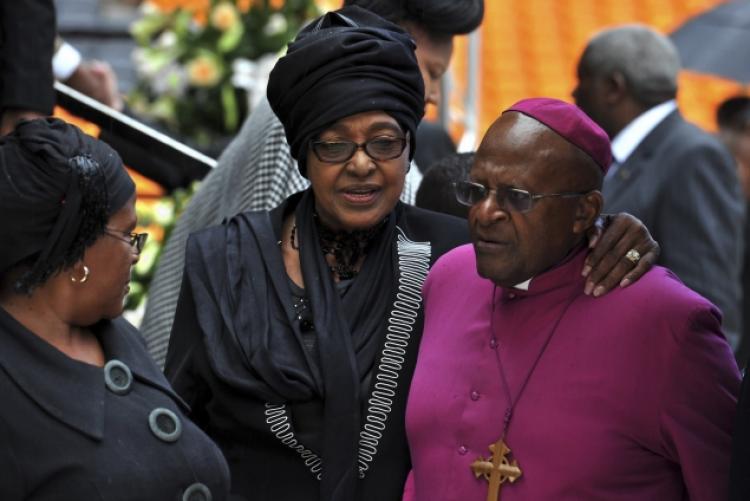
Their meeting at the
Truth and Reconciliation Commission was less inspirational. Questioned about
the murders that had resulted from her wielding of the Football Club, she was
unrepentant, saying that she regretted nothing, and would do the same again if faced with the same circumstances.
But with Tutu’s gentle insistence, she eventually conceded that, at a certain
point, “things went badly wrong.”
How could she do
otherwise? It was her whole life she was being asked to justify, not merely her
actions. This was a woman who felt she had earned the right not to be judged by
other people.
The chairman of the
prestigious Nelson Mandela Foundation, Njabula Ndebele, tried to sum it up this
way:
“All South Africans
are indebted to Mama Winnie, whether they acknowledge it or not. From the witness
of her life, we knew we could stand tall; we knew also we could falter and
stumble. Either condition was an affirmation of life.”





