“No one is born hating another person because of the color of his skin, or his background, or his religion. People must learn to hate, and if they can learn to hate, they can be taught to love, for love comes more naturally to the human heart than its opposite.”
It is very difficult for me to describe or explain the
emotional attachment I have to Nelson Rolihlahla Mandela, known as Madiba, an
honorific that is the name of the clan from which he comes – the Madiba clan of
the Xhosa people.
I was one of millions who cried when TV showed his release from 27 years of
incarceration on February 11, 1990.
And I am one of millions crying now.
Madiba triggers emotions in me that are normally very private. He
embodies so many characteristics that I admire: courage of conviction, patience, vision, tolerance, compassion, and humour. And, of course, dignity.
"During my lifetime I have dedicated my life to the struggle
of the African people. I have fought against white domination and I have fought
against black domination. I have cherished the ideal of a democratic and free
society in which all persons live together in harmony with equal opportunities.
It is an ideal which I hope to live for and see realized. But if needs be, it
is an ideal for which I am prepared to die."
He has been able to set aside, at least in public, what one
would expect from someone who had been jailed for 27 years by an undignified,
bigoted, oppressive regime. He has
shown no anger, bitterness, no desire for revenge, and no need for retribution.
Instead, when he became president, together with the remarkable
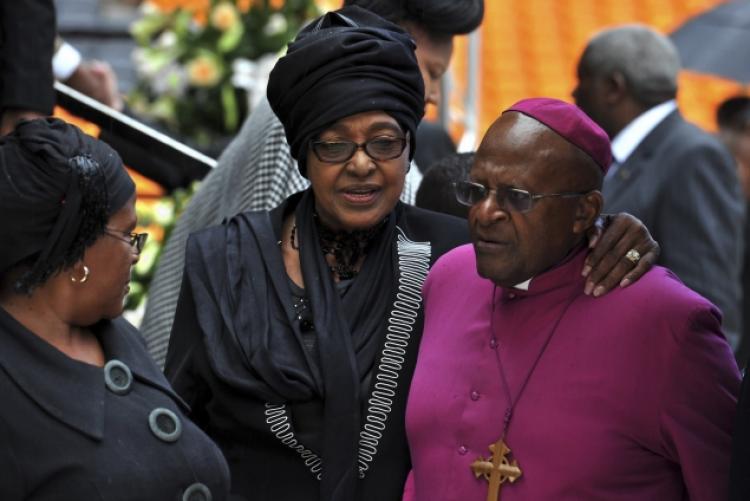
Bishop Tutu, he fashioned the Truth and Reconciliation Commission, which
encouraged the perpetrators of heinous crimes on both sides of the apartheid
fence to confess their crimes publicly, often in front of the families of the
people whom they had killed or maimed.
And if they confessed, showed remorse, and asked for forgiveness, they were
forgiven.
Remarkable.
 |
| Madiba and Bishop Tutu embrace |
Every time PBS shows its documentary on the Truth and
Reconciliation Commission, I try to watch it. It is a most moving insight into the depths of inhumanity and
cruelty that people can sink, as well as the heights to which people can soar.
All areas of conflict in the world could learn from this,
rather than devolving into endless cycles of revenge and persecution.
Madiba believed for there to be a peaceful transition in South Africa - something that few people expected - all South Africans needed to feel included, feel wanted. Before and during his Presidency, he encouraged the
citizens of South Africa to bury the awful past and to work together for a
future that included everyone. To create the Rainbow nation that is South Africa.
To unite the multiple ethnic groups of South Africa, it was decided that the new
South Africa should have eleven official
languages: Afrikaans (the language of apartheid), English, Ndebele, Northern
Sotho, Sotho, Swazi, Tswana, Tsonga, Venda, Xhosa, and Zulu. Less than 2% of the population have as
their first language one that is not an official language.
The new, haunting national anthem, Nkosi sikelel’ iAfrica (Lord Bless Africa),
replaced the old one, Die Stem (The Call or The Voice), which was always sung
in Afrikaans - the language of the oppressor. The new anthem is also a model of inclusivity. The first verse is in Xhosa and Zulu,
the second in Sotho, the third in Afrikaans, and the fourth in English. The Afrikaans stanza is from the hated, old
national anthem.
You can listen to the new anthem here - you will hear the language changing.
One of the most emotional moments, probably for all South
Africans, came in 1995, the year after the country became democratic. For years South Africa had been
isolated from international sport.
In 1995, the Rugby World Cup was held in South Africa to celebrate the arrival of democracy. And South
Africa won the title. But it was
not just winning that was emotional for a sports-crazy nation long starved of
good competition. It was the
presence of Madiba, dressed in a Springbok (the national team) rugby jersey, sporting
the number of the Afrikaans captain.
Rugby has always been dominated by Afrikaners – and to have a black
president embrace the game and literally the white players was completely unexpected. It defused potential
opposition and welded people together.
(The movie Invictus captures
these moments very well. It is
well worth watching.)
Then Madiba did what most politicians should do, but
don’t. After one term as
President, he said it was time to leave.
To leave the country to be led by others. Even though I believe the country would now be better off
had he stayed for two terms, I have the greatest respect for his decision.
I found the following photos and quotes on ABC's Good Morning
America on Yahoo.com. They speak
more eloquently than I can.
From what I have read, Madiba, although a private person, was also
someone who enjoyed physical contact - kissing, embracing, and hugging.
South Africa's
Mail and Guardian newspaper has put together a short slideshow of Madiba with some of his more
famous huggees!
Close to my heart was Madiba's commitment to education:
"Education is the most powerful weapon which you can use to change the world."
And to children.
You can honour Mandiba’s belief in children through the Nelson Mandela Children’s Fund by donating
here to help construction of a new Children's Hospital in Johannesburg.
Please be generous.
"It is my deepest conviction that the children should be
seen and heard as our most treasured assets. They are not ours to be used or
abused but to be loved and nurtured and encouraged to engage in life to the
full extent of their being, free from fear.
The dream to build a child-centered society is a permanent
mandate for the Fund to share with its local and global partners. The
difference the Fund makes should see it contributing to the remaking of our
world to be more familiar with the smiles of children than their tears."