Annamaria on Monday
I am updating this post, which I wrote in January 2016. Back then, I was learning the history and working on a first draft of a historical mystery/thriller that takes place in my ancestral city of Siracusa in Sicily. And I was also continuing along with the Vera & Tolliver series.
By 2019, I had what I thought was a worthy draft. My then agent was happy with it, and she found two editors who were quite interested.
Then came the perfect storm: a publisher in breach of contract, a book launched without ARCs going out, my wonderful agent facing a family catastrophe, and COVID.
And so the book, eventually named La Magica, went into limbo, which turned into purgatory, which threatened to turn to hell. The difference between purgatory and hell is that hell is permanent, purgatory is temporary. my story now stands on the cusp.
Just now, La Magica is resurfacing. I am polishing the manuscript, and it is with my agency. Hope is on the horizon.
Here a peek at what I had to say about the story nearly 10 years ago.
 |
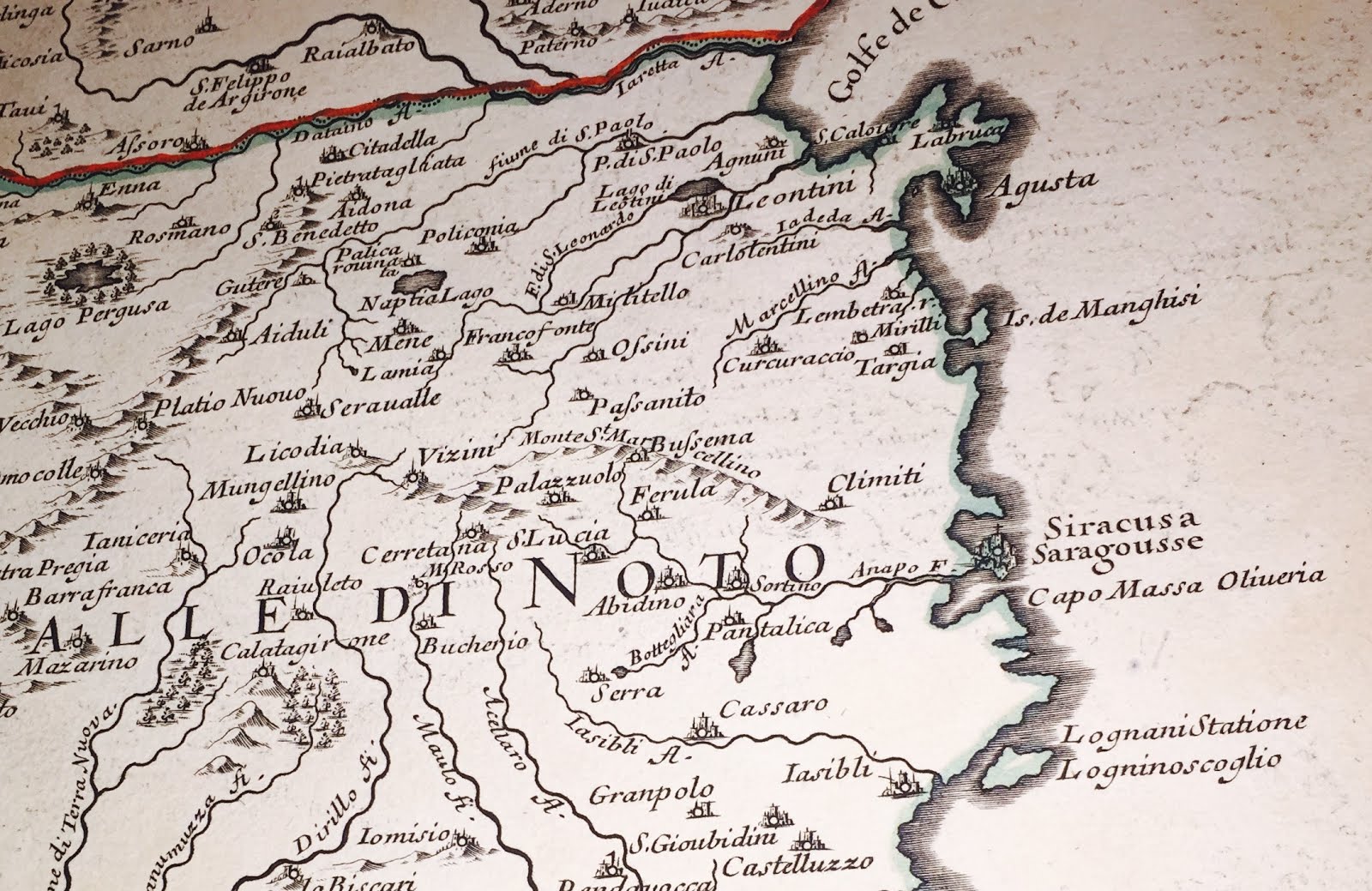
| Period map of the area, found, of course, in the peerless New York Public Library |
What would you call it, if a thing you saw in a dream was suddenly before your eyes and real?
My work in progress, which I began at my desk in New York, takes place in Siracusa, Sicily in the late 17th century and involves the life a young widow, mother of baby son, both of whom are threatened. I had been to Siracusa a few times before starting to imagine how the tale would unfold. But there was no certainty that the places I imagined were plausible, much less realistic.
The tale begins with the heroine on the roof her palace across the piazza from the duomo of Siracusa. From there she can see the harbour and the the moon reflected in the water. But did the geography of the place allow that?
Here is the reality. It seemed completely magical that what I had imagined was exactly right:
 |
The Piazza del Duomo, and there at the end my Marchesa's palazzo on the
left, just across from the Duomo. |
 |
The facade of the palazzo, with no buildings behind, nothing to block
my character's view of the port. |
 |
Evening view from my room--the same point of view as from the palazzo's roof.
There, barely visible in the upper center, is the new moon. And across the water,
the other arm of land that forms the port, which you will visit with me below. |
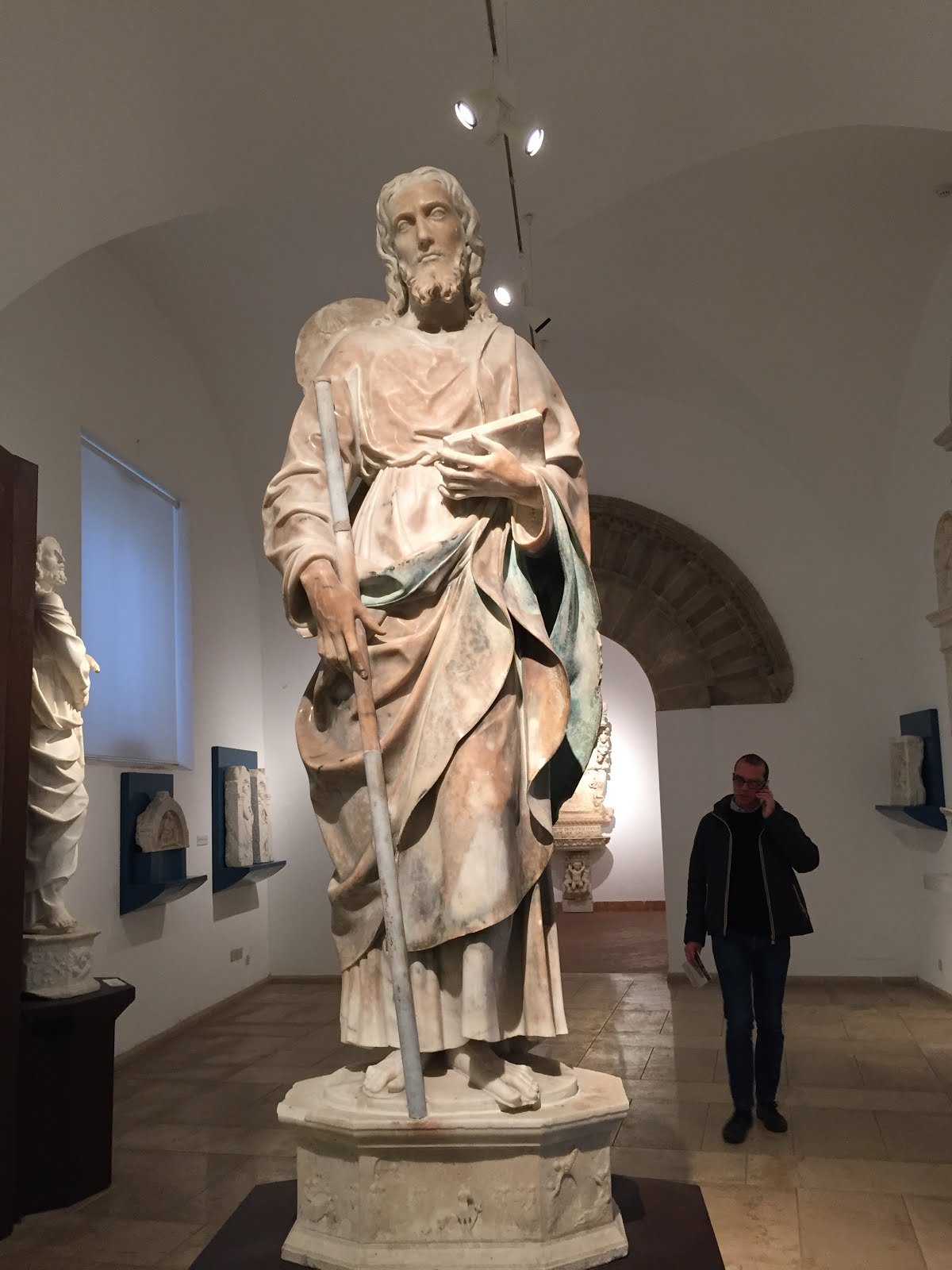
An ensuing scene takes place in the duomo itself and involves the chapel of Santa Lucia, the patron saint of the city. A revered statue of the early Christian martyr and resident of Siracusa graces the chapel, but I had never seen it face to face. It is ordinarily enclosed. I didn't know that it is kept on view for a month after the saint's feast day--December 13th. By chance, I got there just in time to see it in person. And to discover some more grist for my imagination's mill.
 |
| Santa Lucia in her niche, open and on view just when I needed her. |
 |
A close up of the martyr, nicely gruesome for local color
in a historical thriller. |
 |
On the left of this ancient Greek column, you see the entrance
to the chapel of Santa Lucia, and behind it.... |
 |
...the perfect hiding place for a kidnapper. I planned the
scene without knowing how perfect the layout of the
Duomo would turn out to be. |
 |
| A grave in the church floor, just where I imagined it. |
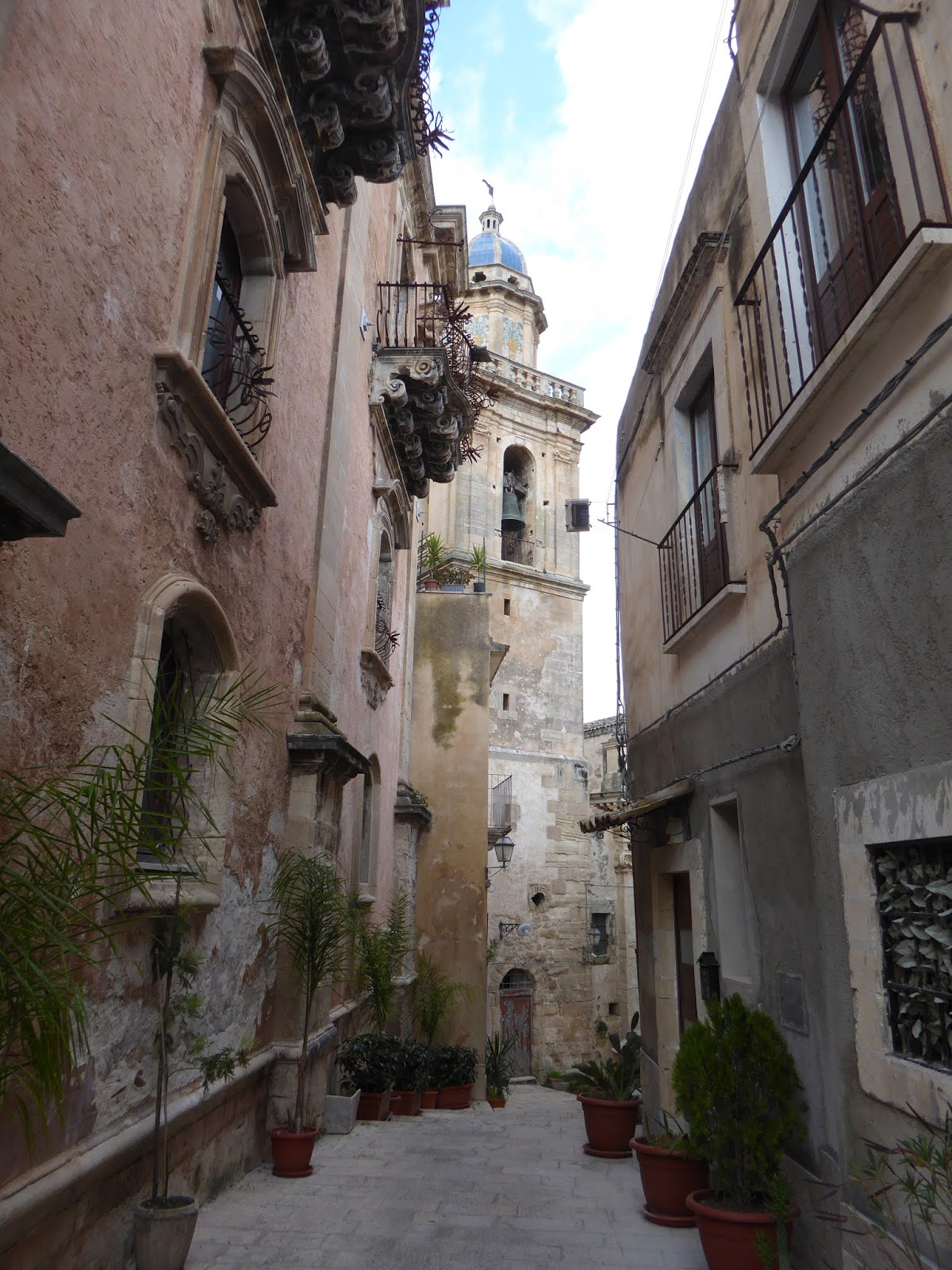
The following two days in the Ortigia afforded a close look at places I had chosen from a map.
 |
| Just enough room for a man on a horse. |
My main character has a wise, old grandmother who lives in a castle at the end of the other peninsula that forms the great harbour of Siracusa. I needed a way to put my feet on the ground over there across the water. But I was off to visit my cousins in Solarino, a small hill town overlooking Siracusa. At another time, I will tell you in detail of the warmth and joy that has always greeted me when I visit them. For now I will concentrate on two darlings, who like a fairy godmother and godfather gave me a fabulous view of everything I wanted to see and much more. I did not even have to ask. They came to greet me and offered to take me anywhere I wanted to go.
 |
Antonello Martorana and Anna Puglisi, teachers and warmest of cousins.
For me on this trip they were magic makers. |
We spent a gorgeous, spring-like day investigating a place I had seen only on maps.
 |
In trying to imagine what my characters would be eating in December and
January, I gave them oranges, not knowing if such would have been in season.
And here in January, I saw them ripe and ready for picking. |
 |
| From the coast road, the two sides of the port entrance. |
 |
I had imagined that from the south arm of the bay, one might see the Ortigia
clearly enough to pick out the buildings. And you can! |
 |
| What I did not know is that you can also see Etna. |
 |
| There is an old lighthouse just at the end of south arm of the bay. |
I told Anna and Antonello that in my story there is a castle where the lighthouse now stands. When I was finished photographing everything in sight and waxing ecstatic about how perfect everything was, they drove me along the coast road where my characters travel--a road I imagined but did not know existed. We continued north, beyond Siracusa, to a town called Brucoli and parked next to this:
 |
It is the castle of my imagination. I had no idea there really were castles like
this in the area. It is the same size as mine and made of the same stone. |
 |
| And it occupies a position on the edge of the sea! |
 |
| And has a view of Etna!! |
 |
With my soul satiated with what I had seen, we then repaired to a gorgeous
restaurant just across from the castle, where we ate a FABULOUS fish dinner,
with wonderful wine. |
 |
Here I am, as happy as I ever was! And grateful to have such generous and wonderful
companions with which to share my joyful day. |