Showing posts with label A writer's life. Show all posts

Sunday, June 29, 2025

There is Magic Here - Update

Annamaria on Monday

I am updating this post, which I wrote in January 2016. Back then, I was learning the history and working on a first draft of a historical mystery/thriller that takes place in my ancestral city of Siracusa in Sicily. And I was also continuing along with the Vera & Tolliver series.

By 2019, I had what I thought was a worthy draft. My then agent was happy with it, and she found two editors who were quite interested.

Then came the perfect storm: a publisher in breach of contract, a book launched without ARCs going out, my wonderful agent facing a family catastrophe, and COVID.

And so the book, eventually named La Magica, went into limbo, which turned into purgatory, which threatened to turn to hell. The difference between purgatory and hell is that hell is permanent, purgatory is temporary. my story now stands on the cusp. 

Just now, La Magica is resurfacing. I am polishing the manuscript, and it is with my agency. Hope is on the horizon.

 Here a peek at what I had to say about the story nearly 10 years ago.


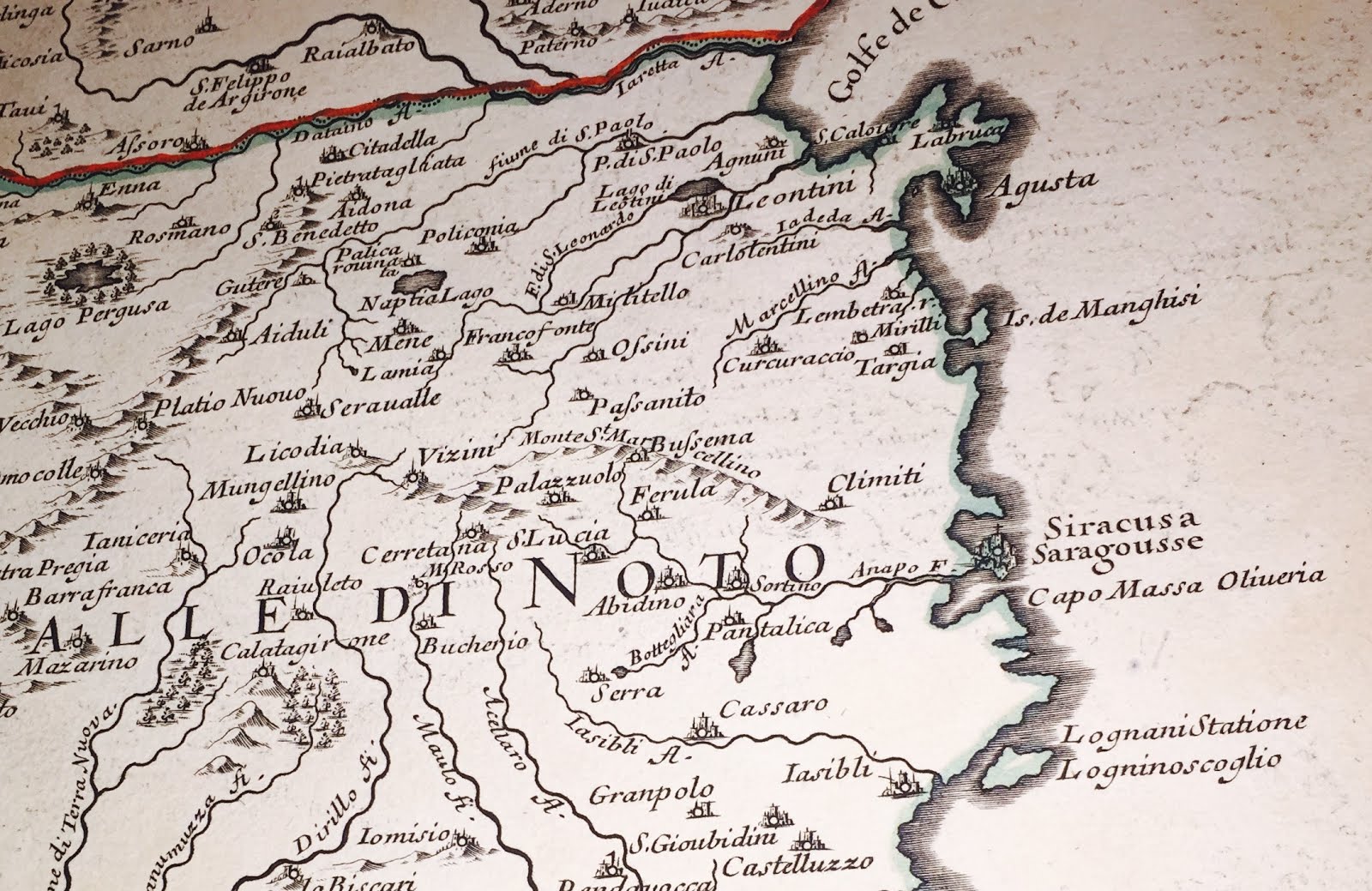
Period map of the area, found, of course, in the peerless New York Public Library

What would you call it, if a thing you saw in a dream was suddenly before your eyes and real?

My work in progress, which I began at my desk in New York, takes place in Siracusa, Sicily in the late 17th century and involves the life a young widow, mother of baby son, both of whom are threatened.  I had been to Siracusa a few times before starting to imagine how the tale would unfold.  But there was no certainty that the places I imagined were plausible, much less realistic.

The tale begins with the heroine on the roof her palace across the piazza from the duomo of Siracusa. From there she can see the harbour and the the moon reflected in the water.  But did the geography of the place allow that?

Here is the reality.  It seemed completely magical that what I had imagined was exactly right:


The Piazza del Duomo, and there at the end my Marchesa's palazzo on the
left, just across from the Duomo.

The facade of the palazzo, with no buildings behind, nothing to block
my character's view of the port.


Evening view from my room--the same point of view as from the palazzo's roof.
There, barely visible in the upper center, is the new moon.  And across the water,
the other arm of land that forms the port, which you will visit with me below.

An ensuing scene takes place in the duomo itself and involves the chapel of Santa Lucia, the patron saint of the city.  A revered statue of the early Christian martyr and resident of Siracusa graces the chapel, but I had never seen it face to face.  It is ordinarily enclosed.  I didn't know that it is kept on view for a month after the saint's feast day--December 13th.  By chance, I got there just in time to see it in person.  And to discover some more grist for my imagination's mill.

Santa Lucia in her niche, open and on view just when I needed her.

A close up of the martyr, nicely gruesome for local color
in a historical thriller.

On the left of this ancient Greek column, you see the entrance
to the chapel of Santa Lucia, and behind it....
 

...the perfect hiding place for a kidnapper.  I planned the
scene without knowing how perfect the layout of the
Duomo would turn out to be.

A grave in the church floor, just where I imagined it.

The following two days in the Ortigia afforded a close look at places I had chosen from a map.


Just enough room for a man on a horse.


My main character has a wise, old grandmother who lives in a castle at the end of the other peninsula that forms the great harbour of Siracusa.  I needed a way to put my feet on the ground over there across the water.  But I was off to visit my cousins in Solarino, a small hill town overlooking Siracusa.  At another time, I will tell you in detail of the warmth and joy that has always greeted me when I visit them.  For now I will concentrate on two darlings, who like a fairy godmother and godfather gave me a fabulous view of everything I wanted to see and much more.  I did not even have to ask.  They came to greet me and offered to take me anywhere I wanted to go.


Antonello Martorana and Anna Puglisi, teachers and warmest of cousins.
For me on this trip they were magic makers.

We spent a gorgeous, spring-like day investigating a place I had seen only on maps.


In trying to imagine what my characters would be eating in December and
January, I gave them oranges, not knowing if such would have been in season.
And here in January, I saw them ripe and ready for picking.

From the coast road, the two sides of the port entrance.

I had imagined that from the south arm of the bay, one might see the Ortigia
clearly enough to pick out the buildings.  And you can!
What I did not know is that you can also see Etna.
There is an old lighthouse just at the end of south arm of the bay.
I told Anna and Antonello that in my story there is a castle where the lighthouse now stands.  When I was finished photographing everything in sight and waxing ecstatic about how perfect everything was, they drove me along the coast road where my characters travel--a road I imagined but did not know existed.  We continued north, beyond Siracusa, to a town called Brucoli and parked next to this: 

It is the castle of my imagination.  I had no idea there really were castles like
this in the area.  It is the same size as mine and made of the same stone.
And it occupies a position on the edge of the sea!
And has a view of Etna!!
With my soul satiated with what I had seen, we then repaired to a gorgeous
restaurant just across from the castle, where we ate a FABULOUS fish dinner,
with wonderful wine.  
Here I am, as happy as I ever was!  And grateful to have such generous and wonderful
companions with which to share my joyful day.

Wednesday, August 21, 2024

The Unspoken Struggles of a Writer's Psyche: Ego, Doubt, and the Constant Comparisons

Kwei--Wednesday


The Emotional Toll of Being a Writer

Writing is often romanticized as a purely creative and fulfilling pursuit. But for many writers, the reality is much more complex. Beneath the surface lies a mental landscape riddled with self-doubt, ego struggles, and unspoken comparisons. The psychological challenges of writing are rarely discussed openly, yet they affect many of us. Like other artists grapple with the weight of critique and their internal battles, so do we, even if we seem outwardly resilient.


Self-Doubt and the Writing Process

The act of writing itself can be fraught with mental challenges. My first drafts are often so rough that I question whether I’m worthy of calling myself a writer. The persistent voice of doubt whispers, "Maybe you’re not as good as you think." Many writers share this sentiment as they question whether their work is “good enough” to justify their identity as creators.


Envy, Jealousy, and Comparisons

In an industry where success is often measured publicly—through book sales, awards, or social media followers—it’s easy to fall into the trap of envy. Seeing other authors achieve success can feel like a personal defeat. "Why them and not me?" is a common, though rarely voiced, thought. Even when we genuinely celebrate others’ achievements, the temptation to compare ourselves can feed our insecurities and deepen feelings of inadequacy.


The Link Between Writing and Depression

Research supports the notion that writers are particularly susceptible to depression and other mental health struggles. Studies have found that the solitary nature of writing, coupled with the emotional vulnerability it requires, can contribute to higher rates of depression among writers. For instance, a meta-analysis highlighted that expressive writing, though often therapeutic, can also bring underlying depressive tendencies to the surface. Furthermore, other studies suggest that the pressure to meet creative and professional standards exacerbates mental health issues in writers (Psychology Today).


How Writers Can Support Each Other

Given these challenges, how can we better support each other? The first step is acknowledging that these feelings exist and are more common than we think. Open dialogue in writing communities and peer support groups can make a significant difference. Creating spaces where we can safely express our struggles without judgment is essential. These small gestures can be transformative, whether it’s a virtual check-in, a casual meet-up, or even reaching out with a simple “How are you doing?”


We also need to remind ourselves—and each other—that writing is inherently a process. First drafts are supposed to be imperfect, and everyone experiences rejection. Sharing these everyday experiences can reduce the stigma around writer’s block, imposter syndrome, and creative slumps.


Moving Forward Together

In a world that often glorifies polished final products, it’s easy to forget that the journey there is full of doubts, setbacks, and mental hurdles. By normalizing the discussion of these struggles and offering support, we can foster a healthier, more resilient community of writers. Writing is challenging, but we don’t have to carry the burden alone.


Monday, June 24, 2024

Author vs Copy Editor

Annamaria on Monday


First, I state the obvious.  All of us writers! We all need copy editors.  And I for one need them desperately, given my proofreading challenges.  I try to find my own mistakes.  But....

Not even Sister Mary Catharine O'Connor could get me to do it well.  SMC, as we lovingly called her, was the most demanding teacher I ever had.  "Hard marker" is not a strong enough a term to truly describe her.  She did not grade one's work on how well you had completed the assignment, but how close you came to what she thought you were capable of.  This was particularly true of her creative writing class, but also of the papers for lit courses she taught.  When you handed in your homework, she insisted that it had to be signed on the title page, with the word "Proofread" over your signature.  If, when reading your work, she came to a fourth error or typo, she stopped reading.  And no matter how brilliant the content, you could not get an A.  In the end, she despaired of me.  In the my third year, she gave me a dictionary, inscribed with the words, "Patricia, I give up.  Use this in good health."

I still have it.  That's it - well-worn, above

(BTW, I would not be here or anywhere else were authors are found, if it weren't for SMC.  She was the real deal when it comes to writers!  Her stories were published in the New Yorker.  The year she gave me the dictionary, her collection of short stories was published.  I also still have my copy of that  There are "rare" copies available on Amazon.  if you look for the book today, here is how the description of her anthology begins:

This work has been selected by scholars as being culturally important and is part of the knowledge base of civilization as we know it.


What a privilege to have had her as my teacher.

I was her student in the olden times, way before spell check and decades before kids were allowed to be dyslectic.  I did not find out that I was so impaired until the person who tested my child also tested me.  The first words she said about me after the test were, "I bet you are a bad speller." Yup! And an even worse proofreader. My  neurological condition is called mixed dominance. It also causes me to mix up my right and left.

I NEED the help of a good copy editor. Through six non-fiction books and so far, six novels, I have had copy editors who found my typos and filled in the missing words.  They have my undying gratitude for making me look as good as I try but fail to be.  Those fixers are the unsung heroes of my writing life.

Except for two. 


One was the copy editor who worked on (I should say "worked over"- in its criminal connotation) my last nonfiction, Monster Boss. That was a hard time for me personally, with four difficulties ganging up on me, any one of which would have tested my capacity.  It was also the first time I was sent a digitally marked up file and had to respond to it on line. We're talking here about 2008.  In addition my other personal issues, David and I were living on a construction site without our own Wifi.  I had to depend on what I could pick up of unpassworded connections in the neighborhood.  Grrr.


For Monster Boss, the copy editor's main goal was to rewrite my book in what she considered a proper business-like style.  She rewrote almost every sentence, on every page, often turning the active voice into the passive, eradicating what she called a "breezy, negligible style, inappropriate for a serious business book."

The change I remember best was her rewrite of the end of a chapter.  I wrote, "Okay.  You have set your goal. Now, pick a path and get moving."

She changed that to: "Once a final result is chosen, it is essential to carefully plan one's approach...Blah. blah, blah."  Her sentence was twenty-two words long.  Grrr.

What I have been facing lately is nowhere near as bad as that.  This time it has to do with a copy editor who may just lack experience with historical fiction.  And in fact, it may be that the copy editor was really not a person at all.  But a Bot.  Or maybe - what may very well turn out to the worst possibility - the combination of a person and Bot.  Anyway, the manuscript that I got back this past Friday for my approval was replete with "corrections" where the editor thought it was his/her/its job to inform me that in the 21st Century, black men will react negatively if anyone calls them "Boy."  This, as you can imagine, was not news to me. She/he/it insisted that I should never use the word "boy."  They (?) replaced it wherever it appeared. Since my characters in this book are living in colonial Africa in 1914, they talk like people of their time, and there were many, many of those "boys@ in my MS.

Late in my story, a drunken and angry bigot refers to the Indian residents of Nairobi as "wogs".  I got the digital version of a tongue-lashing for my horrible disregard for 21st Century sensibilities but employing such racist language. 

I had received a preview of how this editor was going to handle my MS.  I picked up on this misplaced intolerance for 1914 language.  In my comments on the sample, I allowed as how one cannot apply modern-day sensitivity to the way people in 1914 actually spoke.  In my comments regarding the Chapter One sample, I said that, as a historical novelist, it was my intention to portray the times as they actually were.  But, I added that I am also careful never to imply that I approve of racism. (In 1914 British, they called it racialism.)  That said, I thought my nemesis would drop the subject.

But no. When I got back the edited full manuscript, the editor had taken out all the "boys."  He/she/it even changed "houseboy" to "house servant" and "stableboy" to "stable hand."  My characters were made to talk about the three young Kikuyu who show up at the scene of the crime, not as "Kikuyu boys" but as "Kikuyu young men."

Over the past three days, I have spent about seventeen hours, going through the MS and putting my characters back into 1914, where they live.  They are back to talking the way people talked then.  Thinking in the way people thought at that time.

In fact, every body talked differently then, not just my fictional people.  Here's a for instance. That year, WWI began.  Eventually, the Harlem Hellfighters volunteered to fight for their country.  But, they were marginalized by racist US Army policies that refused to let them fight.  Once in France, the French - desperate for warriors - took them and fought beside them.  Those black American heroes composed and sang songs about their battle exploits.  And what did they call themselves in their lyrics?  Boys!  This example is from one of their songs "On Patrol in No Man's Land."


What’s the time? Nine.
All in line.
All right, boys, now take it slow.
Are you ready? Steady!  Very good,Eddie.
Over the top, let’s go!
Quiet, quiet, else you will start a riot.
Keep your proper distance, follow ’long.
Cover, brother, and when you see me hover,
Obey my orders and you won’t go wrong...

Hear it here

After my typing "STET" about 150 times at this point, my story is restored to its historical accuracy.  Now, I will stop this venting.  But please know, I am still smarting from the more than one hundred  sanctimonious scoldings. And I deeply resent my aching spine, which I got from sitting at the computer, getting more and more tense and angry at all the time that it took to restore my manuscript to where I know it has to be.

I remind myself.  And you.  The MS in question is for A Death on the Lord's Day, my first new work to be published in six years.  That painful hiatus was due to a perfect storm of publishing snafus.  For all that time, that book has been in no man's land.  BUT NO MORE!  It will be out in time for Bouchercon.  Just typing those words makes me feel better.


Sunday, July 28, 2019

A Room Of One’s Own Is Not The Problem: A Writer’s Needs


Where do you work?
Picture: expresswriters @ Pixabay.com
Virginia Woolf famously said that what a woman writer needed to work was “a room of one’s own” and “£500 a year”. Of course, when she said that in 1928, women were not welcome in many of the institutions that were open to male writers, and £500 / $650 a year was a pretty hefty income. (It works out at around £30,000 / $37,500 in today’s money.)

Sadly, ninety years later many writers don’t earn much more than £500 a year. And that’s at the non-adjusted rate. Only a small fraction—a mere 5%—make in excess of £30k and even then they perhaps not do so with any great regularity.

Last month, the Royal Society of Literature published its own findings from a 2018 survey funded by the Author Licensing and Collecting Society into UK authors’ earnings. The report, called A Room of My Own, makes fascinating if sobering reading.

The RSL points out that although more than 184,000 books are published in the UK each year, and that sales of books and journals rose to £5.7 billion / $7.1 billion—not to mention all the other media which books give rise to—the majority of authors earn less than £10,000 / $12,400 a year. Considering the hours involved, that’s not even minimum wage.

But, for many of us, this is not simply a job. It’s an urge, an obsession, a compunction, and a catharsis. We write because not writing would be infinitely worse.

Anything else is a bonus.

The RSL findings identified the support a writer needs, in order of importance, as having a place to write, the support of their peers, emotional, and finally financial support.

Emotional support for foxcubs 
But when it came to the main challenges a writer faces at the start of their career, the lack of present or future income was the main stumbling block, followed by a lack of time, lack of confidence in their abilities, or lack of information about any financial aid—grants, bursaries, etc—available to them were noted.

I remind myself on a regular basis just how lucky I am to have made my living from words since the 1980s. To begin with, I wrote non-fiction as a full-time freelance photo-journalist. This introduced me to the concept of no-work-no-eat (always good motivation) although it also made starting work on the first of my Charlie Fox novels something of a busman’s holiday.

People have apparently been badly mauled by thinking pandas are as cuddly
as they look and climbing into enclosures to give them a hug.
I carved out the time to write the early books by setting my alarm earlier in the morning, first by an hour, then two. It’s amazing how much you can get done when you’re forced to sit quietly for fear of waking the rest of the house and tap away at your keyboard.

I date myself horribly by admitting this was pre-Internet, so there was little else to distract me apart from the view from the window in summer, or the gradual breaking of dawn in winter…

Where I wrote was a moveable feast. Yes, I had a desk next to a radiator (for winter writing) and a window (for summer writing). But I also wrote in the car while travelling, or scribbled notes if it wasn’t feasible to get out a laptop. I still carry a notebook and pencil everywhere I go, just in case I find I have a few minutes to spare or inspiration strikes.

I’ve written on trains, planes, ferries, yachts, in cafĆ©s, garage waiting rooms, propped on the sofa with a cat on my legs, in bed, in the garden. And if it’s noisy, I put in headphones and crank the music, or I wear custom earplugs.

Possibly slightly safer to hug than a panda.
(But only possibly.)
 The moral of this story is, if you really want to write, you will find the time. If there’s a story inside you that’s bursting to get out, you will beg, steal, borrow, or simply make the time.

The biggest time-suck of all has to be that haunted fish tank in the corner of the living room. It’s just too easy to switch on the TV while you’re having dinner and to end up slumped in front of a programme you wouldn’t have set an alarm for, but you end up watching anyway. And the next thing you know, it’s time for bed.

Hugging lions is likely to end in tears, also.
Although, whatever you do, do NOT poke one in the ear.
(Especially using a stick with an 'orse's 'ead 'andle.)
But by far the biggest problem for many writers, I think, is getting emotional support and having confidence in their abilities. I worry constantly about the quality of what I write. In fact, in some ways, I get the feeling that the day I stop worrying about it will be the day I really should start to worry.

Hearing from readers has always been possible for writers, although at one time a fan had to take the trouble to write to their favourite author c/o their publisher, who would then forward the letter on. Now, it’s almost instantaneous, via email, blogs, websites, and social media.

Horses are also not known for their ability to hug,
although this one is doing its best.
Even so, getting a positive message from a reader who has absorbed the motley assortment of characters I’ve imagined, sweated over and wrestled into submission on the page, is a wondrous experience, even now. It reminds me, once again, of my good fortune.

I am reminded of this more strongly today, as the Advance Reader Copies of the new Charlie Fox book, BAD TURN, went out to my Advance Reader Team on Friday. By Saturday morning, the first of them had not only read and enjoyed the book but had posted on goodreads to say so.

The support of readers like that is what makes many of us keep scribbling well into the small hours.

So, if you’ve read a book and thought it was terrific, I urge you to let that writer know. Either by sending them an email, posting on social media, leaving a brief review, or even all three. It’s like you’re giving them a big virtual hug. And we all need those occasionally, don’t we?

These days, you can even buy a chair that will hug you...
This week’s Word of the Week is deadline, which has come to mean the date by which a task must be performed. It is thought to originate in the 1860s during the American Civil War. Then it referred to the line drawn around a prison camp, past which no prisoner could pass without risking being shot. Some of the earliest uses of deadline in this context are in prisoner-of-war diaries from 1863 although it wasn’t until the Andersonville prison camp was established by the Confederates in 1864. The camp was notorious for the harsh conditions and the Union soldiers kept there knew if they crossed the light railing twenty feet inside the fence they had crossed the ‘dead line’.