I am celebrating today: celebrating Susan's completion of her quest to climb one hundred mountains of Japan within a year! Celebrating also because in the process she has remade her life into the one she has wanted and needed. Astonishingly, she did so in the face of a life-threatening illness. And made it look graceful. She is my idea of a heroine!

My celebration today also focuses on my own enormous good luck in having such a friend.
We began by sharing an editor at St. Martin's/Thomas Dunne - Toni Kirkpatrick, who opened the magic door for us by publishing our first novels. Realizing that Susan and I were both on board to attend the 2013 Historical Novel Society Conference, Toni put us in touch. As it happened, Susan turned out to be the moderator of my panel.

Susan and I made an instantaneous connection. After that, we got together every chance we had, almost always at crime writing conferences - Bouchercon and Left Coast Crime. At one of them, I brought her to dinner with the MIE crowd. They, of course, immediately adopted her, and she joined us at the next opening on the slate of regulars.
Having traveled to Japan only on business, I often longed to see in person the fascinating places Susan posted about. When she hatched the plan for her year in Japan, she generously offered to let me join her for a couple of week. Get this: she remembered the comments I had made on her posts and made sure to include the places I had said I wanted to see in our itinerary. She chose the timing: October 2018. We started this plan about a year and a half ahead.
Back at home, Alzheimer's disease was sinking my poor husband more and more into a shell of his former self. David was, by year fifteen of his illness, heartbreakingly reduced to a person who could chew and swallow, and nothing else. For a couple of years, he had been blind, unable to speak, unable to interact with the world around him. But he was not compromised in his vital organs.
As my departure date approached, I conferred with the medical folks at the facility where David lived. They advised me to take the trip. Nothing catastrophic was expected for him in the next several months. My brother was just a few minutes away from the care home, just in case.
I really wanted to go. So I did.
My first week with Susan was even better than my over-the-top expectations. We not only visited Japan's glorious historical sites, we went off the usual tourist trails to enjoy its natural beauties, and to climb mountains. Susan had warned me that, if I left her to her own devices, I would be "drinking from the firehose of Japanese history." Given my own proclivities as a historical novelist, I was 100% onboard with that! Here's a sample of what a great guide she is:
 |
| One of my 249 photos of Fuji-san, famously difficult to see, but not for us! |
See what mean about how lucky I am!
Nine days into our two-week trip, after climbing a mountain in Kyoto, we went out for an unusual dinner. One big drawback for me of traveling in Japan was that - unbeknownst to me ahead of time, soy sauce is one of my many food intolerances. The Japanese use soy sauce the way European cuisines use salt. It is in just about EVERYTHING. So on the evening of 25 October, our dinner was ice cream sundaes, yummy and soy source free.

We returned to our hotel about 10:30 PM, said good night, and went to our respective rooms. As soon as I opened my door, my phone picked up the Wi-Fi and started to ding. When I looked at the screen, I knew something was wrong: a text from my brother in New Jersey (thirteen hours behind us).
I quickly learned that David had died peacefully in his sleep. I use a made-up word for how a person feels at such a time: grelief - a combination of grief and relief, but it also comes with shock. I talked with my brother for a while. David's after-death arrangements had been in place for some months. There were no immediate decisions to be made. I told my brother I would let him know what I decided to do.
I asked Susan to come to my room and broke the news to her. No trained grief counselor could have handled the situation more sensitively. She sat with me while I talked about next steps.
What to do? I held out my palms as if my choices were written on them. "Rush home?" Getting back to New York would take at least two days. I was scheduled to leave Japan in four days. I knew some people would expect a woman in my position to get home as quickly as possible. I knew I would be returning to my empty apartment. I did not want to do that. Should I stay with Susan and finish the trip? Deep down, that's what I wanted to do.
"Let me tell you what's planned for the next two days," she said. We were on our way in the morning to Koyasan, the most sacred place in Japan to remember the dead. We would stay in a shrine. We would visit the oldest Buddhist cemetery in the country. We would pray at its temple. There was also a shrine there, built in the 1550s by a Japanese widow for women to remember their deceased husbands.
That decided it. I stayed with Susan.
Here is what the next two days were like:
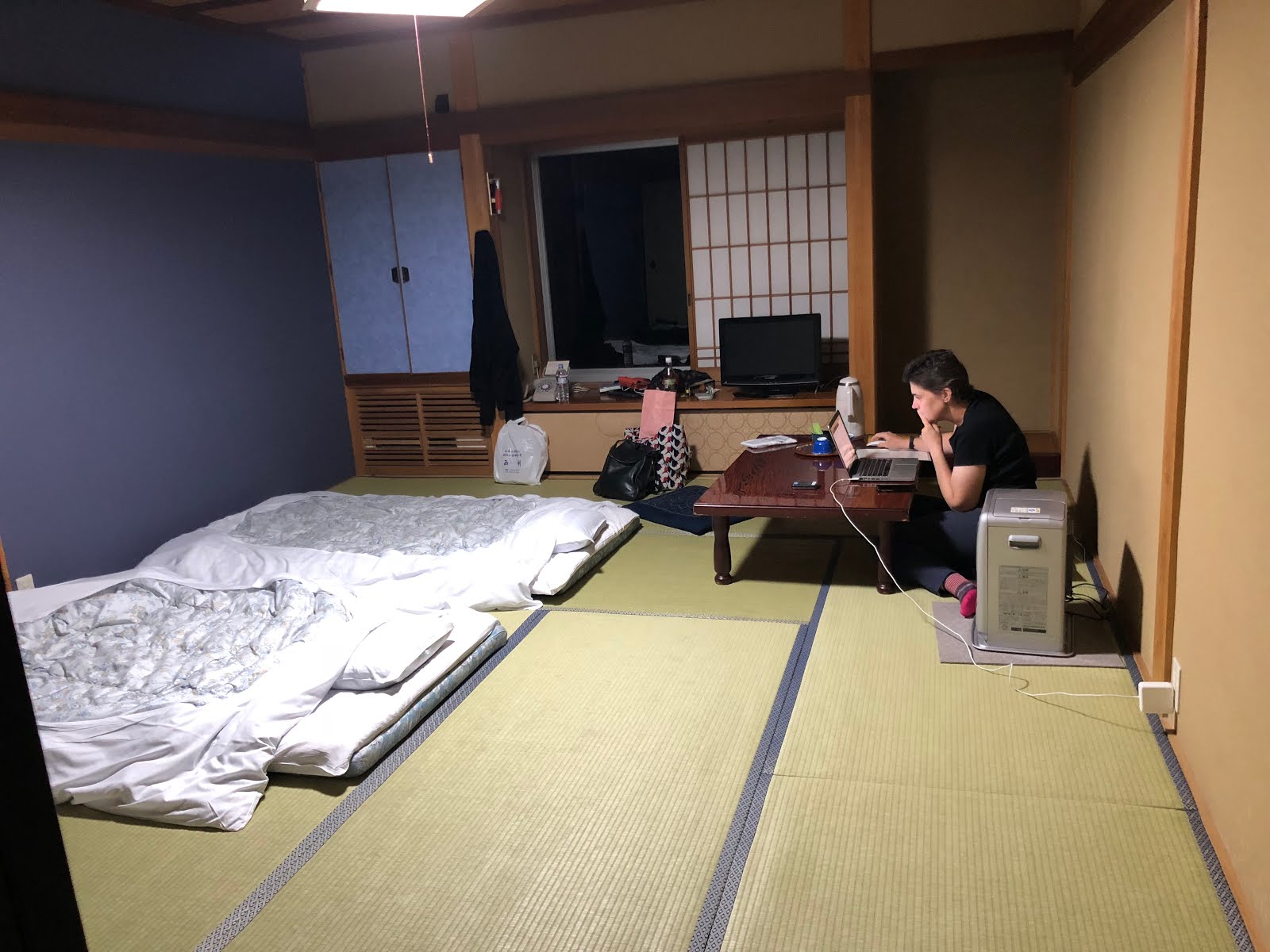 |
| Our room in Koya, spartan, but fine for us. |
 |
| Susan even ate a lot of my dinner to save face for me. It would have embarrassed the monks if the food did not appeal to me. We joked that the CSIsquad would have found her DNA, not mine on the chopsticks. |
 |
| Outside the shrine where we stayed. I liked seeing this, since David had spent quite a lot of time playing Charlie Brown to my Peppermint Patty. |
 |
| The cemetery, the lanterns show the phases of the moon. I loved that. |
 |
| An image that captures the deep serenity of the place. |
 |
| At the temple in the cemetery, I arranged for my intentions to be remembered in the ritual fire the next morning. The stick came with Japanese writing. I added my own. |
 |
| The monk snapped off the top and put it in the little bag. It now hangs next to my bed in New York |
 |
| Then we went to the widow's shrine |
 |
| Susan said this manifestation of the Buddha is called Kannon and sometimes manifests as a woman. I told her this was appropriate, since David believed women were superior to men. Given the monstrous father and lovely mother he had grown up with, that made perfect sense. Susan looked up his birth year- 1936. The patron Buddha for that year is Kannon! |
 |
It felt then and feels even more intensely now that David's dying at that moment was his last gift to me. And to be where I was and with such a splendid, loving friend was far beyond great good luck. It was one life's most precious blessings.
Thank you, my dear friend. Thank you.