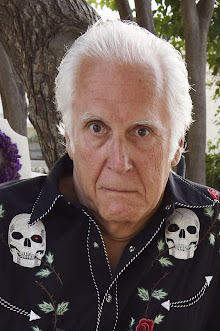
Showing posts with label David jay clark. Show all posts

Monday, May 13, 2019

Green-Wood Cemetery: David Jay Clark

Annamaria on Monday


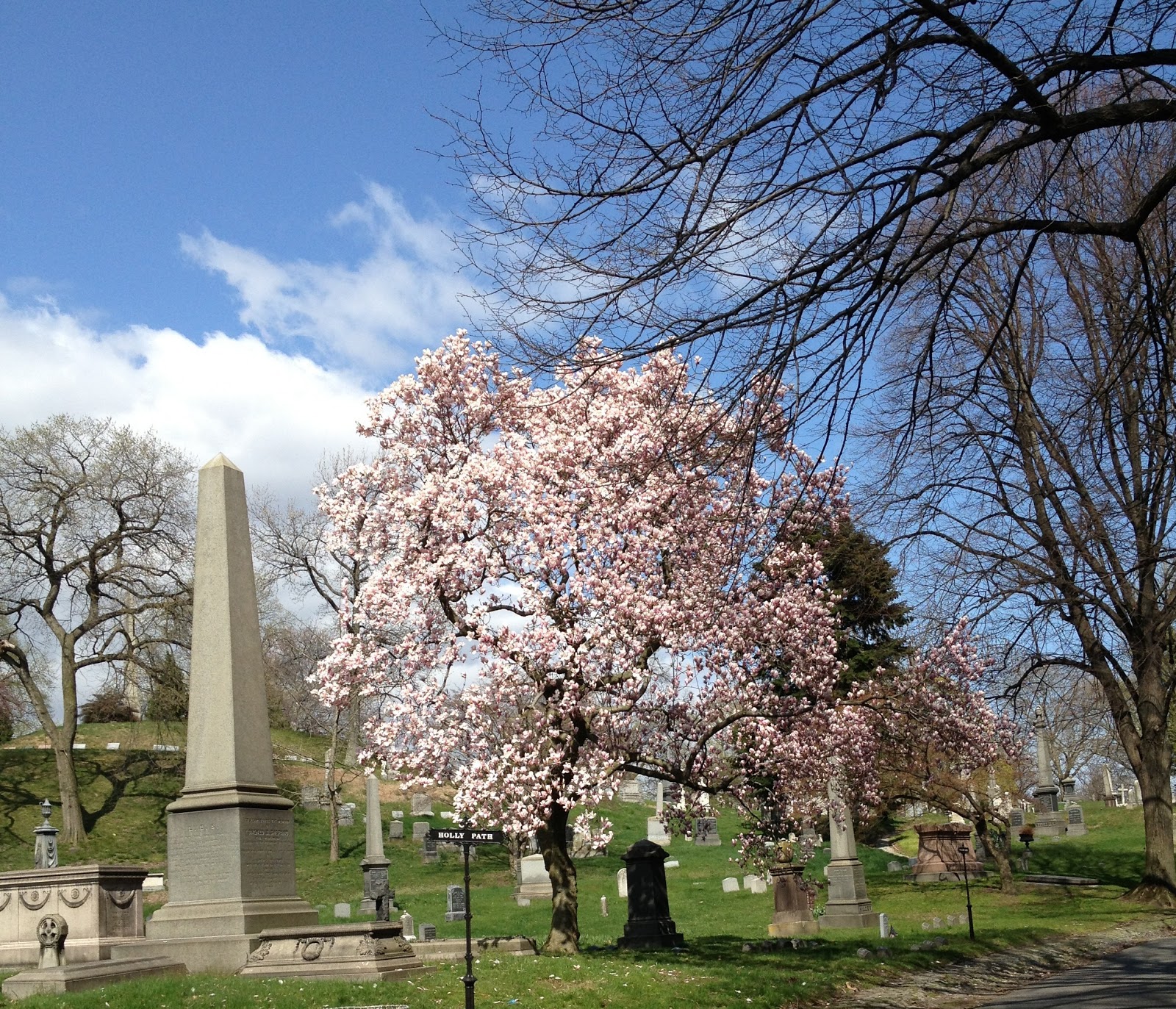
Green-Wood Cemetery in Brooklyn is the most historic such place in New York City.  It was founded in 1838 by Henry Evelyn Pierrepont, a Brooklyn social leader.   My husband David's connection with the place began then, at a point when his family had been in New York (formerly New Amsterdam) for 197 years.  His ancestors bought their plot immediately and the first of them - Simon Van Ness - was buried in it on 5th of April 1853.  David was not a proud man and did not think of lot of himself in any way.  But he was an eleventh generation New Yorker and did express, to me, his pride in the length of his family's connection with Green-Wood.


Green-Wood occupies the highest point in Brooklyn, only 200 feet above sea level.   Not very high at all, but nonetheless important during the Revolutionary War and the site of the Battle of Brooklyn, one of the decisive encounters of that conflict. 


Memorial to the Battle of Brooklyn
From that high ground, one can see the Statue of Liberty in the harbor to the west.  There is a statue of Minerva, the Roman Goddess of Wisdom, looking out and saluting Lady Liberty.   By local law, no building can be erected that would block the sightline from one goddess to the other.

My photo from this past Friday.


Last Friday was a murky day, but here is a pilfered photo that shows Minvera's salute

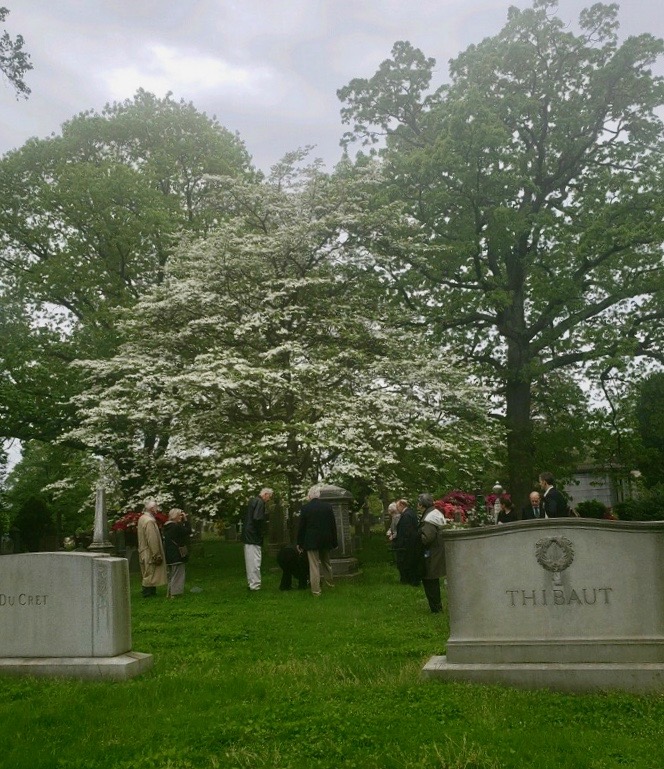
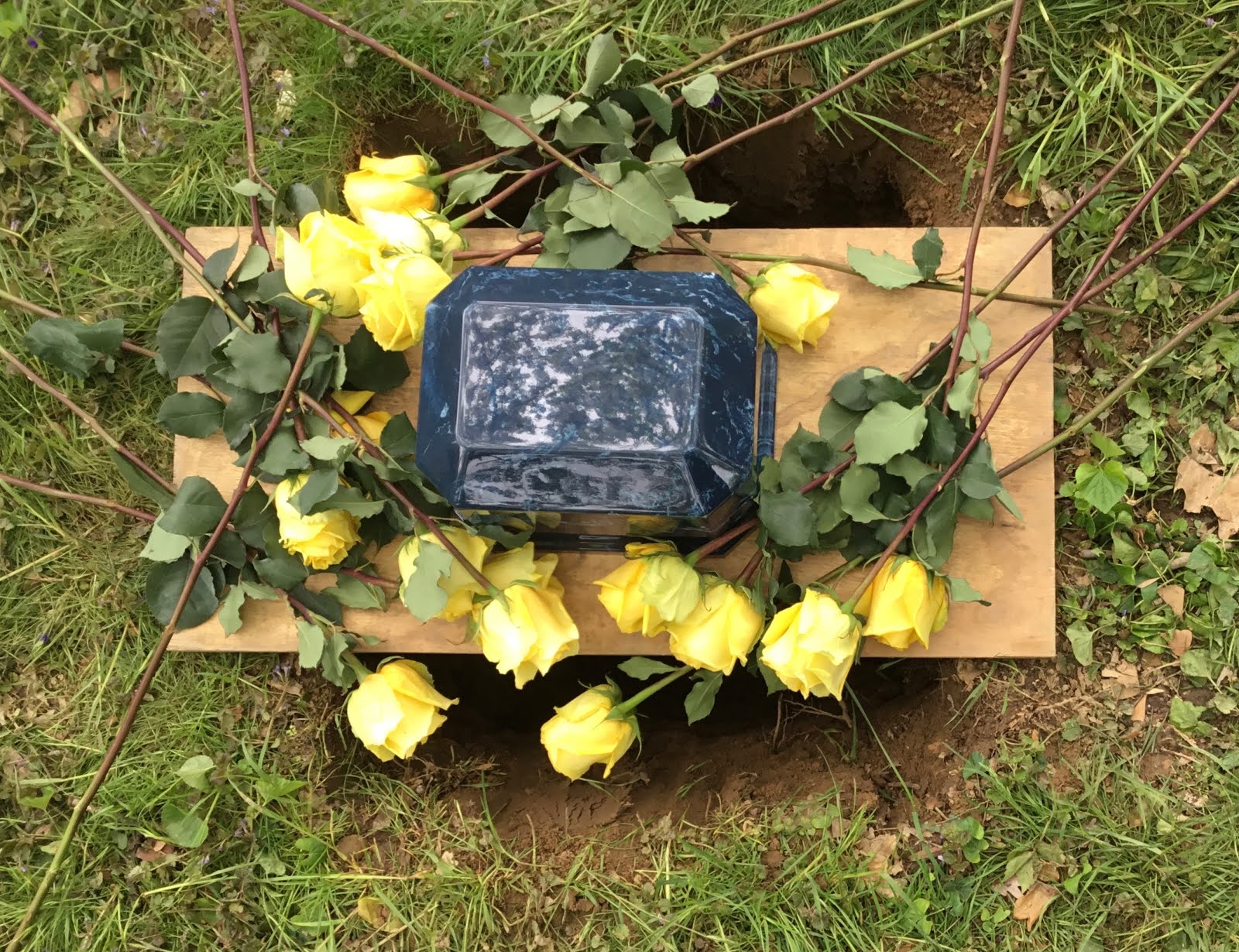
A tourist attraction for more than 150 years, Green-Wood now has over half a million "permanent  residents."  It hosts four to five funerals every day and draws over half a million visitors a year.  It boasts a magnificent chapel designed by Warren and Wetmore, who also designed Grand Central Terminal.  Many of the most famous and infamous New Yorkers are buried there, including Boss Tweed, Theodore Roosevelt Sr, Louis Moreau Gottschalk, Jean-Michel Basquiat, and Leonard Bernstein.  At this moment in spring, it is glorious with blossoming dogwood trees and brilliant azaleas.    Here are photos taken this past Friday when fourteen of my dearest stalwart friends  accompanied me to inter David's ashes.

While there, we visited the graves of some of David's favorite "fellow permanent residents."


Louis Moreau Gottschalk

After David and Ruth, Lenny (as all we New Yorkers call him) is the resident
 whom I most revere. 


Now just some random shots to show you how lovely and interesting Green-Wood is:


A view of Manhattan from the battle site.
A Civil War monument
The hill where David's family plot is located.
As we gathered at the grave
The urn is reflecting the miraculously beautiful dogwood overhead, at the height of its spring bloom

A final souvenir image, before we left.


 David is now at rest beside his beloved mother, Ruth Van Ness Clark.


Fear no more the heat o’ the sun, 
Nor the furious winter’s rages; 
Thou thy worldly task hast done, 
Home art gone, and ta’en thy wages: 
Golden lads and girls all must, 
As chimney-sweepers, come to dust. 

Fear no more the frown o’ the great; 
Thou art past the tyrant’s stroke; 
Care no more to clothe and eat; 
To thee the reed is as the oak: 
The scepter, learning, physic, must 
All follow this, and come to dust. 

Fear no more the lightning flash, 
Nor the all-dreaded thunder stone; 
Fear not slander, censure rash; 
Thou hast finished joy and moan: 
All lovers young, all lovers must 
Consign to thee, and come to dust. 

No exorciser harm thee! 
Nor no witchcraft charm thee! 
Ghost unlaid forbear thee! 
Nothing ill come near thee! 
Quiet consummation have; 
And renownèd be thy grave!

William Shakespeare
From Cymbeline

This beautiful poem was sent to me Friday afternoon after the funeral by my dear, friend Davis McCallum, Artistic Direct of the Hudson Valley Shakespeare Festival.  Davis is in the picture above, first on the right, of my friends who came with me to Green-Wood..  His friendship--like that of the others who were there--is precious to me and a balm to my soul.

Monday, April 15, 2019

Susan Spann: Facets of a Jewel of a Friend

Annamaria on Monday


I am celebrating today: celebrating Susan's completion of her quest to climb one hundred mountains of Japan within a year!  Celebrating also because in the process she has remade her life into the one she has wanted and needed.  Astonishingly, she did so in the face of a life-threatening illness.  And made it look graceful.  She is my idea of a heroine!


My celebration today also focuses on my own enormous good luck in having such a friend.

We began by sharing an editor at St. Martin's/Thomas Dunne - Toni Kirkpatrick, who opened the magic door for us by publishing our first novels.  Realizing that Susan and I were both on board to attend the 2013 Historical Novel Society Conference, Toni put us in touch.  As it happened, Susan turned out to be the moderator of my panel.


Susan and I made an instantaneous connection.  After that, we got together every chance we had, almost always at crime writing conferences - Bouchercon and Left Coast Crime.  At one of them, I brought her to dinner with the MIE crowd.  They, of course, immediately adopted her, and she joined us at the next opening on the slate of regulars.

Having traveled to Japan only on business, I often longed to see in person the fascinating places Susan posted about.   When she hatched the plan for her year in Japan, she generously offered to let me join her for a couple of week.  Get this: she remembered the comments I had made on her posts and made sure to include the places I had said I wanted to see in our itinerary.  She chose the timing: October 2018.  We started this plan about a year and a half ahead.

Back at home, Alzheimer's disease was sinking my poor husband more and more into a shell of his former self.    David was, by year fifteen of his illness, heartbreakingly reduced to a person who could chew and swallow, and nothing else.  For a couple of years, he had been blind, unable to speak, unable to interact with the world around him.  But he was not compromised in his vital organs.

As my departure date approached, I conferred with the medical folks at the facility where David lived.  They advised me to take the trip.  Nothing catastrophic was expected for him in the next several months.  My brother was just a few minutes away from the care home, just in case.

I really wanted to go.  So I did. 

My first week with Susan was even better than my over-the-top expectations.  We not only visited Japan's glorious historical sites, we went off the usual tourist trails to enjoy its natural beauties, and to climb mountains.  Susan had warned me that, if I left her to her own devices, I would be "drinking from the firehose of Japanese history."  Given my own proclivities as a historical novelist, I was 100% onboard with that!  Here's a sample of what a great guide she is:


One of my 249 photos of Fuji-san, famously difficult to see, but not for us!
See what mean about how lucky I am!

Nine days into our two-week trip, after climbing a mountain in Kyoto, we went out for an unusual dinner.  One big drawback for me of traveling in Japan was that - unbeknownst to me ahead of time, soy sauce is one of my many food intolerances.  The Japanese use soy sauce the way European cuisines use salt.  It is in just about EVERYTHING. So on the evening of 25 October, our dinner was ice cream sundaes, yummy and soy source free.


 We returned to our hotel about 10:30 PM, said good night, and went to our respective rooms.  As soon as I opened my door, my phone picked up the Wi-Fi and started to ding.  When I looked at the screen, I knew something was wrong: a text from my brother in New Jersey (thirteen hours behind us).

I quickly learned that David had died peacefully in his sleep.  I use a made-up word for how a person feels at such a time: grelief - a combination of grief and relief, but it also comes with shock.  I talked with my brother for a while.  David's after-death arrangements had been in place for some months.  There were no immediate decisions to be made.  I told my brother I would let him know what I decided to do.

I asked Susan to come to my room and broke the news to her.  No trained grief counselor could have handled the situation more sensitively.  She sat with me while I talked about next steps.

What to do?  I held out my palms as if my choices were written on them.  "Rush home?"  Getting back to New York would take at least two days.  I was scheduled to leave Japan in four days.  I knew some people would expect a woman in my position to get home as quickly as possible.   I knew I would be returning to my empty apartment.  I did not want to do that.  Should I stay with Susan and finish the trip?  Deep down, that's what I wanted to do.

"Let me tell you what's planned for the next two days," she said.  We were on our way in the morning to Koyasan, the most sacred place in Japan to remember the dead.  We would stay in a shrine. We would visit the oldest Buddhist cemetery in the country.  We would pray at its temple.  There was also a shrine there, built in the 1550s by a Japanese widow for women to remember their deceased husbands.

That decided it.  I stayed with Susan.

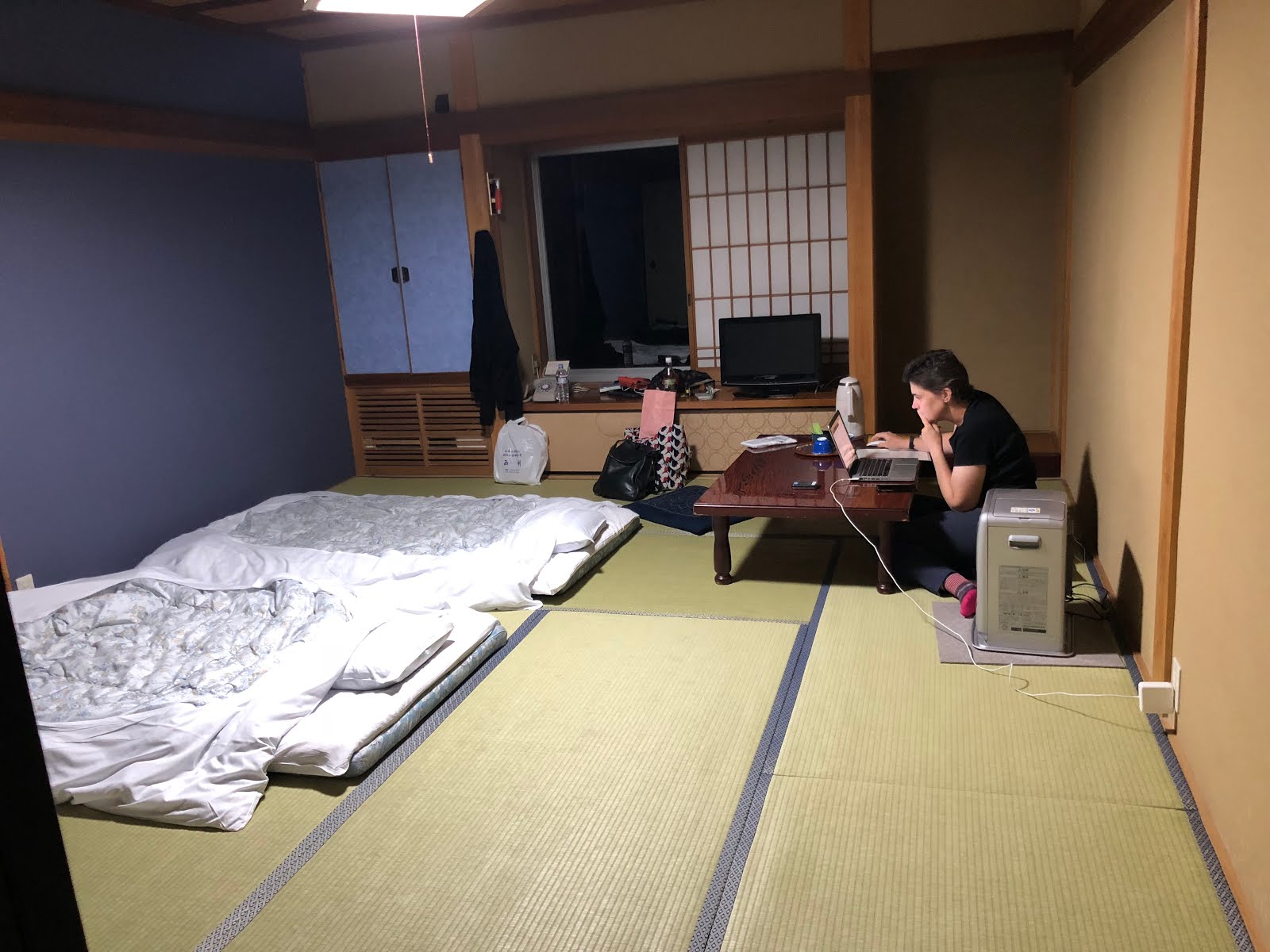
Here is what the next two days were like:


Our room in Koya, spartan, but fine for us.

Susan even ate a lot of my dinner to save face for me.  It would
 have embarrassed the monks if the food did not appeal to me.
 We joked that the CSIsquad would have found her DNA, not mine on the chopsticks.
Outside the shrine where we stayed.  I liked seeing this, since
David had spent quite a lot of time playing Charlie Brown
to my Peppermint Patty.

The cemetery, the lanterns show the phases of the moon.  I loved that.

An image that captures the deep serenity of the place.

David was not a practicing Buddhist, but he did believe in the Buddhist precepts of reincarnation and the evolution of the soul.  He had had the most miserable, abused childhood of any one I have ever known.  And yet he grew up to be a kind, sweet, funny, and generous man.  But I knew of the scars on his psyche.


At the temple in the cemetery, I arranged for my intentions
to be remembered in the ritual fire the next morning.  The
stick came with Japanese writing.  I added my own.

The monk snapped off the top and put it in the little bag.
It now hangs next to my bed in New York
The ritual at the temple, unlike in other places, involved candles and incense.  After seventeen years of Catholic School, I had lots of experience with candles and incense.  Before the image of the Buddha, I lit the candles and sprinkled a pinch of incense on the smoldering bowl.  As the smoke rose, I felt David's soul rise, healed, back to its beautiful self, free of the wounds his early life had inflicted.

Then we went to the widow's shrine
Susan said this manifestation of the Buddha is called Kannon and sometimes
manifests as a woman.  I told her this was appropriate, since David believed
women were superior to men.  Given the monstrous father and lovely mother
he had grown up with, that made perfect sense.  Susan looked up his birth year-
1936.  The patron Buddha for that year is Kannon! 

It felt then and feels even more intensely now that David's dying at that moment was his last gift to me.  And to be where I was and with such a splendid, loving friend was far beyond great good luck.  It was  one life's most precious blessings.

Thank you, my dear friend.  Thank you. 


Sunday, November 4, 2018

In Love with the California Coast

Annamaria on Monday

Back in the USA after peak experiences with Susan in Japan....


I flew back to SFO and immediately set off for parts north...


For Ft. Bragg and Mendocino and a visit with Dolores Clark and Beverly Clark, cousins to my husband David.


Dolores lives north of Ft.Bragg in a splendid redwood forrest.

We traded family stories and warm companionship, walks in the woods, in the towns, and on the beach.


On Dolores and Byron's property, there is a grove where the California branch of David's family bury the ashes of their loved ones.  Dolores offered to memorialize David there.  


We went to a local garden ornament shop, and I chose an image of Senchu Yugen Kannon, the Buddha that Susan had taught me was the patron of people born in 1936, David's birth year.

Beverly carried the statue to the grove.  I chose a spot for it.  


Dolores cleared a flat area; they placed the statue.


There is a bench nearby where one can meditate.


We each said a few words about David.


Serenity resides there with a memorial to him.

Sunday, October 28, 2018

Farewell, My Huckleberry Friend

Annamaria in Japan*


Some of you know that my husband of forty-four years has been suffering from Alzheimer's disease for more than fourteen years.  Lately, the devastation has been so acute that he was robbed of all but the merest vestige of his formerly bright, witty, vibrant self.

Word came to me here in Japan, just a few days ago, that he had died peacefully in his sleep--an event anticipated, but not expected at the time.  I found myself half a world away from him.  But, truth be told, it had been many, many years since he had been a part of the world we all live in.  Arrangements were in place.  My brother was on call, just in case.


What to do?  Should I rush back to New York to deal immediately with the aftermath of this event?  I was at a loss to know.  My darling friend Susan was here with me.  She listened sympathetically while I tried to understand my own feelings.


We were in Kyoto.  Our next planned destination was a sacred mountain, a centre of peace and spiritual renewal for a millennium and a half.  It seemed clear to me that fate was sending me to a place where a person might find enlightenment.  I chose to make that journey.


With Susan as my dear and understanding, wise and knowledgeable companion, I spent the next days visiting temples and shrines.  Walking the paths of serenity and peace.

Brought up a devout Catholic, I had for many years separated myself from the religion of my youth. In Koyasan, prayer once again became natural and comforting for me. Especially in Ukunion. 


At the shrine within the cemetery precincts, pilgrims light candles and burn incense in memory of the departed.  As the smoke from the incense rose, a realisation came to me, that David's soul was free, returned to its pure and original state, without the scars inflicted by his miserable childhood.  Just him, his kind, sweet, and funny, energetic and curious self.

In Koyasan, there is also a shrine that Susan describes like this:
The Otake Jizo is one of the largest cast copper statues on Koyasan. The statue takes its name from Mrs. Take Yokoyama, a woman from Edo (now called Tokyo) who donated this Jizo to Koyasan in May of 1745. According to an inscription on the base of the statue, the Bodhisattva Jizo appeared to Mrs. Take in a dream while she was staying at the nearby Fudozaka-guchi nyonindo and praying for the soul of her deceased husband. Upon awaking from the dream, Mrs. Take had the idea to commission and donate a statue of Jizo to Koyasan. The Otake Jizo has remained on display at this location since that time.
Known as Kṣitigarbha in Sanskrit, Jizo is a bodhisattva—a compassionate being who attains Buddhahood but remains compassionately attached to this world for the purpose of helping other souls in need. Jizo is a protector and patron of travelers, children, and those in need, including the souls of the deceased. He is often portrayed as a Buddhist priest with a halo around his head. His left hand holds a wish-fulfilling jewel, while his right hand wields a staff with which he forces open the gates of hell to help imprisoned souls escape. 
If ever there was a place for a woman to contemplate a loss like mine, this must be it.


So my journey continues.  

Here, along with the photo at the top, are a few of my dearest images of David at his happiest.

7 September 1974


 Farewell my boon companion, my Huckleberry Friend.


* In consideration of the nature of my news, Susan has kindly offered me her slot for Sunday in addition to mine on Monday.