Showing posts with label Bushman. Show all posts

Wednesday, August 31, 2022

Launch of A Deadly Covenant

 Michael & Stanley - Thursday

Finally, we’ve reached September 1. Today, A Deadly Covenant is out in the world!
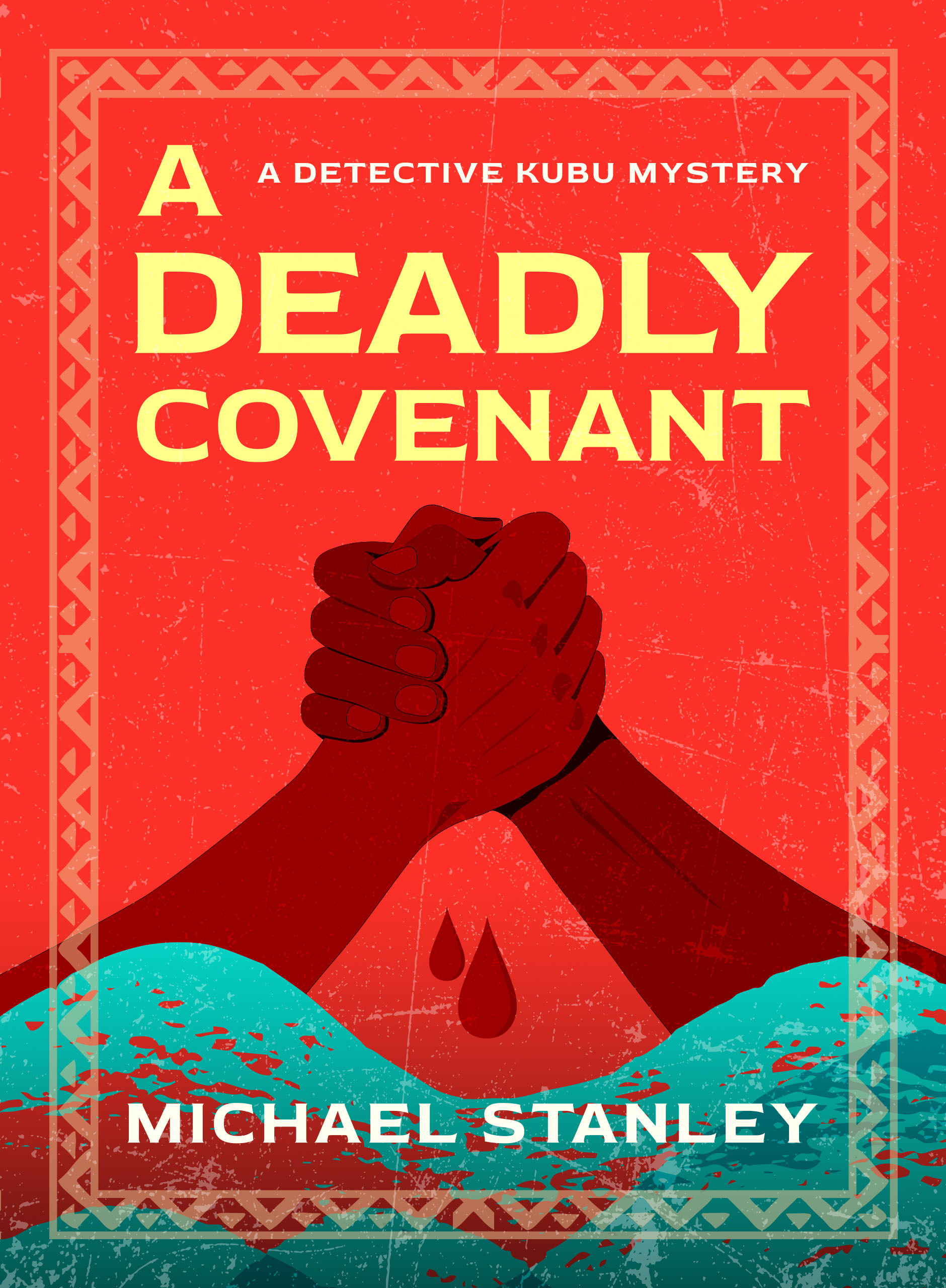

There’s quite a story behind this one. Stan had the idea of a Bushman skeleton being unearthed (by accident) and Kubu investigating, and more skeletons turning up, not necessarily Bushman skeletons. It seemed an intriguing premise.

Drotsky's cabins near Shakawe
where Kubu and Ian stay during the investigation

In terms of location, we’d been keen for a long time to set something in northwest Botswana. Shakawe is the town where the Kavango River from Angola flows from Namibia into Botswana. We experienced “bird overload” there once—so many water birds crowding the drying pools to get the trapped fish that we didn’t know where to look first. 

After that the river makes its way deeper into the Kalahari and then floods the Okavango Delta, creating one of the most amazing wildlife areas of the world. But the Okavango needs those annual floods. What would happen, we wondered, if it was an irrigation project that unearthed the first skeleton, perhaps a pipeline trench to take water from the river? A host of political and corruption issues presented themselves.


That was about what we knew when we started writing the book. We’ve always been “pantsers”— writing by the seats of our pants and wondering (sometimes with fear, occasionally with terror) where it was all going to go.

So Kubu, still a new detective in the Botswana CID, but with the success of solving the diamond heist case of Facets of Death under his belt, was sent out to Shakawe to help the pathologist, Ian Macgregor, get to the bottom of the mysterious skeleton. They get more than they bargained for. Eventually Ian finds nine skeletons, all of Bushmen, some of women and children, and all have been murdered—shot or bludgeoned to death. A Bushman massacre. And no one they ask in Shakawe is willing to admit to any knowledge of what happened.


At that point Selelo, a Bushman, appears from nowhere at the site of the massacre, dances to his ancestors in the sky, and then collapses. The next day he disappears. Next, an elderly man is murdered at his home. The local police think it’s a robbery gone wrong and blame the mysterious Bushman, but Kubu thinks otherwise. So does a strange woman who believes that a powerful river spirit, Mami Wata, is angry about the water project designed to “steal” her water.

Mami Wata

As his time away from Gaborone drags on, Kubu is missing Joy and agonizing over where their relationship is going. We love this quote from Lavender Magazine about A Deadly Covenant that encapsulates how the young Kubu feels:

Kubu, despite personal insecurities concerning love and social skills, sets his keen mind to work, absorbs, solves – gains confidence in handling police procedure, single-malt whiskey, and love.

Kubu’s boss, Assistant Superintendent Jacob Mabaku is sent to join Kubu and Ian amid rumors of corruption around the water project and the build-up of international anger over the Bushman killings.  Then another death occurs…


At that point we knew more or less what was happening and had a pile of cut scenes to show where the dead ends had occurred. But the conclusion itself seemed out of our grasp. What would happen to Selelo? How was the village chief, Kgosi Rantao, involved if he was involved? Who was lying and who (if anyone) was telling the truth? And how were Kubu, Ian, and Mabaku going to make head or tail of all this?

Well, eventually they did. We breathed a sigh of relief.

We hope you enjoy A Deadly Covenant and that, if you can, you’ll come to one of the events to hear more about the book and about Bushman culture.

Here's the September schedule:

Wednesday, 7. 4:30 – 5:30 pm 

Totally Criminal Cocktail Hour at Valley Bookstore

The Zephyr Theatre, 601 N Main St, StillwaterMN 55082

Call 651.430.3385 for reservations.


If you're attending Bouchercon, don't miss Stan's dream panel with Alexander McCall Smith, Jo Nesbo, and Caro Ramsay!


Friday, 9, 1:45 – 2:30 pm

BOUCHERCON Panel:

The Mystery of Multiple Points of View and Multiple Timelines (Writers use dual perspectives/multiple narrators and alternating timelines to tell their stories.)

Marty Ambrose; Mary R. Davidsaver; B.A. Shapiro; Julie Carrick Dalton; Stanley Trollip (Moderator)

Saturday, 10, 11:30 -12:15 pm 

BOUCHERCON Panel:

Under the Sun or Below Zero (You’ve heard of “setting as a character.” Well … what about the weather?  These authors’ works represent a dichotomy of climates where rising temps or bone-chilling cold are just as effective as any villain.)

Alexander McCall Smith; Stan Trollip (Michael Stanley); Catriona McPherson; Jo Nesbø ; Matthew Goldman (Moderator); Caro Ramsay

If you're attending the International Agatha Christie Festival, join us for Agatha in Africa.


Thursday, 15, 12:30 – 1:00 pm (UK time) 

Virtual event at the International Agatha Christie Festival

Agatha in Africa

Michael, Stanley and Zimbabwe author Bryony Rheam discuss Agatha Christie’s trip to South Africa and Southern Rhodesia and its connection with her mystery thriller The Man in the Brown Suit.


Saturday 17, 1:00 pm 

Nokomis Library event

5100 S 34th Ave, Minneapolis, MN 55417 Phone: 612-543-6800


Wednesday 21, 6:00 pm 

Thomas St. Angelo Public Library of Cumberland event

1305 2nd Ave, Cumberland, WI 54829. Phone: 715-822-2767


Thursday 22, 6:30 pm 

Spooner Library event

421 High St, Spooner, WI 54801 Phone. 715-635-2792


Saturday 24, 1200

The Bookstore at Fitger’s

600 East Superior Street, Duluth MN 55802


Tuesday, 27, 6:00 pm (In person and virtual)

Official launch of A Deadly Covenant at Once Upon A Crime

604 W. 26th Street, MinneapolisMN 5540 Phone: 612.870.3785 

Email: onceuponacrimebooks@gmail.com

With Mary Ann Grossman

Thursday, July 28, 2022

How did they do it?

 Stanley - Thursday

We are about a month away from the launch of our eighth Detective Kubu mystery, titled A Deadly Covenant. The book starts with the discovery of several skeletons of Bushmen who had been murdered and buried in the sands of the Kalahari.


Bushmen have played a major role in a number of our books. In A Carrion Death, it is Kubu's Bushman friend Khumanego who teaches him to be observant. The backstory of Death of the Mantis is about the demise of the Bushmen and the need of the remaining ones to maintain their history and traditions. In Dying to Live, a dead Bushman is found in the desert in suspicious circumstances. His body is sent to Gaborone to undergo a postmortem. Although the man is clearly very old, the pathologist finds that his organs are young, and a bullet lodged in his abdominal muscles has no entry wound. This leads to a frenzied belief that he has discovered a plant that prolongs life.

One of the reasons Bushmen play a prominent part in our books is that we have a great admiration for them and an extreme distaste for how they've been treated. For example, it was only in the 1930s that hunting licenses were stopped being issued for hunting them.

"That will be sixpence for the kudu, sixpence for the gemsbok, and thruppence for the Bushman," one can hear the clerk behind the counter say.

There are many things that have attracted us to the Bushmen. Here are some of them.

Bushman poisons

There are a number of poisons that the Bushmen use for hunting. The most intriguing is the poison from the Diamphidia nigroornata beetles which lay their eggs on the stems of shrubs from one of the Commiphora trees in the frankincense and myrrh family. 

Diamphidia nigroornata beetle

They then cover the eggs with their own faeces, creating a hard shell when dry. Eventually the larvae shed their protection and burrow up to a metre into the sand next to the tree, where they make a cocoon from sand. It may take several years before they molt into pupae.

Larva in its sand cocoon

The Bushmen dig up the larvae and pupae and gently squeeze the liquids in them into a container. When they are ready to hunt, they apply the poison, not to the tip of the arrow in case they nick themselves, but rather to the base of the arrowhead. The poison is important because the bows and arrows Bushmen use are very flimsy and unable to kill an animal outright. 

The poison causes partial paralysis and labored breathing, followed by cyanosis and respiration ceasing. Since the poison takes time to bring an animal down, the Bushmen sometimes have to follow a large animal, such as an eland, for days. The the animal falls, the Bushmen kill it if not already dead, and cut up the meat.

They can then eat the meat without dying from the poison.

Several things about this astonish me. First, how did the Bushmen eons ago discover the larvae buried so far underground? Second, how did they figure out that the liquid inside the larvae were toxic? Finally, how many Bushmen died before they figured all this out?

There are a lot of other side issues that are interesting. Because the hunted animal often runs through scrub and bush, and because resources in the Kalahari are few and far between, the arrows that Bushmen use have two parts: the head with the poison; and the shaft. When an animal is hit and start running, the main shaft falls off and is reusable. The part with the poison remains fixed in the animal and is retrieved when the animal collapses. (Surprisingly, the arrow also doesn't have flights.)

Arrow shafts and detachable arrow heads


Poison container, pointed to stand in sand

Navigation

In the northwest of Botswana is a range of hills that rise abruptly out of the desert, known as Tsodilo Hills. 

The Tsodilo Hills in the Kalahari

The Bushmen regard this as the birthplace of humankind. Today it is a World Heritage site boasting thousands of rock paintings, some of which go back thousands of years. I've had the good fortune to visit it several times.

Two paintings always astonish me: one of a whale and one of a penguin. 


I am astonished because Tsodilo is about 500 kilometres from the Atlantic Ocean as the crow flies. (By the way, what is now called the African 
penguin is found on the Atlantic coast of what is now called Namibia.) So how did they navigate over such large distance with no GPS and very few landmarks in the (to us) featureless Namib desert?

I've no idea.

Lack of jealousy

The Bushman were very worried about jealousy. If someone made or found something that was beautiful, they would give it away rather than keep it. Jealousy, they believed, was the cause of friction. And friction in an environment like the desert would only lead to disaster.

There's a wonderful movie about jealousy among the Bushmen. I watched it when I was a kid. It is called The Gods Must Be Crazy. it is worth finding and watching, even though some of it is dated. It is all about a Coke bottle.


Surviving in the desert

Most of us would struggle to survive in the harsh climate of the Kalahari Desert. Yet the Bushmen have been doing it for tens of thousands of years.

How?

First, the nomadic groups were usually very small, usually no more than a dozen or so. This meant that no group had to find a lot of food at any one time in order to survive. Second, they knew where to find food, sometimes buried, and water, even though there were no neon signs and signposts. 

Tsama melons growing wild in the Kalahari

And third - and perhaps the most important - was that they never finished any resource no matter how badly they wanted it. So, even if a group was very thirsty and they came across a small amount of water, they never finished it, always leaving something for the next group. 

This was because there was no such thing as ownership. Everything belonged to everyone, and therefore had to be shared. We could certainly learn from that (and from the lack of jealousy).

However, when ownership came to the territories in which they lived, that was when problems started. Farmers, Black and White, arrived owning cattle, for example, and land. The Bushmen would come across a cow. It was much easier to kill it, because it didn't run away, than to run for several days after an eland. The farmer thought differently and would either kill or enslave the Bushman if he caught him.

And that was the beginning of the end. Today there are probably no nomadic Bushmen left.

_________________________________

September events:


Thursday 8. 

Launch of A Deadly Covenant


Wednesday, 7. 4:30 – 5:30 pm 

Totally Criminal Cocktail Hour at Valley Bookstore

The Zephyr Theatre, 601 N Main St, StillwaterMN 55082

Find out more about the event HERE.


Thursday, 8, 4:15 – 5 pm 

BOUCHERCON Panel:

Multi-Tasking is Murder – Juggling Multiple Series ( How these authors create and balance multiple series at the same time.)

Chris Aldrich (Moderator); Michael Sears (Michael Stanley); Sujata Massey; Julie Hennrikus; Laura Childs/Gerry Schmitt; Anna Lee Hube

Friday, 9, 1:45 – 2:30 pm 

BOUCHERCON Panel:

The Mystery of Multiple Points of View and Multiple Timelines (Writers use dual perspectives/multiple narrators and alternating timelines to tell their stories.)

Marty Ambrose; William Boyle; Mary R. Davidsaver; B.A. Shapiro; Julie Carrick Dalton; Stanley Trollip (Moderator)

Saturday, 10, 11:30 -12:15 pm 

BOUCHERCON Panel:

Under the Sun or Below Zero (You’ve heard of “setting as a character.” Well … what about the weather?  These authors’ works represent a dichotomy of climates where rising temps or bone-chilling cold are just as effective as any villain.)

Alexander McCall Smith; Stan Trollip (Michael Stanley); Catriona McPherson; Jo Nesbø ; Matthew Goldman (Moderator); Caro Ramsay

Thursday, 15, 12:30 – 1:00 pm (UK time) 

Virtual event at the International Agatha Christie Festival

Agatha in Africa

Michael, Stanley and Zimbabwe author Bryony Rheam discuss Agatha Christie’s trip to South Africa and Southern Rhodesia and its connection with her mystery thriller The Man in the Brown Suit.


Monday 19, 6:00 pm 

Nokomis Library event

5100 S 34th Ave, Minneapolis, MN 55417 Phone: 612-543-6800


Wednesday 21, 6:00 pm 

Thomas St. Angelo Public Library of Cumberland event

1305 2nd Ave, Cumberland, WI 54829. Phone: 715-822-2767


Thursday 22, 6:30 pm 

Spooner Library event

421 High St, Spooner, WI 54801 Phone. 715-635-2792


Saturday 24, 1200

The Bookstore at Fitger’s

600 East Superior Street, Duluth MN 55802


Tuesday, 27, 6:00 pm 

Launch of A Deadly Covenant at Once Upon A Crime

604 W. 26th Street, MinneapolisMN 5540 Phone: 612.870.3785 Email: onceuponacrimebooks@gmail.com

With Mary Ann Grossman

October events:


Saturday 1, 9:00 am – 3:00 pm

Meet us at the Deep Valley Book Festival

Mankato, MN

Free book festival. We’ll be there from 9am to 3pm. The event takes place at the WOW! Zone, conveniently located at 2030 Adams Street in Mankato, just off Highway 14.


Thursday 6, 7:00 pm

Barnes and Noble HarMar

2100 Snelling Ave N, Roseville, MN 55113


Saturday 8. 

The Poisoned Pen Bookstore

4014 N Goldwater Blvd #101, Scottsdale, AZ 85251 Phone:(480) 947-2974 Toll Free: (888) 560-9919 Email: sales@poisonedpen.com

Michael and Stanley join Barbara Peters on Saturday afternoon to chat about A Deadly Covenant.


Friday, 14, 10 am 

Lake Country Booksellers event

4766 Washington Ave, White Bear Lake, MN 55110 Phone: 651-426-0918


Saturday, 15, 10:00 am – 5:00 pm 

Twin Cities Book Festival

Minnesota State Fairgrounds, Saint Paul, Minnesota


Thursday, April 26, 2012

Edgar Night

Tonight is Edgar night, the night when Mystery Writers of America throws a gala function and announces the winners of its prestigious Edgar Awards for the best mysteries of 2011.  As you probably know, Death of the Mantis has been shortlisted for the Edgar for best paperback original of 2011.  Just being shortlisted was a huge deal for us and not one we expected.  We didn't even check the announcement when it came out; we were only alerted by generous congratulations from Leighton!  We were blown away.

Stan is going to be there tonight, but unfortunately I couldn't get away from commitments in South Africa - including the Knysna Literary Festival which is taking place this weekend and features a mystery writing event with myself and South African mystery writers Mike Nicol and Margie Orford.  So when the announcement is made tonight, I'll be trying to sleep. (It'll probably be about 3am here.)  But I'm feeling the same butterflies all the other finalists are feeling tonight...

Certificate of nomination
Death of the Mantis was a special book for us.  Of course they are all special, but this was the book were we tried to paint our story on the poignant backdrop of a dying culture.  If the book wins tonight, it is the Bushman people and their extraordinary lives that have made it so.

So here once again is the story of the Bushman people and the way it led to tonight...

The Bushmen have been nomadic peoples – there are many different groups with a variety of languages - for hundreds of thousands of years. As other population groups crowded them, they moved into the arid regions of southern Africa and developed a very successful if spartan lifestyle. They would dig for water and suck it out of the ground through straws or use Tsama melons for fluid. Sharing was a survival strategy. They moved with the seasons, following game which they hunted using bows and poisoned arrows. The poisons make a story in themselves, ranging from snake venom, through extraordinary desert plants, to an extraction of the larva of a beetle which is so poisonous there is no known antidote.  Their ancestors left amazing rock art.

Fast forward to the twenty-first century. (There’s some pretty sickening stuff in the years we’re skipping over, including a period when the Bushmen where hunted like animals.) Now things in Botswana are very different. Much of the Kalahari is declared as the Central Kalahari Game Reserve. Diamond mining drives the economy. Bushmen numbers have declined.

And how you interpret the situation depends on your perspective. Here is my superficial summary of the way some of the Bushman leaders see it, and how support groups like Survival International see it:
The Bushmen have always lived in the Kalahari. Fences and private land ownership – which is alien to them – interfere with their nomadic behaviours, and rules concerning hunting force them near starvation. Their culture is not respected and is being destroyed by the change in environment and legal constraints with which they don’t agree. In order to keep the Kalahari for tourism and – according to some - for diamond mining, the Bushmen are being forced out of the Kalahari game reserve and into settlements little better than concentration camps on the verges of the land they once regarded as their own. Yes, there is some compensation, but this is soon frittered away leaving nothing. Financial investing is completely beyond their ken.

And here is how the Botswana government sees it:
The government has an obligation to provide appropriate infrastructure for all its citizens. This includes proper schools (Botswana has a policy that schools should be within walking distance from where people live), health care at least at a primary level, water and sanitation. Furthermore the Kalahari is remote and inaccessible, an ecological treasure that must be preserved. Discrimination on race is forbidden by the constitution; if the Bushmen live there, how are other population groups to be prevented from living and hunting there? And now the Bushmen hunt with guns rather than bows and arrows. Their nomadic behaviour has changed to informal settlements where water has to be supplied by road, rather than found in depressions or melons. Crudely put, the traditional culture is already dead; only the inconvenience remains. Thus a group of planned settlements set up in appropriate places with schools and services is the way to go. Appropriate compensation is paid to the people who have to move. They have a new and better life ahead.
In the wide gap between these two viewpoints is a variety of groups trying to negotiate a scenario which would bring the two sides closer together. Among these is Ditshwanelo, an amazing human rights organisation led by the equally amazing Alice Mogwe. (Ditshwanelo is a Setswana word meaning variously: obligations, merits, duties.) Nevertheless, with such extreme perspectives, and the muscle behind each side, it was almost inevitable that the matter would end in the Botswana High Court.

One of the three judges was the remarkable Unity Dow – first woman High Court judge in Botswana, member of the Kenyan Constitutional court, novelist. Broadly, the judges ruled in favour of the Bushmen. In the judgement, Dow said that the case was ‘ultimately about a people demanding dignity and respect. It is a people saying in essence: "Our way of life may be different, but it is worthy of respect. We may be changing and getting closer to your way of life, but give us a chance to decide what we want to carry with us into the future”.’

Michael - Edgar Night

Thursday, January 20, 2011

// Kha - The Name of the Lion


Wilhelm Bleek
Dorothea Bleek
Between 1870 and 1880, two linguists – Wilhelm Bleek and Lucy Lloyd recorded the stories and beliefs of five /Xam Bushmen.  By that time, the Bushmen of the southern region – south of the Orange River – were in decline, and it was clear that the /Xam culture would soon be gone.  Bleek had several of the /Xam live with him at his house in Cape Town and learned their language.  This was a remarkable feat for two reasons – firstly at that time there was essentially no written version of the language and its dialects, and secondly its structure involved the frequent use of five clicks each changing the meaning of what followed in the context.  The linguists had to develop a character set to represent these (and other) features of the language.  Thus the five special clicks are written /, //, ≠, ! and Θ.  The names of the five /Xam teachers who shared their customs and beliefs with Bleek and Lloyd in their own language (with the Western names they were given) are /A!kuηta (Klaas Stoffel), //Kabbo (Oud Jantje Tooren), Diä!kwain (David Hoesar), /Haη≠kass’o (Klein Jantje Tooren) and ≠Kasiη (Klaas Katkop).  The material was compiled in extensive notebooks.  Some forty years later one of Wilhelm Bleeks daughters – Dorothea Bleek – first published them.

One of the /Xam teachers
The interest in what is recorded for the ordinary reader is in the picture that it gives of a vanished culture and its beliefs.  The /Xam lived in semi-arid savannah conditions and shared the environment with all the big game for which Africa remains famous.  Of these none was more overawing and terrifying than the lion. Even today sitting in the (relative) safety of an open Land Rover in a game reserve, few things are more awesome than a lion roaring a few yards away.  And the casual glances they give you with big yellow eyes as they walk past seem to say, “You have the upper hand now, but things may be different later.”

Perhaps it is hardly surprising that the Bushmen attributed powers to lions that went way beyond their daunting physical prowess and co-operative hunting skills.  Lions understood human speech.  Owls and crows spied for them.  Worse still, they had swarms of flies which they could send out to listen to what people said and report back.  Thus, children in particular where warned to be careful not to insult a lion; it was best to euphemistically refer to “hair” (“Hair" was here, see there are "Hair’s" footprints) or to indicate the same with one spread open hand.  Then the flies wouldn’t know.  (Presumably flies don’t have enough intelligence to bring to learning such matters.)  Not only would owls report to the lions on where people where, they could also make the sun set quickly – taking away the light people needed to fight or escape.

It is hard to imagine living not only in nightly danger from these large predators, but also endowing them with demon-like powers.  Yet, with great courage, the /Xam would sometimes steal part of a lion’s kill, maybe even driving off an animal or two to do so.  But there is a do-as-you-would-be-done-by moral to that tale.  It was understood that part must always be left for the lions, otherwise they would track the thieves to their homes and demand a human in compensation.
Diä!kwain told it like this:
            “Our parents used to say that if the lion did not find food at the place of the kill, he would be angry and say to himself, ‘Just you wait a bit; because you seem to have carried off all my food, I will do as you have done to me, I will follow your footprints, I will go and seize one of your men in his sleep and eat him.  For you seem to have forgotten that I, too, am hungry.”
(Customs and Beliefs of the /Xam Bushmen, edited by Jeremy C Hollman, Wits University Press.)

These stories and the many others that Bleek and Lloyd laboured to understand and record, give us an insight into a time and a way of life that is now gone in South Africa at least.  

I think we owe them a debt.

Michael - Thursday