Wednesday, April 23, 2014

Show me the way

There is something about lighthouses. How could there not be? It is hard to beat the visual impact of these solitary spires, erected in remote locations, upon the joint of solid land and raging sea.  Pointing upward to the sky, sending a message of light out towards those that travel across the sometimes treacherous ocean waves. The sight of a lighthouse conjures up visions of storms gone by, wooden ships and struggles with the wind over torn and salty sails. Their original purpose also makes them eerie, connecting them with death through the navigational aid they provided and the shipwrecks that were in turn avoided. Eerie is always good.   

A small detour: Does anyone know if the word “aspire” originates from “spire”? It seems likely.

The first lighthouse in Iceland was built in 1877. Before that time, most fishing was conducted in small open boats and almost inclusively during daylight. No one was particularly interested in coming here and under 100 trips from foreign vessels passed the Reykjanes peninsula annually. It is worth a mention that despite there being no lighthouses before 1877, an attempt to pass a lighthouse tax was made. (It did not go through).

With lighthouses came lighthouse-keepers. These men were believed to require guidance so regulations were passed regarding their duties in 1897. Amongst the articles found therein was one forbidding them to allow anyone drunk, dishevelled or raggedly looking into the lighthouse.

Today there are 104 lighthouses owned and operated by the Icelandic Maritime Authority. An additional 30-40 belong to various municipalities and are situated at harbour entrances.

Here are some photos of Icelandic lighthouses for your enjoyment. It is easy to imagine bad things happening there. I have incorporated one of them into my latest book which came out in Iceland last November. I will allow you to guess which one captivated the writer in me.
 
Gróttuviti - in my hometown, originally built in 1897 but replaced by this one in 1947. My husband's great-great grandfather was a lighthouse keeper there. I can only hope he did not allow the druken and raggedy to enter.

Dyrhólaeyjarviti - built in 1927 to replace the original built in 1910. The original did not last long for some reason.
Arnarnesviti-vef
Arnarnesviti - 1941


Þrídrangaviti -1939. Anyone interested in the lighthousekeeper position?
 

Skaftaros-vef2
Skaftárósviti - built in 1911, possibly under the influence of Eiffel's masterpeice - if you put the colour to one side.
Malarrif-vef
Malarrifsviti - built in 1946 in the place of an iron lighthouse like the one above that gave way to rust
 
 
Urðaviti - built in 1986 to replace the original lighthouse that went under lava in the Heimaey eruption in 1973.
 
 
Garðskagaviti - the archetypal lighthouse design - constructed in 1944


 Yrsa - Wednesday


Tuesday, April 22, 2014

The Big Gruyere--Under Paris.


Happy Holidays Everyone - Here's a post from April that I'm sharing again - Best wishes in the New Year! With metro tunnels, sewers, old quarries and catacombs crisscrossing under its streets, Paris is a city of layers. And Charles Axel Guillaumot is often credited with saving the city from collapsing into them. Traces of him – and key moments in history such as the French revolution – can still be found underground today.

If you want to know anything about what’s underneath Paris, you could try to find some cataphiles, people who spend time exploring the catacombs with flashlights and waders. But for the history, the man to talk to is Gilles Thomas, my friend.

A wiry, moustached man, Thomas works for the city of Paris, but he is passionate about what’s underneath it, both physically and historically.

The authorities, he says, are only interested in the structural soundness of what’s above ground - he's interested in preserving the history underneath.

The buildings of Paris were built out of the limestone and gypsum – or plaster of Paris – dug out of its belly. The Romans, who founded the city on the Ile de la Cité, found limestone along the riverbanks. “Then the city grew,” explains Thomas. “Around the 12th and 13th century, there was a big demand for stone, because there was a spike in the population of Paris and of religiosity.”

The Notre Dame cathedral was built around this time, along with several other churches, all of them needing stone, which meant digging further underground. Initially, the quarries were far outside the city, beneath fields. But then the city expanded and those fields became city streets.

“Paris, as it grew, was built over the old quarries,” says Thomas. And over the years, people forgot about the quarries and continued to build on top of them - until they started collapsing.That’s where Guillaumot comes in. An architect for King Louis XVI, he was appointed 334 years ago on 4 April 1777 as the city’s first Inspecteur des Carrières, Quarries Inspector.


He was given three tasks, explains Thomas, “to look for all the empty spaces under Paris; to make a map of them; and to reinforce anything under public streets and buildings belonging to the king.”
“Before the year 1777, the temples, palaces, houses and the public streets of several parts of Paris and its surrounding areas, were about to sink into giant pits,” Guillaumot wrote in a 1797 memoir.

He quickly realised that reinforcing the quarries was a long-term project, so he needed to put a system in place. “Neither I nor my collaborators will see the end of it,” he wrote. “Others will have this opportunity, but I have reason to believe that we have paved the road for them, and they will not have any fundamental changes to make on the system that I implemented.”

The system involved building walls - underground – along the perimeters of buildings, which still exist today.
A limestone quarry under the Cochin hospital in the 14th arrondisement still exists today, maintained by an association that has an agreement with the city to renovate and maintain it.

Gilles Thomas works with the association, and insisted on giving a tour, saying that the only way to truly appreciate the history of the quarries is to see it for yourself. The Cochin quarry is not far from the official catacombs, which are open to the public, but it is certainly not as easy to find. Navigating through the hospital’s emergency room entrance, winding through the hospital grounds, Thomas heads into an underground parking area where there is a non-descript door.

Behind the door is a room with old photos and maps of what’s underneath the streets: blue for the empty spaces, brown for the masses left to hold up the quarry ceilings, all laid out in a rough grid.Another door leads to a long concrete stairway that was built in the 1930s when the city turned underground spaces under administrative buildings into bunkers.

And about 20 metres down is the entrance to the quarry.Unlike the public catacombs, which are mainly hallways packed with human bones, this quarry has open spaces with columns. The walls are limestone, the ground is packed dust. Street signs are engraved on columns and walls.

"When you are above ground, you can ask people for directions,” Thomas points out but in the 18th century Guillaumot and his workers had to wander in the dark, holding candles to light their way.

Traces of the first quarry inspector are everywhere, as each reinforcement wall and pillar has a code engraved on it, like 1G1786, which indicates the first column built by Guillaumot in 1786.

Every engraving had a date, but Thomas says you will be hard-pressed to find 1789, the year of the French revolution.
“You’ll see 1777, and years during the revolution, but there are very few from 1789, because it was year when there were other things to think about,” he says.

Guillaumot was imprisoned during the revolution, and removed from his position because he had been appointed by the king.
Later, in 1795, he was given his job back. He reappears on inscriptions with dates referencing the republican calendar, which was introduced between 1792 and 1806. The inscription 22.G.12R indicates the 22nd column built by Guillaumot during the 12th year of the French republic.

Thomas says the work of the Quarries Inspector continued through all of the upheavals of French history.
“Whatever the troubled history in Paris and in France, there was always being work done the quarries - during the revolution, during the terreur,” he says. And traces of this remain: street signs with scratched-out fleur de lys, the royal symbol, because in 1793, anything having to do with royalty was systematically destroyed.

Or not quite everything. Ten signs with fleur de lys remain underground.

“There are so few, that there is an explanation for each one,” he says. The one above the number 270, for example, survived because it was in a pool of water. Another one was on the back of a sign that had been recarved.

In 1794, all references to religion were destroyed. Signs for streets named after saints, like Rue Saint Jacques or Rue Saint Paul were changed, above and below ground.

“The plaques made during the revolution just say Rue Jacques,” says Thomas. “And during the restoration, as there is no room between Rue and Jacques, some just carved a little “St” over it.”Vestiges of this still exist above ground. Look closely at the stone carved street signs on the corner of Rue du Faubourg Saint Jacques and Rue Fossés Saint Jacques, you can see that the Saint was scratched out and put back. The same exists on Rue Saint Paul in the Marais.

Nearing the end of the tour, we come across members of the association setting up an underground lunch, taking a break from their renovation work.And then it was time to walk back through the ages: through the 19th-century tunnels, up the 20th-century stairwell and into the air of the 21st century.

Cara - Tuesday

Monday, April 21, 2014

Crime and the Italian Dog

This is a true story.  The names have been changed.  No animals were hurt in the course of writing this tale.


A Tuscan woman of a prominent family was preparing to leave for Ferragosto, the Italian appellation for that wacky European habit of mass exodus for ten or so days during August.  Let’s call her Lucia dei Furbi.  She was heading off to her family’s mountain home in the Dolomites.  Her husband had decamped a few days before her to visit an ailing brother near Bologna.  They were to meet at the brother-in-law’s and then continue north to the cool of the Alps for the rest of the month.

That sick brother-in-law needed rest, so Lucia decided not to take along her German Shepherd named Maia.  Maia was a good dog, but tended to be a bit noisy when she was in strange places.  Arrangements were made to board her with Dottore Bugiardo, the animal doctor to Florentine high society.  He kept dogs at his establishment near Fiesole, north of the city.


Since traffic would be horrendous on the morning of the great egress, Lucia took Maia to the kennel on the eve of her departure.  She then went home to her country house near Greve in Chianti, south of Florence—a distance of about twenty very hilly miles.  She went to bed, in anticipation of a five AM departure.


At two AM, Lucia heard barking in the cortile of her house.  She opened a window, and there in the moonlight was Maia.  Astonished, Lucia took her dog in and looked her over.  She was tired and a bit scruffy, but not hurt, though she had—after her jailbreak—traversed a lot of territory, including at least one major highway and one railroad line.  Bemused about how to handle the situation, Lucia decided she would take Maia with her to the mountains and leave at five AM as planned.


Driving along during the next day, she waited for a call from the vet about Maia’s disappearance, thinking how amazed Dr. Bugiardo would be when he learned that the dog had found her way home.  No such call came.  By four that afternoon, Lucia was convinced that something was very amiss if the dog’s absence had not been noted.  She called.  When Bugiardo came on the line, Lucia played it cool, sticking to the literal truth, but not giving the facts away.


“I am calling about my dog Maia.”

“Oh, Signora,” the vet said, “I am so sorry to have to tell you that Maia is not quite well.”

“Really?  What do you think is wrong with her?”

“It doesn’t seem too serious.  We will give her some medicine.  I am sure she will be alright.”

“Well, Dottore, please let me know what you think about her condition.”

“Certainly.  Why don’t you call back in a day or two?”


Two days later, happily ensconced with her husband and dog in their mountain retreat, Lucia called back.

“Oh, Signora, I am so sorry to have to tell you.  Maia’s illness is quite serious.”

Sticking to her tactic of never lying to the vet, but not disclosing the truth either, Lucia responded, “Oh, my, what do you think should be done?”

“I am afraid I will have to operate.”

“I would never want to deny Maia any treatment that might help her live.”

“Very well, I will operate tomorrow.  Please call me the day after.”


At the appointed time, Lucia was back on the phone.

The vet was extremely distressed.  “Signora, I have dreadful news.  I am afraid that Maia died during surgery.”

“Oh, Dottore, Dottore.  How terrible.  I am too upset to speak.”

“We need just one decision from you, Signora.  I know you plan to be away till the end of the month.  We can cremate the remains for a nominal fee, or we can bury Maia in our memorial garden for twelve hundred euros.”

“A dog as wonderful as Maia deserves only the best.  A burial in the memorial garden would be my choice.”

Two weeks later, when she arrived back in Florence, Lucia found the Bugiardo’s bill—for the boarding, for the medication, for the surgery and for the burial.

Criminal, don’t you think?

Annamaria - Monday    


Sunday, April 20, 2014

Guest Blogger: M.L. Longworth–"After the darkness of war, the light of books."


Every other Sunday is our day for Guest Author Postings by mystery writers who base their stories in non-US settings.  We think it a great way of introducing our readership to new experiences and places.  We’re honored to have with us today France-based novelist Mary Lou Longworth who writes as M.L. Longworth.  Mary Lou has lived full-time in Provence since 1997 and has written about the region for The Washington Post, The Times (UK), The Independent, and Bon Appétit magazine. She writes a mystery series, set in Aix-en-Provence, for Penguin USA: Death at the Château Bremont, Murder in the Rue Dumas, and Death in the Vines. Her fourth book, Murder on the Ile Sordou, will be released in September 2014. She divides her time between Provence, where she writes, and Paris, where she teaches writing at New York University.

Welcome, M.L.  And thank you.


Each August, before the fall semester begins at New York University's Paris campus, I hesitate whether or not to keep Ernest Hemingway’s A Moveable Feast on my reading list. Younger colleagues, I know, (although they don't tell me) find the book 'cliché' and old-fashioned. But come December, before we break for the holidays, the majority of the students tell me how much they loved reading it. Papa Hemingway's memoir is so many things, and each student gets something different from it: it's a trip back to 1920's Paris; a treaty on discipline and how to write; a culinary travel through Montparnasse; and above all, a love letter, and apology, to Hadley.

I think of Hemingway when I'm in certain neighbourhoods of Paris: near the Place Contrescarpe (then, a "cesspool"), or the Jardin du Luxembourg, where the young writer would bump into Gertrude Stein walking her dog. But I think of him most often when I'm in a Parisian haven for Anglo Saxon expats: The American Library of Paris:


The American Library Association founded the library (pictured above, on the right) in 1920. Hemingway was one of its first trustees, as was Stein, and Edith Wharton. What began as a shipment of books for WWI soldiers, it is now the European continent’s biggest English-language lending library. Hemingway wrote articles for the library's newsletter (I've never been able to find copies of them), called Ex-Libris, derived from the library's moto: Atrum post bellum, ex libris lux. After the darkness of war, the light of books.


It may feel strange--as if one is being lazy--to live in a city where French is the spoken language and yet to yearn for a place where one is surrounded by English-language books. But the American Library of Paris feels like home--insert your town's public library name here--although you can often hear French being whispered by patrons and staff. It's a great place to do research, or amble through the stacks and pick out books higgledy-piggledy, or sit comfortably in one of the sofas or armchairs and read a magazine (my first choice: The Wine Spectator. I sometimes miss California, Oregon, and Washington State wines, and love reading up on young maverick winemakers).

During the German occupation library director Dorothy Reeder and her staff bravely opened an underground book-lending service, providing books to Jews barred from the city's public libraries. Also during this time, the Gestapo shot a staff member when, very sadly, he failed to raise his hands quickly enough during a surprise inspection. I always thought that the library stayed open during the occupation thanks to its very brave staff. Brave as they were, it was family connections that kept the library open: an early chairman of the board was Clara Longworth de Chambrun, sister of the U.S. Speaker of the House of Representatives, Nicholas Longworth (no relation). One of Clara's sons married the Vichy Prime Minister's daughter.

The library has always been a bridge between the USA and France, as is the Foundation Mona Bismarck, just across the river at 34 Avenue de New York (you can walk across the lovely foot bridge, the Passerelle Debilly). The exhibitions are diverse, from quilts to Yosef Karsh and Andrew Wyeth retrospectives, to American ceramics. Check their calendar for lectures or musical events, too; the setting, Mona Bismarck's Paris home, is stunningly glamorous, as she was:


And to end on a Hemingwayesque note: where to eat in the neighbourhood. Around the corner from the Bismarck Foundation is one of my favourite bistros in Paris: Aux Marches du Palais, 5 rue de la Manutention, 01-47-23-52-80. Lunch is a great time to eat in this very busy, and authentic, restaurant. They offer a set lunch menu (last time I was there, it consisted of two dishes, with a 1/4 liter of quite good wine, for 21 euros). The food is fresh, seasonal, and prepared daily. It's not for vegetarians, of fussy eaters. Hemingway would have loved it.


Guest Blogger M.L. Longworth—Sunday

Saturday, April 19, 2014

Easter and Springtime Redux on Mykonos


Tomorrow is Greek Orthodox Easter. It's also Easter for Protestants and Catholics.  The Julian and more modern Gregorian calendar are in synch this year for Easter.  If you want to know precisely how the date is determined, check out this link to my post a couple of years back.  

In celebration of this coming together of the faiths I'm showing you what springtime looks like on Mykonos. If the photos look familiar, you're right; I've run them before, a couple years back at Easter time. Please accept my apology, but I'm too busy recovering from jet lag and greeting old friends to run new photos. Besides the flowers still look the same.:)


It’s sunny and into the 60's, praise be the Lord!   When I arrived four days ago, the old town was just coming out of hibernation, but now restaurants, bars, and shops are open everywhere, pumped up and ready for business. 

Nature, too, is in full bloom, giving the island a blanket of green covered in red, yellow and purple wildflowers.  But it will all be gone by the advent of tourist season.  It’s a picture of the island few tourists ever see.


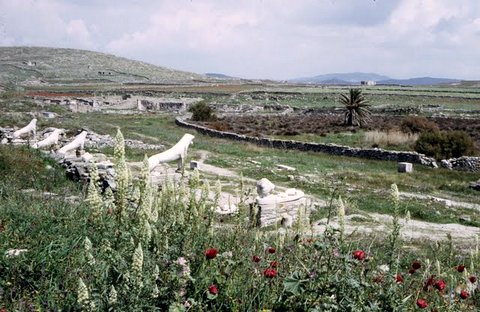
Although the religious rituals and local traditions practiced during Easter Week on Mykonos are something special to behold, I also covered that in the same post a few years back, and so I thought I’d share with you this Springtime pictorial view of Mykonos and its neighboring island of Delos.  The photographs are from the files of the master collector of all things visual Mykonian, Dimitris Koutsoukas.  Enjoy.

The harbor and windmills.


The Countryside.


Delos.


Kalo paska.

Jeff—Saturday