Showing posts with label flowers. Show all posts

Sunday, July 17, 2022

Becoming One With the Garden at Teamlab Planets Tokyo

 -- Susan, every other Sunday

To say I'm a fan of Teamlab art installations and exhibitions is a massive understatement. I've visited both the Borderless and Planets sites in Tokyo multiple times, and have plans to see some of the installations outside Tokyo later in the year. (Sadly, Borderless is closing on August 31, but fortunately Planets has been extended until the end of 2023.)

Teamlab installations are interactive, ever-changing, and expanding the boundaries of digital art in  amazing ways.

As it happens, though, my favorite Teamlab exhibition piece isn't digital at all.

The Teamlab Planets exhibition contains a "garden space" that includes an exhibit called "Floating Flower Garden: The Flowers and I Are of the Same Root, the Flowers and I Are One."

Visitors to the space pass through an entry entirely hung with blackout drapes. The sign below hangs on the one illuminated wall:

The sign at the entrance to the exhibit space

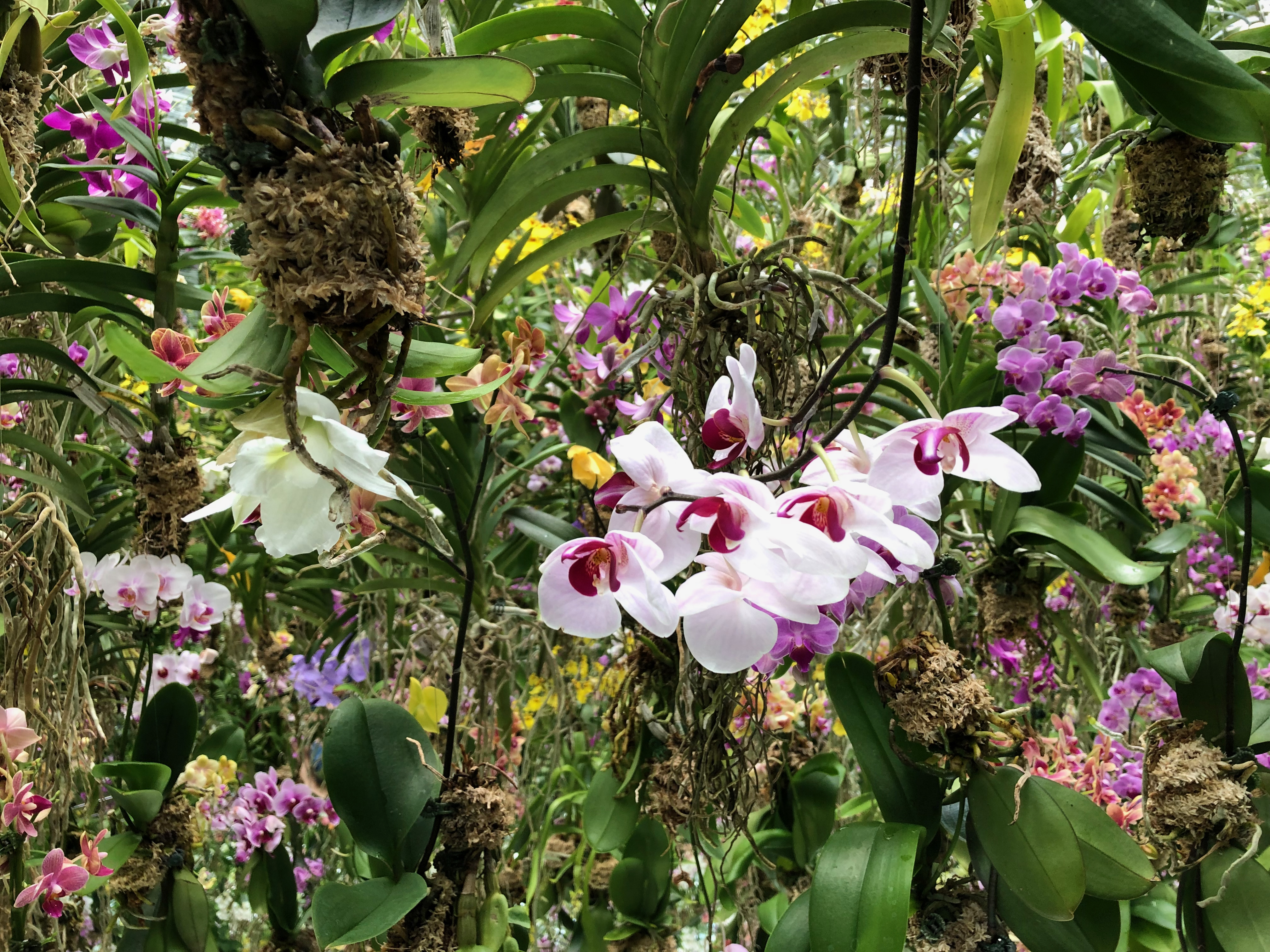
From there, visitors pass through yet another curtain into a mirrored room that opens onto a hanging garden filled with orchids, trained to grow in a bare-root environment, hanging upside down. Long ropes of orchids hang from special ropes that raise and lower independently, at random. 


Visitors waiting to become one with the garden.

As the flowers raise, visitors can walk beneath them and enter the exhibit space, which has mirrors on the floor and walls, creating the illusion that the people are entirely engulfed in flowering plants. (Signs ask people to be careful, and not touch the delicate plants, and I have never seen anyone disrespect that request.)

Can you see where the flowers end and the floor begins?

Every one of the thousands of orchids on display is in some stage of blooming. (More on that in a minute...)
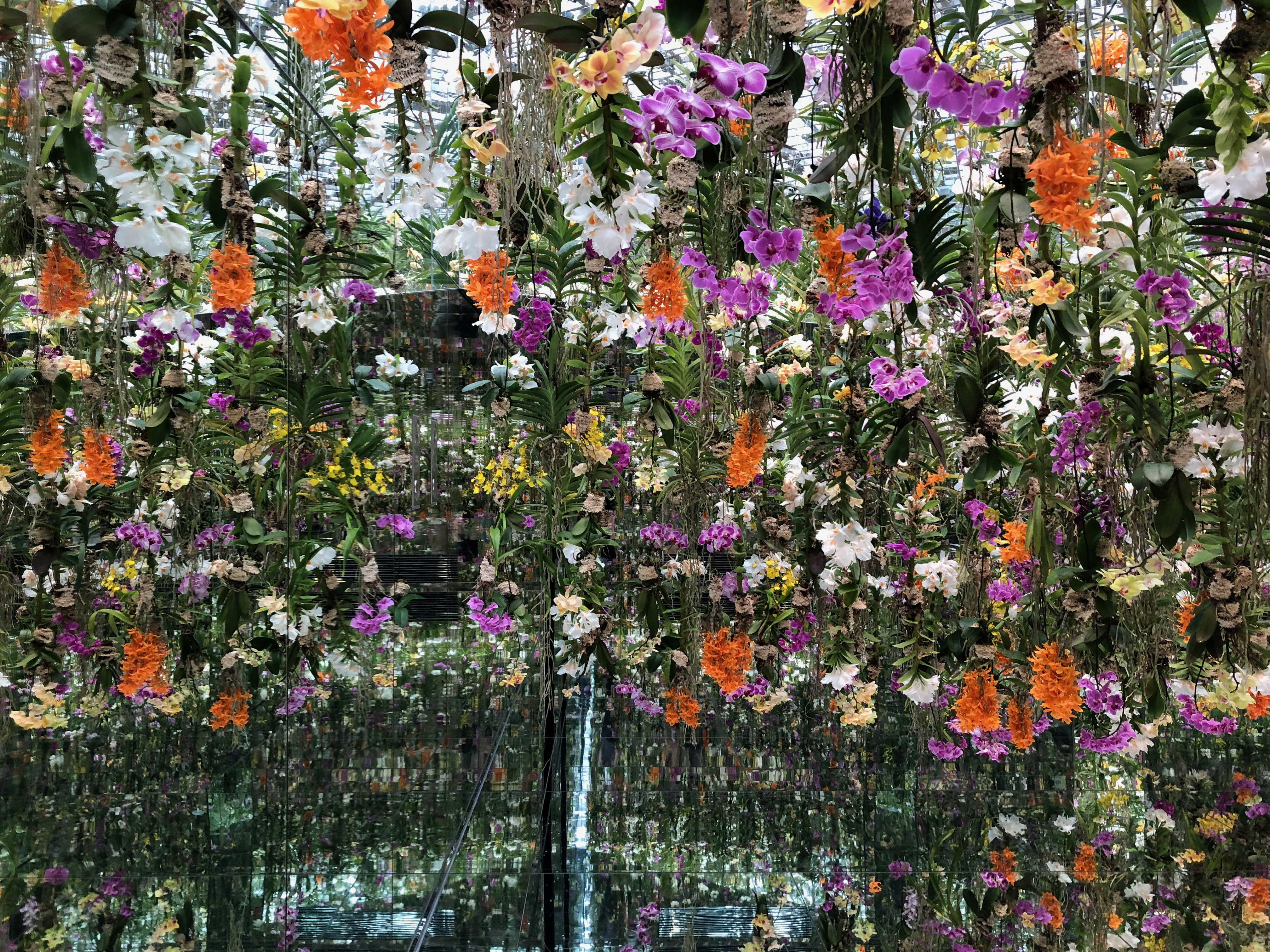

Orchids above, mirrors below. We are one with the garden.

The title of the piece references a Zen Koan (a question without an answer that forms part of Zen priests' theological training) known as "Nansen's Flower."

According to Zen tradition, when the monk Nansen was asked his thoughts on the famous saying, "Heaven and I share the same root. All things are of the same substance," Nansen gestured to a flower and said, "In these days, people see this flower as if they were in a dream."

Can you see the flowers looking back?

The creators of the installation hope that visitors will see the flowers as living things, and since orchids, in particular, evolved to thrive in places where no other flowers grow (as saprophytes, clinging to the trunks and branches of trees, because there were no niches left for them in the soil), the creators also want us to understand that "evolution selects for diversity" and to consider what that means--and should mean--for the way we view, and value, not only flowers but other humans too.

Take a minute with the photos that follow. Pictures are a dim reflection of the artwork's power, but hopefully it resonates with you too.


Some of you may be wondering what happens to the orchids when their blooming days are over. As it happens, the creators of the installation thought about that, too. The museum shop at Planets has a room filled with "retired" orchids that have finished their blooming cycle. There, visitors can choose and buy one of these former performance artists to take home, or for a little more, buy a canvas tote bag filled with a group of orchids that formerly lived in the exhibit space. If you buy the tote bag (which I did) you can take it back with you the next time you visit, and the staff will fill it up again, free of charge (assuming the shop has orchids on the day you go - which, in my case, they did).

My "home for retired performers" now has seven residents, three of which are blooming once again. Their presence livens up my home, but also reminds me to celebrate and appreciate the diversity around me--a piece of Planets' message that now lives in me as well.

Japan is beginning to reopen to tourism, and hopefully will be open entirely long before the doors to Planets close for good. If you happen to be in Tokyo, and have the time, I definitely recommend a visit.

If you go, please tell the flowers I said hi.


Saturday, April 19, 2014

Easter and Springtime Redux on Mykonos


Tomorrow is Greek Orthodox Easter. It's also Easter for Protestants and Catholics.  The Julian and more modern Gregorian calendar are in synch this year for Easter.  If you want to know precisely how the date is determined, check out this link to my post a couple of years back.  

In celebration of this coming together of the faiths I'm showing you what springtime looks like on Mykonos. If the photos look familiar, you're right; I've run them before, a couple years back at Easter time. Please accept my apology, but I'm too busy recovering from jet lag and greeting old friends to run new photos. Besides the flowers still look the same.:)


It’s sunny and into the 60's, praise be the Lord!   When I arrived four days ago, the old town was just coming out of hibernation, but now restaurants, bars, and shops are open everywhere, pumped up and ready for business. 

Nature, too, is in full bloom, giving the island a blanket of green covered in red, yellow and purple wildflowers.  But it will all be gone by the advent of tourist season.  It’s a picture of the island few tourists ever see.


Although the religious rituals and local traditions practiced during Easter Week on Mykonos are something special to behold, I also covered that in the same post a few years back, and so I thought I’d share with you this Springtime pictorial view of Mykonos and its neighboring island of Delos.  The photographs are from the files of the master collector of all things visual Mykonian, Dimitris Koutsoukas.  Enjoy.

The harbor and windmills.


The Countryside.


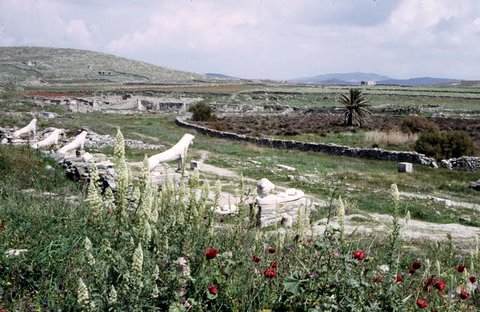
Delos.


Kalo paska.

Jeff—Saturday

Saturday, April 14, 2012

Eastertime on Mykonos Passes Over into Spring


Tomorrow is Greek Orthodox Easter. If you remember what I wrote a year ago (don’t worry, there won’t be a quiz), the simple answer for the difference in the date used by Greeks and others of the Eastern Orthodox faith from that followed by Protestants and Catholics is that the former calculate their Easter based upon the Julian calendar while the latter use the modern Gregorian calendar.  If you want to know precisely how the date is determined, check out this link to my post last year around this time.  Things are confusing enough these days without my adding to them.

It’s still wintry here on Mykonos, which means rain at times and temperatures dipping into the 40’s at night. But we’re starting to have far more sunny days than not, with a few creeping into the 70’s.  A taste of what’s soon to come, no doubt.   When I arrived ten days ago, the old town was still in hibernation, with only a few open bars and restaurants catering to locals and early bird tourists. But by Thursday of Easter week restaurants, bars, and shops were popping open everywhere, pumped up and ready for business.

Nature, too, is in full bloom, giving the island a blanket of green covered in red, yellow and purple wildflowers.  But it will all be gone by the advent of tourist season.  It’s a picture of the island few tourists ever see.

Although the religious rituals and local traditions practiced during Easter Week on Mykonos are something special to behold, I also covered that in the same post last year, and so I thought I’d share with you this Springtime pictorial view of Mykonos and its neighboring island of Delos.  The photographs are from the files of the master collector of all things visual Mykonian, Dimitris Koutsoukas.  Enjoy.

The harbor and windmills.

The Countryside.


Delos.

Kalo paska.

Jeff—Saturday