There's a item in the newspapers and social media today about some Christmas Hallmark Netflix hit, something about Brooke Shields buying a castle in Scotland and the locals walking around saying very un Scottish things. This has led to the usual professional ranters on Facebook saying it's racist and condescending. Like we should expect Hallmark Christmas programmes to be documentaries. Do they eat that many gingerbread men in Maine? I have no idea.
So here are some sayings that were listed at Scottish, but I doubt they are. How many have made it across the Atlantic? And what's your version of the sentiment....
1) Your face is tripping you. You look somewhat unhappy.
2) I'll skelp your lug! You need a slap.
3) I'll give you something to greet about.
4) Ye cannae teach yer Granny tae suck eggs.
5) Gonne see a man about a dug. To be going about your business - or to the loo!
6) Do you think I button up the back? Think I'm daft?
7) Don't talk mince Don't talk rubbish. Val McDermid does a thing where she replaces one word in a book title with the word mince. Try it when not quite drunk. It's hysterical.
8) Where you born on a farm? Close the door.
9) It's like Blackpool Illuminations in here. Turn some lights off.
10) The big light . The in the middle of the room. It's a 'thing'. Oh to see that. I'd need to put the big light on. This seems to be a drama.
11) Running about like a blue a***d fly .....
12) Geein' me the boke .... to provoke a feeling of nausea
13) Heids up ma arse .. having so much to do, you meet yourself coming backwards
14) Yer bum’s oot the windae....... Your head is full of nonsense.....
15) Yer arse is parsley see above
16) They couldny run a bath a useless individual
17) And what did your last slave die of? Get somebody else to do it.
18) I'm no as green as I am cabbage lookin'
19) Gie it some welly .... put some effort into it
20) Look at the nick of ye! you are not looking your best at the moment
21) The sweat's running down the sheuch of my arse
22) Would you steal my grave as quick. When somebody sits in your seat the minute you stand up.
23) What's for ye’ll no go by ye
24) Is the budgiedeid? for some reason this means that your trousers are too short. Another one is 'Are you paying for your trousers by instalments?'
25) You're ripping ma knitting ..... when somebody is being a tad irritating
26) I'm up tae high doe .... stressed out your head.
27) Away an bile yer heid . Go away until you can talk sense.
Nelson Mandela and FW De Klerk at the Nobel awards
That may sound like a strange title for a blog, but Frederick Willem De Klerk did have a role to play in South Africa, and that role led him to a joint Nobel Peace Prize with Nelson Mandela. One might imagine that his death two weeks ago would create some reaction, but apart from a few rather formal obituaries, there has been very little attention. A few ripples amid the waves and nothing more. By contrast, there was an outpouring of emotion that was almost universally shared by everyone in the country when Mandela died.
De Klerk was elected to the white parliament in 1972. He quickly rose in the National Party hierarchy, becoming a minister. He was never regarded as a progressive. In his portfolios under President PW Botha, he made some minor concessions, but was staunchly supportive of the apartheid system and the nationalism of the Afrikaner people.
The Rubicon speech and the PW Botha finger...
In 1985, PW Botha delivered his so-called Rubicon speech. It was widely expected that he would begin the phasing out of apartheid and make a variety of concessions including releasing Nelson Mandela from his Robben Island prison. I remember being on a road trip and stopping my car near a town so that I could listen to the speech as it happened. In fact, if Botha was crossing the Rubicon, the one in South Africa must have been a very small stream. He put forward a complicated (and ultimately pointless) tricameral system aimed at co-opting people of Indian and mixed descent into the existing system. He was adamant that the way forward for black African peoples was through the independent "homelands" with their collection of scattered land masses. There's a story that, in fact, a much broader and wider ranging proposal had been drafted by the cabinet, but it was Botha himself who refused to accept what he saw as "a capitulation to terrorists". I resumed my trip bitterly disappointed.
In fact, Botha was already ailing, and within a few years he gave up the leadership of the National Party and later of the government.
All the time, De Klerk had been building a political base, waiting for his moment. Pragmatism was what he was about. He'd had a number of contacts with overseas leaders, and realized that financial sanctions were starting to bite deep. As time went on, and South Africa became more and more isolated, he began to accept that major compromises would be required if the country was not to find itself in an ever escalating bush war that was ultimately unwinnable. No doubt he'd also been bitterly disappointed with the width of the Rubicon.
Archbishop Desmond Tutu
De Klerk's own Rubicon came in 1990 when he publicly abandoned apartheid and put forward a vision of South Africa as a Western-style democracy, with a market oriented economy. Political parties previously banned would be accepted and political prisoners, including Nelson Mandela, would be freed. This time the reaction was one of amazement, locally and abroad. Archbishop Desmond Tutu, a respected church leader and anti-apartheid activist, said, "It's incredible. Give him credit. Give him credit, I do."
The rest of De Klerk's presidency was devoted to negotiations that eventually led to the first universal elections. The National Party had always claimed that the majority of black people supported their government. Maybe they believed their own propaganda and really thought they would be reelected. It didn't happen. Th ANC won 62% of the vote and the National Party 20%. Mandela put together a government of national unity with De Klerk as deputy president. That was his last public office.
Mandela's first cabinet
In 1993 he made a speech in which he apologized for the effects of apartheid, saying,"It was not our intention to deprive people of their rights and to cause misery, but eventually apartheid led to just that. Insofar as to what occurred we deeply regret it... Yes we are sorry". It seems hard to believe that with everything that had happened, this was truly "not our intention".
De Klerk played a key role in negotiating a transfer to true democracy and majority rule. He was the right man at the right time - a pragmatist who met a visionary leader and worked with him. Perhaps he deserved his share of the Peace Prize - it's been awarded to recipients who have done much less.
The final words of the last apartheid president came in the form of a video released after his death. In it he apologized "without qualification" for the harm caused by apartheid and exhorted the country to protect its constitution and democracy and to try to work together. Perhaps, in the end, there was a touch of personal regret.
Clearly, governments and corporations absolutely must do the heavy lifting to save us all from this threat. We must pressure them to do so, in every way we can.
On the other hand, there are billions of human beings on this planet, and by collectively putting in some effort, we can certainly help. Besides, by pitching in – changing our habits and the way we live in our homes—we will energize ourselves to fight the good fight politically.
Photo: Reuters
Let’s begin with the art of the doable. Here are some simple, easy ways we can reduce our individual carbon footprints:
We can switch our thinking about what feels comfortable for the season. I have been fuming about this for years. In my country, where the populous's fossil fuel consumption is 4-times the world average, people typically heat their homes to 74F (23C) in winter and cool them to 68F (20C) in summer. This is the opposite of sense both economically and environmentally. For heating, a one-degree temperature reduction means a 6% drop in energy consumed. Since 68° feels comfortable in summer, why not set your thermostat to 68 in the winter. You will reduce your environmental impact of heating your home by 48%. I think my math is right, so why not be sensible. If you feel a little chilly, there is that marvelous invention—the sweater. I know. It’s low-tech. But also nice and cozy.
In summer, given the fact that AC eats up even more power than heat, a 74°-degree indoor temp will really reduce your carbon footprint.
Our sacred planet comes with the wonderful convenience of evaporation. This means we never have to expend energy to dry things. Left to themselves, wet socks will become dry socks. And, mirabile dictu, wet dishes will become dry dishes. Marvelous, ain’t it? And, when it comes to clothing, cold-water washing will almost always do. Run the washing machine on the cold cycle. Then put your clothing on a rack to dry. This is not merely an environmentally friendly way to clean your clothes. These measures will also make them last longer, eliminating the environmental costs of producing and transporting replacements.
Run the washing machine when you have a full load. Do the same with the dishwasher, if you have such a blessing in your life. Put it in energy-saving mode. You don’t need to consume fossil fuels to dry your forks and spoons. When the wash and rinse cycle is over, all you have to do is open the door a crack and let the stuff sit there for a while. E’ voila’—dry dishes!
Food is a huge issue when it comes to environmental impact. By now you have heard that a plant-based diet is the most environmentally friendly. As woman passionately concerned with this issue, I have the terrible challenge of also having more than a score of allergies and sensitivities to plant-based foods. The best I can do is to eat meat, poultry, and fish in smaller amounts.
BUT there are lots of other things to work on when it comes to food. Most important is to buy locally. Dragging lettuce from Arizona to the Northeast or flying fresh asparagus from Chile to Chicago in January is environmentally nuts. We Americans do far too much of this. Also, by actual tonnage, in the US 40% of food is wasted. This means also wasting all the energy it took to grow it, transport it, all the related packaging floating around in the oceans. On top of that, wasted food puts carbon back into the atmosphere as it rots in landfills. YUCK! So, buy as much as you will actually consume and shop more often, so that less of what you tote home will go off and have to go into the trash.
LOCAL! AND NO PLASTIC
Also, be sensitive to the packaging your food comes in. No matter how carefully you separate your trash, only 5-10% of plastic is actually recycled. A loose head of local lettuce is a great deal more environmentally friendly than one in a plastic box that crossed a continent to get to you. Yes, you’ll have to wash it yourself. Swallow your pride and, if you are in a drought area, use the drained H2O to water your petunias.
Buying local will help, no matter what you are buying. Need a screwdriver or want to buy a book? You can go online and order it, or you can go to a local store and find it waiting for you. This transaction has far less environmental impact, saving costs of individual transportation and packaging.
Doing research for this post, I have caught myself in waste I had not thought of. From now on, I will shut down my computer when I am going to be away from it for hours. Even when it is snoozing, it is—in a manner of speaking—eating up fossil fuel.
From tonight on: Good night, room. Good night, iMac and the man in the moon.
Omotenashi lies at the core of Japanese culture. Although the word is usually translated into English as "hospitality," like many Japanese words, the true meaning is much deeper and more complex. It involves anticipating a guest's every need (or in some cases, desire) and meeting it at precisely the moment the need would arise--and, equally importantly, to do so expecting nothing in return.
The concept is often linked to the origins and development of the tea ceremony, in part because of the great lengths tea masters went (and go, to this day) to make the experience a perfect moment in time for attending guests.
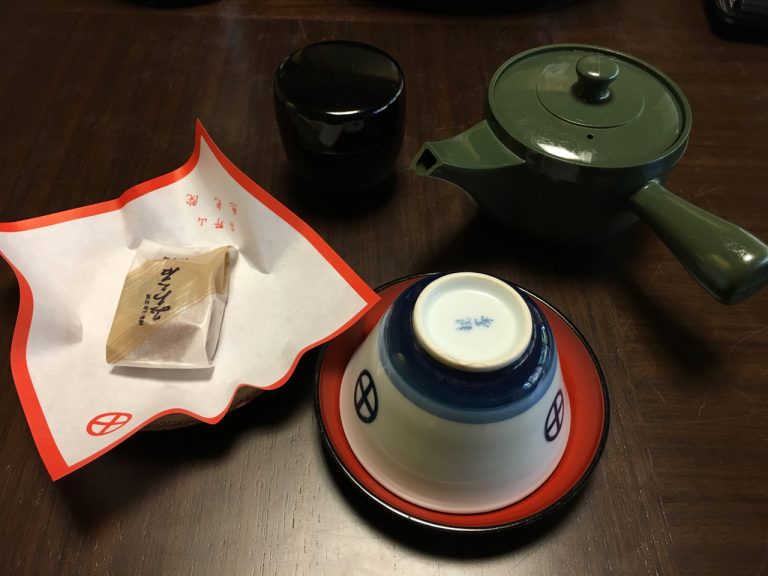
One place omotenashi is almost always seen in modern Japan is the "welcome tea" provided to guests upon check-in at a Japanese ryokan (traditional inn) or shukubo (temple lodging).
Tea and a traditional Manju (steamed bun filled with bean paste)
Tea is customarily served in the guest room--again, by tradition, since guests arriving at a ryokan typically would have been traveling all day, or at least for several hours, and would want to rest and refresh themselves upon arrival.
Welcome tea at Nishimuraya Honkan, a ryokan in Kinosaki Onsen
Welcome tea is also usually accompanied by a small, sweet treat--usually a local specialty of the region. In Hiroshima Prefecture, you might receive momiji manju--a sweet cake, similar to a pancake, shaped like a maple leaf and filled with sweet bean paste. In Kyoto, it could be crispy, cinnamon Yatsuhashi cookies. Regardless of region, the treat is usually small--a bite or two at most--and something that complements the delicate taste of the local tea.
Welcome tea at a temple on the 88-temple pilgrimage in Shikoku
As you can see in the picture above, and others throughout the post, the tea is usually "DIY"--a thermos or pot of hot water is set in the room (or brought within minutes of your arrival), along with a canister of loose leaf tea (or, sometimes, tea bags) and a cup, so the guest can prepare a fresh, hot cup of tea.
Welcome tea at Sanraku-so, a shukubo in Tottori Prefecture
Welcome tea waiting after a long day's hike on the Nakasendo
Modern ryokan (especially the high end ones) occasionally riff on the welcome theme, especially in the heat and humidity of summer. For example, Kai resorts offer "welcome kakigori" (Japanese shaved ice) with local toppings. You can have tea too...either hot or iced.
Strawberry-matcha (green tea) "welcome kakigori" at Kai Nikko
Since kakigori doesn't travel well, the Kai resorts serve the summer treat in the lobby lounges rather than the guest rooms.
Mixed Berry Kakigori at Kai Kinugawa, Kinugawa Onsen
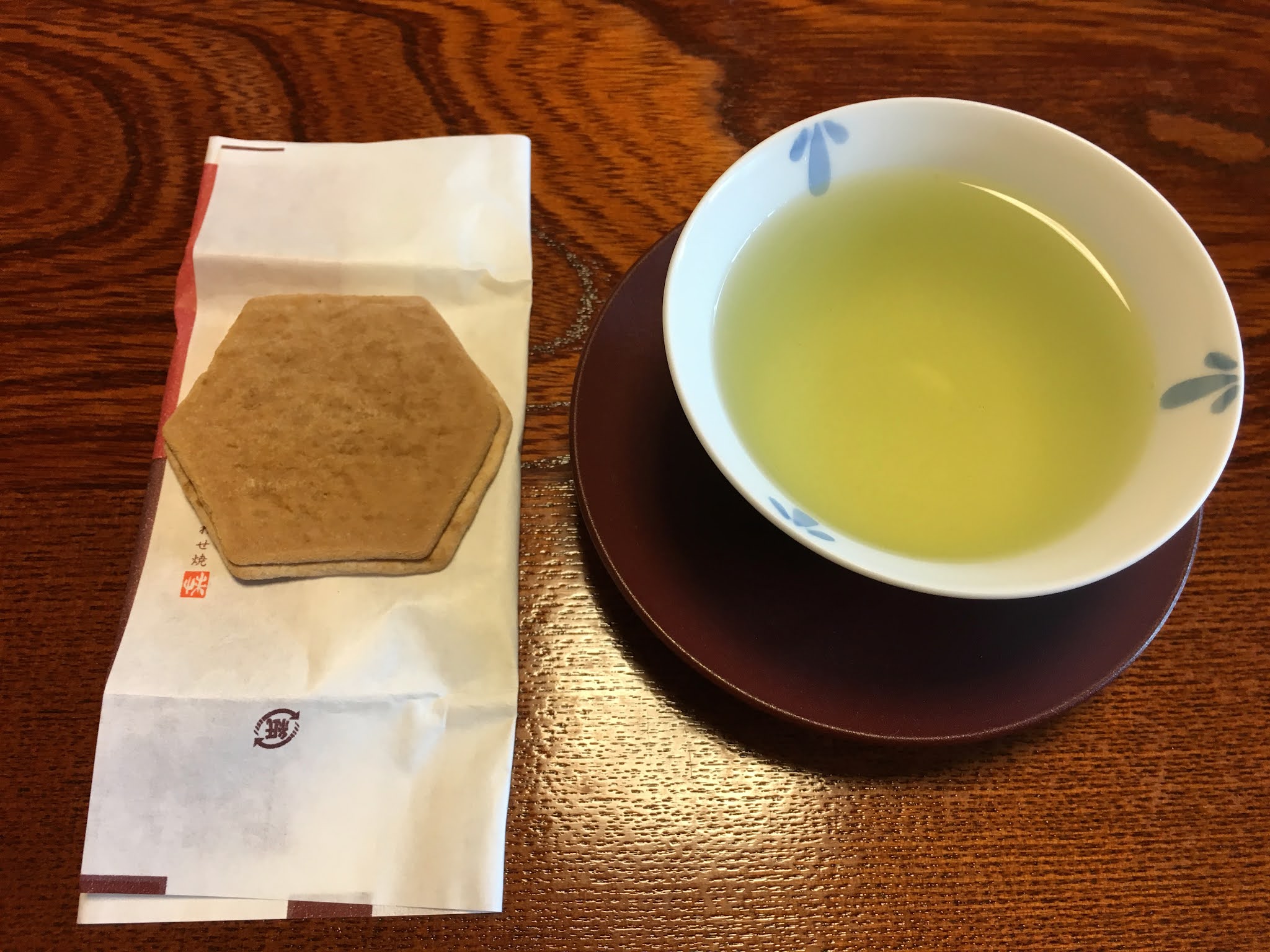
That said, the vast majority of ryokan still stick with the basics: a local sweet and a cup of hot green tea in summer, and a sweet and a cup of hojicha (roasted green tea) in the winter months.
Green tea and a local cookie - the original, and still the best.
While some ryokan buy mass-produced sweets, many still acquire their welcome treats from local purveyors of wagashi--traditional Japanese sweets.
Green tea and bean paste-filled crispy monaka in Yuasa, Wakayama Prefecture
Whether or not I've spent the day traveling by foot over mountain roads (which actually does happen to be my state when checking into a ryokan about 25% of the time) a cookie and a cup of tea is always a delightful check-in treat.
Pear Gaufrette and sencha at Sanraku-so in Tottori Prefecture
All too often, the modern world pushes us to move faster, sleep less, and endure more stress. We're frequently overworked, under-rested, and less relaxed than is good for us. All of which tends to make the sight of a low wooden table bearing a welcome tea and cake--and the implied invitation to set down your cares and sit for a moment, sip your tea, and breathe--an exceptionally welcome sight indeed.
Please excuse me for this stream of consciousness blog, but I’m
trying to write in a hurry so that I can run off to a private club in Reykjavic
where scores of authors and friends, who made this week’s pilgrimage to participate
in the ICELAND NOIR FESTIVAL, plan to hook up until the wee hours.
Moi, Stan, Yrsa, Barbara
Anyone who’s ever attended a writer’s conference understands the urgency
calling out to Barbara and me to make that appointment.
This evening’s final panel session ended in a one hour presentation
of anecdotes and good humor by the festival’s quartet of hosts, Yrsa
Sigurdardottir, Oskar Gudmundsson,Ragnar Jonasson, and Eva Bjorg Aegisdottir.
Eva, Oskar, Yrsa, Ragnar
Over the course of that session, I learned several interesting things.Such as, a statue to “The Unnamed Bureaucrat”
stands outside Reykjavik’s town offices, and the town hosts a museum dedicated
to penises (yes, you read that correctly). But wait, there’s more.Within that museum stand “empty” display cases
holding “fairy penises.”Fairies are sacred
in Iceland, and one is said to need a sixth sense to see them—which might explain
why the cases appear empty.
In a display of MIE team spirit, I’ve decided to leave those two topics
for Stan (who’s also here) to elaborate upon in his next blog, as it is Stan
who brought them to my attention. I’m assuming he’s better equipped than I to
handle inquiries on those topics.
All I can say is, I LOVE ICELAND NOIR.It’s unique in the world of book festivals because
there is only one track of panels (allowing all to see every panel), AND there
is not a book for sale in sight!Iceland
Noir is not about selling books, it’s about hanging out with your mates in a
family reunion sort of affair.
This year featured relaxed chit-chat interviews with writers such
as Sara Blædel, Ann Cleeves, AJ Finn, Anthony Horowitz, Shari Lapena, and Ian
Rankin by the likes of Iceland’s Prime Minister and Iceland’s First Lady, among
others.
Anthony Horowitz and Iceland's First Lady
Ian Rankin and Iceland's Prime Minister
For most of us, this is our first appearance before a live audience
in close to two years, and it falls in the midst of a Covid surge across
Europe.
To borrow from Caro’s Friday blog on her recent experience at a live
author event, “It was rather nerve wracking being
in front of an audience again. Quite a few authors have doubts as to recalling
the anecdotes, not being able to answer the question or simply, not remembering
what the book was about.”
Yet, Iceland Noir reaffirms why we do what we do, how we share
the same sort of introspective moments, and that there exists among crime writers
a camaraderie unmatched in the writing world.
It was Scottish book week this week, the authors were out and about. Nothing odd about that, but these were the first events for some of us for 18 months or so, in some cases it had been over two years since we had performed in public.
Nobody really knows why the powers that be have the book week so late in the year as the weather is terrible, it deters all but the most determined fans from attending.
and then the ferries go off at the last minute.
This is the way Douglas and I looked at the start of lockdown.
(I do write fiction!)
Below is how we look now.
This was us at the event in Paisley library.
The real library is a huge sandstone building, with mezzanine walkways and books everywhere. It's being refurbed at the moment, and has been for 4 years or so. This is a portacabin in the carpark swimming pool. No, I mean the swimming pool car park.
It didn't take long for us to reach for a drink. Due to covid, the audience were not allowed a refreshment.
It was rather nerve wracking being in front of an audience again. Quite a few authors have doubts as to recalling the anecdotes, not being able to answer the question or simply, not remembering what the book was about.
The audience had to be socially distanced, the windows had to be open ( it was bitter cold).
It made for an odd atmosphere.
While they were fiddling with the mics, I audience if they were confident again in coming out, they all nodded.
But the limit was 30, so those not confident were not there!
The next night I was hosting a launch in the function suite of a pub.
The launch was about the book Retribution Road and we were also raising money for the Firefighters Charity.
Having a laugh in the corner before the event kicked off.
Private function so no social distancing, no masks, lots of drink, windows closed.
Most Scots are now on their booster ( 3rd Covid jab, plus a flu jab if you want it)
If a member of the audience guessed correctly how many sweary words were in the book ( 93 000 words) they could win a bottle of Monopole and ten tunnocks caramel wafers. Not camel wafers, as a vegetarian, I could not condone such a thing and the audience got the hump.
The event quickly got underway.
I read out some of the great reviews John had received for his book.
Not all of them were written by his mother...
For my event I was talking about this book. Well I was supposed to be talking about this book. I have now written six books since that one - couldn't recall a thing about it.
'What was the inspiration for this book?'
No idea!
The book in my mind is the one on the computer at the moment - deadline is a week today.
In quiet moments, my mind flips to the next book WT 'The Girl Who Wasn't There', in the way that what happens in this book will have repercussions in the next one.
I heard two intellectual people talking at the launch about a book that had seven years to write and they were surprised, with the depth of the book that it hadn't taken longer.
MMMmmmmm.
The number of sweary words was 88 by the way! Most of them began with an f!
I could quite easily have titled this blog About time since it would have applied to both stories in the news that have caught my attention.
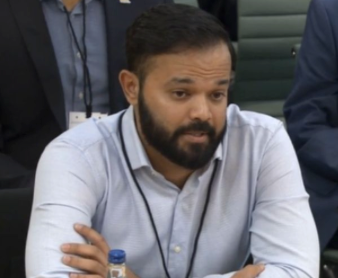
I am not surprised that English cricket is reeling from a series of allegations of racism by well-known cricketer, Azeem Rafiq. It has been a long time coming.
Azeem Rafiq
Azeem Rafiq bowling
Basically Rafiq played for one of the most influential cricket clubs in the U.K., namely Yorkshire. For a number of years, he bore the brunt of racist jokes and attitudes.
In a hearing currently being held on Tuesday by parliament's Digital, Culture, Media and Sport (DCMS) Select Committee, he was asked why he didn't do something about it. I found his answer telling: "For people of colour, to start accepting you're being treated differently, it's very difficult. After that, you're always asking why. Right up to 2017, I didn't believe it. I reported it as bullying. For me to believe I was being treated this way because of my colour, my race, it was difficult for me to digest."
He eventually realised that he needed to do something about it and tried to raise the issues with the club. Nothing was done. Even when a lot of pressure was brought on the club to censure some of its management, nothing was done.
It was then that Rafiq decided he had to pursue the matter further.
Rafiq's evidence to the DCMS Select Committee on Tuesday recounted shocking instances of racist treatment he suffered during two stints at the club from 2008-14 and 2016-18, and even before when, as a 15-year-old Muslim playing local club cricket, he was pinned down and had red wine poured down his throat. Rafiq, who was a hugely promising player, also told the hearing that he believed he had "lost my career to racism".
Cindy Butts, chair of the England and Wales Cricket Board (ECB)-appointed Independent Commission for Equity in Cricket (ICEC), which was established as a result of Rafiq's case, told The Telegraph that more than 1,000 whistleblowers had come forward in the past week to raise potential cases of abuse after the commission issued a "call for evidence" on November 9.
"It is crucial people across the game, many likely inspired by Azeem's bravery, have the chance to be heard," Butts said.
Rafiq's response echoed my own feelings: "The experiences yesterday, it wasn't the first time they heard it," Rafiq said of the ECB. "They've had good notice of it for over a year now. We've heard a lot of stuff from the ECB in terms of PR initiatives and a lot of waffle in my opinion."
I am not optimistic that the entrenched racism is likely to change after the storm has passed, but I can only admire Rafiq's courage in bringing it into the open.
***
On the other hand, I was surprised at an announcement out of Germany.
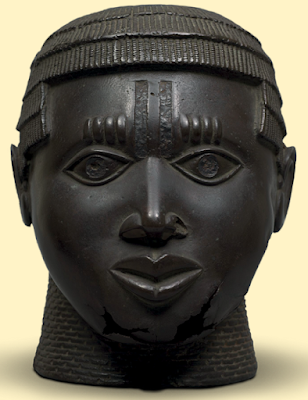
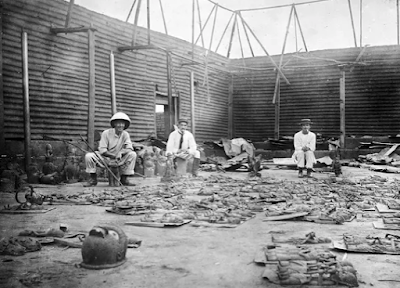
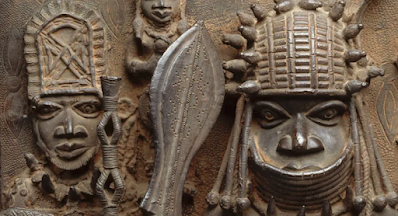
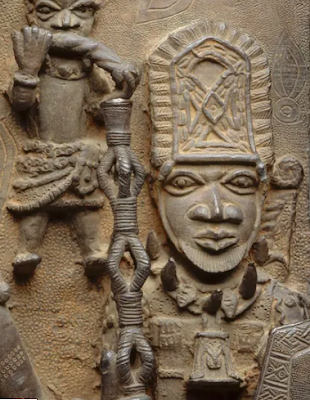
As readers of this blog may remember, I have written often about African (and other) art treasures that have been looted by colonial powers. I have advocated their return to where they were stolen from. However, most museums around the world have continued with their paternalistic, colonial attitudes, arguing that the art may be lost if returned, and so should remain in the West.
Looted
Looters
If it weren't so sad, this attitude would be laughable: that countries motivated by nothing but avarice can accuse countries that had looked after the treasures for hundreds, sometimes thousands, of years, are incapable of doing so again. A bit racist maybe?
However, I felt a glimmer of hope at an article in The Conversation, which claims that Germany has committed to returning hundreds of looted artefacts to Nigeria. There are probably thousands of such items in the country, but returning hundreds is a start. This follows a commitment by the French Parliament to return a couple of dozen of its tens of thousands of items.
And where will they be housed? you may ask.
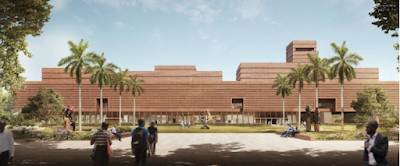
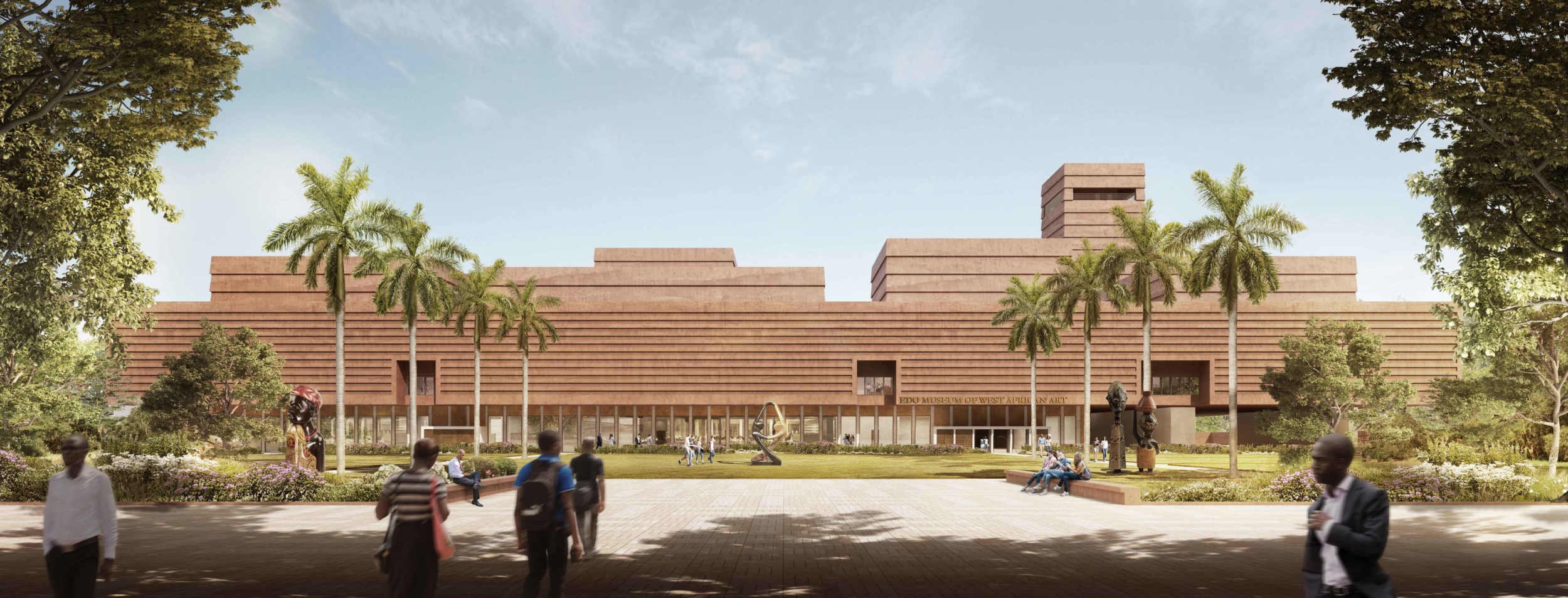
How about here! The Edo Museum of West African Art (EMOWAA), to be built in Benin City. It is being designed by Sir David Adjaye, designer of many spectacular buildings around the world, including the Smithsonian National Museum of African American History and Culture.
The proposed Edo Museum of West African Art
"From an initial glance at the preliminary design concept, one might believe this is a traditional museum but, really, what we are proposing is an undoing of the objectification that has happened in the West through full reconstruction." - David Adjaye
The Adjaye website, adjaye.com, explains the thinking behind the design:
The new EMOWAA draws inspiration from its historical architectural typologies and establishes its own courtyard in the form of a public garden, exhibiting a variety of indigenous flora and a canopy that offers shade – a welcoming green environmen for gatherings, ceremonies and events. The galleries float above the gardens and are articulated by a series of elevated volumes – an inversion of the courtyard typology – within each of which sit pavilions which take their form from fragments of reconstructed historic compounds. These fragments allow the objects themselves to be arranged in their pre-colonial context and offer visitors the opportunity to better understand the true significance of these artefacts within the traditions, political economy and rituals enshrined within the culture of Benin City.
A new dedicated space, EMOWAA will contain the rich, regal and sacred objects of Benin’s past, in a way that allows visitors not just the possibility of “looking in” but “looking out” into the visual landscape of imagining the once historic borders of a restored ancient kingdom.
I can't wait to visit it.
______________________
Upcoming event:
Iceland Noir
The Puffin Panel
Friday 1600 at Kjarval with Will Carver, Lilja Sigurðardóttir & Simone Buchholz, moderated by Karen Sullivan









 Posts
Posts





