Showing posts with label ryokan. Show all posts

Sunday, October 23, 2022

The Ultimate in Recycling--on Japan's Kumano Kodo Pilgrim Trail

 -- Susan, every other Sunday


Japan is big on recycling. From multiple bins and collection days (I have six bins in my kitchen, and take out various types of recycling three days a week) to recycling bins beside (almost) every vending machine,  for easy disposal of empty cans and bottles, it's a country that loves "reduce, reuse, recycle." 

But perhaps the most impressive example of recycling I've seen in Japan goes far beyond plastic and aluminum.

The village of Koguchi sits nestled in a narrow valley along the ancient Kumano Kodo Nakahechi, a pilgrim trail that winds through mountainous Wakayama Prefecture to the three Kumano Grand Shrines (Hongu, Shingu, and Hayatama Taisha).

It's difficult to photograph Koguchi from a distance, as the picture below demonstrates. The village sits between the Kogumotori-goe ("Small Cloud-Grasping Pass") and Ogumotori-goe ("Large Cloud-Grasping Pass") - two of the highest passes pilgrims encountered on the trail, and two of the last, for those who took the pilgrimage in a West-to-East direction.

I took the picture below standing atop the lower Kogumotori-goe, and the Ogumotori-goe passes over the mountains in the background. Koguchi lies far below the clouds, between them.

The Kumano Kodo, coming over Kogumotori-goe

For centuries, Koguchi (whose name translates "little mouth") was isolated by its mountain location, but also a vital link in the Kumano Kodo chain. The village inns hosted travelers, and its restaurants offered refreshment to hungry and thirsty pilgrims, who often stopped there for the night before attempting the trail's highest pass the following day. 

Entering Koguchi on the Kumano Kodo Nakahechi

The trail enters the village near the river that cuts Koguchi in two, and is home to the sweetfish that formed a primary part of the village's diet for centuries.

The bridge, entering Koguchi

Today, a bridge makes it easy to cross the river, but at the height of the pilgrimage's popularity during the 12th and 13th centuries, pilgrims had to cross the river on one of the flat-bottomed ferries operated by villagers.

The river runs lower than it used to, especially in winter.

On the far side of the river, and a small way up the road, stands the former Koguchi Middle School.

Formerly, Koguchi Middle School

Japan's declining population, combined with the tendency of young people to move to the cities in search of modern types of work, has sent many remote, traditional villages into decline. The smaller, aging population also meant that the middle school, once a necessity for the village children, closed from lack of need. (Today, the middle school children of Koguchi take the bus to schools in cities up to an hour away.)

However, instead of letting the school go derelict and decay, the residents of the village came together and came up with an intriguing plan: why not transform the school into a village-run ryokan (traditional Japanese inn) for modern travelers hiking the Kumano Kodo Nakahechi? 

Koguchi Shizen-no-Ie

The plan succeeded, and the former school--now a ryokan called Koguchi Shizen-no-Ie--allows hikers on the Kumano Kodo to stay on the actual trail, in the village where pilgrims have sheltered for centuries. Each of the former classrooms has been converted to a Japanese-style guest room, complete with tatami floors and seating area. 

A guest room at Shizen-no-Ie

Residents of the village man the front desk, cook and serve the evening and morning meals (which are delicious), and handle all of the other tasks that go along with running a ryokan.

Another guest room, where I stayed in 2020

The inn is small, with only 11 rooms (each of which can accommodate 1-4 guests, depending on the number in your party), and often fills up far in advance year-round. It employs the local residents, and continues the centuries-old tradition of Koguchi playing host to travelers on the Kumano Kodo.


A beautiful morning in Koguchi.

An excellent example of recycling, indeed.

Sunday, November 21, 2021

Welcome Tea and Cakes: Japan's Omotenashi Spirit

 -- Susan, every other Sunday


Omotenashi lies at the core of Japanese culture. Although the word is usually translated into English as "hospitality," like many Japanese words, the true meaning is much deeper and more complex. It involves anticipating a guest's every need (or in some cases, desire) and meeting it at precisely the moment the need would arise--and, equally importantly, to do so expecting nothing in return.

The concept is often linked to the origins and development of the tea ceremony, in part because of the great lengths tea masters went (and go, to this day) to make the experience a perfect moment in time for attending guests.

One place omotenashi is almost always seen in modern Japan is the "welcome tea" provided to guests upon check-in at a Japanese ryokan (traditional inn) or shukubo (temple lodging).

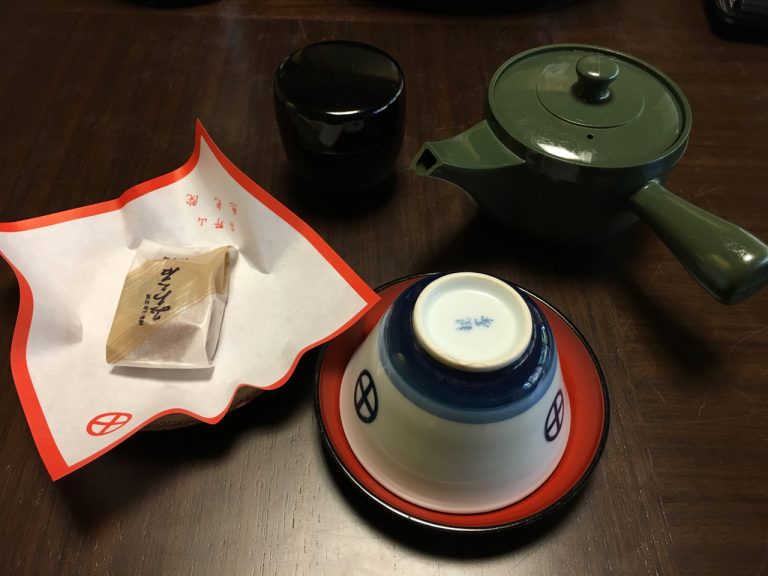
Tea and a traditional Manju (steamed bun filled with bean paste)

Tea is customarily served in the guest room--again, by tradition, since guests arriving at a ryokan typically would have been traveling all day, or at least for several hours, and would want to rest and refresh themselves upon arrival.

Welcome tea at Nishimuraya Honkan, a ryokan in Kinosaki Onsen

Welcome tea is also usually accompanied by a small, sweet treat--usually a local specialty of the region. In  Hiroshima Prefecture, you might receive momiji manju--a sweet cake, similar to a pancake, shaped like a maple leaf and filled with sweet bean paste. In Kyoto, it could be crispy, cinnamon Yatsuhashi cookies. Regardless of region, the treat is usually small--a bite or two at most--and something that complements the delicate taste of the local tea.


Welcome tea at a temple on the 88-temple pilgrimage in Shikoku


As you can see in the picture above, and others throughout the post, the tea is usually "DIY"--a thermos or pot of hot water is set in the room (or brought within minutes of your arrival), along with a canister of loose leaf tea (or, sometimes, tea bags) and a cup, so the guest can prepare a fresh, hot cup of tea.


Welcome tea at Sanraku-so, a shukubo in Tottori Prefecture


Welcome tea waiting after a long day's hike on the Nakasendo

Modern ryokan (especially the high end ones) occasionally riff on the welcome theme, especially in the heat and humidity of summer. For example, Kai resorts offer "welcome kakigori" (Japanese shaved ice) with local toppings. You can have tea too...either hot or iced.


Strawberry-matcha (green tea) "welcome kakigori" at Kai Nikko


Since kakigori doesn't travel well, the Kai resorts serve the summer treat in the lobby lounges rather than the guest rooms.

Mixed Berry Kakigori at Kai Kinugawa, Kinugawa Onsen

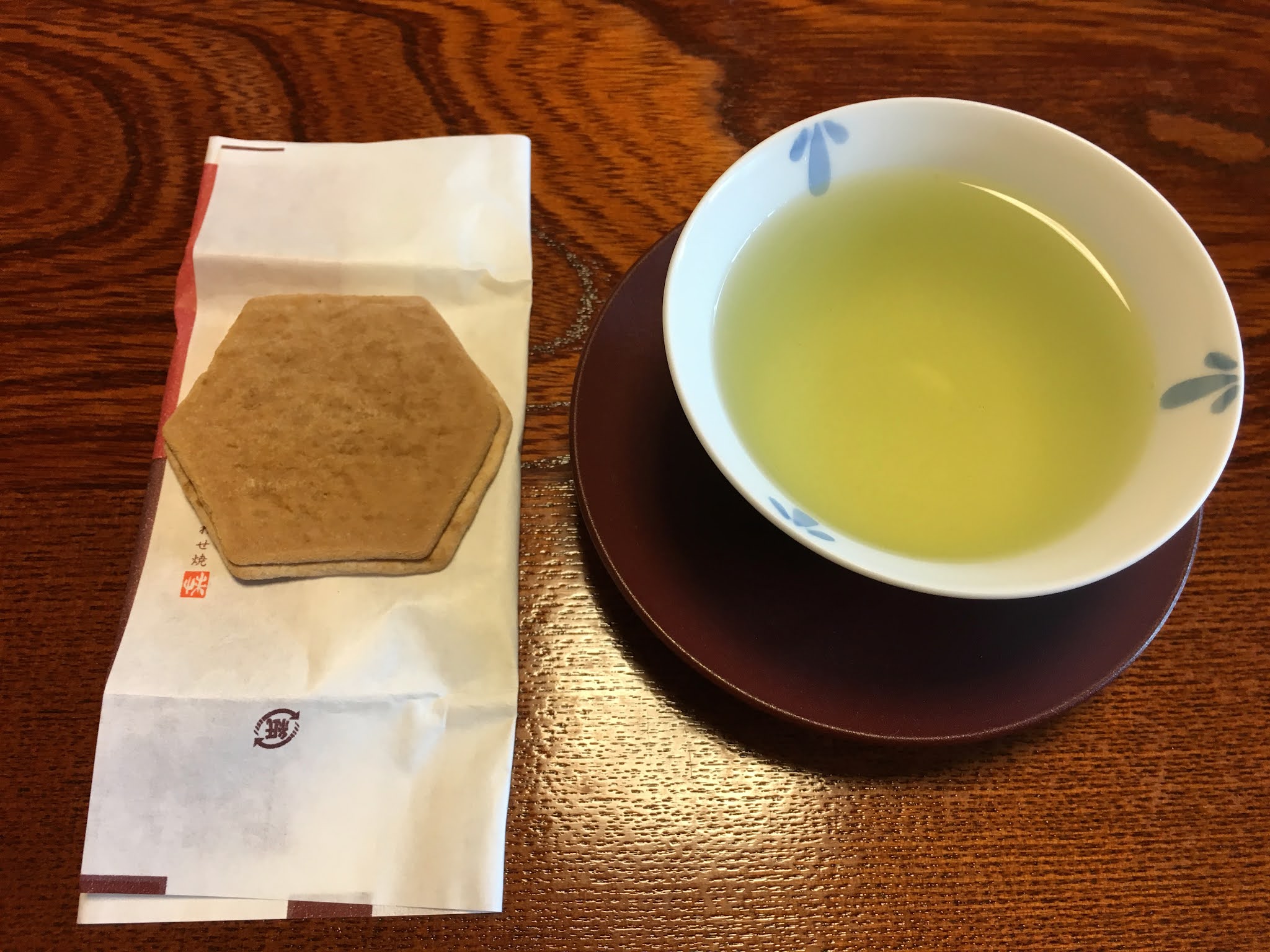
That said, the vast majority of ryokan still stick with the basics: a local sweet and a cup of hot green tea in summer, and a sweet and a cup of hojicha (roasted green tea) in the winter months.

Green tea and a local cookie - the original, and still the best.

While some ryokan buy mass-produced sweets, many still acquire their welcome treats from local purveyors of wagashi--traditional Japanese sweets.

Green tea and bean paste-filled crispy monaka in Yuasa, Wakayama Prefecture

Whether or not I've spent the day traveling by foot over mountain roads (which actually does happen to be my state when checking into a ryokan about 25% of the time) a cookie and a cup of tea is always a delightful check-in treat.


Pear Gaufrette and sencha at Sanraku-so in Tottori Prefecture

All too often, the modern world pushes us to move faster, sleep less, and endure more stress. We're frequently overworked, under-rested, and less relaxed than is good for us. All of which tends to make the sight of a low wooden table bearing a welcome tea and cake--and the implied invitation to set down your cares and sit for a moment, sip your tea, and breathe--an exceptionally welcome sight indeed.