Showing posts with label war. Show all posts

Saturday, March 1, 2025

I Asked This Question Three Years Ago: Is Our World at War?


Jeff–Saturday
  

Three years and two days after Russia INVADED Ukraine on February 24, 2022, I wrote the following introduction to a post titled, "Is Our World  at War?":


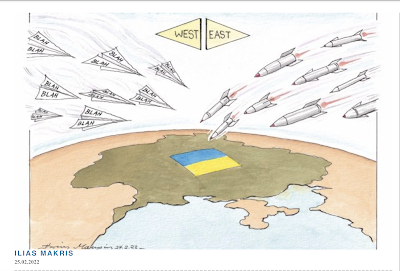
I think everyone would agree that the world is a very different place today than it was one  week day ago. 24/7 news coverage of Russia invading Ukraine [and live coverage of yesterday's White House confrontation] has driven that home to American audiences. But how do Europeans see the war?  For that I turned to Ekathimerini, the newspaper of record in Greece, and found three interesting stories directly bearing on the topic. The first is an opinion piece by Nikos Konstandaras, titled,“A Geopolitical Earthquake:” 


History’s tectonic plates are shifting. No one knows the magnitude, depth or duration of the earthquake caused by Russia’s invasion of Ukraine on Thursday. What is certain is that our world is changing. We will either see a strengthening of the system of global government and Russia’s retreat (and consequent loss of great power status), or we will enter an era of absolute fluidity and danger, with neither laws nor principles. February 24, 2022, did away with the illusion of a collective understanding, in which powerful countries maintained balance with each other, kept to certain rules, avoiding confrontation even when they disagreed over important issues. 


When a nuclear power and permanent member of the UN Security Council invades a neighbor, with arguments that are aimed more at convincing its own citizens than the international community, this is a direct threat to the global system of governance and to the principles of behavior that developed after World War II. The Russian president is fully aware that his actions can open the gates of hell, issuing a direct threat that “anyone who would consider interfering from the outside… will face consequences greater than any you have faced in history. All relevant decisions have been taken. I hope you hear me.” It is clear that, after this statement, there is no return to the world that we knew. Either the international community will get its act together and stop Vladimir Putin, or we will enter a period of instability and barbarism, where those who can will tread all over international law at the expense of the weak. The last time such circumstances prevailed, Europe was led to 1939.


The last decades do not inspire optimism. The United States often set a bad example with unilateral actions, autocratic regimes have taken hold in many countries, liberal democracy is under fire, the UN has been weakened. But disaster is not a given. Putin faces two insurmountable obstacles: His country, with a population of 144 million and GDP of 1.5 trillion dollars, is not as powerful as he considers himself to be; the only great power that could support him, China, has invested in stability and development. With the United States and the European Union putting on a united show, with China looking after its own interests, Putin – though always dangerous – will be on his own.


Picking up on that point is Stathis N. Kalyvas, Gladstone Professor of Government at the University of Oxford, with his observation on what Greece’s stance on the Ukrainian crisis should be:

Russian aggression is justified with geopolitical excuses: It feels surrounded after losing a large geographical zone over which it once held complete sway. Such analyses usually also contain some reference to the catastrophe that befell Russia with the collapse of communism and the trauma that caused.

But a closer look at the situation in Russia reveals that it is less at risk from being surrounded than it is from other factors: Its economy is overly reliant on energy (with the production of oil and natural gas accounting for some 40% of its economy), its demographics are nosediving (its population shrank by a million between 2020 and 2021 alone), and its young and educated people are migrating in droves. Politically, it is a combination of an old-school autocratic regime that openly stomps on individual freedoms and an oligarchic economic structure with all the traits of a mafia.


The real threat, therefore, lies within its own borders. Regardless of the mistakes made by the United States from 1990 onward, Russia could have chosen to take a different path, similar to that of the European countries that were once part of the Soviet bloc, just as Ukraine is trying to do.


So, the real issue is about politics and principles. On the one hand, we have an autocratic power that is employing methods harking back to Austria or Czechoslovakia in 1938 and behaving toward its neighbors like a colonialist. Vladimir Putin himself even wrote that the Russians and Ukrainians are one people, a position rejected by the vast majority of Ukrainians. On the other hand, we have a nation that is trying to get ahead and threatening nobody in the process, by adopting modern political and economic practices. The situation is crystal-clear and there should be no hesitation whatsoever about what stance Greeks must take.


In reporting on the Greek government’s position
, Ekathimerini wrote:

Greece’s Prime Minister Kyriakos Mitsotakis told an emergency summit of NATO countries on Friday that Revisionism is the main threat to world peace and should not be tolerated, no matter where it comes from. 


The Prime Minister stressed that Russia’s aggressive actions violate international law and are a blow to European and international security and stability.


He reiterated the Greek position on respect for the territorial integrity, sovereignty and independence of all countries, and condemned in the strongest possible terms the Russian revisionist actions that run counter to those values.


With so much of the sane world of the same mind…albeit each nation facing differing potential political and societal consequences, the question on everyone’s mind is simply this: NOW WHAT?


Two years have passed without my finding an answer to that question. Perhaps well have one by next week. But don't bet on it.


–Jeff

Tuesday, October 24, 2023

Writing Mysteries While Gaza Burns?

 Ovidia--every other Tuesday


The skies are peaceful here in Singapore right now, but we're well aware that's far from the case elsewhere in the world right now.

Singapore has committed to contributing over half a million dollars in humanitarian aid to Gaza, but that feels like so little. What else can we do? This island is about one-thirtieth the size of Israel, and if even world powers like America and the UN can't extract a fair agreement on sharing land, water and tolerating differences what can we, on the other side of the planet do?

What can anyone do?

I suspect that's what we're all trying to figure out--some of us by writing books and things like this. Writing murder mysteries while people are being massacred in their homes and hospitals might be today's version of fiddling while Rome burns. 

But let me point out that Nero was likely finger strumming (not bowing) an instrument closer to a ukulele or guitar than a fiddle. That makes no difference to the fate of Rome or of Nero--the image that's come down to us via writers like Suetonius, Shakespeare, Samuel Pepys and Samuel Johnson. So maybe writers can do some little good?

Trevanian's Shibumi,  no longer reads like a farcical take on the action-spy genre.


Trevanian (Rodney Whitaker, once a fierce supporter of Israel) said of Shibumi, thirty years after he wrote it: "Nicholas Hel... would have wished the current rational leaders of Palestine all good fortune in negotiating towards peace with justice",

But writers aren't always listened to: Robert Musil wrote of the "tortured relationship between writers and mass politics, literature and radicalized societies" as he watched the rise of Nazism:

[from : February 1933: The Winter of Literature by Uwe Wittstock, translated from the German by Daniel Bowles.]


“Life goes on”—even though, each day, hundreds are killed, imprisoned, beaten up, et cetera. This is not frivolity, but is rather to be compared to the helplessness of the herd that is slowly pressed forward while those at the very front go to their deaths. The herd sniffs the air, senses what is happening, becomes uneasy, but has no stored psychological response, has absolutely no defense against this situation,"

It feels like we in the global herds are sniffing now, uneasy over Putin's assault on Ukraine and Narendra Modi's approach (explicitly inspired by Nazism) to handling "enemies of the people" in India.

I don't know enough about any of this to say anything useful, but I'm trying to learn by reading Maria Stepanova's poetry in translation, following Galina Yuzefovich's English language podcast The Naked Pravda and Mikhail Shishkin's articles (especially on the 2022 invasion of Ukraine) and novels.

And there's Anuradha Roy's novels and articles--last year she said,  


"We are perpetually in turmoil—a state of debate, worry, anger, and confusion…. Formally there is no censorship of written work, but the atmosphere of constant anxiety within a whole community of reading and writing people, a sense of there being violence in the air we breathe, is equally undermining,"

With this overload of real life horrors, what are mystery writers to do? I think the only thing we can do is go on writing.

In the best mysteries (according to Dorothy L Sayers)  "you find a world of people having their roots in time and space and a life which extends beyond the limits of the immediate problem. Larger issues are at stake than the precise method by which the arsenic is administered"

We aren't writing (just) puzzles or thrillers or moralising tales with happy endings. 

Yes, we may be offering escapism and comfort reading but we're also giving readers a chance to try on possible reactions to the worst life throws at them--and hinting that they might rise to throw something back at life.

Like fables and fairy tales mystery stories tell of the possibility of justice and happy endings. 

And most important, though death is always lurking and people can be bloody horrible, mystery writers remind us that individuals matter. And that we are individual moral creatures who can make choices that can make a difference.


Saturday, February 26, 2022

Is Our World at War?


Jeff–Saturday


I think everyone would agree that the world is a very different place today than it was one week ago.  24/7 news coverage of Russia invading Ukraine has driven that home to American audiences. But how do Europeans see the war?  For that I turned to Ekathimerini, the newspaper of record in Greece, and found three interesting stories directly bearing on the topic. The first is an opinion piece by Nikos Konstandaras, titled,“A Geopolitical Earthquake:” 


History’s tectonic plates are shifting. No one knows the magnitude, depth or duration of the earthquake caused by Russia’s invasion of Ukraine on Thursday. What is certain is that our world is changing. We will either see a strengthening of the system of global government and Russia’s retreat (and consequent loss of great power status), or we will enter an era of absolute fluidity and danger, with neither laws nor principles. February 24, 2022, did away with the illusion of a collective understanding, in which powerful countries maintained balance with each other, kept to certain rules, avoiding confrontation even when they disagreed over important issues. 


When a nuclear power and permanent member of the UN Security Council invades a neighbor, with arguments that are aimed more at convincing its own citizens than the international community, this is a direct threat to the global system of governance and to the principles of behavior that developed after World War II. The Russian president is fully aware that his actions can open the gates of hell, issuing a direct threat that “anyone who would consider interfering from the outside… will face consequences greater than any you have faced in history. All relevant decisions have been taken. I hope you hear me.” It is clear that, after this statement, there is no return to the world that we knew. Either the international community will get its act together and stop Vladimir Putin, or we will enter a period of instability and barbarism, where those who can will tread all over international law at the expense of the weak. The last time such circumstances prevailed, Europe was led to 1939.


The last decades do not inspire optimism. The United States often set a bad example with unilateral actions, autocratic regimes have taken hold in many countries, liberal democracy is under fire, the UN has been weakened. But disaster is not a given. Putin faces two insurmountable obstacles: His country, with a population of 144 million and GDP of 1.5 trillion dollars, is not as powerful as he considers himself to be; the only great power that could support him, China, has invested in stability and development. With the United States and the European Union putting on a united show, with China looking after its own interests, Putin – though always dangerous – will be on his own.


Picking up on that point is Stathis N. Kalyvas, Gladstone Professor of Government at the University of Oxford, with his observation on what Greece’s stance on the Ukrainian crisis should be:


Russian aggression is justified with geopolitical excuses: It feels surrounded after losing a large geographical zone over which it once held complete sway. Such analyses usually also contain some reference to the catastrophe that befell Russia with the collapse of communism and the trauma that caused.


But a closer look at the situation in Russia reveals that it is less at risk from being surrounded than it is from other factors: Its economy is overly reliant on energy (with the production of oil and natural gas accounting for some 40% of its economy), its demographics are nosediving (its population shrank by a million between 2020 and 2021 alone), and its young and educated people are migrating in droves. Politically, it is a combination of an old-school autocratic regime that openly stomps on individual freedoms and an oligarchic economic structure with all the traits of a mafia.


The real threat, therefore, lies within its own borders. Regardless of the mistakes made by the United States from 1990 onward, Russia could have chosen to take a different path, similar to that of the European countries that were once part of the Soviet bloc, just as Ukraine is trying to do.


So, the real issue is about politics and principles. On the one hand, we have an autocratic power that is employing methods harking back to Austria or Czechoslovakia in 1938 and behaving toward its neighbors like a colonialist. Vladimir Putin himself even wrote that the Russians and Ukrainians are one people, a position rejected by the vast majority of Ukrainians. On the other hand, we have a nation that is trying to get ahead and threatening nobody in the process, by adopting modern political and economic practices. The situation is crystal-clear and there should be no hesitation whatsoever about what stance Greeks must take.


In reporting on the Greek government’s position
, Ekathimerini wrote:


Greece’s Prime Minister Kyriakos Mitsotakis told an emergency summit of NATO countries on Friday that Revisionism is the main threat to world peace and should not be tolerated, no matter where it comes from.


The Prime Minister stressed that Russia’s aggressive actions violate international law and are a blow to European and international security and stability.


He reiterated the Greek position on respect for the territorial integrity, sovereignty and independence of all countries, and condemned in the strongest possible terms the Russian revisionist actions that run counter to those values.


With so much of the sane world of the same mind…albeit each nation facing differing potential political and societal consequences, the question on everyone’s mind is simply this: NOW WHAT?


Perhaps I’ll have that answer for you next week.


–Jeff

Monday, May 3, 2021

At the going down of the sun and in the morning ...

Craig every second Tuesday.

Kia ora and gidday everyone.

So since my last post a fortnight ago a rather momentous day for Aussies and Kiwis passed on by. 

For more than a century the 25th of April has brought both antipodean nations to a pause, a special and sombre day where we remember the soldiers, sailors, and others who have served (and are still serving) our countries in wars and conflicts all over the world. Anzac Day, as that date is known in our part of the world, has been commemorated every year since 1916, the first anniversary of an ill-fated battle. 

Dawn over Anzac Cove on Turkey's Gallipoli peninsula

Ten years ago, I took the photo above. Like many young Aussies and Kiwis, I'd made the pilgrimage to Gallipoli, a rocky peninsula in Turkey, a place whose name alone resonates strongly with us from a young age, regardless of our family ties or otherwise to the military. Perhaps it's the equivalent of 'Pearl Harbour' for Americans, in that the name has so much more weight than just its geography.

106 years ago, on 25 April 1915, our two nations first fought side by side under the Australian and New Zealand Army Corps (ANZAC) banner – our soldiers landing together at dawn on a desolate beach on the Gallipoli peninsula in Turkey. The campaign and landing were a military bungle by the British commanders (including the First Lord of the Admiralty, a certain Winston Churchill) - but the attitudes, actions, and courage of the Australian and New Zealand soldiers both at Gallipoli and over the many battles and years since, stoked a burgeoning sense of independent identity and nationhood.

Anzac. It’s a powerful word for anyone from our end of the world. 

But despite attending many an Anzac Day parade in New Zealand as a youngster – feeling proud as we marched, paper poppies pinned to our Scout uniforms, alongside aging veterans weighed down with medals, and feeling my skin tingle as the notes of the Last Post rang out – I don’t think I truly grasped its significance until that freezing morning I experienced on the Gallipoli peninsula ten years ago. 

Thousands of young Kiwis and Aussies, buried 10,000 miles from home

Gallipoli. Another word drenched in meaning for antipodeans. The afternoon before we’d walked down a dusty road towards the site of the ceremony, past open fields and sheer cliff faces that few would want to scale in the best of conditions let alone when you were under heavy gunfire, past cemeteries where white stones marked where men from all parts of Australasia, every state, city, and town, lay side by side, forever. Looking back, I have to admit that before taking that walk Gallipoli was a name from a book, a place on a map, a word that carried weight because of what we’d read or watched on TV. 

Then,  it was real. It may sound kind of silly, I know, and for many people dirt is dirt is dirt, but I couldn’t help myself from placing a hand on the grass beside those graves (I wasn’t alone), and thinking that there was something special, something meaningful, about this particular strip of earth. I have family buried near European battlefields, but as far as I’m aware, none here. 

But I still felt something in the air at Gallipoli.

It was a surreal, special experience visiting that tiny part of Turkey, a nation overflowing with rich history (Greek, Roman, Biblical, Ottoman Empire, and more) far beyond its (relatively) modern meaning for Aussies and Kiwis. 

And I had a few realisations over the course of the 24 hours or so we spent exploring and camping out under the stars at Gallipoli. For the first three decades of my life I'd thought of Anzac Day as a sadly special day for two countries, my own and our closest neighbour.

The crowds huddling up for a long, cold night before the dawn service

It was their ages that particularly got me. We were huddled together, thousands of Kiwis and Aussies wrapped in blankets, beanies, jackets, thermals and sleeping bags to ward off the bone-chilling overnight temperatures of a spring morning at Anzac Cove. The sky hadn’t yet lightened, it was still the ‘wee small hours’ of 25 April, and the big screens had been showing the haunting images of a small selection of our forebears who’d lost their lives on this blustery peninsula almost a century ago. They were all so young, most in their teens or very early twenties. At the time I liked to consider myself still a young (ish) man, at 32, and yet only two of the many dozens of soldiers shown were my age or older. 

We often say we sent our men to war, all those years ago, but in truth we really sent our boys. 

And lost so very many of them.

More than 2,700 New Zealanders and 8,700 Australians died at Gallipoli. Many thousands of others were terribly injured. Young men and boys from across our nations. While the numbers are horrifying enough, time and distance perhaps underplays them. Despite being about as far away from the battlefronts of the First World War that you could get, and in no direct danger ourselves, New Zealand sent more than 42% of its men of military age overseas to fight alongside the UK and other allies. 

Anzac soldiers landing at Gallipoli were faced with steep terrain and deadly artillery
 
To put it in perspective, the losses at Gallipoli, given New Zealand's population at the time, are the equivalent of the United States losing just under 900,000 people in a single military campaign today.

It's hard to fathom. 

You can see why it was such a big deal for Australia and New Zealand, and why Anzac Day was commemorated since 1916 (the one year anniversary of the landing) even as the war raged on. 

But let’s not forget, around 20,000 Turks died on that peninsula too, defending their country against forces who were outside invaders. We may have been fighting for freedom, but so were they.

Ten years ago, as we were let in to find a patch on the grassy slope or a seat in the stands, and night began to fall, the reminders were all around of what we were really there for; to remember. 

Wreaths of remembrance at Gallipoli

The New Zealand, Australian, and Turkish flags flew high above us. Military personnel, New Zealand, Australian and Turkish, wandered the grounds. Informative films about the Anzacs and the Turks played on the big screens. Military bands entertained the crowds throughout the night (not everyone appreciated the New Zealand Air Force band launching into a stirring rendition of some old classics at 3am, but I enjoyed it). At midnight, messages were played from then Prime Ministers Julia Gillard (Australia) and John Key (New Zealand), and during the night we saw broadcasts from services already happening back home Downunder (it was strange being ‘behind’ timewise), and as the sky began to lighten everyone stirred themselves from drowsiness or sleep for the dawn service. 

It was a strange mix of emotions, being there at Gallipoli. You could see it on everyone’s faces.

There were few dry eyes as the words of the Anzac Dedication rang out:

“They shall grow not old, as we that are left grow old,
Age shall not weary them nor the years condemn.
At the going down of the sun and in the morning,
We will remember them.”

But the dawn service at North Beach wasn't the end of our Anzac Day experience in Turkey. Afterwards we wandered the beach, chatted to Turkish soldiers, and then began the hike up the steep trails and roads to the Australian service at Lone Pine and then further on up the road to the New Zealand service at Chunuk Bair. Turkish boy scouts handed out water bottles on the way up.

Compulsory 'flag at Anzac Cove' photo

It really was a surreal and special experience, celebrating Anzac Day in Turkey. 

And it opened up my eyes to the fact it is a very special day and remembrance not just for two countries. When you think about it, how many nations would warmly welcome the descendants of an invading force to come and commemorate the very men who killed so many of their own people? 

War is a horrible, horrible thing, for whatever reason it is fought. 

How many military commanders would years later, as President of their country, say words such as these about the men they fought against: 

"Heroes who shed their blood and lost their lives! You are now lying in the soil of a friendly country. Therefore rest in peace. There is no difference between the Johnnies and Mehmets to us where they lie side by side here in this country of ours. You, the mothers, who sent their sons from far away countries wipe away your tears; your sons are now lying in our bosom and are in peace. After having lost their lives on this land they have become our sons as well."
Mustafa Kemal Ataturk


I was amazed by what the Turkish people had done at Anzac Cove, not only opening their doors, but creating a memorial area for thousands of Kiwis and Aussies to gather every year (well, pre-pandemic). 

And I was left with the realisation that despite years of thinking of Anzac Day as something about Australia and New Zealand, that'd I'd been wrong. For me now, it isn't about two countries, but three. 


Until next time. Ka kite anō.


WhakataukÄ« of the fortnight: 
Inspired by Zoe and her 'word of the week', I'll be ending my fortnightly posts by sharing a whakataukī (Māori proverb), a pithy and poetic thought to mull on as we go through life.

Ko te manu e kai ana i te miro, nōna te ngahere. Ko te manu e kai ana i te mātauranga, nōnā te ao

(The bird who feeds on the miro berry has the forest. The bird who feeds on knowledge has the world.)

The native New Zealand kererÅ« (wood pigeon) is particularly fond of miro berries