Showing posts with label samurai. Show all posts

Sunday, March 27, 2022

How a Songbird Saved the Age of Samurai

 --Susan, Every Other Sunday

It's safe to say most people have heard of samurai--the highly skilled warriors who sat atop the social pyramid during Japan's medieval age--as well as the shōgun(s) who served as the de facto rulers of the country at that time.

Far less well-known is the fact that, but for a split-second decision by a single, otherwise unremarkable little bird, the Age of Samurai might not have come to pass.

In 1180, a long-standing feud between the noble Taira and Minamoto clans boiled over into war. Shortly after the war began, a  young nobleman named Minamoto no Yoritomo assumed leadership of the Minamoto forces and led them into battle in a mountainous region near the eastern coast of Japan, in what is now Shizuoka Prefecture. 

A path through the mountains not far from Ishibashiyama

The Taira launched a surprise attack on the Minamoto near Mt. Ishibashi (Ishibashiyama) at night, in heavy rain; the Minamoto forces were overwhelmed, and young Yoritomo was forced to flee with a small band of his surviving followers. They fled through the mountains toward the coast, hoping to escape by sea. 


Kannon statue along the route to Shitodo

The region into which they fled was controlled by a clan of noble warriors called the Doi; their leader, Doi Sanehira, had a castle on the summit of Shiroyama (Mt. Shiro) overlooking Sagami Bay (in what is now the city of Yugawara, in Shizuoka Prefecture, about 90 minutes south of Tokyo by train).

Minamoto Yoritomo and his followers hurried through the forested mountains, on narrow trails, with the Taira in hot pursuit.


One of the trails connecting Ishibashiyama and Shiroyama

At some point, the fugitives made contact with the Doi, and Sanehira agreed to shelter his young ally, Yoritomo--but not in the castle, which the Taira would have overwhelmed in a siege.  

Trail approaching the Shitodo cave

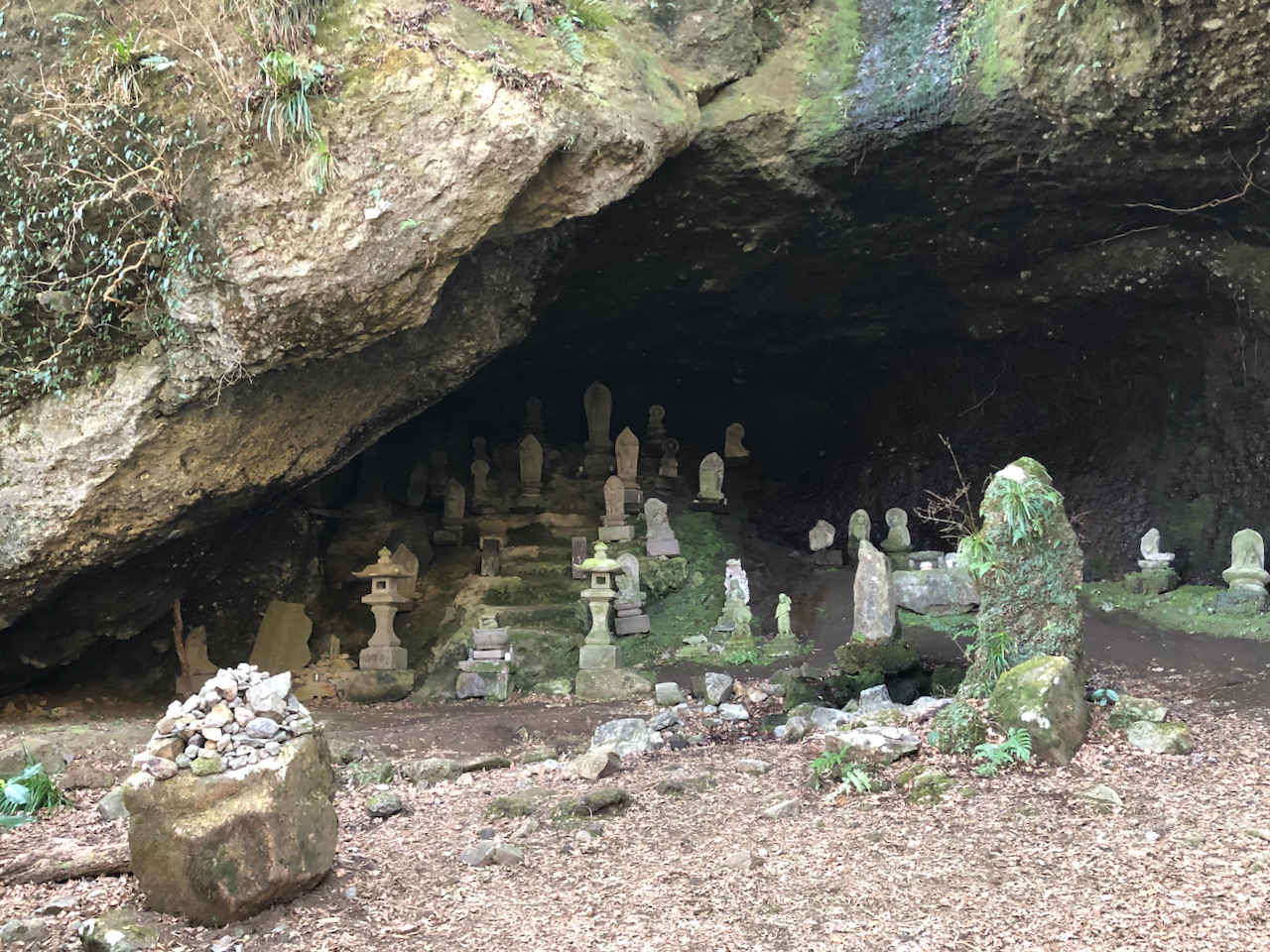
Instead, Sanehira Doi directed Yoritomo and his followers to a small cave--today, called the Shitodo no Iwaya (Shitodo cave)--on the east side of Shiroyama, about half an hour's climb below the summit. 


Statues of Kannon, the Buddhist avatar of mercy, near the Shitodo cave

Yoritomo and his little band took shelter in the cave.


Stairs leading up to the Shitodo

The Taira approached the Doi, who of course claimed they had no idea where Minamoto no Yoritomo and his men had gone. The Taira proceeded to search Mt. Shiro, determined to destroy the young Minamoto leader (and, likely, win the war) while they had the chance.
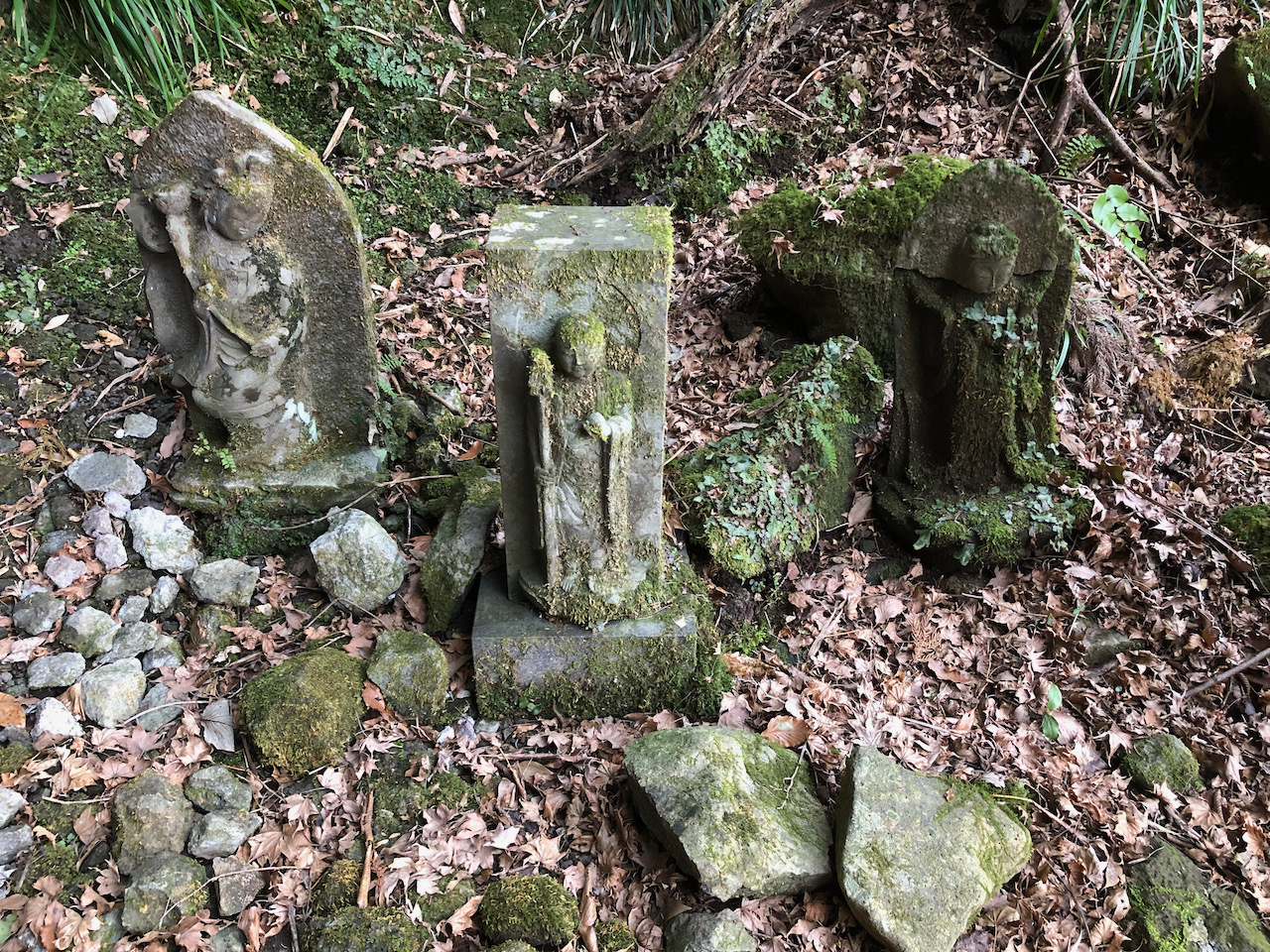

More Buddhist statues outside the Shitodo.

When the Taira approached the cave where Minamoto no Yoritomo and his little group were hiding, a little bunting, then known as a shitodo (and similar to a sparrow) flew out of the shallow cave and flew away. 

The Shitodo cave

In what has to be one of history's best examples of why "it seemed like a good idea at the time" generally isn't, the Taira decided that the cave must be empty, because a bird would not have stayed inside with humans present . . . so instead of searching the (notably shallow) cave, they turned around and went away.

After hiding in the cave for several days, Minamoto no Yoritomo and his men fled over Shiroyama and down the far side to Cape Manazuru, where they escaped by ship.

With help from the Doi and other allies, as well as surviving members of his own clan, Minamoto no Yoritomo regrouped, gathered a new army, and went on to defeat the Taira, win the Genpei War, and persuade the emperor to name him Sei-i Taishogun (征夷大将軍), shogun for short.

Thereafter, Yoritomo established the first shogunate (bakufu) at Kamakura--a city on the coast between Sagami Bay and Edo (now, Tokyo), ushering in the Age of Samurai.

Historically, there is no doubt that the Taira forces would have killed both Yoritomo and his little band, had they entered the cave that fateful night. Had that happened, the Taira likely would have won the Genpei War, and the Kamakura Shogunate--as well as the Age of Samurai--might never have come to pass. 


None of us will ever know what made that one little bird choose that one moment to take flight, but Japanese history seems to prove that if a bird in the hand is worth two in the bush, a bird that flies away at the proper time is worth the entire kingdom.


Sunday, October 2, 2016

Sengaku-ji: the Resting Place of the 47 Ronin

-- Susan, Every Other Sunday

One of Japan's most famous historical tales involves the revenge of the 47 ronin. More commonly known as the "Ako Incident," the tale is immortalized in the (numerous) Japanese film(s) and books entitled Chūshingura, which tell the story of the 47 ronin who avenged their master (and then committed mass suicide).

Signpost at Sengaku-ji (in Tokyo) telling the story of the Ako Incident


Many Westerners have heard of Chūshingura -- either because they've seen one of the famous (and, in some cases, brilliant) Japanese film or stage adaptations or (regrettably) due to the recent Keanu  Reeves Hollywood release, 47 RONIN (which modified the original very heavily but drew its inspiration from the Japanese tale).

What many Westerners don't realize is that the story--at least the Japanese versions--is true, and that the 47 loyal samurai who avenged their lord and then took their own lives en masse are buried, and honored, at a Tokyo temple called Sengaku-ji.

Formal entrance gate at Sengaku-ji


I visited the temple last summer, at the end of my research trip, because I owe these samurai a deep and personal debt, and wanted to pay my respects. Why?

The temple yard.


Their story is more interesting, so I'll tell that one first:

In 1701, the Japanese shogun ordered Daimyō Asano, Feudal Lord of Ako Province, to entertain a visiting imperial envoy. Prior to the meeting Lord Asano was instructed to seek instructions from his official advisor, Kira Kozuke-no-Suke, at Edo Castle. 

During the meeting, Kira treated Asano rudely, disgracing and dishonoring Asano in the process. Asano drew his sword--violating the law against drawing a weapon in Edo Castle--and wounded Kira, but Kira escaped and Asano was arrested.

By law, both Kira and Asano should have been punished for the fight (Kira for starting it and Asano for attacking another samurai). However, while Asano was sentenced to death by seppuku that very day, and his titles and lands were confiscated (leaving his family penniless and transforming his retainers into ronin, or masterless samurai) Kira escaped without punishment.

Asano's loyal samurai retainers were furious, and begged for reconsideration of Asano's punishment (which, admittedly, would not have helped Asano personally any longer, but would at least have prevented his family from becoming destitute and let the retainers keep their honor and status). 

The request was denied.

Two years later, on December 14, 1702, Asano's former senior retainer, Oishi Kuranosuke, assembled the 47 loyal retainers and led them in an attack on Kira's home. After surprising and killing Kira, the 47 loyal samurai marched to Sengaku-ji, presented Kira's head to Asano's grave, and then immediately turned themselves in to the shogun, fully expecting to receive the death penalty for murdering a samurai lord.

Statue of Oishi Kuranosuke at Sengaku-ji


On February 4, 1703, the 47 ronin were sentenced to death. Again led by Oishi Kuranosuke, the loyal retainers accepted their fate and committed seppuku en masse. 

After their deaths, the 47 samurai were interred beside their lord at Sengaku-ji, and their names and story have become one of Japan's best-known examples of bushidō and samurai honor.

The front gate to Sengaju-ji.

I first heard about the Ako Incident as a college freshman at Tufts University, and was struck by the dedication and commitment it would take to avenge a master knowing that doing so would require your death. The story compelled me to look more deeply at several aspects of Japanese culture and history, and was one of the pivotal factors in development of my lifelong love and respect for Japan.

View of the formal entry from the temple yard.


In many ways, my visit to Sengaku-ji--where an annual festival on December 14 still honors the courage and sacrifice of Asano's 47 loyal retainers--was a pilgrimage long overdue.

Worship hall at Sengaku-ji

It closed a circle that I had not realized needed closing, and as I burned incense on the graves of the 47 ronin, I thanked them for inspiring not only their own countrymen and women, but many others (including me) across a distant sea. 


Sunday, April 12, 2015

Onna-Bugeisha: the Female Samurai Warriors

When I say "samurai warrior," most people conjure an image of a man in lacquered armor wielding a pair of wicked swords.

Something like this:


Look! A samurai!
Or possibly this:

Yep, that's a samurai.


Far fewer people realize that, on occasion, samurai warriors also looked like this:

Onna-bugeisha, the female Japanese warrior

During (and since) the medieval era, the Japanese term for these female samurai warriors is onna-bugeisha (女武芸者). It translates roughly to "woman warrior."

The term "female samurai" isn't exactly correct, because all women born to samurai families were considered samurai--whether or not they wore swords and rode into battle like a man. Women in samurai households were usually literate and received at least minimal training in hand to hand combat, often with the naginata, a type of Japanese halberd. 


(Unlike European halberds, which were normally used by men, the naginata was normally considered most suitable for use by women and monks.)

Samurai women were expected to watch over the family income, accounts, and household when their fathers or husbands went to war, duties which often included managing ledgers and--when necessary--defending the home against thieves or invaders. These were NOT the "shrinking violets" many people imagine when they consider medieval Japanese wives!

Most onna-bugeisha lived as women--wearing women's clothes and acting as wives, daughters, and sisters except when danger required them to take up arms to defend their homes and families. 

Tomoe Gozen on horseback
However, if a samurai warrior had no son (and occasionally, even if he did) he could raise a daughter as a full-time onna-bugeisha. In rare cases, these women even adopted male dress and hairstyles, wore two swords, and served full-time in the army of the daimyo to whom they pledged their service.

Tomoe Gozen, center, fighting in the Genpei War
One famous onna-bugeisha, Tomoe Gozen, allegedly fought in the Genpei War (1180-1185) and served as a role model to generations of Japanese women. Although some historians argue about whether or not Tomoe Gozen truly lived, other famous onna-bugeisha like Hojo Masako and Nakano Takeko are well-documented historical figures.

Portrait of Nakano Takeko

My fondness for onna-bugeisha carries over into my fiction. The first Shinobi Mystery, Claws of the Cat, featured a female samurai warrior named Akechi Yoshiko, who lives (and acts) more like a samurai man than a woman. Yoshiko makes a return appearance in my upcoming release, Flask of the Drunken Master (Minotaur, July 2015)--and I promise, she hasn't abandoned her warrior's ways.

One reason I set my books in Japan is the host of intriguing, surprising--and realistic--characters who populated that medieval world. I love exploring their stories, and sharing them with readers who might or might not realize that such people--though fictionalized in my stories--also existed in medieval Japan. 

The onna-bugeisha was only one...I'll share some others in weeks to come....

--Susan (who wishes she could walk around wearing swords).

Sunday, March 1, 2015

The Rope and the Sword


Today, we're leaving the modern world for a tour of "justice" in samurai-era Japan.

The medieval Japanese justice system was actually two parallel systems: one for commoners, and the other for samurai.

By the 16th century—the era when my Shinobi Mysteries take place—Japan had a highly developed system of courts and law enforcement. 

Ashikaga Yoshiteru, shogun of Japan and a great supporter of the Japanese justice system

Magistrates presided over the courts in every major city (and many towns had magistrates as well). Magistrates acted like modern judges, resolving disputes and conducting trials when commoners were accused of crimes. Although the magistrates themselves were members of the ruling samurai class, their official law-enforcement activities generally focused on commoners. By law, the noble samurai class had the right to resolve their legal disputes themselves. 

Beneath the magistrates, the yoriki or “assistant magistrates” acted as supervisors for the “beat cops” (known as dōshin) who patrolled the cities and arrested commoners accused of crimes. Like magistrates, yoriki and dōshin were always members of the samurai class. However, policemen usually came from low-ranked samurai families, whereas the magistrates were appointed from among the more noble, educated clans.

Although the police force was composed entirely of nobles, samurai rarely used the justice system to resolve their own disputes. Samurai families generally tried to resolve minor issues through negotiation, but where that failed, samurai justice was delivered on the edge of a sword. On rare occasions, samurai did resort to the magistrates, but for the most part the official justice system existed to manage the lower classes rather than the ruling elite.


Like the justice system itself, punishments meted out to criminals often depended on the social class or rank of the convicted (or condemned).

Samurai delivering an order to commit seppuku

As the highest-ranking social group, samurai had special privileges when it came to punishment. For serious crimes, samurai often had the right (and, occasionally, the obligation) to commit seppuku – a form of ritual suicide in which a samurai disemboweled himself with a dagger. The "self-determining" samurai was usually allowed a “second,” called the kaishakunin, who ended the samurai’s life with a merciful strike to the neck as soon as the fatal stomach cut was completed. 

A skillful kaishakunin would not completely sever the head; instead, he would leave it barely attached to the body, hanging by only a narrow strip of skin. The thinner the strip, the more respect the kaishakukin--and, by association, the samurai committing the seppuku--received.

Ritual suicide by seppuku restored a samurai’s honor, and that of his family, preventing the need for a feud between the wrongdoer’s clan and the clan of his victim. However, only samurai were allowed the option of seppuku (and the “honor” was not extended to every samurai who committed a crime.)

Among commoners, the sentence for serious crimes was generally death by hanging. In contrast to seppuku, which restored a condemned man’s honor, hanging was a degrading and defiling form of death. It shamed the convict and also his (or her) family. Hangings often took place in public,  sometimes followed by decapitation and display of the criminal’s head as a warning to the population at large.

19th century woodblock showing a beheaded criminal (the clothing indicates
 he's a commoner)

In an ironically “modern” twist, the Japanese justice system treated women as equal to men, at least where punishment was concerned. Female criminals went to the gallows alongside their male counterparts, and female samurai who committed crimes were often allowed the option of suicide (though usually by poison rather than seppuku).

Prisons existed in medieval Japan as well, but mostly as holding areas for commoners awaiting trial. Unlike modern prisons, medieval Japanese prisons were neither designed or intended for long-term incarceration.

For people in medieval Japan, crime and punishment were inseparable from the larger ideals of honor, respect, and social class. Serious crimes were an unforgivable disrespect for the law and the social order. A major crime created a debt that could only be “repaid” with the criminal’s life—a truth that transcended even the sharp class lines that pervaded every aspect of medieval Japanese culture--and one that provides a limitless source of fodder for a mystery author interested in justice as well as crime.