This year I moved my desk and laptop into the long skinny room running along the back of our third floor. And this has changed not only our house--but also my writing life.
It’s always been a difficult room. An oddball zone with great windows, but nowhere to place a bed. Back in the 1890s, the room was an afterthought without serious interior function. Doors dominate three of its four walls. Two large windows allow for copious sun all day long, and an adjacent laundry room has its own wrap around windows adding more sun to the party. Our plan for this sunny but awkward room was for it to be the television place. That idea fell apart because we affixed the TV up high on a short wall—a truly terrible location. The couch fit on a wall adjacent to it, not facing, so any attempt to watch resulted in a cricked neck. So we didn’t watch TV there or do much of anything except store and wrap Christmas presents, because nobody would think to go there and snoop.

I decluttered the room, which also became a catchall for storage, after ten years. I then consulted with Wesley Finnerty, a smart local decorator who knows these quirky old houses. We brainstormed ideas on how how we could turn this room into a writing place because there certainly was room for a desk (although not many bookshelves). I chose a blue and white floral wallpaper print based on Indian woodblocks appropriately called Jaipur. It’s bold and surrounds me in a way that supports focus. I brought up some furniture from downstairs: an old mahogany cabinet with three shelves that could hold supplies, as well as a console that could hold the printer and papers. At auction, I nabbed a mid-19thcentury settee that was narrow enough for the room. Someone before me had re-upholstered it in a funky blue velour, and it just fit. I also had an ottoman upholstered 25 years ago with a William Morris fabric that has traveled with me everywhere. Why not here? It means I can sit on the settee, put up my feet, prop a cushion on my lap and get to it on the laptop.

Yes, I have a modern office desk and a very comfortable chair. I am there less than half the time.
Moving into this room, though, and having just one cabinet and one console table, has forced me to be a little more organized. My typical style is to keep research materials for each book in a large cardboard box, and to stack pages on desks and any other surface I can find. Now, I’ve moved more into using folders…and keeping folders in cases. And I'm also recycling papers faster than I used to.
I truly wish I could adjust to digital storage. But my mind doesn’t remember things as well when I read them online. This is why I print out my pages as I go along to be able to see my repetitions of ideas and other errors. When writing a 110,000-word novel—as my books tend to average—I keep track of more than a dozen important characters, all of whom have their own physical and linguistic traits, their own schedules, and roles in the story. As a historical mystery writer, there’s the added necessity of research (aka the fun part). Every writer has their own methods, but this is what I’ve fallen into over my 30 year-career:
Boxes. They are not spread out willy-nilly like before, but I am keeping just one modest-sized box in this room. It's the place where I protect any information I’ll need to refer to while writing. I typically gather facts from old books and records housed at the Ames Library of South Asia at the University of Minnesota. It's 1100 miles away, and I get there just once or twice a year. The fastest way I can save pages from rare books for detailed reading later is by snapping photos on my phone that I read later. Some of these I’ve printed out to serve as a weird kind of photocopy. I also snap a shot of the book and author and publisher details in case I want to mention it in the acknowledgments or even try to buy a used copy from somewhere in the world, if it still exists.
Folders. I keep folders within the boxes of subcategories of information. For example, I have a folder about Dadar Parsi Colony, where my character Perveen lives, with a rough map and articles about the history of the place. I also take photographs of this Parsi colony each time I visit Bombay, just as I take photos of preserved architecture in other historic areas, like Fort and Malabar Hill. Other much-used folders relate to British colonial government and police organizations, women in law, and sari fabrics. And food, naturally!
Character Sheets. I came across this concept when searching online, and there are a lot of PDFs of character sheets to play with. These worksheets ask the writer to record details about each character and are guides for keeping facts straight in the current book, and future books if you happen to be writing a series. I have made them for Perveen’s family members and her closest friends. The trickiest parts are remembering the date of a character’s birth, so the people have ages that are correct in relation to the series’ progression. For instance, Perveen was born in 1898, so for the book I’m writing now, set in 1923, she’s 25. The only character I wish I could age faster is the book’s resident infant: Khushy Mistry. I am frankly tired of a character who can’t walk or speak. In the current book, Khushy has made it to 14 months—hurray!

Index cards and Timelines. I write mysteries, and once I’ve got to the point in the story where someone dies, timelines and who-was-where-when becomes very important. As I get into a second draft, I usually find I need to rearrange some scenes and also remember what happened at various stages: when people could know the facts that I say they know. I summarize each chapter on an index card and tape it along with a bunch more (my books are typically 32 chapters) to a 17-inch manilla envelope. That envelope serves as a flexible kind of bulletin board that I can lay down on the carpet and study. I probably should put up a bulletin board on my fantastic wallpaper, but I’m a little fearful of getting the spot wrong. Besides, envelopes are good because the surface for the cards needs to be a long vertical space, rather than horizontal.

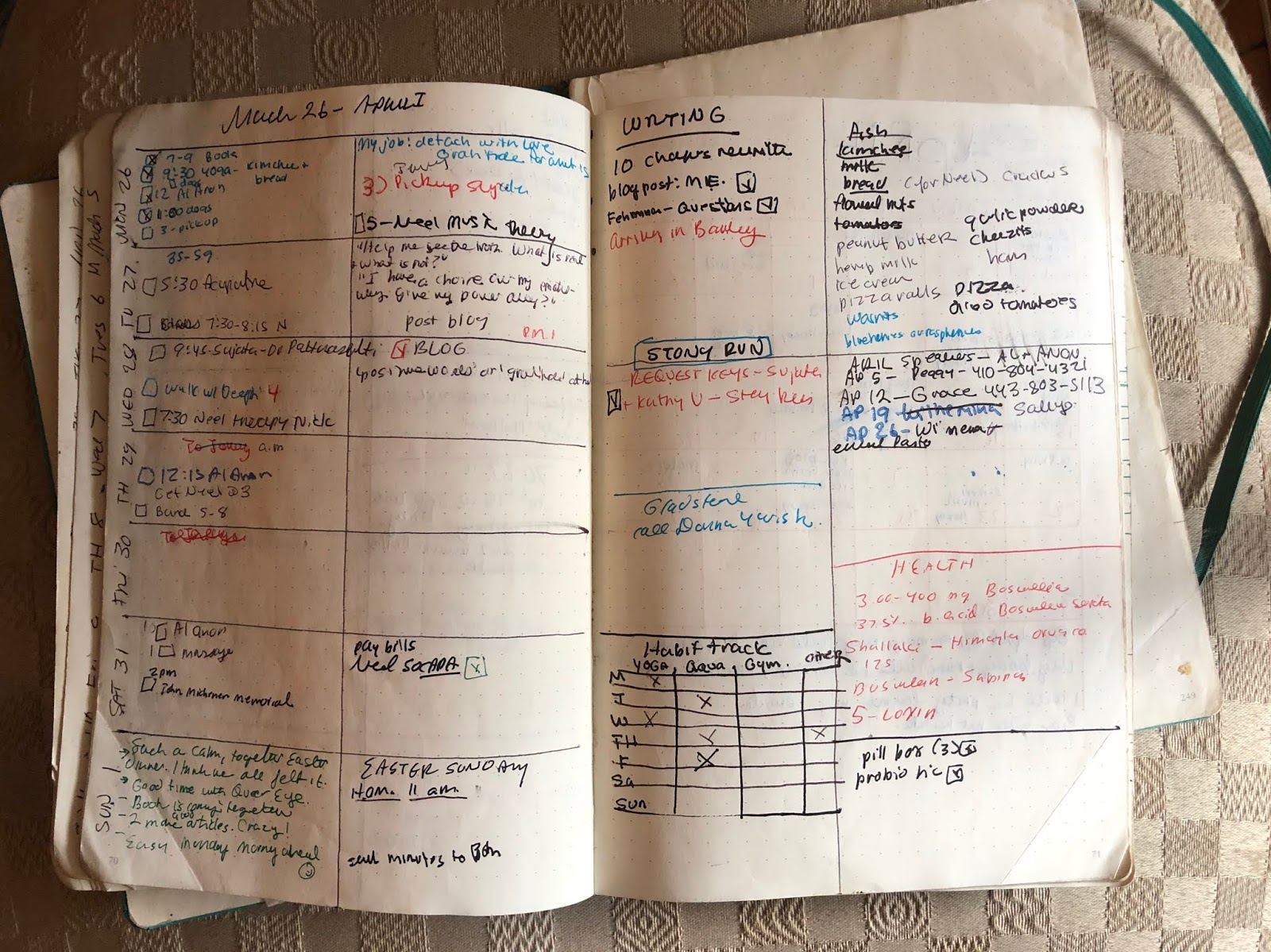
Notebooks. Oh, how I love them. And I never turn down freebies. While on the road, you can carry a small notebook in your bag or pocket and take it out to jot down notes that people tell you—or details that you observe. The key is to mind your handwriting, going slow and carefully enough that you can read your own writing later. This is a genuine problem for me.
A library of books. Most of the novels and nonfiction I keep about India can’t fit in the new study. However, I bought an antique brass expanding book rack on ebay that can be set on any desk or surface. It can be pulled wide enough to hold 20 books upright, or be collapsed to hold as few as five. I can imagine students of the early 20th century traveling to a dormitory or boarding house and setting up their row of necessary textbooks in such modest racks.
Reviews. Not all writers want to read their reviews, especially on the internet. However, in the golden days when my career started, newspapers and magazines printed lots of book reviews, and wrote feature articles about authors, too. Even though I don’t read these things, it’s lovely to have a clipping about The Sleeping Dictionary from the Baltimore Sun of 2013, or a color photocopy of clipping about The Salaryman’s Wife from People Magazine “Page Turner of the Week" from1997. I also store marketing materials (like how to strategize Instagram, etc) in the same area.

How-Tos: I keep a section of craft books not for sewing, but for get-back-to-writing inspiration. I keep them together in the library, though I might allow one down in the study for times I get antsy. I am trying to get my hands on a paper copy of Virginia Woolf’s long essay, A Room of One’s Own, which bursts with indignation, activism, and amazing details of early 20th century English literary life.
There you have it: the scaffolding that surrounds me as I embark on a new book. Protective walls, powerful sun streaming through the windows, and all the necessary aids. But it’s not until little Daisy the terrier jumps up on the ottoman, that this writer’s mise en place is complete.