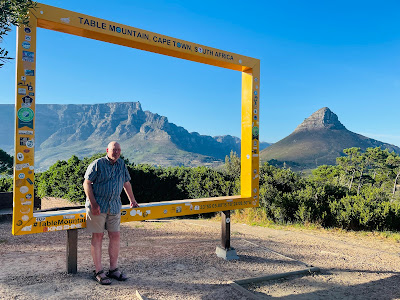
Table Mountain in Cape Town is one of the world’s most
recognised and iconic mountains.
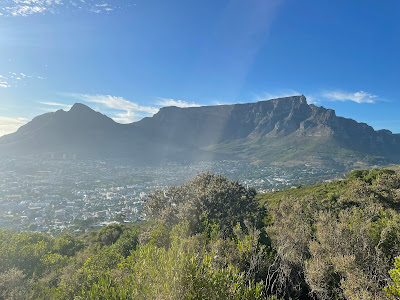
Rising 1000 metres (3500 feet) out of the Atlantic Ocean, with a
3-kilometre (1,8 mile) flat top, it overlooks Table Bay (in which Robben Island
is situated). One of the
surprising aspects of the mountain is that it faces north. Most people unfamiliar with the area
believe, since it is nearly at the southern tip of Africa, that it faces south.
Looking at Table Mountain from the bay, on the right there
is Signal Hill (where at noon every day a cannon fires to signal the time) and
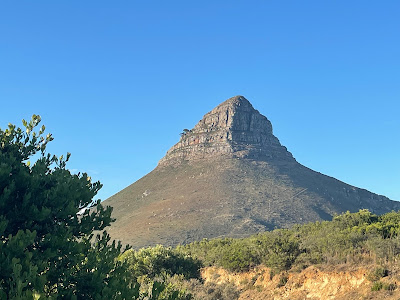
Lions Head, so named because from some angles it looks like a male lion
crouching. On the left is Devil’s
Peak, higher than Lion’s Head, but not as high as Table Mountain.
 |
| Painting of Table Mountain by William Hodges (1772) from about Captain Cook's Ship HMS Resolution |
 |
| Table Mountain from Bloubergstrand (Blue Mountain Beach) |
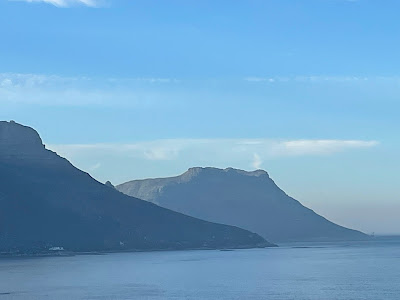
Running back from Table Mountain to Cape Point and the Cape
of Good Hope is a range of mountains known as the Twelve Apostles rising
steeply out of the sea.
Despite its very rocky disposition, the Table Mountain area
is home to over 2200 plant species, more than that of the United Kingdom. The National Botanical Garden,
Kirstenbosch, lies on the side of Table Mountain, and is one of my favourite
parts of the city.
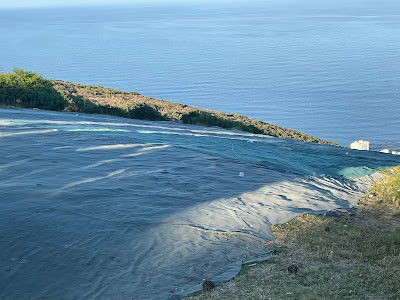
One of the amazing things about Table Mountain is that one
minute it can be standing proudly with clear blue sky above it, and the next
minute a layer of cloud can pour over the top, giving the impression of a
dynamic tablecloth.
 |
| New York Times photo of its 2014 #1 travel destination with the tablecloth spilling over the mountain |
 |
| The tablecloth from the Victoria and Albert waterfront |
The whole process is pretty spectacular to watch.
The tablecloth is beautiful, but can be very dangerous to unwary
hikers on the mountain, because it can become so dense that it is very
difficult to find one’s way back to the cable-car station.
A weatherman will tell you that the tablecloth is formed
when a south-easterly wind blows up against the mountain, lifting moist air
abruptly, cooling it rapidly, causing condensation. When these orographic clouds (as they are called) reach the
edge of the mountain on the other side, they descend and warm up, and the cloud
disappears.
The San peoples who inhabited the area long before any
Europeans or Blacks arrived called Table Mountain Camissa – the place of sweet water – and attributed the tablecloth
to their mantis god smothering a fire with a kaross, which is any animal hide, usually a sheep’s, with its hair
left on.
This is certainly an appealing explanation, and I can see a
San family clustered around a fire, listening to grandpa telling the story of
why the cloud appears and disappears.
But neither the weatherman’s nor the San’s stories are
correct. The real story is as
follows.
In the 18th Century, during the time of the Dutch
East India Company’s tenure in what is now Cape Town, there was a fierce pirate
in the area – at least he thought he was fierce. His name was Van Hunks. Everyday, when he wasn’t pirating, he would walk up the hill
to the east of Table Mountain, called Windberg (Wind Mountain). He had a favourite tree, very ancient
and gnarled, under which he would pull out his pipe and smoke, gazing over
beautiful Table Bay and, presumably, planning his next dastardly attack on Cape
Town’s upper class.
 |
| Van Hunks |
He was a proud man and boasted that he could out-smoke
anyone. No one took up the
challenge.
Until one day, when he arrived at his usual spot, there was
a man, dressed all in black, hat pulled down over his face, sitting where he
always sat. I can only assume that
Van Hunks was a little miffed. And
even more so when the stranger challenged him to a smoking contest, goading Van
Hunks with taunts.
Of course, Van Hunks took the challenge.
They divided the tobacco into two large
piles and sat down to smoke. They
smoked, and they smoked. And they
smoked some more. For hours and
hours, covering Table Mountain with white fumes.
Eventually the man in black, frustrated that Van Hunks was
still going strong, wiped his brow in frustration and accidentally knocked off
his hat, revealing a pair of horns.
Poof! He vanished in a puff
of sulphuric smoke. Van Hunks was
the winner.
And that is why the mountain that was once called Windberg
is now called Devil’s Peak.
And every time the southeaster blows, the devil returns for a rematch,
once again causing the mountain to be covered in a white cloud. The devil never wins, but keeps coming
back for more.
[As an aside, for those of you who haven’t read any of Deon Meyer’s
books, I heartily recommend Devil’s Peak
and its wonderful, love-him, hate-him protagonist, Bennie Griessel.]
Stan - Thursday