Showing posts with label homicide. Show all posts

Wednesday, October 28, 2020

GUNS AND THE TRAGEDY OF SUICIDE

 Kwei--Wednesday

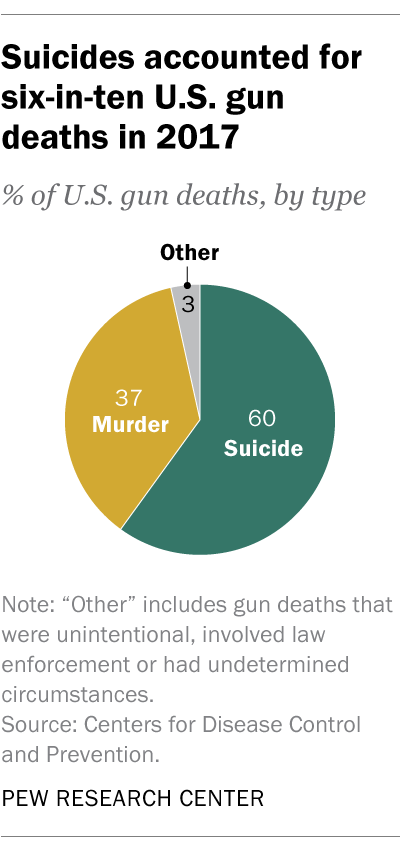
We often think of guns in the context of hurting or killing others, but in fact in the USA, suicide deaths by firearm are more common than any other category of gun death (including homicide) among both males and females and across most age categories. Males account for more than 85% of all gun deaths, regardless of intent category. 

(Image: andriano.cz / Shutterstock) 


Suicide claims the lives of 23,000 Americans every year, including 1100 children and teens. Nearly two-thirds of all gun deaths in the US are suicides, which is an average of 63 deaths a day, about the same number as the fatalities in the Las Vegas mass shooting.


(Centers of Disease Control & Prevention / RCraig09)


The pie-chart view is another way to look at it:


The Global Perspective


The USA leads the world in gun-related suicides. 
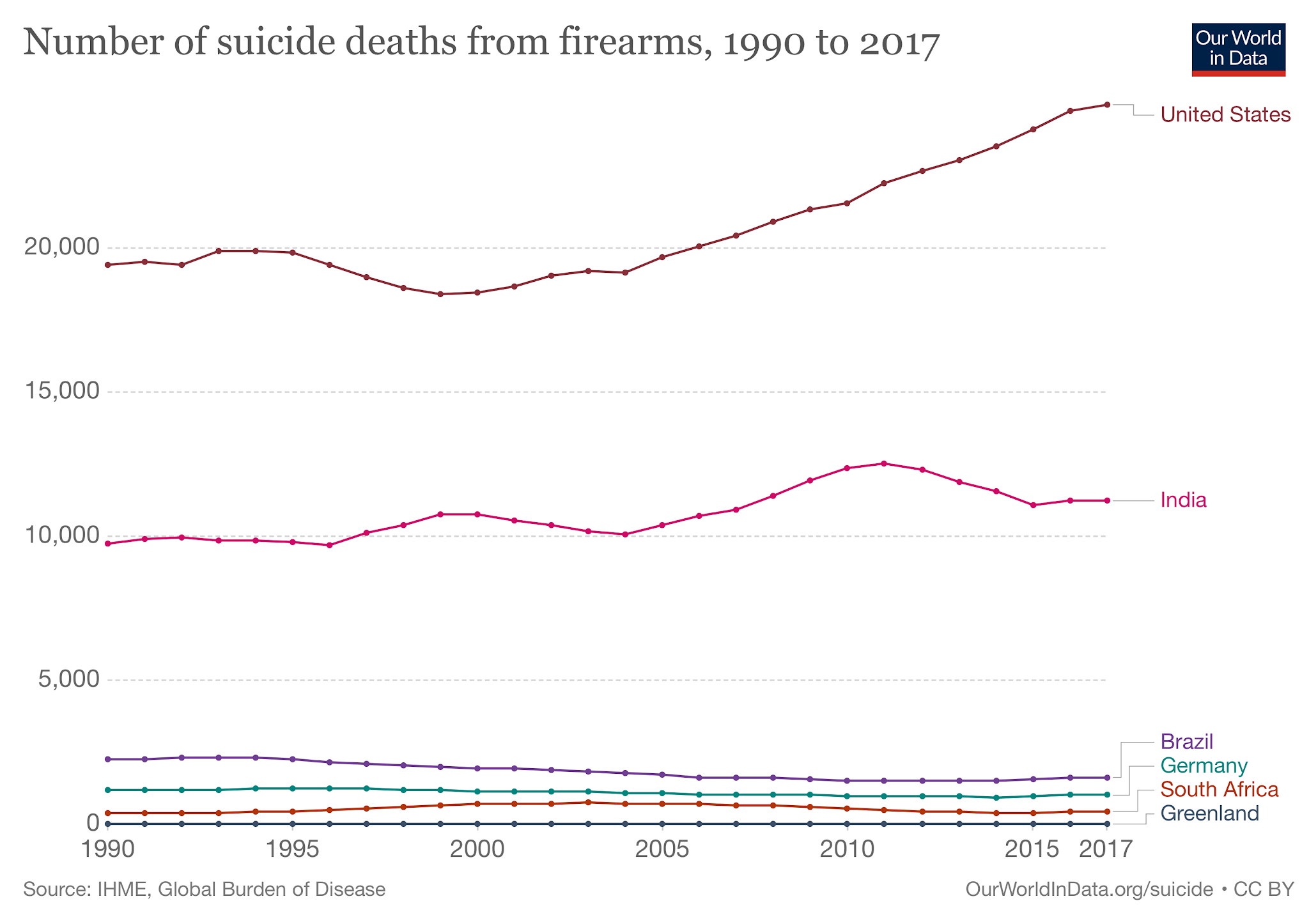


Although the USA ranked fourth in the world in 2016 with 12,400 firearm-related homicides, that figure pales in comparison with its 23,800 gun suicides. None of the other 194 nations and territories in the report came close; India ranked second at 13,400. It should be noted that in 2016, the highest per capita suicide rate by firearm was recorded by Greenland at 22 deaths per 100,000. Greenland is beset with challenges such as social turmoil and alcoholism.


Gun Ownership And Suicide Risk

A large and influential study in The New England Journal of Medicine found an elevated risk of suicide among a large sample of first-time handgun owners. Stanford University researchers followed over 26 million men and women in California who were 21 and older and who hadn’t owned guns before October 2004. A little less than 3% of the cohort, or 676,425 people, became gun owners between then and 2016. In this group, the risk of suicide in this group was about nine times higher than among non-owners. 

Those who died by suicide using a firearm — 6,691 people out of 17,894 total suicides (37.4%) — tended to be male, white, and of middle age (mean age of 41 years). The period after gun purchase that had the highest suicide risk was 1 - 3 years. A firearm was used in 89% of the suicides among handgun owners and 33% of those among nonowners.

Two notable findings emerged in this rigorous study: first, new handgun ownership is strongly associated with suicide immediately following California’s 10-day waiting period between purchase and acquisition of a firearm; second, although the absolute risk of suicide is higher among men than among women, new handgun ownership is associated with a disproportionately greater increase in death by suicide among women.

The one-purpose device

Suicide by gun is a particularly violent and heart-wrenching mode of death. Imagine the horror of coming home to find one of your loved ones dead from a fatal, self-inflicted gunshot wound. This is the kind of image that will haunt a person for years. To me, the revulsion I have for a firearm is that it's an instrument singularly-purposed for a single deadly purpose. People jump off bridges, but that's not why bridges were built; rope can be used to hang oneself, but that's not the primary use of a rope; you can slash your wrist with a razor or knife, but they weren't made for that reason. You can OD on opioids, but their original purpose is otherwise. But a gun? There are no two ways. If you point a loaded pistol at your head and fire, it will do its only assigned job.

Morality of Suicide

There is philosophical, psychological, and moral debate about suicide. Is it actually immoral or wrong in some other way? Is it selfish? People often cite the severe blow dealt to family and loved ones. Why didn't the suicide victim think about that? And anyway, isn't the phrase "suicide victim" an oxymoron?  

In considering suicide however, it's well to examine the surrounding circumstances. Perhaps suicide should be thought of not so much as an isolated act, but as the fatal and tragic (always tragic) end of a certain progression of events. In the depth of a severe depression, the self-loathing can be so intense that the sufferer completely devalues themselves. Even the persuasion that their family loves them can be quite meaningless and unhelpful, because, in any case, a suicidal person doesn't believe that. 

Why guns are the problem

Sworn NRA members often say, "Guns don't shoot people, people shoot people." This is one of the stupidest, most simplistic, circular, and self-defeating platitudes I've ever heard. The answer, of course, is, "Yes, but people can't shoot people without a gun." [Insert rolling eyes emoji here.]

Many people can get to the other side of severe depression by their own fortitude or with the support of others. With treatment, these same people will no longer want to kill themselves. Suicide is sometimes a flash decision after waxing and waning of suicidal intent. That flash decision, which could have been otherwise forestalled, is fulfilled by a gun at hand. The chance the person had to get through their dark, terrible moment is now gone for good. That's where the tragedy is, and that's why the call for gun regulation remains strong.


Tuesday, December 7, 2010

It's not Inspector Clousseau


The French police system grows more confusing all the time. Maybe that's because Napoleon designed it that way. Civil law enforcement and the military police were structured separately but with semi-equal powers and conflicting arenas to avoid his being toppled. Waterloo did that. But Napoleon's structure is still in place. The little man still rules from the grave. Sarkozy for all his faults and more faults is in the process of streamlining, simplifying, centralizing and re-organizing the police and military services who tread on each other's riot boots. And they're not happy about it one little bit.
(See a similarity maybe small men, big ideas, glamorous wives that Napoleon and Sarko might have in common?)
But this mutual hostility in the forces goes back to Napoleon's time. What's new?
What will really change? Much of France falls under the Gendarmerie, a military force, the Gendarmes who enforce national law outside of Paris, in the countryside under the Ministry of Defense. The Police Judiciare, in Paris, in under the Ministry of Interior and so is the Renseignements Generaux, RG a very FBI-like hydra headed intelligence branch but do their own thing ie. run investigations independently. Needless to say the RG are not any one's favorite lists. But this part always confuses me and since it's changing suffice it to say the Police Judiciare - only in Paris - run their own turf and the Brigade Criminelle - the elite homicide unit handle murder and cases that perplex most others.

Not that they can't be outmanuevered by their sort of military equivalent also with power in Paris. Diferent SWAT units, counter terrorist teams get muddled here and like always I reach for a drink when this gets explained to me.
We're sitting in the Great Canadian, a noisy pub on the Seine right across from the famous 36 quai des Orfévres where many of my drinking companions work in Brigade Criminelle. Small tables huddled in the back, beer spilt and stories. Lots of stories.
I'm really impressed by these guys, actually, they're sharp, funny, self-deprecating and I like them. Even a counter terrorist specialist who speaks several Arabic dialects, is a computer whiz and shoots 15 our of 15 with this Sig Saur on target at the firing range we've been to.
He's a big bear of a man in a teddy bear way but I'd definitely want him on my side. Not the other way around. The take I get on these French flics is the human side. Maybe it's the beer talking but when I ask them about the case that's most got to them in their careers, it's the look in their eyes, this story they tell and it's not about 'the one who got away or the guy I couldn't put inside but will' it's the human toll they've witnessed at a homicide. I hear those stories; a sociopath's calm and bored recounting of why he murdered his mother and a good samaritan who came to her aid, looking into the faces of a kidnapped victim's family and informing them 'the operation wasn't successfull' after living with them for three weeks, a father who murdered his children and wife then changed his clothes and took the dog for a walk.
I asked one of them 'how do you do this work and not let it affect you, your home life?' He shrugged. 'It's my job, first of all, it's dealing with a dirty side of life everyday. I'm divorced; left the suburbs, the house, the wife and now share our children but right now all I'm thinking about is painting my daughter's room this weekend in our new apartment. And hoping we can agree on a color.' I sense something else behind his eyes and then it's gone.

(btw in January Murder in the Marais is being re-issued and with a new cover)

Cara - Tuesday