Showing posts with label NRA. Show all posts

Wednesday, October 28, 2020

GUNS AND THE TRAGEDY OF SUICIDE

 Kwei--Wednesday

We often think of guns in the context of hurting or killing others, but in fact in the USA, suicide deaths by firearm are more common than any other category of gun death (including homicide) among both males and females and across most age categories. Males account for more than 85% of all gun deaths, regardless of intent category. 

(Image: andriano.cz / Shutterstock) 


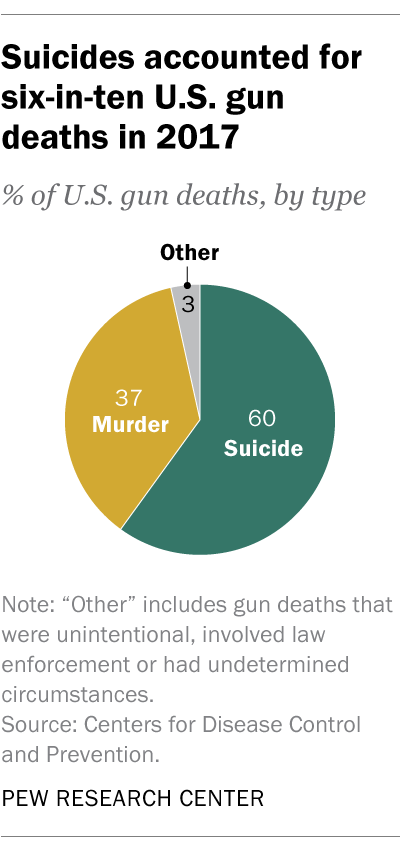
Suicide claims the lives of 23,000 Americans every year, including 1100 children and teens. Nearly two-thirds of all gun deaths in the US are suicides, which is an average of 63 deaths a day, about the same number as the fatalities in the Las Vegas mass shooting.


(Centers of Disease Control & Prevention / RCraig09)


The pie-chart view is another way to look at it:


The Global Perspective


The USA leads the world in gun-related suicides. 
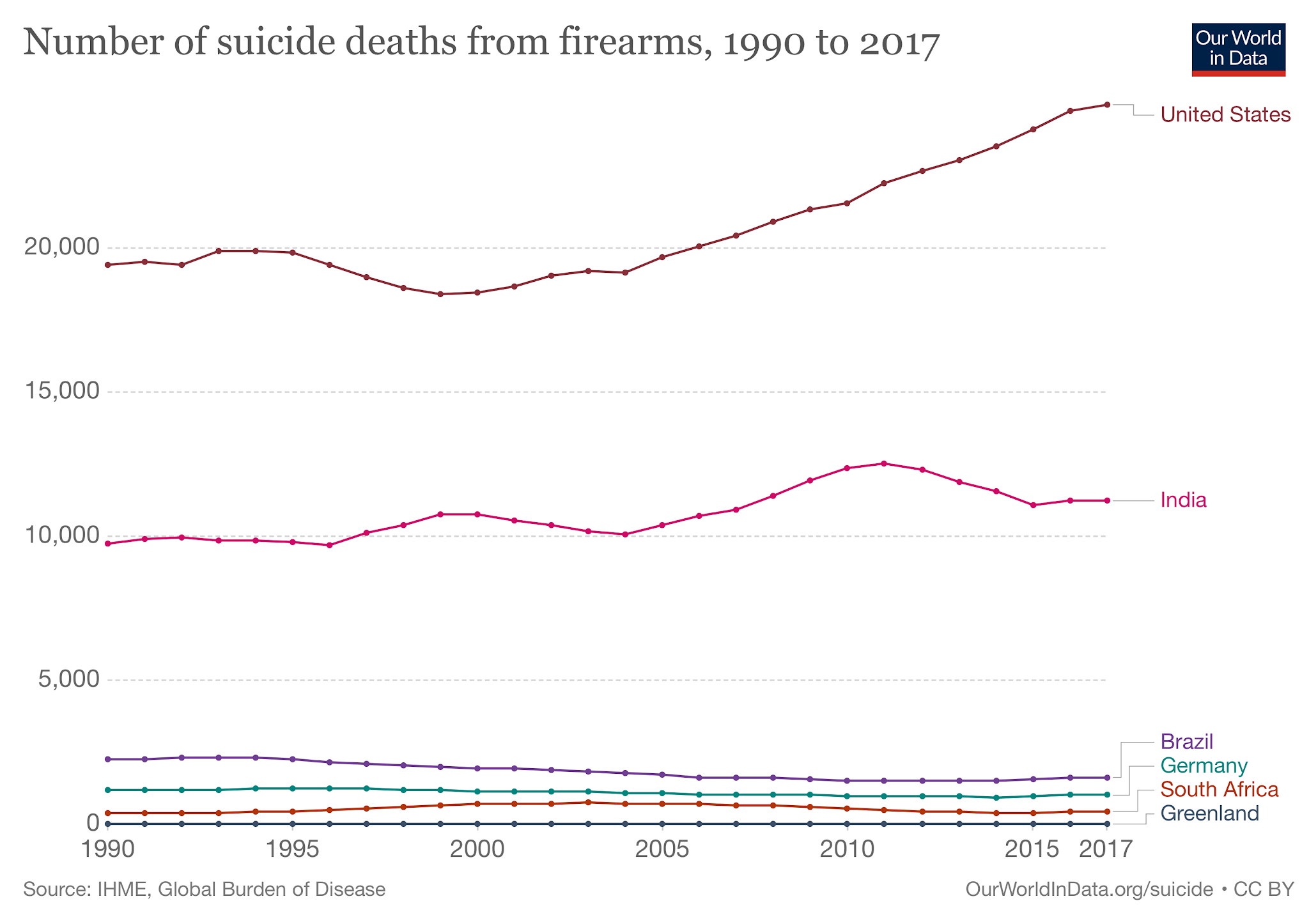


Although the USA ranked fourth in the world in 2016 with 12,400 firearm-related homicides, that figure pales in comparison with its 23,800 gun suicides. None of the other 194 nations and territories in the report came close; India ranked second at 13,400. It should be noted that in 2016, the highest per capita suicide rate by firearm was recorded by Greenland at 22 deaths per 100,000. Greenland is beset with challenges such as social turmoil and alcoholism.


Gun Ownership And Suicide Risk

A large and influential study in The New England Journal of Medicine found an elevated risk of suicide among a large sample of first-time handgun owners. Stanford University researchers followed over 26 million men and women in California who were 21 and older and who hadn’t owned guns before October 2004. A little less than 3% of the cohort, or 676,425 people, became gun owners between then and 2016. In this group, the risk of suicide in this group was about nine times higher than among non-owners. 

Those who died by suicide using a firearm — 6,691 people out of 17,894 total suicides (37.4%) — tended to be male, white, and of middle age (mean age of 41 years). The period after gun purchase that had the highest suicide risk was 1 - 3 years. A firearm was used in 89% of the suicides among handgun owners and 33% of those among nonowners.

Two notable findings emerged in this rigorous study: first, new handgun ownership is strongly associated with suicide immediately following California’s 10-day waiting period between purchase and acquisition of a firearm; second, although the absolute risk of suicide is higher among men than among women, new handgun ownership is associated with a disproportionately greater increase in death by suicide among women.

The one-purpose device

Suicide by gun is a particularly violent and heart-wrenching mode of death. Imagine the horror of coming home to find one of your loved ones dead from a fatal, self-inflicted gunshot wound. This is the kind of image that will haunt a person for years. To me, the revulsion I have for a firearm is that it's an instrument singularly-purposed for a single deadly purpose. People jump off bridges, but that's not why bridges were built; rope can be used to hang oneself, but that's not the primary use of a rope; you can slash your wrist with a razor or knife, but they weren't made for that reason. You can OD on opioids, but their original purpose is otherwise. But a gun? There are no two ways. If you point a loaded pistol at your head and fire, it will do its only assigned job.

Morality of Suicide

There is philosophical, psychological, and moral debate about suicide. Is it actually immoral or wrong in some other way? Is it selfish? People often cite the severe blow dealt to family and loved ones. Why didn't the suicide victim think about that? And anyway, isn't the phrase "suicide victim" an oxymoron?  

In considering suicide however, it's well to examine the surrounding circumstances. Perhaps suicide should be thought of not so much as an isolated act, but as the fatal and tragic (always tragic) end of a certain progression of events. In the depth of a severe depression, the self-loathing can be so intense that the sufferer completely devalues themselves. Even the persuasion that their family loves them can be quite meaningless and unhelpful, because, in any case, a suicidal person doesn't believe that. 

Why guns are the problem

Sworn NRA members often say, "Guns don't shoot people, people shoot people." This is one of the stupidest, most simplistic, circular, and self-defeating platitudes I've ever heard. The answer, of course, is, "Yes, but people can't shoot people without a gun." [Insert rolling eyes emoji here.]

Many people can get to the other side of severe depression by their own fortitude or with the support of others. With treatment, these same people will no longer want to kill themselves. Suicide is sometimes a flash decision after waxing and waning of suicidal intent. That flash decision, which could have been otherwise forestalled, is fulfilled by a gun at hand. The chance the person had to get through their dark, terrible moment is now gone for good. That's where the tragedy is, and that's why the call for gun regulation remains strong.


Saturday, May 11, 2019

Guest Blogger LENNY KLEINFELD: That Time I Took My Rifle to the Airport


Jeff—Saturday

I’m at CrimeFest this weekend in Bristol, UK along with Cara, Caro, Zoë, Stan and Yrsa, and we’re having more fun than should be legally permissible.  I was thinking of how to convey a sense of all our good times to you who follow what we write, and considered posting photos; but with all the ones Cara is shooting (no pun intended) of the festivities it struck me as rude to scoop hers with mine.  So, I searched for another way to pass along a genuine feeling of the fun generated by this get together while exploring some serious topics.

Enter Lenny Kleinfeld, one of the absolutely funniest writers I know. I was lucky enough to convince Lenny to write a piece for MIE on the occasion of his latest novel, Shooting Lessons.  When I read it, I thought this is what Mark Twain would sound like if he wrote crime.

But don’t take take my word for it, The Austin Chronicle calls Shooting Lessons A damned good read. This latest Kleinfeld spectacle is no less a clever, culturally aware, and entertaining adventure than the first two tales about Bergman and Doonie. But the game’s been upped a bit here, too. As in, this latest one grabs you by the shirtfront and drags you through its dark and increasingly blood-spattered shenanigans like something engineered for max adrenaline and engagement.”

Lenny’s first novel, Shooters and Chasers, was called “A spellbinding debut” by Kirkus Reviews.  His second novel, Some Dead Genius, was one of National Public Radio’s Great Reads of 2014, and named Thriller of the Month by e‑Thriller.com. Back before Lenny was spellbinding, he was a playwright in Chicago and a columnist for Chicago magazine. His fiction, articles, humor and reviews have appeared in Playboy, Galaxy, Oui, The Reader, Chicago Tribune, The New York Times, and Los Angeles Times. According to a reliable rumor he also spent fifteen years writing screenplays.

So, here’s Lenny…


I might be on the wrong blog site. My new novel, Shooting Lessons, tracks a deranged multimedia lobbying campaign to make an Illinois concealed carry permit as easy to obtain as a grocery coupon. So maybe this post should be on Murder Is For Policy Wonks. But I'm not gonna Google MIFPW, because I'm afraid it might exist.

Besides, the story isn't about making legislation, it's about marketing guns. Which America is great at. A recent survey revealed 94% of the Earth's population believes the phrase on our dollar bill, E Pluribus Unum, is Dothraki for Guns R Us.

Hey, I have nothing against guns. I like guns. They were an everyday—literally every day—part of my childhood. My father wore a gun, and a significant percentage of the guys who came to our house for social events were packing. He and they were cops. I don't know if it's still the case, but back in the 1950s and 60s New York City police officers were required by law to carry their weapon whenever they left home, whether for work or not, while they were within city limits. There was always a holstered gun on Dad's belt or strapped to his ankle. Dad packed a piece at our synagogue during the High Holidays, and at Mass when Catholic friends were getting married or being mourned. And in restaurants. And when he and Mom danced together anyplace outside our living room. And when he saw my grade school production of The Pirates Of Penzance, and at parent-teacher conferences. And when he visited the doctor or dentist.  When we went to the beach he'd unload it and sneak the empty gun into my mother's purse before he went swimming. We had to go to Miami for the three of us to go swimming simultaneously.

I got my first rifle when I was twelve. Minutes later I became an Active Junior Member of the NRA. It came with a magazine, American Rifleman, featuring gun reviews and exhortations about firearm safety. The editors were deeply concerned about guns doing damage to people, but deeply unworried about Adlai Stevenson doing damage to guns.


In 1963 I made it onto on my high school rifle team. It worked like any other sport. We had home matches and away matches. To get to a match at a rival school we'd take the train. Imagine five teenage boys carrying rifle cases and a teacher carrying a locked bag full of ammunition boarding your packed subway car today.

In 1966 I took my rifle to college. I walked into the airline terminal carrying a rifle case, set it on the ticket counter, removed the rifle and, with the ticket agent watching, took the gun apart, removed the firing pin, showed the firing pin to the ticket agent and placed it in my shirt pocket, then put the neutered rifle back together and checked it through like any other piece of luggage. Nobody in line behind me said anything, or paid much attention. Imagine that today.

Now let's reverse the perspective. It's 1966 and you're peering into your futurescope. This is what you see:

Today, a growing number of states (but not Illinois, yet) issue handgun permits which automatically include the right to concealed carry.

Open carry of rifles and handguns is legal in many states—including in malls, hospitals, schools, theaters, houses of worship, bars, and on public transport.

Semi-automatic versions of assault rifles with high-capacity magazines have been used in mass slaughter after mass slaughter after mass slaughter—quick, can you tell me off the top of your head, in the US in 2018 were there more major tennis tournaments or mass shootings? But civilianized assault weapons remain legal and easily available.

Could you have imagined all that, way back in the famously turbulent 1960s?

We live in the best of times for writing cell phone apps, the worst of times for writing satire. Satire requires exaggeration. American politics in general and gun policy in particular have grown so extreme that trying to stay a step ahead of them is like challenging the Flash to a foot race.

Another little thought experiment:

If someone told you they were writing a story about a bill being introduced in a state legislature that would decriminalize the use of a firearm while inebriated, would you:
A) Assume the author was a satirist.
B) Assume the author was a journalist.
C) Be unable to decide.

—Lenny, in for Jeff