Showing posts with label historic houses. Show all posts

Wednesday, September 20, 2023

Writers on the Farm

 http://sujatamassey.com


Near my childhood home in St. Paul, Minnesota, you’ll find the Gibbs Farm, a historic farm homestead dating from the 1850s which includes a one room schoolhouse, barn, and household—all of it filled with a miscellany of pioneer life. Old books, clothing, toys, farm equipment, and household furnishings enchanted me. During the summer I was nine, I “volunteered” at Gibbs Farm, walking over daily and doing small tasks the docent staff kindly gave me. I wished I'd been born a hundred years earlier, and by spending days at Gibbs Farm, I pretended that this was true.


Gibbs Farm, Falcon Heights, MN 


Gibbs Farm nostalgia returned last weekend when I visited a late 1700s farmhouse called Linthicum Walks. The clapboard house is sited in the Anne Arundel Maryland town of Crofton, where a Welsh immigrant family, the Linthicums, farmed for more than 200 years on a large parcel of land originally purchased in the 1700s. Today, a small graveyard exists, as well as a barn and the original 1700s farmhouse which was built on through the 1920s. 


Linthicum Walks, Crofton, MD


Development surged in Anne Arundel County in the 20th century. Now the small gravel driveway into the Linthicum Walks acreage intersects busy Maryland State Highway 424. Linthicum Walks is flanked by public middle and high schools on either side. Still, because of the tall trees, it remains a private sanctuary. 


Today Linthicum Walks is managed by a board of trustees endeavoring to bring the local community to enliven the house.The board first invited Marcia Talley, an Anne Arundel County writer, to speak about mystery writing. Marcia generously invited me. So in short order, the two old friends got to chatting with a group of women from Maryland and Virginia in the home’s cozy colonial parlor. Sitting comfortably in a pair of wing chairs, Marcia and I had a signing that really doesn’t compare to any other event we had. It felt like going back in time to a social hour in an enchanting atmosphere.. Sunlight streamed through small old-fashioned windows; patinated wooden cabinets were filled with vintage fine china; and original fireplaces were surrounded by  fox hunting prints and paintings. 


Marcia and I talked about mystery; how we both treasure writing books that are low on violence and high on character and setting. The readers wanted to know about the kind of research we did. Marcia has spent many hours in Maryland graveyards and doing genealogical research that has enriched her Hannah Ives mystery series. I lose myself in libraries such as the Ames at the University of Minnesota that have rare historical source materials. It was heartwarming to be among a group of readers who treasured history while being open to new stories. A board member of Linthicum Walks told us about a library in Maryland we needed to visit that had a strong collection of historical records.


After the book talk, I tiptoed up a narrow staircase and explored three more rooms. One was a sleeping porch, now closed in, from the twentieth century and still furnished like an old-fashoined bedroom. The second room was a nursery bursting with toys and oddities. The other original bedroom contained a melange of antiques, among them a gilded purple velvet gown that somebody's great aunt is said to have worn to a Presidential inauguration. 


That’s the thing about historic house museums. The stories behind treasures are often orally transmitted legends. Rooms rarely hold furniture that completely belonged to the family, or shows the same time period. There are no little signs that tell you the age and provenance of items, but there’s a lot of amusement to be had when poring over vintage boots, empty tins of Hershey’s cocoa, and samplers embroidered by children. However, there is information galore about the families who lived for generations in one place.


Volunteer gardeners planted several lovely beds of flowers and shrubs outside that attract local pollinators. I spotted a proud-looking beehive, and a cozy squirrel house. And as I regretfully left Linthicum Walks, the air stirring through the trees whispered: “come on back.” 


Wednesday, May 3, 2023

A Tree Grows in Baltimore, and so Does a Book

 Sujata Massey


From where I sit, the view has changed. The windows which once offered views of my neighbors’ houses are now filled with nothing but green. The elms, oaks, and cherry trees have leafed out, giving a false appearance that summer has arrived. However, the temperatures in Maryland are still mostly in the fifties, not the eighties. It’s still coat weather. Still, how can my mood keep from jumping ahead?


Summer is a mindset shift. My hope for the next four months is that I’ll have a magical, intensive time writing and reading. It will happen two different ways: some of the weeks, starting in July, will involve leaving here to tour a few areas of the country; not a bad time to be gone, given that July and August are quite hot. Therefore, it makes sense for me to start thinking like it’s summer while it’s still spring. And this means it’s time to set up my treetop office.


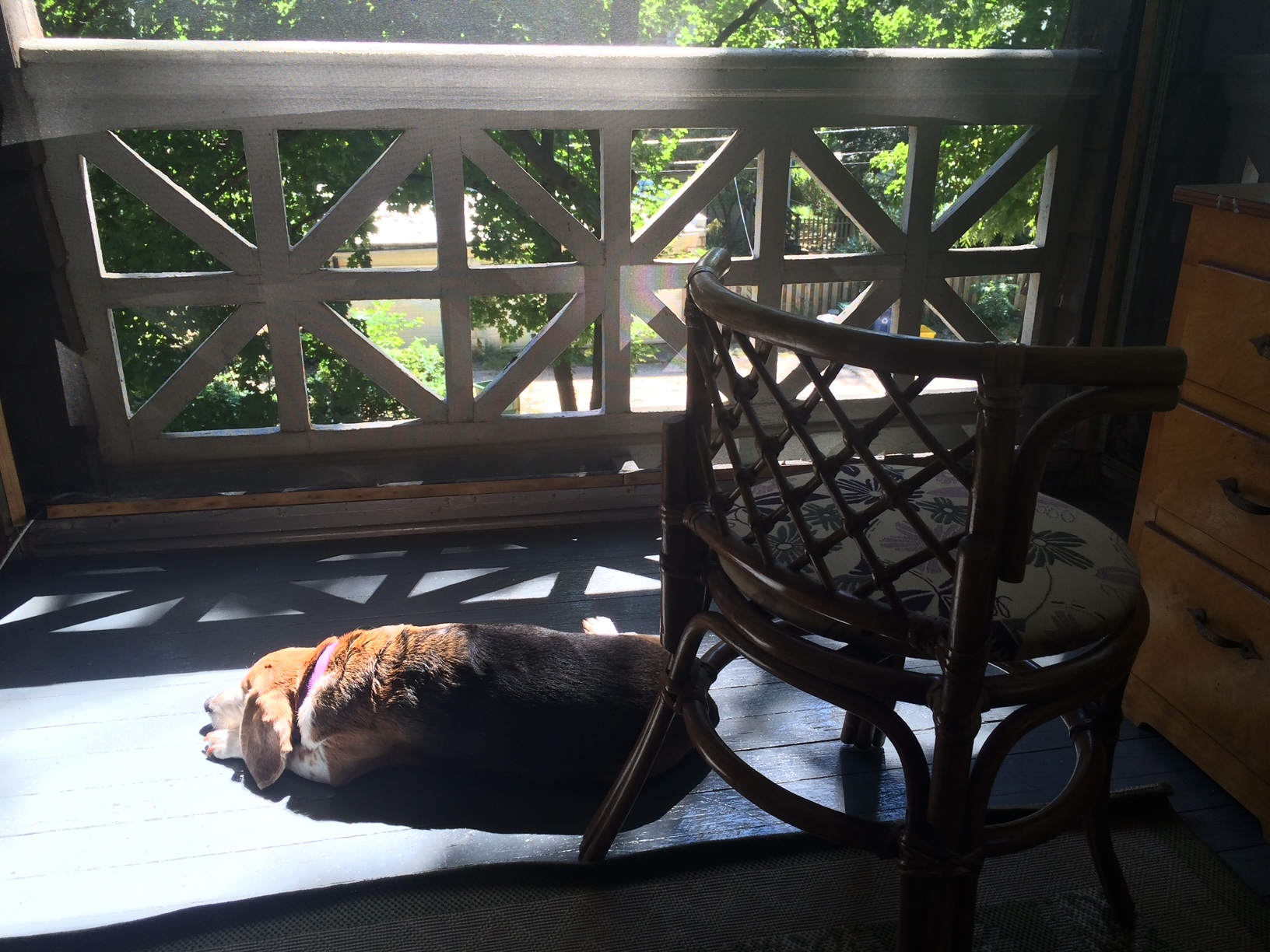
To be clear, I’m not in a tree fort, nor is it one of those trendy structures you see in AirBnB ads. house built in a tree. I’m safely in my house, but also outdoors on roof level, writing on the house's western-facing sleeping porch.


I didn't know what a sleeping porch was until we bought this house. Basically, it’s an outdoor living area that was typically built during the Victorian and Edwardian periods in North America, especially in the American South, where summer nights are usually hot and humid, and the Northeastern states and Canada, where many summer cottages for the wealthy were built from 1890 through 1920.


Elevated porch sleeping areas was believed to provide protection against tuberculosis and other contagious diseases, as well as providing relief from the heat. Some people were able to afford mosquito wire (aka screens) that further protected family members from insect bites. They were very popular in the period between 1910 and 1920, when homeowners added them on as renovations, the way we might add a mudroom or a family room to a house today. Our house was built in 1897 with the sleeping porches an integral part of the original design. Old-time electric lamps hang from the porch ceilings, which seems more evidence that these spaces were intended for socializing, game playing and reading before bedtime. 


Our house is extremely symmetrical, and it has a matched pair of second story sleeping porches that are defined by grand, Romanesque arches. The porch on the east side of the house catches the sunrise, while the western sleeping porch is very hot and sunny from noon onward. Our house has a third floor that's just above the porches. Up there, we found two places with rotting wooden strips of porch and damaged railings that indicated a rough gesture of comfort for servants. We removed these balconies, which seemed more hazardous than lovely. We put in new screens on the second floor porches and repainted and retained them, and a whole new world opened up.


Although I can’t wait to set myself up on the sleeping porch, my back starts to twinge when I think about the floor maintenance. When I was cleaning the porch’s woodwork recently with Murphy’s Oil Soap and water, I thought of others who have done the same job the same over the last 125 years. In 1897, the neighborhood trees would have been seedlings, and without car traffic, there would be less airborne pollution. Yet, given what I’ve read in historical novels about household maintenance, the servants probably had to wipe clean the porches several times a week. I hate the pain of vigorous cleaning, but I can always stop when I want, ignoring a spiderweb or errant leaf. 


This week, I’ve made a lot of plans to clean the porch floor that have resulted in procrastination. The gray floors have so much pollen that they are pea green; not even my dog will lie down on the. After the floors are swept and mopped, I will lay down the outdoor rugs that I vacuumed before storing indoors over the winter. When I drag in the porch’s vintage rattan and wicker furniture, the porch is buzzing with energy that has nothing to do with our carpenter bees. 


Year round, I do my writing in the morning; there are tables or desks in various rooms to suit my whim. On the sleeping porch, I’ve used a cheap, child-sized plywood desk from second-hand shop that I didn’t mind leaving out all year. And I got what I deserved: the old desk is starting to sag from ten years of porch life.  This year, I’ve decided to junk the desk and replace it with a new desk that’s adult sized, and has iron legs and a surface made from mango wood, a sustainable, inexpensive hardwood that does better outdoors than most woods. And this desk should be nice enough to bring inside during the winter.


One piece I’ll probably never replace is an extra-long wicker chaise that I bought for $50 on Craig’s List. I had a very long fresh cushion covered in outdoor fabric made for it, and now it’s the perfect place for reading, and of course, sleeping. Its generous width and high back made it extremely difficult to pass through a door out to the porch. Therefore we bring in the cushions, but not the chair, in the off-season. So far, so good. 


But nobody really looks at the furniture. The best thing about the porch are views right into the high branches of the trees. I’m captivated as I see squirrels chase each other along branches and then jump like Olympic athletes to the next tree and finish up by springing onto our roof. Sometimes, a squirrel explores all the way up to the edge of the screen separating us. At the sight of me, or my tiny snarling dog, the squirrel shoots back to a safer zone.


The bird songs are quite exquisite, and I‘m sorry to admit that I can’t recognize the singers by name. When it rains, I sit in comfort while hearing the drama of falling drops and feeling the whooshing of damp wind against my skin. 


When we are outdoors among trees, we go into what scientists call soft focus. The trees and sky and animals become part of a pleasant blur. Soft focus frees the dreams lurking in the subconscious. 


My goal this summer is to write approximately 1000 words a day, seven days a week. Sometimes, the sentences pour out and the duty is all done by ten in the morning. Yet there are just as many days when the process is slower. 


I believe the only way to overcome my writing challenges is to show up for them every day. Just like the squirrels and birds come to the trees, doing their own important work.