Showing posts with label fees must fall. Show all posts

Thursday, October 27, 2016

Whither South African Universities

Michael - Thursday

Protest at the University of Cape Town
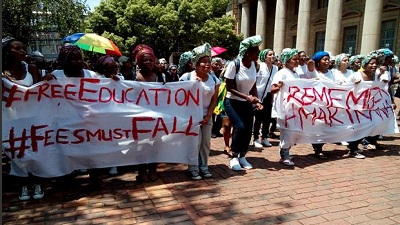
The last months have seen a concerted push by students around the country in the Fees Must Fall campaign. Initiated at the end of last year in response to the large fee increases proposed by the universities, it was successful in getting the government to agree to fund part of the increase and the universities to eat the shortfall. Somewhere along the line, the demand changed from no increases, to reducing fees, and finally to free tertiary education.

Protest at the University of the Witwaterstand
I’ve been a staff member in one form or another at the University of the Witwatersrand in Johannesburg for 44 years, so I have a lot of myself invested in the institution and its future is of real concern to me. It has transformed dramatically over those years from a largely segregated institution where 90% of the students and almost all the staff were white, to a university three times the size with a multiracial and multinational staff body and a student body whose racial makeup pretty well reflects that of the surrounding Gauteng province that it serves. It also hosts many international students, mainly from Africa. It does stronger research and has better students and courses than it did in the eighties.

The current scenes of police all over the campus supporting private security personnel and massive student protests remind some people of the demonstrations against the apartheid government in the eighties. But the comparison is wrong for a variety of reasons of which the most important is that then the university and the students were on the same side. Although the university has tried to align itself with the students by declaring that it’s in favor of “free, quality, decolonialized higher education”, the students are too savvy to fall for that. If that’s so, they say, then join our protest. Close your doors until the government agrees to exactly that. Our university has refused to do so—90% of staff and 75% of students want to finish the academic year and write the final exams.

Small groups of students (and others) break up classes, damage property, set fires and throw stones. I have to say that I’m disgusted by much of the violent protest. Sometimes it consists of bullying—often targeting on female staff and students. Fire extinguishers have been used to break up classes. A cleaner subsequently died from the fumes. Firecrackers of the most explosive type are hurled into classes. A student of one of my colleagues was burned in three places on her leg. Buses and cars have been vandalized and destroyed. This week a fire was started on a bus transporting 15 students. Thankfully, it was spotted, the bus stopped, and the students evacuated; they could all have died. That isn’t robust protest, it’s nothing short of terrorism.

And what is the government doing while all this is going on? The president too has urged the students that he hears them, that he’s on their side, that their aim of free higher education is just and reasonable and one the government supports. So there's no need for violence, no need for protest aimed at wrecking the academic year. Another stakeholder trying to get on the right side of the students by supporting what he has no intention of delivering. (He has other things on his mind.)

Protest at Parliament
How “just and reasonable” are the student’s demands? Free higher education is almost certainly unaffordable in South Africa which is beset by needs from poverty, healthcare, primary education, through to crushing unemployment, to say nothing of the president’s new mansion. But fees have increased rapidly ahead of inflation, and bursaries are inadequate for the total of fees, living, and other costs. Furthermore, sometimes students are denied bursaries on the grounds that their family income is too high. Yet that calculation takes into account the income of siblings who may have their own financial stresses and have no obligation and no intention of supporting a brother or sister at university. The administration of the national loan scheme is hopeless, with students sometimes being excluded because their loan payments are delayed. Banks also loan students money but they want it back! (People in the US are well aware of how that may play out.) The students don’t need platitudes, the system is broken and they need it fixed.

Also there is another aspect. When asked at his recent book launch to comment on the student unrest, Athol Williams, a self-made man by any standard, said that it reflected a deep disillusion of South Africa's youth who feel failed by the new South Africa. That goes way beyond the issue of fees. 

It’s the universities that will be the meat in this sandwich, being squeezed between student demands and government priorities and ineptitude. Research will decline, good staff will go elsewhere. Well-healed students will take themselves off to private universities as they have with private secondary schools already. Take the ‘h’ out of the first word of this blog's title.

Still, violent student protests have occurred throughout the world. Sometimes things are achieved, sometimes not. Yet the universities have survived. I hope.

Thursday, August 18, 2016

Wither the Universities?

Michael - Thursday

From time to time I’m asked by people I meet how things are going with South African universities. Have standards fallen? They know that I’m still a part-time professor at Johannesburg’s University of the Witwatersrand (Wits). I don’t want to speculate about what motivates these worries, but recent student protests and wrangling with the government have certainly brought them to the fore, and I hear these concerns from black acquaintances as well as white ones. My answer is that as far as my subject area is concerned (mathematical sciences), I feel standards have risen, research is stronger than ever, and graduate students are as good as before and there are far more of them. Whatever failings we’ve seen in government primary and secondary education in this country (and there are many), the government has been supportive of quality tertiary education and research, especially in the science, technology, and health areas.

This week a report came out from one of the organizations that rates universities worldwide and tracks established universities' relative positions in the top 500 in the world from a research perspective. Only 34 countries made the 500 cut and, although all these types of ratings can be criticized on a variety of fronts, if we accept their criteria and look only at relative position over time, the situation for South African universities is encouraging. 
University of the Witwatersrand
Shanghai university ratings
The graph shows the relative position of my university over the last 13 years. Starting in 2003 just making the cut, and then being in the 300-400 position range (not terrible in view of the number of institutions worldwide and the quality and funding of many of them), we have now moved to the top university in Africa at 203. This seems to indicate either that Wits has improved as a research university or that many others have weakened. I believe both are true. What’s more a further four South African universities also made it onto the list.

Minister of Education
Blade Nzimande
So does this indicate that all is well? Hardly. The universities here are currently facing what may well be the biggest threat since the previous government segregated them by race and thus subsequently largely isolated them from the rest of the world. The current threat comes from an unlikely quarter. Our own students. And they have a lot of arguments on their side that will not be alien to people in the US and many other countries.

Fees Must Fall protest at Wits
Last year’s student demonstrations were sparked by an ill-considered announcement before the end of year examinations of fee increases ranging between 9% and 11%. This in an environment where inflation was running at around 6%. Of course the local currency was weak and many academic requirements – books, journals, equipment - were escalating at very much higher rates. This sparked the Fees Must Fall campaign that led to mass student protests, some not so peaceful. Last year I wrote about it here. The protests escalated to government level (where they really belong) and the solution was a zero fee increase for 2016. The government promised to fill the revenue gap. It filled part of it.

A year has passed. The government is talking about an inflation-related increase, too little for the universities. The students want free tertiary education for all who qualify academically. The left wing EFF (which became king-maker in the elections of a week ago - see Stan’s post here) has cheerfully adopted a policy of free quality education at all levels. They know they won't have to fund it. Students have already closed two university campuses for several days, and have threatened to close them all for a year if necessary to achieve their demands.

Jonathan Jansen, Vice Chancellor at the University of the Orange Free State, points out in an article in the Herald Live - Demise of Universities Near - that there are three choices: Free education and the government foots the bill. This is pretty well universally accepted as unaffordable in terms of South Africa’s economy and priorities. Or a well thought out plan that allows all qualifying students to attend university, but involves payment either now (if they can afford it) or later in some reasonable way. (Yes, we have heard of the student loan trap in the US, for example.) The third option is that we stagger from year to year with zero fee increases and the government supplying more of the budget, but with the cake shrinking over time.  Another zero fee increase this year will see some universities closing programs and retrenching staff. As Jansen puts it: “What happens in the next week or two can determine whether your children and grandchildren will have respectable universities to go to in the future, or any university at all.” And he goes further: “When a country loses its universities, it loses self-respect.”

Really, it’s the people of South Africa who must decide what they want in terms of tertiary education. The sad thing is that the public seems uninterested, content to see it as an issue to be sorted out between the students, the universities, and the government. As for Jansen himself, he's heading for Stanford. 

Watch that graph turn sharply downward over the next few years.