
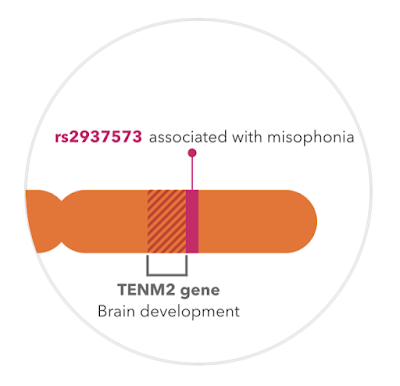
Late last week, I received an email telling me something I didn't know and, quite frankly, had never thought about. To make a short story long, researchers at 23andme, one of the companies to which you can send a sample of your DNA for analysis, had tested my rs2937573 marker, which is located close to the TENM2 gene, which in turn is related to brain development. I was found to be a AA genotype.
Translated into language I can understand, this means that I have slightly lower than normal odds of suffering from misophonia (a good word for you, Zoë!), which is a condition in which a person experiences intense anger and disgust at the sound of someone else chewing!
Good to know.
A good friend of mine was given a DNA test kit as a present by his son, who had already sent his sample in. A couple of years later, the son, call him Peter, was contacted by someone, call him John, claiming to be a close relative - a half cousin, in fact. That is, Peter and John shared one grandparent.
In this case, everyone lived happily ever after. My friend and his family accepted the reality of a new relative. John has never laid any claim against the estate of his grandfather or against his grandfather's heirs. As far as I know, the two families have gone back to leading their separate lives with no acrimony or anger. Perhaps part of the reason for the outcome being so benign is that the infidelity happened a long time ago, and the persons involved is no longer alive.
It is useful to know some of the facts about DNA testing - particularly when our world seems to respect facts less and less.
If you are told that you are related to someone with any of the following relationships, you can be confident that you are closely related. The only exception to this is if the DNA samples were switched, inadvertently or advertently.
Parents, children, siblings
There is an anomaly in the case of the children of identical twins. We know them as cousins, but a DNA analysis will report them as half-siblings, and both twins will be shown as parents to both sets of kids.
Second cousins or closer
There is an anomaly here too. If someone shows up as your first cousin, they could be your first cousin, but they could also be your great-grandparent or great-grandchild, half-aunt or half-uncle, half-niece or half-nephew. So, if it is important to know how someone in the first cousin category is related, a little research should sort that out.
I didn't know until researching this blog that an important word to know is centimorgan (cM) (another one for Zoë!), which is just the word that geneticists use to describe the length of DNA segments – specifically, the difference between chromosome positions.
Every person has approximately 6800 centimorgans of DNA. This number includes both copies of each numbered chromosome, or approximately 3400 centimorgans inherited from each parent. However, siblings are likely to inherit different sets of centimorgans from their parents, because sets of centimorgans are passed down randomly from one generation to the next. This is the reason siblings are usually different.
Here is a brief explanation of this diagram which I took from whoyouaremadeof.com. It explains how segments may be passed down.

A quick search of the internet reveals many stories of unexpected results, some causing great trauma, some not. Since tens of millions of tests have been performed, it is not surprising that so many people end up surprised. A good article in The Atlantic from three years ago shows some of the issues that surface. You can read it here.
I was surprised at how few reports I found of unexpected matches resulting in lawsuits, although my writer's mind came up with many.

Of course, people submitting their DNA have control over the extent they want the results revealed or shared. However, I suspect that most people who have paid money for the information want at least some of the information for themselves, even if they don't want anyone else to see it.





