Wendall -- every other Thursday
Like my protagonist, Cyd Redondo, I am a “carry-on only” traveler.
We’ve all had airlines lose our luggage, either temporarily or permanently, but it was only in my twenties, after I was horrified to recognizes a few of my “scanties” circling the luggage carousel—the handlers had destroyed one of my duffel bags and only partially duct-taped it back together—that I decided never to check a bag again.
 |
| Who wants this, really? |
This makes a lot of things easier, including checking in and arriving at my destination, not to mention reducing stress, but the downside is that it limits the kind of treasures I can bring back from my travels, both international and domestic.
 |
| The top of our fridge. The bottom is also full of commemorative magnets. |
Since I am a Million Miler plus on American, this means I have an inordinate number of postcards, magnets, pens and hotel pads, jewelry, scarves, and coffee mugs.
 | ||
| James and I stayed at the Sahara the weekend we got married. And many times after, until it was sold and ruined. This mug has been glued back together, twice! |
 | ||
| Although there is still a decent restaurant in the old Sly's space, it's not the same. Glad we have the mug. |
 |
| The booksellers in Wildys deserve a medal. |
 |
| One of my favorites, from the Museum of New Zealand Te Papa Tongarewa. |
 | ||
| We always try to get exhibition mugs. Particularly happy still to have the MOMA Picasso mug from '96 and the Titanic mug from Belfast. |
 |
| And from concerts I've traveled to. |
Hotel mugs, always, if they have them.
 |
| I always stayed in the Niche Hotel in Newcastle when I lectured there. |
 |
| And the Beverly Hills Hotel mug was a must, right? |
 |
| The mug on the far left features a Harvey Girl, from the exhibit in the New Mexico Historical Museum. |
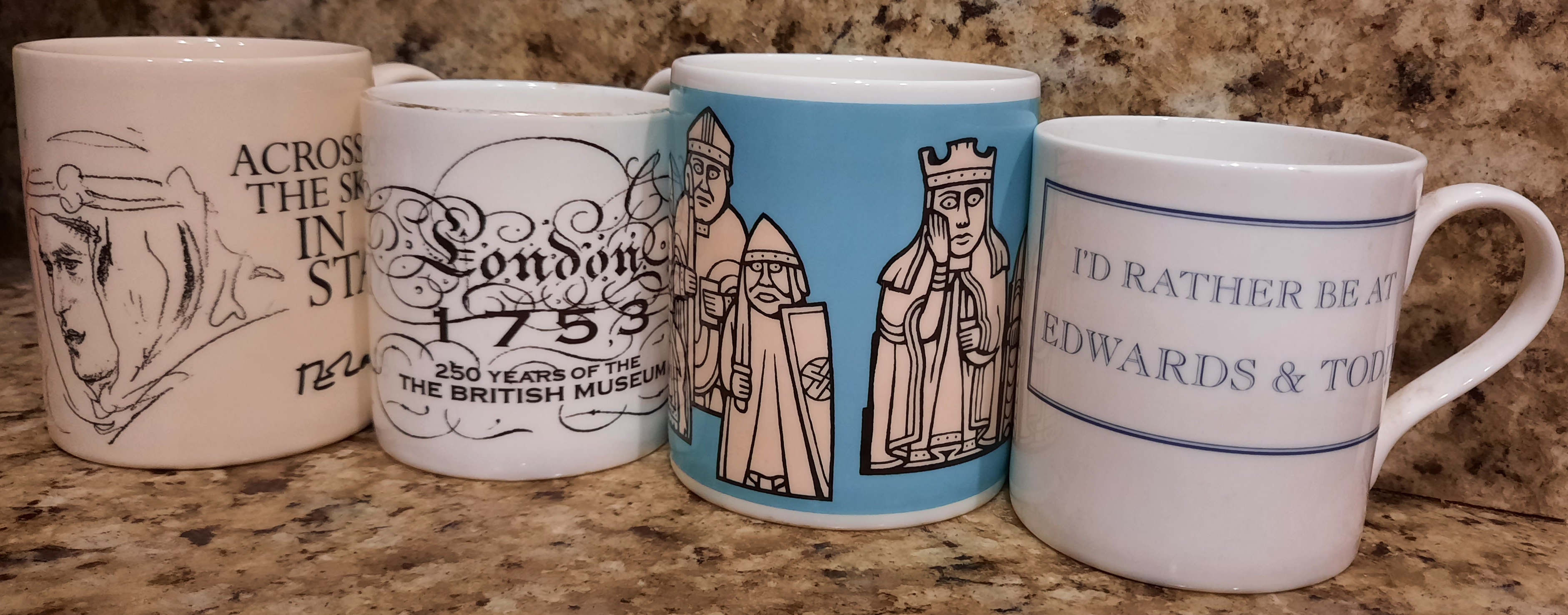 | |||||||||||||
| I've brought too many mugs home from England, but here are some of my favorites. The T.E. Lawrence mug from the National Portrait Library, the Lewis Chessmen and 250 year anniversary mugs from the British Museum, and a mug from my favorite store in Bloomsbury, Edwards and Todd. |


What do you all bring back from your travels?
--Wendall