Wendall -- every other Thursday
Since I’ve been much occupied with the launch of Cheap Trills, this week I'm offering an essay I wrote for my students on scene writing for film, in hopes it might be useful for fiction writing too, but mainly because it might remind you of some films worth watching and re-watching.
 |
| Marilyn Monroe's character, Sugar, makes an entrance for the ages in Some Like It Hot. |
Screenwriting courses always stress the importance of film structure, but frequently ignore the very building blocks of that structure: the scene. Yet so often, it is one scene which we remember, which haunts us when the film is done—Sugar boarding the train in Some Like it Hot, Evelyn Mulwray's incest confession in Chinatown, Bertie’s first meeting with Lionel in The King’s Speech, the farewell in Casablanca. What is it that makes these scenes so unforgettable? I think asking yourself these three questions can put you on the road to memorable scenes of your own.
 |
| In Chinatown, Faye Dunaway gives us one of the most quoted scenes in film history. |
1) WHY IS THE SCENE THERE – WHAT ARE ITS FUNCTIONS IN THE STORY?
Often we write scenes and we don’t really know why. Then we become attached to them and they stay when they don’t really have a purpose. When you’re looking back at your script, it’s important that you know EXACTLY what the scene is contributing to the story—what are its FUNCTIONS?
Scenes are both a short film in themselves, with a beginning, middle and end, but they must also always be looked at in terms of their purpose in the entire film—as part of a sequence, as part of an act, as part of the whole. So each scene has a specific goal both in and of itself and a goal in terms of the whole film.
THE POSSIBLE FUNCTIONS OF A SCENE:
to give plot exposition/new information
to give character development
to set up a world
to provide backstory
to express the theme
to create suspense
to create laughter
to set/maintain an atmosphere/tone
to provide transition(in time, place, story)
to set-up a later scene or situation
to pay-off an earlier scene or situation
to speed up or slow down the action
to turn the action in a different direction
to express the writer's POV
to change the way we feel about the story
to reference another film and evoke emotion that way
to resolve a conflict
to create rhythm
 |
| This opening shot from Fritz Lang's The Big Heat does a host of things, including starting the plot and mystery of the film and symbolizing the violence in domestic life that permeates the story. |
SCENES SHOULD ALWAYS HAVE MORE THAN ONE FUNCTION. Usually, the best scenes have at least five. Often in a first draft, scenes only accomplish one or two objectives, but frequently, in rewriting, combining scenes will give you one powerful scene operating on several levels.
Beyond that, you have all the potential elements of a scene to consider and use. Believe it or not, the elements of the slug line itself can make a huge difference.
2)WHAT ARE THE PHYSICAL CIRCUMSTANCES OF THE SCENE? WHAT IS THE LOCATION? WILL THE SCENE BE MOST EFFECTIVE SET DURING THE DAY OR NIGHT? INSIDE OR OUTSIDE? PUBLIC OR PRIVATE?
The elements involved in when and where a scene takes place can add so much tension, irony, emotion, suspense, etc. to a scene, and it’s an area many writers take for granted or don’t consider seriously.
Think about how much more depressing a bowling alley is during the day and how that highlights Bad Blake’s downfall and creates empathy for him in Crazy Heart.
 | |
| Showing this bowling alley in the harsh light of day, rather than at "neon night," helps show Bad Blake's desperate situation. |
Or how the place where Sandra Bullock hope will be safe, inside the capsule, becomes a kind of prison in Gravity, and how the cuts to the exterior— space—increase our concerns about her survival. The brothers in Hell or High Water talk around subjects indoors, but air the truth more easily outside.
How does the actual location help to add conflict to the scene? Is it a recurring one in the story, and if so, does it gather meaning each time we return, as in Emily Blunt’s apartment in Sicario or the mill floor in Norma Rae? Do we worry that Martin Sheen’s mission in Apocalypse Now is “off the books” when it takes place at a private residence rather than an office?
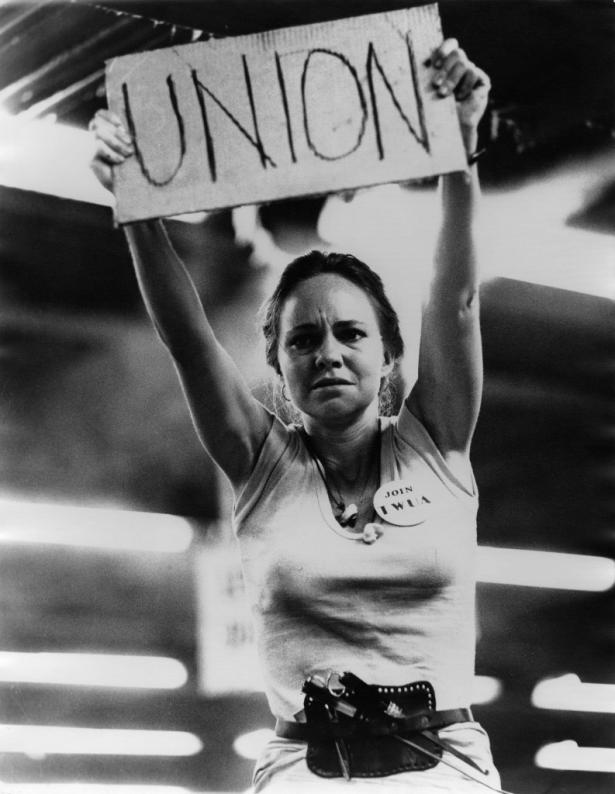 |
| So many crucial scenes that mark the emotional movement of Sally Fields's character happen in the mill, including this famous one. |
Think about the contrast in the first act of The Godfather—what goes on in the Don’s office vs. what goes on outside at the wedding. This is the epitome of how to use contrast of public/private. Is a scene more or less intimidating if anyone else is there? Is it more or less romantic if it’s public vs. private?
3) ARE YOU USING ALL THE POTENTIAL ELEMENTS OF THE SCENE TO THEIR BEST ADVANTAGE?
Here are most of the elements which are available to use in any scene:
Primary Characters
Secondary Characters
Tertiary Characters
Landscape/Physical Setting/ Weather
Physical Details/Size of setting/Objects, etc.
Dialogue
Sound/Silence
Color
Primary Physical actions/events
Secondary Physical Actions/events
Background Physical Actions/events
Often as writers we fail to take advantage of all the elements that can elevate and dramatize the material.
It’s amazing how much an object—like the bag of bread in Michael Clayton or the spacesuit helmet and whiteboard in Arrival—can layer and deepen a scene.


Tertiary characters can mean everything, too. Think of how much the “I’ll have what she’s having” line makes us remember the deli scene in When Harry Met Sally, or how the fact that Terry and Charlie forget there’s a driver in their cab leads to Charlie’s murder in On The Waterfront. Behaviors in the background can make scenes feel more dangerous, more claustrophobic, more exposed, more hilarious.
 |
| Rob Reiner's Mom steals this scene with her one and only line. |
Weather can also work for you. Rain is often used for painful emotional scenes, but if the tone of your piece is ironic, then bright, painful sunshine may serve your purposes better. Obviously, the heat and humidity in Body Heat helped create the atmosphere of corruption in that film. Think of Fargo, where the weather is a character. The rain and mud in Don’t Look Now makes the inciting incident more horrible.
 |
| The "heat" is on and makes all the difference in Body Heat |
And sounds can add immeasurably to a scene—think of the how the insistent warning signal in Alien and the iron lung in The Verdict create tension and emotional movement in the characters.
So, next time you are going back to your scenes, be sure you are making the most of them.
WENDALL’S upcoming Cheap Trills appearances:
READING AND SIGNING
Sunday November 5th at 2pm
BOOK CARNIVAL
348 S. Tustin St.
Orange, CA
https://www.annesbookcarnival.com/events/
INTERVIEW on Baron R. Birtcher’s WRITERS BAR PODCAST
available November 10 at https://www.facebook.com/WritersBarPodcast
Cheap Trills is now available here: https://amzn.to/3PVPuc1
--Wendall