Showing posts with label Writer's Block. Show all posts

Thursday, November 16, 2023

I LIED ON NANOWRIMO

Wendall-- every other Thursday

I cannot tell a lie. Actually, it turns out, I can.


I first attempted National Novel Writing Month—i.e. NaNoWriMo—years and years ago for three reasons. One, I heard a piece about it on NPR, two I had wanted to try to write a novel for thirty years and hadn’t had the nerve to do it, and three, my husband was going to be in England for the first two weeks of November.


Also, I always loved the logo...
 

Even though the idea of writing 50,000 words in a month, or even 10,000 words in a month, seemed absolutely impossible to someone who second-guessed themselves as much as I did, I decided to try.


And I astounded myself by actually writing more than the required 1667 words a day for the first few days. There was something about entering my word count and watching what it did to the graph they provided that was inspiring and invigorating. I wanted to get ahead of the curve. So the words piled up, I made progress. Actual progress. On a novel.


First title page of my first NaNoWriMo draft
 

It only happened because I couldn’t go back. I couldn’t revise. I couldn’t change my mind. And I definitely couldn’t delete anything—that would cost words. I could only go forward. I’d been a screenwriter for twenty years and I’d never done that before. It was a revelation. I kept thinking, if I can just write another hundred words, if I can just write another two hundred words, I’ll be ahead for tomorrow. It involved, of course, plenty of coffee, working in restaurants, and more than a little wine. But it worked. 


Sometimes the coffee worked. Sometimes the wine.
 

So, by the time my husband came home I’d already surpassed my 50,000 words, and by the end of that 30 days, I had 300 pages of my first novel, Lost Luggage. Back in those days, you actually had to submit your novel on the NaNoWriMo site, so that meant, for copyright protection, you had to “scramble” it to verify the word count. It looked like this:


Lost Luggage, scrambled.
 

Lost Luggage, published.
 

Granted, it was a hot mess, and it would take another year and a half to get it even close to something other people could see, but it existed. And I was hooked. It had been the thing I needed to, for once, get through a first draft without getting in my own way.


I have done the November challenge every year since, as well as an occasional “Camp NaNoWriMo” in April or July. I’ve used it to do first drafts of all my novels, as well as their rewrites. 


The beginnings of Cheap Trills.
 

To date, I’ve earned nine “completion” certificates, bought a variety of coffee vessels, gotten half price on Scrivener, and lots of other perks of “winning.”


The very first coffee cup I bought on my very first try.

A newer incarnation


As the years have gone by, of course, it’s transformed itself into something that’s much bigger—and hipper—than it was when my first time. I remember mentioning it at a Sisters in Crime LA meeting when I first started and no one had any idea what I was talking about. Now, almost every mystery writer I know participates. The National Chapter of Sisters in Crime does daily “write-ins,” writers post their word counts on Twitter, and it feels almost uncool not to participate.
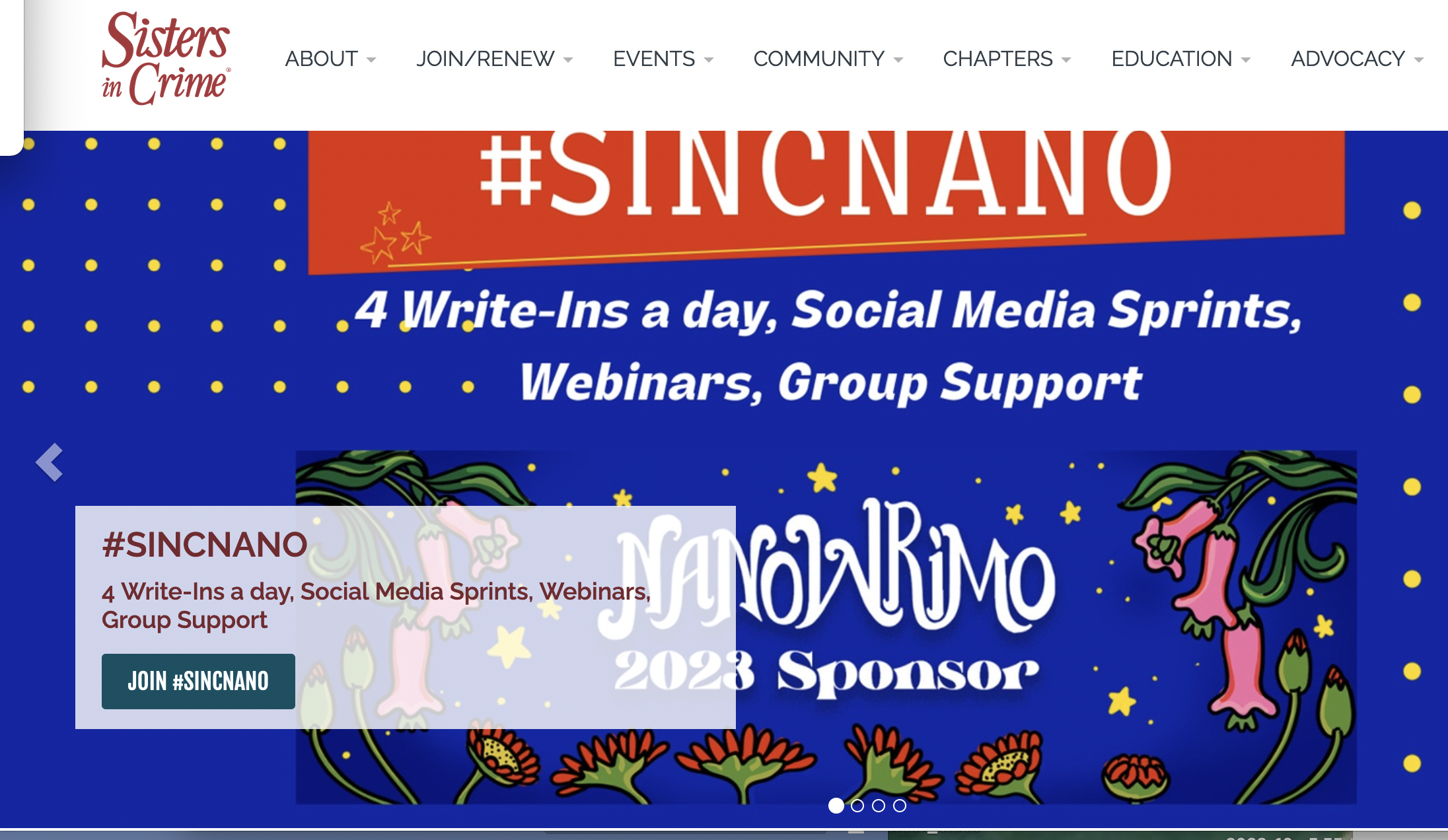
 

See what I mean???
 

So, this year, I signed up, registered my book, and took a deep breath, waiting for the November 1 start date.


Since Cheap Trills came out on October 30th, I was still in the midst of writing guest blog posts and trying to create very amateur graphics, so the first few days were a struggle. 


Marketing was never my strong suit.

Still, I managed to do the daily words. Barely. Then, the fourth day, I fell behind—only 500 words. And the next day, I got nothing done at all. And the next day, nothing again. And the next day, 200 words. The equivalent of nothing.


Suddenly, the graph was no longer my friend. How was I ever going to catch up, especially since I seemed to have no energy for writing? At all. My status page just sat there shaming me. The guilt! The embarrassment! After so many years of succeeding at the 50,000 word challenge, the idea of failing was devastating. How could this happen? How could I live with myself? Plus, all my “buddies” could see my word count. Did I just look like a lazy jerk?


On the sixth day, in a moment of weakness, I just added to my word count with words that didn’t exist. That I hadn’t written. For the graph. For my what I mistakenly thought was my self-respect. Flat-out lied. On NaNoWriMo.


The graphic illustration of an epic fail.

For the love of God!


The irony was not lost on me. It was horrible. I took the words off the next day, but the fact that I did it at all made me take a real look at myself, at my writing, and at what the hell I thought I was doing, anyway.


First, who was it I was writing for? Who cared about my word count? Anyone? Did anyone even care that I was writing a novel at all? I had always seen myself as a non-competitive person, so where had this ludicrous ego come from all of a sudden? Had it morphed with my crippling sense of responsibility, to rationalize such bad behavior? Was I horrified at myself, or just not willing to deal with the fact that, this year, I wasn’t up to it.


In the end, I realized the only person I needed to write for was myself. I was the only one I'd let down. Which meant I was the only person who could let me off the hook. So, in the end, I did. The new book is still burbling in my subconscious, where, right now, it belongs. And that’s okay. Novel writing is a long game. And it’s not all about the word count.


I still love you, NaNoWriMo, I just think we need some time apart.


---Wendall


You can hear Wendall talk about writing, movies, music, songbirds, and all things Cheap Trills on Baron R. Birtcher's THE WRITERS BAR here:

https://youtu.be/S32L679n08k


Sunday, November 28, 2021

What comes next? Handling writer's block

Zoë Sharp

I wrote a post about writer’s block about seven years ago, but as it’s a condition that does not improve with time—or age, alas—I thought it was well worth revising and revisiting.


Up until a few years ago, I would never have considered that I suffered from writer’s block. I still view my work as a craft not an art, and whilst I always strive to become a better craftsperson/crafter/more crafty, that doesn’t mean I can get away with sitting around waiting for the muse to strike. Putting arse in chair and putting fingers on keyboard generally works for me. This is a job, after all, no longer a hobby. As Lee Child famously once said, lorry drivers don’t get lorry driver’s block—they simply get up in the morning, get in their lorry, and drive.


In the past I thought of writer’s block as being a dreadful case of staring at a blank page and not being able to get a word down. But according to the online definitions, it can go much further than that. It also covers being able to write, but being convinced that everything you produce is utter rubbish.


If that’s the case, I’m a chronic sufferer. 


One of the best blogs I ever came across on the subject was penned by 
Charlie Jane Anders going back ten years ago. In it, she explored the different types of creative shutdown that form WB, and how to overcome them. The blog itself is well worth reading, but here are the highlights:


You can’t come up with an idea

This has never been my problem. I have so many novel ideas they’re falling out of my ears. Unless, of course, we’re talking about blog ideas, or short story ideas, and then yes, I do stare holes in the walls. These days, if I’m stuck I try writing up any kind of scene for which I have half an idea, regardless if it might fit with a current project or not. The CJA blog recommends you do a ton of exercises to get your creative juices flowing, from writing a random scene in which somebody dies, or falls in love, to writing a scathing satire of someone you hate. (Of course, just be careful not to accidentally email this one out to your writing class buddies…)


You have plenty of ideas, but none of them seem to go anywhere

This is a tougher one to get around and I admit to it being an issue with me. Until I have the starting point of a story of any kind nailed down I feel I can’t proceed further. CJA suggests working out the purpose of a project—that the novel idea you’re losing a grip on is actually a short story, for instance—which may rescue it. Saving them for a later date is often the only thing you can do, and come back to them later—and by that she means sometimes years later—when any reservations surrounding them have had time to disperse. Instead, look round for something fresh. If your creative mind is working so hard on reasons to reject the current crop, the chances are it will soon produce something that works here and now.


You can’t make progress even though you have an outline

This always happens when I’m in the middle of a novel. I’ve carefully worked out my outline beforehand, but there will always be sticky bits, and they’re usually where things have got a little vague. I tend to think of working from an outline as like driving along a road at night. Your headlights are on and you can see the road immediately in front of you in stark detail, but beyond that things are hazier. You know ultimately where the road leads, but that doesn’t mean a deer isn’t going to leap into your path, or an oncoming driver will career into your lane and you have to be prepared to react to that. If I’m trying to shove a story forwards and it won’t go, there’s usually a good reason. The best bits—to my mind at least—are the ones that arrived easily and fast.
 
CJA points out there could be a couple of reasons for getting stuck in this way. Either your outline has a major flaw and you won’t admit it, or there’s nothing whatsoever wrong with your outline, but you just can’t see a way of getting from one high-point to the next. In either case, she suggests going off on a bit of a tangent and seeing what happens.


You have no idea what happens next

This can quite often happen if the night before I didn’t stop writing until my forehead kept nudging the space bar. The next morning I’ll open up the document and discover that not only have I stopped in mid-sentence—occasionally in mid-word—but I have no idea where I was going with it. Sometimes the bulk of the previous paragraph makes very little sense either, but that’s another thing altogether. This is why I try never to end the day’s work at the end of a scene or chapter, so I do know what’s supposed to happen next when I pick up the thread again, and I re-read the previous day’s scribblings as well to get me back up to speed. CJA suggests, if you’re really stuck, to have something unexpected happen. To have Huck and Jim take a wrong turn on the river and get lost, or to drop a grand piano on someone. Or, as Chandler would say, to have a man walk into the room with a gun.


You think your story took a wrong turn waaay back, but it’s only finally come to a head now

This is terrible. I mark progress on a book by the cumulative total of words and having to throw away some of those words because you’ve wandered down a literary cul-de-sac just throws the whole project out of whack. To quote some old phrase: there’s no harm in turning back if you’re on the wrong road. That’s not to say it doesn’t hurt, but don’t throw any of that excised chunk away. The chances are it might come in handy for something else further down the line. You just might not be absolutely sure what that is yet. CJA suggests that you miss a section and carry on from the point you feel you should have been at, had you not decided to deviate in the first place, leaving the missing part to be filled in later. As someone who frequently writes out of sequence—many’s the epilogue I’ve written before the rest of the book—this would work for me.


You’re bored with the characters

Here CJA and I deviate because she suggests that perhaps this is because you haven’t worked out who your main protagonist is yet, and you’ve been concentrating on someone who’s a minor character. CJA’s advice is that sometimes you have to find the knife before you can twist it, and therefore writing a dozen pages or so of nothing-much-happening will help you get inside the world you’re creating and possibly also discover whose voice grabs you hard enough to make it obvious they should be the main character rather than a bit-part player. 
 
When I was writing only the Charlie Fox series, I was never in any doubt who was the main protagonist. But since then I’ve written more third-person, multiple-viewpoint narratives. The latest Blake & Byron books focus on two main characters, but with various scenes from other viewpoints. These characters are important to that particular story, but who may (or may not) reappear in the next book.
 
The best advice I ever received on this front was to make everybody count. Imagine Hollywood is turning your book into a movie, and a bit-part actor has just been cast in only one short scene, in which he/she is questioned by your hero/she-ro. I want that actor to be delighted with the part, rather than reading glumly through their lines and thinking, ‘ah well, it pays the rent…’
 
The scenes I’ve just been working on are a case in point. My detective, Byron, needs to question a possible witness at a motorway service station. The witness turns out to be a female truck driver from Glasgow, who is a reformed drug addict and spends her downtime reading Dostoevsky. What’s not to like?


You keep imagining all the reasons why people are going to hate your work

CJA describes this as your Inner Critic—you can’t make choices because you keep imagining how someone on goodreads or Amazon will tear you apart for it later. The Inner Critic, she says, has its place during revision, but during the first draft stage is better drowned out with some Finnish death metal. I’d agree with this, but at the same time I tend to self-edit as I go along, and therefore I don’t rush a first draft onto the page with the thought that I can correct any problems at the second/third/fourth draft phase. But, this is just me. I know everyone writes in their own way and therefore I do give sneaky house room to my Inner Critic during the first draft. I just try not to let it paralyse me to the point where I can’t get anything down. Reading over and over what I’ve written previously, trying to refine and improve it, always helps.


The Difficult Third Quarter

Here I’m deviating completely from CJA’s list to add a few of my own. The Difficult Third Quarter—DTQ—is one of my constant bugbears when I write. The first quarter of the novel I’m racing into the story, introducing the players and asking more questions of the reader than I’m answering. The second quarter is for some answers, followed by more questions and a few red herrings. But the DTQ is when you have to start pulling the threads together. Pull them too tight, too soon and the ending falls flat. Don’t pull them tight enough and you’ll be left with too much explanation to do in the final chapter. Unless you write the kind of books where the detective settles everyone down in the drawing room for the big reveal, this is something to avoid.


So, my question this week is do you suffer from writer’s block and if so what do you do to combat it?


This week’s Word of the Week is carking, meaning anxiety, worry, a burden on the mind or spirit. It comes from the Anglo-French karke, from the Old North French carche, charge—a variant of load, burden, imposition.


Saturday, August 23, 2014

With Apologies to Shakespeare and Hamlet (Act 1, Scene 2).


Is this a blank page which I see before me,
The blog thought toward my hand? Come, let me clutch thee.
I have thee not, and yet I see thee still.
Art thou not, fatal vision, sensible
To writing as to sight? Or art thou but
A blogpost of the mind, a false creation,
Proceeding from the late-night pressèd brain?
I see thee yet, in form as palpable
As this which now I write.
Thou deceived me the way that I was going,
With such inspiration I was to use.
Mine blog is made the fool o' th' other ones done,
Or else worth all the rest. I see thee still,
And on thy screen and laptop gouts of blood,
Which was not so before. There’s no blog here.
It is the bloody press to write which informs
Thus to mine eyes. Now o'er the one half-world
Nature seems dead, and wicked dreams abuse
The curtained sleep. Witchcraft celebrates
Pale god Poe’s offerings, and withered murder,
Alarmed by his sentinel, the wolf,
Whose howl’s his watch, thus with his stealthy pace,
With deadline’s ravishing strides, towards some design
Moves like a ghost. Thou sure and firm-set earth,
Hear not my words, which way they speak, for fear
my very stories prate of my runamuck,
And take the present offer from the time,
Which now sits on me. Whiles I write, MIE lives.
Words to the heat of reads too bold breath gives.


Jeff—Saturday
