Showing posts with label Target: Tinos. Show all posts

Saturday, July 5, 2025

The Joys of Researching a Robbery Plot


Woodcut print by Gustave Dore

Jeff—Saturday

Happy Fourth of July, US folks. And Happy Tourist Season, Greece.

I emphasize the word "Happy" because I don't want to talk about anything that makes us question what the hell’s going on in our world. 

There’s plenty of that everywhere you turn, whether you’re looking for it or not.

So, I’m going to retell something crazy.  Not really crazy, but decidedly Greek and exemplative of how I’ve gone about writing my fourteen books based in Greece.  Admittedly, retelling the tale also shows how much I love being there.  

Researching a new murder mystery can be fun.  Especially when it’s placed in Greece and you’re looking for the perfect spot to do the deed. Or find the corpse(s).   Deep blue seas, wispy white clouds, green-brown hills, blood-red blood.  Yes, finding the site is fun.   Mainly because it’s something you can do without confiding your purpose to a soul beyond your own. 

Saying, “Hi, can you suggest the perfect spot for a dismembering moment,” is not likely to get you the same sort of warm response as, “Your spanikopita are the best spinach pies I’ve ever tasted.”  [Note: On the off chance that it does, take a hint from Sweeney Todd and dine elsewhere.]

In that spirit, I’ve taken to fading in among the anonymous tourists driving and hiking about Greece until the moment I come across that spot my deep, dark mysterious mind always told me must be out there.  Then, voilà, let the mayhem begin.

Having said all that, some plot elements can take hold of your mind that by their nature necessitate a far more adventuresome sort of exploration.  Like when a little voice in your head says, “Hey, genius, why don’t you make the robbery of the millennium pivotal to your story.”

When will I ever learn that the most dangerous voices are the most flattering ones?   And of that lot, the worst by far are those blithering away inside your own head—even more so than that of an agent hot to represent you.

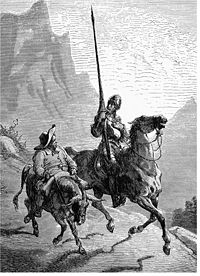
Don Quixote (Honore Daumier)
But the trouble with imagination is that once it takes hold the most difficult aspirations turn irresistible.  I’ve been told that Quixotic characteristic passes with maturity. 

To get to the point of all this, my fourth novel, "Target: Tinos," required a detailed understanding of security surrounding one of the least known  treasures in the world—if you’re not Greek—in order to make the leap from reality to the impossible not that far.

The Treasure of the Sierra Madre
To do that, I needed to speak to an insider, someone with intimate knowledge of the target.   And so, I set off on my quest with a friend (let’s call him Sancho) who knew such an insider (let’s call her Dulcinea).  My friend had read all of my books and knew I was working on a new murder mystery, but had no idea why I was interested in learning about the treasure.

Guy Fawkes Conspirators (Crispijn van de Passe)
“If Dulcinea wants to know the purpose of the meeting, tell her I’m an American writer working on a book about the hidden charms of Greece and could not possibly write such a book without including their priceless treasure.” 

I had my questions and my approach all prepared and worked out in advance. Sancho assured me that Dulcinea spoke perfect English because my Greek could not carry off the type of in-depth, subtle fishing expedition I had in mind.

“Perfect,” I once again learned, was an imperfect word.  Dulcinea’s English was as perfect for getting around an English language country as mine was for ordering a gyro in Greece.  Within thirty seconds Sancho was serving as interpreter.  I told him to translate my questions and her answers exactly as they were spoken.  He assured me he would.

I began with carefully phrased general questions of the type intended to make everyone comfortable.  They would run on for several sentences, Sancho would nod and say four words to Dulcinea who’d give him a two-word reply, followed a several-line editorialized answer from Sancho to me. 

I was getting nowhere fast.

Nope, not the Hope,
After ten minutes or so, Dulcinea suggested we leave her office to see the treasure that was the purpose of our visit.  Let’s make the image simple: think breathtaking, spiritual, priceless and very portable.

As we stood in front of the treasure, I tried a few more subtle questions, all with the same result.  So I switched to a different tack.

Nor Fort Knox
Me:  “Where do you keep the treasure when it’s not on display?”

Sancho to Dulcinea to Sancho to Me:  “In a safe over there.” She pointed to a two-meter tall, cloth-covered rectangle.

I walked to the cloth, pressed my hand against it, felt the steel, moved my fingers to the hinges and then the handle.  “Is it bolted to the floor?”

S to D to S to Me:  “Yes.”

I asked if I could take few photographs and Dulcinea said, “Yes,” a rare honor according to Sancho.  I nodded and smiled to Dulcinea then began photographing the skylights, windows, doors, and floor.

Dulcinea said something to Sancho, “She wants to know what you’re doing.   The treasure is over there.”

I said, “Sorry,” and quickly took a few of the treasure.

Sancho said, “Are you done yet?”

“There must be more security for the treasure than just that safe.  Ask her.”  Sancho hesitated.  “Just ask,” I said.

This time it was Dulcinea who gave the lengthy answer and Sancho four words back to me.  “A lot, plus guards.”

“What time do the guards change shifts?”

Sancho said to me in English, “Are you out of your mind.  Don’t you know what she’s thinking?”

“Just ask her.”

He did. Dulcinea’s answer was quick and guarded.  “It varies.”

Sancho and Dulcinea looked like two bank tellers waiting for the masked man to hand them the note.

I smiled, “Can they be bribed?”

This time it was Sancho who went on for a full minute.  Dulcinea smiled and held out her hand to me.  She was thanking me for my lavish praise of her kind assistance and wishing me the best of luck with my new cookbook.

I'm still laughing.

—Jeff

Saturday, August 11, 2012

Greece Cannot Allow That To Happen


I wanted to write something light.  Something that would get my mind off my race to finish the new Andreas Kaldis novel by the end of August, and forget that for the first time in a decade I won’t be on Mykonos in September and October.  But I’ve delayed my US book tour for Target: Tinos long enough. 

I shall miss those months in Greece, they are the best of times.  But perhaps this fall the next six words of A Tale of Two Cities will prove more appropriate.   I hope not.

On that note, let’s take a test.  What was the first thing that came to mind when you saw the photograph at the top of today’s blog?  The Greek Meander or the Nazi Swastika?

How about both—A Greek Nazi Symbol? 

It is the symbol of Chrysi Avgi (Golden Dawn), a far right party that until this year was a fringe group dismissed by all.  It now has eighteen members in the Greek Parliament (of 300) representing 7% of the popular vote. 

Chrysi Avgi Magazine cover boy, Rudolph Hess
Although the party officially disclaims any intended resemblance to the Nazi symbol and colors, its leaders have used the Nazi salute, expressed public admiration for Adolph Hitler and others leaders of The Third Reich, shown undisguised, unvarnished hatred of immigrants (along with others who don’t fit their image of pure Greek), and demonstrated an uncanny ability for manipulating public opinion that would make Joseph Goebbels, proud—Adolph Hitler’s Minister of Public Enlightenment and Propaganda. 

I greatly admire the Greek journalists condemning the dark side of civilization represented by Golden Dawn, but I’m appalled by how many of prominence and authority in and out of Greece are still quick to dismiss them as nuts.  They should know better.

They are not nuts or crazies.  They are, as their Leader declared after being elected to Parliament in the first of two Parliamentary elections in 2012, something else:  Golden Dawn is a movement of which to “Be afraid.”  

Chrysi Avgi leader, Nikolaos Michaloliakos
It took three parliamentary elections in Germany in 1932 before Hitler became Chancellor in 1933.  Greece has five months to go in 2012 and Golden Dawn is relentlessly pressing its agenda in brilliant exploitation of the anger and frustration of a populace suffering through its equivalent of The Great Depression.  So successful is Golden Dawn in their public relations efforts, that the three parties comprising Greece’s governing coalition are rocked back on their respective heels trying to show that they, too, can be “tough on immigrants.”

The problem is that governments forced to deal with serious problems on a macro level can never effectively compete in a show of “toughness” where all its competitor need do is “small” things that appeal to the bile of so many, especially when it’s known there is nothing to fear from a government utterly afraid to hold them accountable.
Free Food in exchange for IDs in Athens' Constitution Square

How can an organized government compete against this sort of public relations driven shows of “toughness”:  Packs of men beating individuals of color nearly to death…threatening non-Greek shop owners to leave a community “or else”... using Athens’ parliament square in open (and unpunished) defiance of the Mayor’s order denying them the right to do so for their purpose of passing out free food only to Greeks prepared to demonstrate the purity of their ethnicity by submitting identity cards and blood types to Golden Dawn’s representatives for recording and use in who knows what fuhrer purposes (no typo)…forming a lynch mob to storm a police van transporting a 19 year-old Pakistani man accursed of a horrific crime against a 15 year-old Greek girl as part of their show of how they would protect Greek women against the immigrant hordes (forgetting for the moment that their party’s spokesman (and former special forces soldier) had recently repeatedly punched a female opposition party member in the face during a nationally televised election debate).

Those “little” media driven demonstrations of vigilante toughness will always be more appealing to the masses than the true private toughness required to address the root problems of illegal immigration ignored for so long by so many past governments for any number of politically expedient reasons.

The homogeneous Greek society of a few decades ago is no longer.  At least ten percent of its population is now immigrants.  Accept it.  There is no going back. And trying to mimic the methods of Golden Dawn with “programs” of immigrant round-ups and deportations that are universally condemned by groups such as Amnesty International only lends credence to the vigilantes and their own Final Solution for the immigrant problem.

What confronts Greece is not new to Greece or indeed the rest of the world.  What is needed though, is new: fearless thinking.

And if none is forthcoming, permit me to be so presumptuous as to present a warning right out of the pages of TARGET: TINOS.  It is a segment that served as the frame of reference for all that followed (and for which Marilyn Stasio of The New York Times made Target: Tinos one of her picks of the summer, he said in BSP):

“There are serious people in the E.U. looking for any justification for ending financial aid to Greece.  So far the arguments against us are purely financial.  That we don’t work hard enough, we’re corrupt, we don’t want to pay taxes.  You know the routine…

We don’t want to do anything that might give our enemies different ammunition.”

“What sort of ammunition?”…

“[O]ur adversaries would love to switch the focus of the debate from our country’s financial problems to our national character.  Paint us as indifferent to the plight of non-Greeks, an intolerant place where only Greeks are treated as deserving of protection, and all others be damned.  It’s a volatile, irrational, and emotional argument but one that could turn world opinion against us if it found traction in the press.  And then it would no longer be just a question of denying us further bailout funds, but whether or not to drum us out of the E.U.”…

And the longer this case remains open the greater the chance of some foreign reporter seeing glory in a story that shocks the world into action against us by linking Greece to words like ‘intolerance’ and  ‘genocide.’  We cannot allow that to happen.”

I'm likely to see more of this after today.
I’ve blogged about this before (I Will Not Be Silent) and no doubt will again for one simple reason:  Greece cannot allow that to happen!

Jeff—Saturday

Saturday, June 30, 2012

I Will Not Be Silent


Some might think I’m taking the easy way out this week by posting a story written by Pantelis Houlakis and Yiannis Souliotis that recently appeared in eKathimerini, Greece’s equivalent of The New York Times.  Trust me, I’m not.  Their story focuses on the marked increase of organized, vigilante violence against immigrants to Greece.  Yes, my new book, Target: Tinos, has a twist on that issue at the core of its plot but that is a work of fiction, and what these journalists describe is as real as it gets…something no tourist sensitive country wants to see publicized.  But every day journalists across Greece are reporting more of the same. Their courage is to be applauded by all civilized people, the conduct they report abhorred.

Some say this violence against immigrants is no different from what is happening elsewhere in Europe, it is not unique to Greece.  Others say the flood of immigrants into Greece is directly responsible for the increased level of robberies and other violent crime in their communities and they must protect themselves because their government and police cannot or will not. 

Both may be true—likely are—but neither justifies what is happening in the cradle of democracy as described in this story: 

Violence against Migrants in Greece intensifies.

Brutal attacks against migrants in Greece are becoming almost a daily occurrence, with violent mobs acting almost unhindered as police have failed to make any significant arrests.

As well as Attica
[the region of Greece that includes Athens], where numerous such assaults have been recorded in the past month or so, there have also been reports of similar attacks on the island of Crete, where two extremely violent incidents were carried out in as many days this week.

In the early hours of Monday, a group of unidentified assailants jumped a 25-year-old homeless Egyptian man who had found temporary shelter at Talo Square in Hania’s Nea Hora district. They beat him with metal bars, causing extensive injuries all over his body. The victim was taken to Hania Hospital, where he had to have lifesaving surgery which included the removal of a kidney.

In the early hours of the previous day, a group of four men attacked two Algerian migrants in their mid-20s who were sleeping near the Nea Hora beach. The assailants used iron bars, wooden bats and knives in the assault, and robbed the pair of their mobile phones and money. Hania Hospital treated them for extensive head injuries and stab wounds.

Back in Attica, late on Sunday night, a gang of young men assaulted a Pakistani migrant at the Attiki metro station, in an incident that was recorded by a bystander on a mobile phone camera. Police arrested 25 people in connection with the attack and confirmed that several were members of the neo-Nazi Chrysi Avgi (Golden Dawn) party, which was elected into Parliament on Sunday with 6.9 percent of the vote on an anti-migrant platform. When the victim of the Attiki station assault failed to positively identify his attackers, all 25 suspects were released from custody.

Golden Dawn political party's flag and logo
These attacks did not come out of the blue, as such incidents have been steadily increasing recently in frequency, causing rising concern among the majority of Greeks.

The first of this recent spate came on the night of May 28, when a Greek man, who remains at large, stabbed a Pakistani national at the Aghios Nikolaos electric railway (ISAP) station.

A day later, a gang brutally beat a Bangladeshi man, also at Aghios Nikolaos station. Witnesses of both attacks said they believed the attackers to be supporters of Golden Dawn, though police investigations could not confirm this.

On the evening of June 1, several Golden Dawn supporters were arrested after attacking a number of migrants they spotted while on a motorcycle rally through the capital -- in central Athens, as well as on Iera Odos and Pireos streets, south of the center. Among those taken into custody was the daughter of Golden Dawn’s leader, Nikos Michaloliakos.

Again, no one was arrested.

On June 12, an Egyptian man, who was working legally as a fisherman, was viciously beaten during a mob attack on the home he shared with another three compatriots in Perama, outside Piraeus, in the middle of the night. He told police that at least one of the assailants was wearing a T-shirt with the Golden Dawn logo on it. Five men and one woman were arrested after the victim identified them as being among his attackers. They testified before a Piraeus prosecutor last week and were conditionally released.

In Hania, however, local groups are trying to get a handle on the situation and responded to the latest assaults with the creation of the Anti-Fascist Initiative, holding an open meeting at the town’s soup kitchen in order to discuss the problem and ways of dealing with it.

Representatives of local groups condemned the attacks and called for immediate police action so that the perpetrators are brought to justice.

According to Yiannis Tsoukatos, a member of the Steki Metanaston migrant support center and rights group, the attacks are most likely racially motivated.

“They were carried out by a gang that most probably has a racial motivation,” Tsoukatos said. “These immigrants live within our society and they have never harmed anyone. Unfortunately, they had no work and were forced to sleep outdoors,” he added of the three recent victims, who were known by the local community as quiet people who could often be seen lining up for food at the soup kitchen.

Late on Tuesday, the Hania branch of the Steki Metanaston released a statement saying: “Society as a whole needs to stand united and strong against such phenomena of extreme racism. We need to create a protective net around all people against these fascist gangs. This is not just about the migrants or those who help and support them, but about society as a whole because migrants are the fascists’ first target because they are the weakest target. Then it will be everyone else.”

Meanwhile, two anti-racism rallies have been organized in Nea Hora next week, at 7 p.m. on Monday and Thursday, to condemn the attacks.

According to regional councilor Serafeim Rizos, “the murderous attacks of the past few days against economic migrants must be condemned by the whole of society, because it is the business of everyone to stop the spread of such phenomena.”

Hania bar representative Nikos Tzaras said on Wednesday that the attacks are a breach of the civil code and have no ideological content. They are committed, he said, “by people who have no regard for human life and who have no connection to society. The police must investigate these crimes and society must consider the magnitude of the problem.”

There are people of good will clamoring for their government to act—to protect citizens and immigrants alike.  If their leaders do not listen things will only get worse.  And quickly.

Jeff—Saturday

Saturday, April 7, 2012

Back Home Again


Ahhhhhhhhhhhhh.

That’s my way of letting you know I’m back on Mykonos, safe and sound as of late Thursday.  It’s early Friday morning and I’m sitting on my front porch taking in the view.  And what a view it is. I’m on a rise behind the seven windmills symbolic of my island, looking across the old port toward the much larger neighboring island of Tinos, a half dozen miles away.

It’s been a hectic week, starting off with chores on a farm in western New Jersey (that’s my forest fire fighter buddy’s new truck in front of the barn) and a few days in New York City to tidy things up a bit before flying off from JFK—no doubt passing Stan headed in the opposite direction somewhere midway across the Atlantic.  But I made it, and the photo at the top of this article is the start of my first Aegean sunset of 2012.  Glad I could share it with you. 
Park Avenue
JFK Delta Lounge
My trans-Atlantic view

I know it’s time to start writing the new book.  But for this morning, at least, I prefer reminiscing about the last one, and what got me to write it.  After all, it all started here, on this porch.

Have you ever wondered how many times a day your eyes see something that your mind never gives a second thought?  Birds, for instance, or the color of the floor in your apartment building’s halls.  That’s sort of the way I’d always looked at Tinos.  It was just a high-ridged, mountainous island backdrop for whatever what was happening on Mykonos. 
Tinos' Church of Panagia Evangelistria

I knew of Tinos’ Church of the Annunciation (Panagia Evangelistria) and of the more than one million pilgrims who flocked there each year seeking to invoke the healing powers of its Miraculous Icon of the Virgin Mary (the Megalochari).  It’s perhaps the most revered religious shrine in Greece and is known as the “Lourdes of Greece.”  I also knew that every August 15th Tinos was overrun with gypsies coming to pay their respects to the Virgin during the annual religious festival celebrating her assumption into heaven. 

Many times I’d stood on the deck of a ferry stopped in Tinos’ port and watched pilgrims head off to begin a half-mile crawl up the steep hill from the harbor to the Church.  But I never had much interest in visiting there.  It seemed too close to bother, much like the Statue of Liberty is to New Yorkers.
Path crawled by pilgrims

About two years ago I was having morning coffee on my front porch with an American friend.  Her late husband had been a jeweler on Mykonos.  We were talking about a new book I was working on and she said, “You should write one about Tinos.”

When I asked why, she said, “It has all that hidden treasure.”

She sure knew how to get my attention.  That’s when I learned that her husband had been one of the few jewelers entrusted to restore and maintain hidden caches of gold, silver, and precious gems given as gifts to the Church of the Annunciation by grateful pilgrims.  Not long after that I learned that all this wealth was not controlled by the Greek Church, but by a two-hundred-year-old private foundation so rich and powerful that some referred to it as “The Vatican of Greece.”

A miraculous icon, vast hidden treasures, a mysterious foundation, and gypsies.  How could I not be inspired?  Still, it took until last spring before I got around to seriously exploring Tinos.  Now it’s one of my favorite places in Greece.

Most who come to Tinos are only aware of the Church and its surrounding harbor town.  But for those who venture out onto the island, there are serious surprises in store.  Fifty villages as quiet and undisturbed as a dreamer’s quaint fantasy of Greece; brilliant vistas at every turn; a meandering two-hundred-mile network of cobblestone trails and old farm paths running from hillside to hillside and dipping into valleys in between; and a history of fabled marble quarries and artisans linked to some of Greece’s greatest artistic achievements.

And unlike other Aegean islands, Tinos successfully resisted Ottoman rule for most of Greece’s occupation, making it a Christian oasis amid Turkish domination and the Cycladic island chain’s economic center and most populated island, earning it the nickname “Little Paris.”

What a setting for a story. 

And it will be out this June.


For those interested in a peak at the tale, here’s Publishers Weekly’s starred review of Target: Tinos.  Dare I need say it began my week on as glorious a note as that resolving first sunset!

Set on the Aegean pilgrimage island of Tinos, Siger’s superb fourth procedural featuring Chief Insp. Andreas Kaldis (after 2011’s Prey on Patmos) cleverly integrates the ancient with the modern. When Andreas looks into the mysterious immolation of two gypsies on Tinos, apparently a hate crime against immigrants, he faces formidable pressures from his fiery fiancée, Lila, whom he’s to marry in six days on nearby Mykonos—and from his wily boss, Spiros Renatis, who abruptly orders him to close the investigation. While the Greek government can’t afford bad publicity during the country’s current financial crisis, Andreas, aided by his feisty chief assistant, Yianni Kouros, and his friend Tassos Stamatos, chief homicide investigator for the Cyclades, pursues this eerie case, which soon involves ruthless Albanian mobsters, the history of Greek independence from Turkey, and a Tinos-based esoteric cult. A likable, compassionate lead; appealing Greek atmosphere; and a well-crafted plot help make this a winner. (June)—Publishers Weekly (starred review) 3/30/2012
Jeff—Saturday
