Showing posts with label Santorini. Show all posts

Saturday, September 15, 2018

A Massive Storm's Brewing in the Aegean


Jeff—Saturday

This weekend the Southeast US and the Philippines face horrendous storms.  The in-your-face enormity of the potential tragedy faced by the people in the storms’ paths got me to thinking about the region of the world in which I spend more time than anywhere else on earth: Greece’s Aegean Cycladic Islands.


There’s a storm raging through my part of the Aegean.  It’s already hit hard on Mykonos, Santorini, too, and alerts are sounding on other islands.  Paros, Naxos, and Milos sit directly in its path, but they’re far from the only ones at risk.

It is a devilishly cunning storm; one that comes ashore subtly, offering welcome rain to drought parched islanders, and in so doing distracting the citizenry from the great risks their island faces from what’s coming: gale force winds to level its unprepared institutional authority, torrential rains that drown those brave enough to challenge the invading storm’s will, and massive flooding to forever alter the island’s landscape.

It is a storm unlike any other, for what gives it energy is not warm waters, but cold hard cash.


The islands are experiencing an influx of tourism money unlike any ever experienced before.  And there is no sign of it going away anytime soon. Yes, the types and origins of tourists will change—they always do—and some islanders will go bust because they misjudged the market, but tourism cash will keep coming, and if cash remains the piper, islanders appear willing to keep dancing to the tune, no matter how foreign it may be to their own culture and values.


The islanders say, “We’re just giving the tourists what they want.”  That’s a seductively understandable explanation, one quite compelling on the surface, but dig deeper and you’ll find its insidious ramifications. 

Let’s start from this proposition. If you are willing to provide an environment where the purveyors of vices and their clientele may freely conduct their business without threat of official repercussions, you will always make money.


So, enter the one-week-long tourist (four days longer than the average stay on Mykonos), who during those days lives as if Sodom and Gomorrah is alive and well.  The tourist leaves to return to life at home, one far more limited, ordered and restrictive than the one just enjoyed for a week.  What are the chances of that person’s behavior patterns having been changed by a one-week binge?

Now, let’s look at the islander who spends between four and five months a year, “just giving the tourists what they want.”  How great do you think is the risk facing the islander enabling such aberrant tourist behavior, that it is the islander’s family values that will suffer as a consequence?

Just think about it.

I’m not preaching morality here. I’m just saying that islands that see a golden pot of money to be made in chasing after tourist cash ought to take a long hard look at how far they are willing to go to get it.

Making a deal with the Devil is not new. Nor are the consequences.  The Devil is charming, the Devil is clever, and the Devil knows how to subtly make a deal for the souls of the innocent as well as the greedy. 


In other words, Islanders, heed the warning signs. One hell of a storm is headed your way.

Prepare, if you wish to have a say in saving your island.

—Jeff

Saturday, June 11, 2016

Mysterious Santorini


Jeff—Saturday

The classic, one-week Greek island vacation splits time between the Cycladic islands of Mykonos and Santorini.  When people ask me for my opinion on the differences between the two islands I invariably say, “You come to Mykonos to meet the person you’ll want to take with you to Santorini.”   If I have to explain that, may I suggest you consult a romance novel blogsite.

Readers of this blog are well aware of my loyalties and longstanding ties to Mykonos, so let me spend this Saturday sharing my take on Santorini, another Aegean gem.


Santorini stands as the southernmost of Greece’s Aegean Cycladic islands, 145 miles southeast of Athens, 85 miles due north of Crete, and slightly smaller than the American island of Manhattan.  Its official name is Thera, but Santorini, a contraction of Santa Irini from its Latin Empire days, is how it’s known to tourists worldwide.  To romantics drawn to legend, it bears yet another name, one tied to a cataclysmic volcanic eruption some 3,600 years ago: Atlantis, the lost island. 


Two million years of volcanic activity created a round-top island of lava rock embracing three limestone mountain peaks created eons before the Aegean existed as a sea. Evidence of pottery from approximately 6,000 years ago put the first settlers on the island in Neolithic times, and archeological excavations at the prehistoric city of Akrotiri unearthed a prosperous, developed civilization in
residence in the mid-16th century BCE at the height of the Minoan Civilization.


That’s when literally all hell broke loose, destroying everyone who’d not fled a prefatory warning earthquake, in likely the most catastrophic volcanic eruption in recorded history. 


For centuries after its hellfire volcanic eruption, Santorini remained deserted, but its critical location, fertile soil, and awe-inspiring beauty ultimately drew new settlers and conquerors. Phoenicians, Franks, rulers from other parts of Greece, Persians, Romans, Venetians, and Turks laid claim, virtually all enduring earthquakes or volcanic eruptions of varying degrees during their occupation.

Today, the main island of Santorini constitutes the eastern crescent––and by far largest––of five volcanic islands comprising a small circular archipelago. Three of those islands, Santorini (or Thera), Thirasia, and Aspronisi, are all that remain of the original island of Atlantis legend, with Palea Kameni and Nea Kameni born as new islands out of that and other eruptions, including more than two-dozen in the Common Era alone.

With 43 miles of coastline, an east-to-west breadth of between one and four miles, and an overall north-to-south length of eleven miles, Santorini resembles a seahorse standing on its head and staring west (an example inspired by Susan’s friends)––in the same direction as do most tourists. 


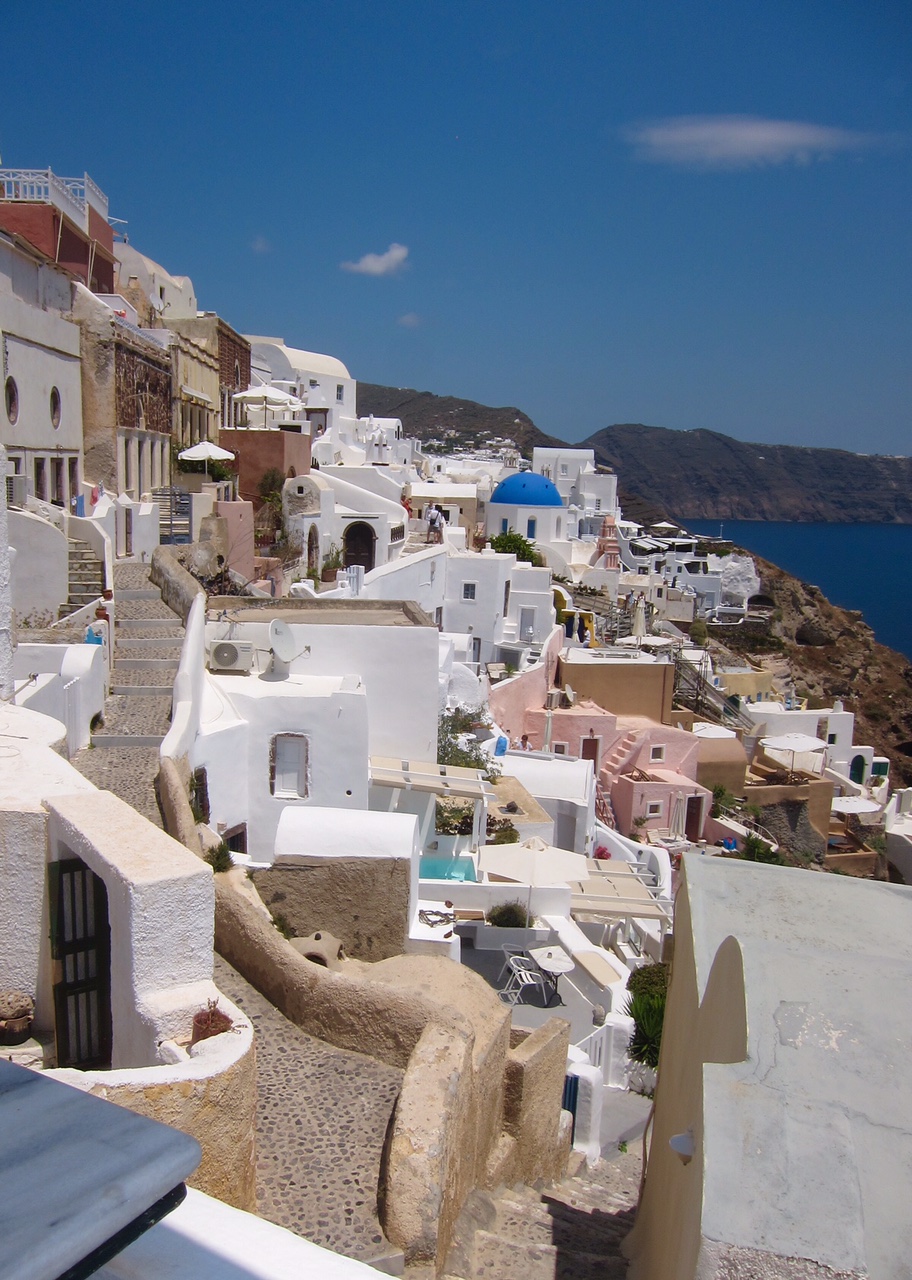
As reflected in its hotel prices, the island’s primary attraction is its view looking west from atop the rim of the volcano’s caldera. From Santorini’s capital of Fira and stretching north six miles along the caldera’s western rim through Firostefani and Imerovigli into Oia at the island’s northern tip, tourists pay hefty premiums for the breathtaking views and promise of romance symbolized by Oia’s emblematic blue-domed, bright-white, cliffside churches at sunset.


Away from the caldera Santorini seems much like many other parts of Greece, and its beaches alone are not a draw.  But standing on the caldera’s 900-foot red-black-brown cliffs, looking across the seemingly bottomless quarter-mile depths of the crater’s sapphire blue lagoon, one faces a true wonder of the natural world.

Locals, though, tend to live in areas off the caldera, many growing wine grapes cultivated in the unique, tightly coiled, ground hugging fashion that in winter resemble rows of dull baskets, but in growing season shelter the enclosed clusters from the wind.  Tiny cherry tomatoes, capers, fava beans, barley, and a unique white eggplant are other island growing favorites, with plantings filling practically every arable spot of land.


Historically, whether built in or out of town, Santorini houses came in three basic forms: those dug out of the volcanic earth and lived in as caves, those built partially dug out and partially built in the normal way, and those built completely above ground, virtually all designed with vaulted roofs of one form or another.  As the island’s residents became more affluent, the mansions that evolved from those forms fell more under the Italian influence of the Renaissance than any other style. (For those interested here’s a link to photos and more details).

Although everyone on the island pays homage to some extent to the tourist, most Santorinian hearts still beat as farmers and muleteers.  But not as fishermen. From ancient times, the island had great merchant trading fleets, and its ships performed heroically in Greece’s 1821 War of Independence, but Santorinians generally preferred to live far away from the sea in places where they could raise their crops and mules.  It was tourists who changed all that, starting, it’s said, with teaching many a Santorinian how to swim.


It seems only fitting that an archipelago born out of ancient cataclysmic events, would be transformed by a modern catastrophe into the tourist paradise it is today, rivaled in reputation only by its Cycladic cousin Mykonos.  On July 9, 1956, a 7.8 magnitude earthquake struck Santorini in what was recorded as the largest to hit Greece in the 20th century, severely damaging if not collapsing practically every building on the island.  But much as with the mythical Phoenix, out of its destruction Santorini rose to what today is a place of 15,000 year-round residents drawing 1.7 million tourists annually––900,000 to its hotels and rooms, 800,000 more from cruise ships.


Hmmm, sounds like a fertile location for a mystery.

By the way, virtually all of the photos are by the brilliant Barbara Zilly.


—Jeff

Saturday, June 13, 2015

Santorini.


I just returned home to Mykonos after three storied days on its sister Cycladic island of Thira.  That’s its official name but it’s known to most as Santorini.  I can see your heads nodding in sympathy for what I must endure to practice my craft. 


Santorini is said to have inspired the legend of the lost island of Atlantis.  I can’t say whether or not that’s true, but I can say Santorini’s inspired me to place my 2016 Andreas Kaldis mystery there, and that, dear readers, requires a lot of research.   


Admittedly I’m a little late for catching the Atlantis show, as it stopped playing more than thirty-six centuries ago when one of the largest volcanic eruptions in recorded history devastated the island, sending forth a mammoth tsunami toward Crete ultimately contributing to the destruction of the Minoan civilization.


But that’s all in the past. Or so we hope.

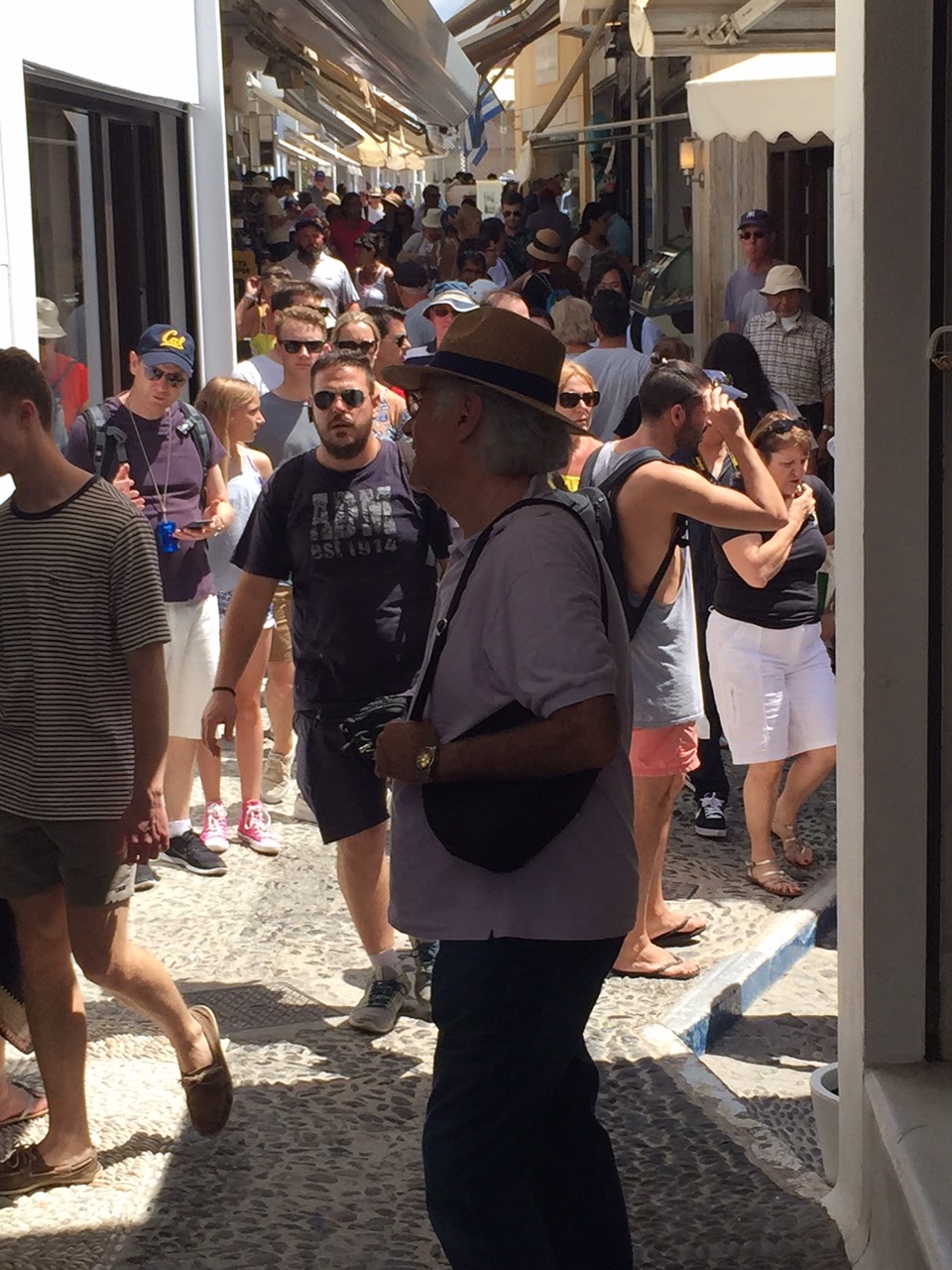
Today the only tsunami in the area of Santorini is tourism.  Santorini and Mykonos rank as the two most popular tourist islands in Europe (their tourism boards can argue over which ranks #1 this year :)).

Tourists in Fira

The unique call of Santorini is undoubtedly the breathtaking views from the northern part of the island, looking out from the rim of the caldera (crater) across the sapphire blue lagoon formed within the crater. It is a view truly worthy of a wonder of the world. 


Santorini is a place for staring hypnotically off into the middle-distance for hours while you contemplate the meaning of life.  Mykonos is more about the beauty of its old town, its fabled beaches, and 24/7 nightlife.  In other words, you come to Mykonos to find the person you want to spend time with on Santorini.

But enough words.  Let me show you Santorini in photographs, courtesy of my faithful photographer Barbara Zilly.  We stayed north of the island’s capital city of Fira, just before now famous Oia—the town on the western tip of Santorini featured in virtually every Santorini advertisement.

First, I have to say about our hotel (Csky) that it’s hard to imagine more spectacular views anywhere on the island, sitting as it does on the crest of the narrow caldera rim, with the lagoon in front and the broad blue Aegean to the rear.

Csky Hotel, Imerovigli, Santorini
Our View


 Our 3+ kilometer hike to Oia


The Promised Land
Oia


My photographer on break

Proprietor of Atlantis Bookstore
Goodbye to the port of Santorini


Jeff—Saturday