Showing posts with label Pandemic. Show all posts

Monday, September 12, 2022

The Journal of the Plague Year Redux

Annamaria On Monday

I am still here in Minneapolis and still basking in the glow of the first gathering of the mystery tribe in three years.  For my Bouchercon hiatus, I am going back two and a half years to my first post of the pandemic.  The people who lived in the black death of the 1660s had no weapons to fight that disease.  In our time, some people have chosen to refuse to use the powerful weapons that could have saved lives in the past thirty months.  Here is what I wrote at the beginning of Covid.  I hope you find looking at it again today of interest.  


One of the great things about writing and reading historical novels is that one sees dreadful past events safe in the knowledge that the human race has survived, even thrived in their wake.  One also can see the lessons to be learned from history.  Today, the historical novelist in me wants to compare what is going on now with the experience of a long ago epidemic, the 1665 Great Plague of London.  There are many similarities, but quite a few differences, all of which are very encouraging.  My source is Daniel Defoe’s A Journal of the Plague Year.**


The paperback I read in college looked like this


 Defoe’s account begins, as our experience of COVID-19, with statistics. (Coincidentally, by the way, their outbreak—like ours—began in December and began to grow in earnest January through March.)

His stats in early days of the outbreak:


Ours also in early days:


Right there, you can see how much better off we are now.  We have better data and know a lot more about how to use it. 

When it comes to identifying causes of the disease, we have an enormous advantage, which better informs us how to behave in the face of it.


Not surprisingly, the Londoners of old were totally wrong about what caused the plague.  There was a comet over London in the winter of 1664, and the disease hit with a vengeance the following year.  To Londoners of the time, a comet was a warning from the Almighty and the plague was God’s vengeance, punishing them for the sinful excesses of the Restoration.  The cure then would be to appease an angry God.


Because the seventeenth century Londoners thought God was punishing them, they ran to church to pray for respite.  They packed houses of worship, and not only on Sunday.  In Defoe’s description, many went to pray daily.  Such gatherings, of course, only made cross infection more likely.

Like us, they shut down theaters and music halls, venues of that sort.  Their motivation, however, was not like ours—to achieve social distancing.  They wanted to put a stop to the sinning and frivolity carried on in such places.  An angry God demanded that people stop having any fun. 

The “why” of our current pandemic is a proven fact:


 And knowing the true cause elicits (I am tempted to insert “Thank Heaven” J ) a much different response. We may not know exactly which bat bit which wild animal, but we know that bats can carry around lots of viruses without harm to themselves.  And they can transport them, in a bite, to other animals, including homo sapiens (I am tempted to insert, “sometimes not so sapiens L ).  Once the virus gets into one of us, it multiplies, makes us sick, and one way or another we start passing it on to each other. 


Some people may still see the wrath of God in this.  In researching this post, I visited one website where a minister answered the question: Is the corona virus going to bring on the End of Time?

Let's compare the Londoners of old and our behaviors in the face of an epidemic.  Well, despite their ignorance of the underlying cause, Londoners actually did some commonsensical things.  When a house was discovered to shelter victims, the place was “shut up.”  Quarantine was enforced with gargantuan measures.  Infected houses were marked with a red cross.


Some also carried the inscription, “Lord have mercy upon us.”  Such buildings were guarded 24/7.


London set up pest houses where sick people were forced to go into quarantine.  Any hackney coach that was used to transport a sick person to a pest house or a corpse to the graveyard was cleaned and put out of service for five or six days.

They practiced a certain amount of social distancing.  Samuel Pepys in his diary, talks about avoiding “noxious pestilential vapors.”  Defoe describes people walking in the middle of the street to avoid what they thought was poison air that might be coming from open windows.  He also says that the streets were deserted.

London 1665:

  “…if I have been a stranger and at a loss for my way, I might sometimes have gone the length of a whole street…and seen nobody to direct me….”


Florence 2020:

My friend Nicoletta sent me these stunning pictures of Florence near my apartment.


 Nobody!  Absolutely nobody!!


One reason for the deserted streets in 1665 London was that folks who could left town.  There is an exodus from cities today too.  For instance, a friend told me that her boss took her children to their house in Vermont.  In both cases, of course, those who travel risk spreading the disease.  Then as now, people often think only of themselves.  But that is not true of everyone.


In London in 1665: There was no organized medical service.  Medicines and remedies from both doctors of The Royal College of Physicians and from the neighborhood quack were equally ineffectual.  They ranged from anti-pestilential pills to carrying around a magical piece of paper that looked like this:


“Physik” was on offer.  Defoe describes quacks who died with their own elixirs in their hands. 

The most important—the life-saving difference for us, of course, is that we have scientists who can help us work out what we need to do to stay safe.  And trained doctors and nurses who will treat us if we fall ill.


One thing Defoe got completely right was his praise of those who cared for the sick.  He says “..to their praise they ventured their lives to lose them in the service of mankind.  They endeavored to do good and to save the lives of others.”

My favorite scientist in this fight: Dr. Anthony Fauci


We, who in 2020 are hiding out from the infection, need to think about those heroes and heroines who are acting with the very same courage today.  They are saving lives at the risk of their own.  


Thank you, Nurses
Thank you, Doctors
Thank you, Technicians
Thank you, Orderlies.
We pray you will be safe!


**Defoe was only five years old in 1665.  He presents his story as an eyewitness account.  When he first published it in 1722, he wrote as H.F.  The account is based on the journals of his uncle Henry Foe.  Nowadays, some scholars categorize the book as an edited version of Uncle Henry’s eyewitness account. Others call it a historical novel.  The jury is still out on this question.  What the book certainly does is what well-researched and well-written historical fiction always does.  It makes the reader feel like an eyewitness.  Reading it at this moment made me feel a sense of kinship with those poor suffering 17th Century Londoners.  And enormous gratitude to the scientists who give us all a much better chance to live through our 21stCentury pandemic.


Wednesday, December 29, 2021

An Improvisational Year

Sujata Massey


The songs are playing day and night. Some of them are tentative, while others blow the dust off the steep wooden staircase. My son is home from college for the winter holidays and nestled in his third floor bedroom with all his electric guitars--and the amplifiers. The improvisations he makes seem endless. 


I felt as if I'd ridden up to the crescendo of a power rock ballad when the first dose of Moderna went into my arm. After the jab, a sweet slide of relief into feeling saved. Yet after the freedoms of late spring and early summer, the Delta variant, and now Omicron, are showing that I can't expect the world to do what I want for it.  


I could give up and live in a 'what we lost' world. But there is another choice.


According to the Cambridge English Dictionary, the primary meaning of 'improvisation' relates to creations of music, dance and theater. The secondary definition is described as "the act of making or doing something with whatever is available at the time."


I have the privilege of sheltering in a home that I own during this pandemic with the company of family and the support of other good people nearby. Surely that makes it easier to think positive. 


And yet, my mind turns to M.F.K. Fisher.


I count Mary Frances Kennedy Fisher, as she was named at birth, as one of my most important spirit guides. The barrier-breaking food writer (1908-1992), began with essays and memoirs in her 20s, when she left California to live in Europe. Fisher spent most of her life melding her literary talent with her affection for cooking and people. Her books make you want to feast and drink fine wines, but the reality is that her life was often excruciating. When her desperately ill husband died by suicide in the 1940s, she stayed in Europe, a single mother with a young child, and no obvious means of support. During this time she was always dancing on the edge of starvation, yet she found ways to feed herself and others, and wrote a hilarious book called How to Cook a Wolf with recipes for living this way that has been rediscovered and comforted yet another generation. As she writes in introduction, “War is a beastly business, it is true, but one proof that we are human is our ability to learn, even from it, how better to exist.” She goes on to say, “It is all a question of weeding out what you yourself like best to do, so that you can live most agreeably in a world full of an increasing number of disagreeable surprises.” 


I live agreeably, because I am in an old house that has settled around me over like bedsheets slowly warming.  It's an 1897 cedar-shingled summer cottage within a nine-block neighborhood within North Baltimore that was developed in the mid 1890s through the 1920s. This development, Tuxedo Park, adopted the name of an elite community in New York, although my Tuxedo Park always had considerably more plebeian occupants. The plot of land on which the house stands was bought by a woman, most likely because the developers wouldn't sell to her husband because he owned a saloon. Tuxedo Park was just a streetcar ride away from the business life of the city, including the rough-and-tumble harbor and bustling downtown.


It's my suspicion that dreams of outdoor socialization and leisure led to our house's grandest feature, a three-sided wrap-around porch, and two large upstairs porches and several balconies.

I've spent a lot of time writing on the private upstairs porches, but rarely used the wrap-around porch. In fact, I didn't even have furniture for it.


But this spring, I decided to set up the porch like a Victorian lady might have, with plenty of settees, chairs both for dining and lounging and a a variety of tables. Most of the shopping was accomplished from online sources recommended to me by an online designer at Decorist who provided color renderings showing where everything should go--including potted palms. I followed some of her shopping links and went to the crafters at Etsy and my storage room for other pieces--and to the garden for the four old handmade Adirondack chairs.


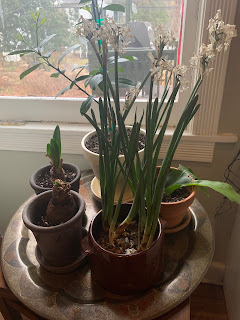
I wanted plants on the porch, which were part of the design, but I was nervous. I am comfortable with a garden full of native plants. I’ve never kept house plants, which are often exotics, alive for very long. So the first potted plants only arrived because they were gifts from friends. And these plants didn't need much tending; they shot up with new leaves, even with my off-and-on watering.


In midsummer, a neighbor held a moving sale, searching for new owners for the dozens of potted plants that she'd tended lovingly on her building's fire escape. I ambled over to her building with a small wagon and she agreed to sell me everything I wanted--and tossed in a few more plants for free. Gratefully, I wheeled away mature ficus and other friends, large and small, and best of all, already planted in ceramic pots with a soil blend that they liked. 


 Happily, the plants accepted their new home. Feeling more confident than expected, I bought some planters, potting soil, and a variety of big plants like palms and birds of paradise and citrus. Some of the plants I watered too much, and others seemed perennially thirsty. 


Yes--I still had to do actual yard work with plants that lived in the ground. I pulled Virginia creeper and English ivy and set my spouse to battle invasive mulberry and Rose of Sharon. In fall, I divided the proliferating native flowers and shrubs I've planted in fits and starts since 2014. Coincidentally, a friend dropped by with seedlings she had no time to plant. She was also touched by desire a not to let anything be wasted.


Now that I had an outdoor room, friends came over, singly or in pairs. Sharing some pie and a cup of tea felt as special as the multi-course candlelit dinners of the before times. I arranged a weatherproof dining table and chairs on the east side, which is so pleasant in the evening, especially under the fans. The fans and mosquito lamps were shut off in cooler weather, and the guests dwindled, although a last supper with Minnesota visitors bundled up in coats and hats, was fun. As we sipped mugs of soup and ate corn muffins, I thought maybe…this could happen again on a nice February day.  


As summer’s warmth slipped away, I moved the plant family, now numbering 27 souls, from the porch into the house. I took an unused desktop computer off a kitchen table and loaded it with plants, which would get happy sun exposure all afternoon. More plants made a colony in the butler’s pantry with its west-facing windows. To make room, I had to re-home the vacuum and remember to take out the recycling bags--but all things considered, I'd rather look at plants than empty cans and crumpled newspaper.


I dove into the writings and photographs of a modern plant guru (Hilton Carter, who lives in the next neighborhood over!) and followed his directions to make cuttings from the most exuberant plants. Roots slowly grew. I also went into the basement and found old forgotten flower bulbs that had survived a few seasons in paper bags. I've planted the ones that I hope are tulips in the garden, and the ones that are clearly dormant amaryllis in pots indoors. 


I also converted a sunroom—which had been a storage room—back into a home for plants. How ironic that the architect's original purpose for the room would finally be restored. I wrote about how this sunny hideaway has nurtured me in a short essay for Femina Magazine. The sunroom is tiny, but it's an utter luxury to have two walls of windows with garden views, and seasonal theater starring birds, squirrels, rabbits, and the occasional fox.  


Most evenings, I hunger for an activity that was relaxing, yet doesn't involve the printed word, or a brightly lit screen. About once a week, I settle in a comfortable chair, bringing the lamp closer, and mend. Any sweater with moth bites is fair game, seized as well as pretty pillows that had been ravaged by the dog. The hardest repair project I undertook was my early 1960s fake-fox winter coat. I’d believed its fragile satin lining was irreparable, but I knew I could never find anything like it again. What else could I do but try?


I stitched together ripped seams and patched a hugely frayed section with a colorful scrap of fabric from my last trip to India. As I sewed, I remembered several friends I knew who were sewing masks at the start of the pandemic. I think of sewing, just like baking and gardening, as being quintessential pandemic activities. And I'm unashamed that my patches don't match the fabric. They stand out as memories of fall 2021.


The more I ponder it, the dictionary definition of improvisation seems rather limiting. I. notice that the word ‘improvise’ shares a linguistic connection to ‘improve.’


When Neel makes repeated changes in his playing, he becomes more skilled. Let him be the star. I'm happy enough to have learned to sew patches and grow a plant from a single leaf. 


On January 4 at 1 p.m. EST, Sujata will chat about the creative process and all manner of things with her good friend Naomi Hirahara, who also writes historical crime fiction with Asian characters, including the highly praised recent novel, Clark and Division. For a link to this free Zoom event sponsored by Penguin Random House, please register ahead of time. 

Saturday, September 18, 2021

A Reluctant--But Necessary--Parody


Jeff–Saturday


I enjoy doing parodies of great poems. The exercise detaches my thoughts from reality, no matter how thorny the subject matter may be–a process some might argue, in my case, has proven irreversible.  Here’s my reworking of Reluctance a particular favorite of mine by Robert Frost. Its putative metaphor relates to the change of seasons, something soon to be upon us. My version addresses something already upon us.


Here’s my version of Reluctance:


Out through the streets and the hoods,

Past folk living where I have traveled,

I’ve witnessed the passing of those

Among both the rich and the bedraggled,

Left to face their fate all alone,

As each life unraveled.


Many are gone now from the earth,

Even more struggle to survive,

Cursing as they battle

An enemy well equipped to thrive

On souls not believing that

Jabs will keep them alive.


As the not-yet-dead lie lost and still,

Their minds drifting to what might have been

Had they listened to science–

Not trusted the cursed false prophets’ din;

Now in their fervent prayers to live,

We join in as next-of-kin.


For let us never forget,

That in this battle we’re related,

By a single urgent truth:

End Reluctance, be elated,

True salvation lies for all

In getting vaccinated.


And here’s the other guy’s original version.


Reluctance


Out through the fields and the woods

And over the walls I have wended;

I have climbed the hills of view

And looked at the world, and descended;

I have come by the highway home,

And lo, it is ended.


The leaves are all dead on the ground,

Save those that the oak is keeping

To ravel them one by one

And let them go scraping and creeping

Out over the crusted snow,

When others are sleeping.


And the dead leaves lie huddled and still,

No longer blown hither and thither;

The last lone aster is gone;

The flowers of the witch hazel wither;

The heart is still aching to seek,

But the feet question "Whither?"


Ah, when to the heart of man

Was it ever less than a treason

To go with the drift of things,

To yield with a grace to reason,

And bow and accept the end

Of a love or a season?


–Robert Frost


--Jeff

PS.  Just a subtle reminder that this month my tenth Chief Inspector Andreas Kaldis novel, THE MYKONOS MOB, is available across all e-book formats for $1.99 via this link.


Sunday, December 27, 2020

Surrogate Living

Zoƫ Sharp


Back in 2009, a movie came out starring Bruce WillisRadha Mitchell, and Rosamund Pike, called ‘Surrogates’. The basic idea was that everyone had stopped going out in person, preferring to remain in the safety of their homes and experiencing life outside by being hooked into a robotic surrogate—a younger, more attractive version of themselves.


Pure sci-fi, of course.


This year, though—as going outside and mixing with other people seems increasingly risky, and with the virus mutating rapidly—is this the direction in which humans are heading?


In some ways, I can appreciate the attraction. Sitting in your all-encompassing pod, you can see, hear and feel everything that your surrogate feels, without the risk or pain. Plus, of course, everyone you meet is invariably beautiful, healthy, etc.


At the other end of the scale is a story by EM Forster called ‘The Machine Stops’. In this, a civilisation in the far future lives entirely away from the surface of the planet, with their every need tended to by the Machine. They message each other and speak via video conferencing. The only occupation appears to be the communication of what passes for ‘knowledge’.


Does this sound familiar? Does it sound like Facebook, Twitter, Zoom and Skype, all rolled into one?


BBC Out of the Unknown drama of The Machine Stops

‘The Machine Stops’ was first published in 1909, pre-dating any such means of communication in quite a remarkable way. It was published in various anthologies and collections, was voted one of the favourite short stories published up to 1965. The following year, the BBC dramatised the story, under the same title, as part of its Out Of The Unknown series. It was also included in the Science Fiction Hall of Fame, Volume II, in 1973, edited by Ben Bova.


In the novella (it was approximately 12,500 words) Forster tells that those who do not agree with the overall control of the Machine are considered ‘unmechanical’ and are threatened with expulsion to the surface—‘Homelessness’.


In many ways, this is the premise of Hugh Howey’s very successful Silo series, where humanity has been forced underground into massive silos, with the threat of being sent outside into the toxic atmosphere for any transgression.


I’ve been thinking about this type of science-fiction quite a bit during this past year, as fears have grown of what lies outside our homes and our borders, and misinformation and conspiracy theories have spread more rapidly than any virus.


Human nature rails against anything that is enforced. It’s lovely to work from home in your pyjamas, it seems, but not if that’s all you’re allowed to do. When we are given time to sit in solitude, to catch up on all those books we feel we should have read, or hear all those pieces of music we feel we ought to have listened to, all we really want to do is chat with our absent friends and mix with strangers.


We are, as ever, a contrary and discontented species. My hope for 2021 is that we learn to appreciate what we have, and work constructively to make it better.


Here’s wishing you Health, Luck, and Happiness for the New Year.


This week’s Word of the Week is pandemic, which is one of the words of the year for 2020, not surprisingly. It comes from the Greek pan meaning all, and demos meaning people. Then the English addition of ‘ic’ onto the end. First came into use in the mid-17th Century. As opposed to an epidemic, which comes from epi meaning upon. The difference between the two words is that an epidemic is an infectious disease that has spread through a community, region or population, whereas a pandemic has spread across countries or continents.

Wednesday, October 21, 2020

Kicking the Pandemic Bucket

 Sujata Massey


This is not a post about death.


It is about the phenomenon of Pandemic Bucket Lists. 


In the Before Times, my family and I commuted to work and spent long hours on errands and other activities outside our house. When our state locked down in April, I was among many who vowed to do things differently: to think positively, in the face of fear, and use the empty hours as a commitment to fulfilling dreams.  


I heard a lot about pandemic bucket lists, and they seemed to fall into two varieties: one for wonderful activities to look forward to after the pandemic’s end, and the other for things to accomplish while living in solitude.


The bucket lists are a way to make sense of the insane; to order unpredictability. I can understand why some might think of them as a trivial trend. But I am a list maker and a resolution lover. I already had buckets at the ready.


The first imaginary bucket I have is shiny clean, because it is the bucket for Wishful Thinking.

Peering in, I don’t see much. I’m happy with the work I do, so I don’t want to reinvent that, or the place that I leave. I do spy imaginary reservations for planes and trains and beautiful inns around the world. The first trips on this bucket list will be only see a few mundane activities of my past, and a few imagined activities for the future. I see travel: plane, train and car. I’ll get to Minnesota and Louisiana, to see my family and in-laws. I’ll also drive to Asheville, North Carolina and Martha’s Vineyard, Mass. I will reappear looking different, with salt and pepper hair. I am using the pandemic let artifice fade and reality rise.


Another activity is feeding local friends inside my home and going around the country to see far-flung mystery readers and writers at conventions. Finally, the bottom of my wishful thinking bucket is filled with water. It represents the warm-water pool where I used to exercise four times a week and where I hope to someday be jumping and kicking and splashing again. 


The second bucket—Pandemic Action Bucket—is gritty because it’s in use.


Gardening was one of the first things I got going on during pandemic spring, and as every gardener knows, the goals never stop. Besides my weed knife, the bucket holds plenty of books, especially those that are newly released by authors who I can read and watch on zoom. I'm also enjoying my children's book collection, which felt too indulgent before, but is just right now.

And speaking of writing, I aim to finish my next book before pandemic’s end. 


In the Before Times, there were social justice issues I cared about but didn't have time to show up for. Now I am showing up, again and again, for Black Lives Matter, for the sake of the Post Office, and to support voting. In the end, each action takes only an hour or two; and the feeling of raising my voice for what I believe in gives me such an energy boost.


Back to the bucket of to-dos. I still haven't decluttered my home to the point of looking as serene as  an AirBnB. Yet I've re-organized my fridge and freezer and pantry every few months. Each venture teaches me how much food I actually have, and gets stuff out of storage and onto the table. I've mentioned my garden in previous blogs, and in the waning light of autumn, it is fullblown and exuberant. While I weed, I get to chat with my friends and neighbors and see the adorable young generation learn to ride bikes in the nearby lane. 


Enjoying outdoor socialization, I felt inspired to buy two small tables for the side porch. Once the tables were set up, I arranged for the installation of ceiling fans. And the porch’s paint job was chipping, so it needed repainting. But wouldn't it look weird for the rest of the house to stay dingy? That meant new shingles. And a fresh coat of stain.


As I write this, ten men are literally climbing the walls of our house, sanding off flaking paint, staining cedar shakes, and transforming tired beige trim to Windsor Green. After about a week's work,t hey’ve still got a ways to go, but without a doubt, they’ll finish before the pandemic does.


“Thank you for the work,” a man nailing shingles to the house said to me when I praised his work.  One of the painters said the same thing to me today. It made me realize that the things I think about doing to help myself feel calm have the potential to do the same for others. 


And in such an uncertain time, this realization makes me happy.