Showing posts with label Nigeria. Show all posts

Wednesday, April 13, 2022

How West Africa Helped Win WW II

Wed--Kwei

As Putin the Butcher changes tactics--I hesitate to call it strategy--and concentrates on massacring the eastern part of Ukraine, it makes it even more difficult to supply Ukraine with more firepower, because it would have to cross the entire west to east span of the country.


This situation made me think of a situation that arose during WW II.

(Originally published in FPIF).

In June 1940, when France fell to the German invasion, Italy seized the moment to attack British positions in Egypt, Kenya, and Sudan. By the end of March 1941, German Major-General Erwin Rommel’s mechanized troops had driven the British out of Libya and back into Egypt. In late spring, German and Italian aircraft were pummeling Britain’s sea stations in the Mediterranean, making it difficult if not impossible for supply ships to reach British forces in the Middle East. The remaining sea route by which to deliver supplies to Egypt was via Africa’s Cape of Good Hope, but that was a protracted journey of three to four months, a luxury of time that Britain simply did not have.

In desperation, Prime Minister Winston Churchill and his military advisers turned to an underdeveloped, 3,700-mile air route from Takoradi in the British colony of the Gold Coast (now Ghana) to Cairo, Egypt. 

Takoradi’s Major Role

As the starting point of the Allied trans-African supply line to Egypt that became officially known as the West African Reinforcement Route (WARR), Takoradi became one of the most important bases for Britain’s Royal Air Force (RAF). 


On September 5, 1940, the first shipment of a dozen Hurricane and Blenheim aircraft fighters in large wooden crates arrived at the port of Takoradi from the United Kingdom.

Takoradi Harbor (Image: sextant.net)


 Like many more consignments to come, they were unpacked and then assembled locally to be made airworthy for the flight to Cairo. 

Fuselage of Hawker Hurricane pulled from package crate at Takoradi (Image: IWM)

The six-day journey, officially called The Takoradi Route, started at Takoradi with several rest and refueling stops that included Lagos, Nigeria; Khartoum, Sudan; and Luxor, Egypt. 

The Takoradi Route (Shutterstock)


Nelson Gilboe, a Hurricane pilot, describes the Takoradi assembly plant as cut out of the dense forest with monkeys playing in nearby trees. (Simian residents of modern-day Takoradi still frolic in the trees of the Monkey Sanctuary.)

The first delivery flight to Cairo left Takoradi on September 20, 1940. Like the flights that were to follow, it was a journey plagued by problems. In the Sahara Desert portion of the route, sand took a severe toll on the aircraft engines. There was no map of the route, and many pilots used ominously burned-out aircraft on the ground as their guide.

In spite of these challenges, between August 1940 and June 1943, over 4,500 British Blenheims, Hurricanes, and Spitfires were assembled at Takoradi and ferried to the Middle East. Between January 1942 and the end of the operation in October 1944, 2,200 Baltimores, Dakotas, and Hudsons arrived from the United States (via the American base at Natal, RSA, Brazil, and a mid-Atlantic stop on Ascension Island), and virtually all of them were ferried in similar fashion. There were other final destinations via the Takoradi Route, including India.


Eurocentric WW II

The contribution of West Africa to the Second World War is rarely highlighted in the history books, as if the continent had no positive role in the war whatsoever. But, for example, more than a million African soldiers contributed to the defeat of Nazism and Fascism in World War II, a contribution often ignored or underestimated by France. African kings like the Asantehene of the Gold Coast became indispensable resources in this effort because they were able to mobilize their subjects for all manner of projects, whether it was to join the imperial army, help assemble Hurricanes, or construct airfields, harbors, and roads. In the first few years of the war, the RAF recruited 10,000 West Africans for ground duties in the British West Africa colonies of the Gold Coast, Nigeria, Sierra Leone, and the Gambia. To be sure, British personnel, who were succumbing to West Africa’s punishing heat and enervating malarial attacks, needed support from an acclimatized populace in a region of the world once called the “White Man’s Grave.” 

Beyond that, West African soldiers went to the battlefront itself. The 4th Gold Coast Infantry Brigade, which later became the 2nd West African Infantry Brigade, contributed 65,000 men to the 1944 Battle of Myohaung, which drove the Japanese out of Burma. Today, in testament to that history, the military section of Accra, Ghana’s capital, is called Burma Camp, and there is a Myohaung Barracks at Takoradi.

Resources and Location

The war brought about a greater demand for Africa’s raw materials. With the loss of Southeast Asia’s rubber to the Japanese, Nigeria became one of Britain’s most important sources of rubber. The Gold Coast’s bauxite, the raw material for aluminum, was critical to British aircraft production. It would be misleading to say, however, that these contributions were all made under blissful conditions. Britain’s ultimately failed attempts to increase tin mining in Nigeria involved forced labor under appalling conditions.

Apart from having the Takoradi air force base on its shores and the headquarters of the West Africa Command at Achimota College, which supplied the 200,000 total military men from the four West African British colonies, the Gold Coast was of strategic importance for another reason: it was bordered on all sides by potentially hostile French colonies that were under the Vichy Government. If the Gold Coast had fallen to the enemy, the West African Reinforcement Route would have come to an end.

A lesson here is that the history of the Second World War  must be widened to give sub-Saharan Africans and many other world peoples their due. In September 1940, clearly recognizing the critical importance of defending the skies over the Mediterranean, Winston Churchill observed, “The Navy can lose us the war, but only the Air Force can win it.” The contributions and cooperation of Africans along the Takoradi Route made the fulfillment of that principle possible and the defeat of the Axis forces a reality.


                                                            ~~~

Wednesday, January 5, 2022

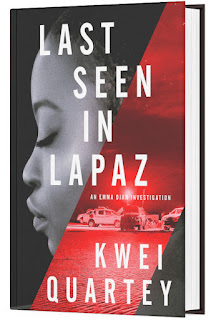
Jacket reveal: LAST SEEN IN LAPAZ


Presenting the jacket design for the next Emma Djan Investigation, LAST SEEN IN LAPAZ, to be released in approximately a year. Originally, it was slated for June 2022 pub date, but another year of Covid severely delayed my trip to West Africa for research. The bad timing simply made it unworkable to have the novel ready for the hoped-for date. The publishing schedule works rather like an airport. Every plane has a time slot to push back from the terminal. If the airline misses the slot due to a delay, it must be scheduled for the next available time, and it can’t bump other planes from their spot. All Soho Press 2022 releases are already scheduled, so unfortunately LSIL had to be pushed back to February 2023. I know it’s painful, but I hope to make it worth the wait.

Research for LSIL took place over two months in West Africa, involving Nigeria, Niger, Libya, and Ghana. The novel takes place in these four different countries, making the plot and sub-plots somewhat complex. For the first time, Emma will travel outside of Ghana to Nigeria, a brand new experience for her (including flying, of which she’s terrified). She will visit Benin City, an ancient city with history that goes back centuries. Just one example is the Holy Aruosa Church, founded 1506.


Ancient Holy  Aruosa Church (Image: Kwei Quartey) in Benin City, Nigeria
Holy Aruosa Church (Image: Kwei Quartey)


Benin City’s roundabout, called Ring Road or King’s Square, is one of the largest in Africa, and maybe one of the craziest I’ve experienced. Its perimeter is dotted with monuments and statues. In essence, Benin City constantly reminds you of its ancient legacy.


Ring Road, or King’s Square (Image: Shutterstock)


But like many cities that are impressive on the service (e.g. Florence, Italy), Benin City has a hidden, dark side. It's arguably Nigeria's ground zero for human and sex trafficking.
NAPTIP sign in Benin City (Image: Kwei Quartey)


In LSIL, Ngozi, the daughter of the Nigerian ambassador Ojukwu, elopes with her ex-convict boyfriend, Femi. After someone spots her in a large suburb of Accra called Lapaz, Ojukwu appeals to Emma and her colleagues at the Sowah PI Agency to find her. Femi’s subsequent and surprising murder raises a crucial question: what’s the connection, if any, between Ngozi’s disappearance and Femi’s death?

As Emma investigates, she comes face to face with the brutality of sex work and sex trafficking, both locally and internationally. This is a tough case. It’s fair to say that this new adventure has been a challenge for both Emma and me!

Meanwhile, Mom has come to stay with Emma for a while (uh-oh), and Emma takes a new step in her relationship with Courage, her boyfriend.

Here’s hoping for a better 2022 that will have us nicely set for the release of LAST SEEN IN LAPAZ early in 2023.


Wednesday, September 29, 2021

THE TANGLED WEB

Wed--Kwei 

My two months in West Africa--Nigeria, Niger, and Ghana--were spent researching for my next Emma Djan novel, LAST SEEN IN LAPAZ (LSIL). The first draft had already been written and was with my editor during those two months. With perfect timing, she was ready with the first edit not long after my return. The following partial quote is ascribed to Ernest Hemingway:

"Don’t get discouraged because there’s a lot of mechanical work to writing … I rewrote the first part of A Farewell to Arms at least fifty times….The first draft of anything is shit."


Museum and former home of Ernest Hemingway, where presumably he wrote his shit first drafts (Shutterstock/Joseph Sohm)
Museum and former home of Ernest Hemingway, where presumably he wrote some of his shit first drafts (Shutterstock/Joseph Sohm)

The italics in the above quote are mine, because it's true. Even this blog is not in its original form. I would echo Hemingway to say, "The first drafts of my novels are a mess." The time sequences are all jacked up, some of the characters are dull or shallow, the ending doesn't make any sense, and so on. Sometimes I look at the editor's markup on my pages (e.g. "this makes no sense," "cut this," "what does this mean?") and gloomily think, "I can't even write," and go to bed depressed.

That being said (cut this--overused expression). Sorry, I'll try that again. Despite the initial stab to the heart on receiving the first edit, a writer plods on, determined to get it right.

In LSIL, human and sex trafficking form the backdrop against which a mysterious murder takes place. The novel has an international flavor involving Nigeria, Niger, Ghana, and Europe, but there is another stream of trafficking within a relatively restricted area between Nigeria and Ghana that I call "local."

Sex work in international migration
Sex work in this setting is invariably coerced and often begins by exploiting the desperation of poverty-stricken girls and young women who see no future for themselves in their home countries. Someone tells them that if they can get to Europe, e.g. Italy, they can own successful businesses that will make more than enough money for them and the family back home. The reality is far different from the fable.

Sub-Saharan routes of migration (Shutterstock map modified by Kwei Quartey)


Nigeria contributes more migrants to Europe and Ghana than most other countries in sub-Saharan Africa, regardless of the route. Benin City supplies a disproportionate number of these migrants.

For most West African migrants seeking to escape to Europe, the initial destination is Agadez, although that has begun to change because EU has worked with the Nigerien government to implement a 2015 anti-smuggling law designed to limit irregular migration through Niger, and that has forced previously open migration underground and increased migrants’ vulnerability to forced labor or sex trafficking by criminal networks. There is no longer open loading up of trucks with migrants in Agadez heading for Libya. Because of the 2015 law, it is all highly secret now, with some migrants remaining in Agadez in ghettos for prolonged periods as they try to raise money for the rest of the journey to Libya. For many women, that means sex work (men will find employment meager and hard to gain). The sex workers I met in Agadez were all from Nigeria.

If a migrant survives the journey across the Sahara to Libya, the main danger there becomes capture and detainment in detention centers, where violence and sexual abuse prevail.

Sex work in local migration
Nigerian sex workers who don't try to get to Europe may attempt to go to Ghana instead. Why? The money is better. I'm no social economist, but it may be significant that Ghana's GDP per capita growth rate is greater than Nigeria's by far, despite Nigeria having seemingly inexhaustible amounts of petroleum. Identical to international migration to Libya and beyond, Nigerian women form a significant proportion of sex workers in Ghana. The means of transportation from Nigeria to Ghana may involve speedboats off the coast in order to avoid the tiresome hassle of crossing three borders.

Just as in Europe, the "madam" system works in a similar way in Ghana. The madam, often an ex-sex worker herself, bears the cost of bringing girls from Nigeria on the pretext that they'll be working in custodial jobs. Once the girls arrive, they discover they owe money to the madam, who saddles them with a debt multiple times the cost of smuggling them in from Nigeria. This forces them into indentured servitude. By these means, madams can make a staggering amount of money--enough to buy at least a mansion and a couple of expensive vehicles. Although violence toward the sex workers under her command is often the purview of men, madams have been known to stab or beat their workers for misbehavior or failure to pay their monthly dues.

Multiple "hotels" in Accra are simply in the sex business. While a number of euphemistic names like, "guesthouse" or "movie-house" are used to name these places, the result is the same. The sex workers use the hotel as their base and don't venture out very far. They, too, use phones, but mostly for setting up sessions at the guesthouse and not so much for online apps. Below is a picture of one such rather grubby guesthouse in Accra, which I won't name at the moment, although I do reference it in LSIL. The madam just happened to pull up in an expensive vehicle just as I was videoing Ninja-style.

Alligator guesthouse in Accra used as a brothel
Guesthouse in Lapaz, Accra. The murky conditions are well-suited to the cause. The madam's shiny SUV is on the left. (Photo: Kwei Quartey)


Voluntary sex work
Voluntary sex work is without threat of violence, even though there may be dire circumstances pressuring a woman to go into it. Here, I'm talking about upper-class sex workers catering to well-off clients who can afford to pay up to $1000 a night for sexual services. In Accra, examples include attractive University of Ghana and Wisconsin International University College female students (again, often Nigerians) who use sophisticated phone apps and even social media sites like Instagram and Twitter to enhance their online visibility. Not under any coercion, these voluntary sex workers can stop whenever they wish or for whatever reason. As an aside, one of my sources tells me that up to forty percent of female students at the University of Ghana engage in sex with their professors in return for good grades. That seems like an awfully high percentage, and I can't independently confirm it. Nevertheless, it may still involve coercion as well, i.e. a lecturer's threat to fail a female student in his class unless she has sex with him.

Accra's upscale neighborhood of Cantonments, the location of several embassies including the French and American, is a source of high-paying clients for sex workers who hang around the Cantonments roundabout, which is conveniently dim at night and close to a number of posh hotels or luxury townhouses/apartments within driving or even walking distance. In this case, the hotel is not necessarily taking part in the trade, and claims no responsibility. Nonetheless, they can make money off sex workers indirectly, because hotel occupants may pay for expensive suites where they can hold sex parties.

Luxury apartments in Cantonments, Accra
Want to spend a million bucks? Live here in Cantonments (Photo: Kwei Quartey)

Luxury townhouses and apartments near Cantonments Circle, Accra (Photo: Kwei Quartey)

The tangled web
This is indeed a tangled web of lies, deceit, broken dreams, and violence, but there is little political will to change it. Parliamentarians in the Ghana government, for example, are some of the biggest clients of sex workers, and one member of parliament actually owns a guesthouse. Lust for money and sex in its myriad forms are driving and maintaining the system.