Showing posts with label New Years. Show all posts

Saturday, December 28, 2024

Auld Lang Syne Time is Upon Us Once Again!


Jeff—Saturday


Several years ago, a Mykonian lass who'd read my parody of "T'was the Night Before Christmas,"  suggested I take a crack at a similar treatment of "Auld Lang Syne," a New Year's Eve standard derived from a poem by perhaps the most famous Scot of all (other than our Caro)–Robert Burns (1759-1796). I see "Auld Lang Syne" as a paean of sorts to not forgetting old friends; somewhat of a downer subject as we all hope and pray for a far better new year for our world in 2025. 

But I went on to write the parody.
 
And I've come to realize over the years that what I wrote subliminally emerges as both uplifting and clear. I say that because last year I realized the question Ι posed in the first stanza is answered with optimism in the final line of each following stanza. Or so I think.:)

Robert Burns
 
Burns wrote the poem (here’s the original version) in 1787, set to the tune of a traditional folk tune (Roud #6294).  Its seminal phrase, “Auld Lang Syne,” is traditionally translated as “long, long ago” though “old long ago” is more literally correct (based upon my deep understanding of the Lowland Scots language) and is a song about love and friendship in times past. For those of us who believe in time travel, astral planes, and questionable sobriety, I should point out that the phrase “auld lang syne” has been used by other poets in their work, including one Allan Ramsay (1686-1757), which I guess gives our Caro and her Alan a claim to have beaten me to the punch (bowl).

The other Ramsay...also with another career, a wigmaker

Happy New Year, everyone—and please forgive me, Scotland.


Should odd acquaintance be forgot,
And never brought to mind?
Should odd acquaintance be for not,
And made to toe the line?


As in odd.

For all fond thine, I cheer,
For all fond mine,
We'll share a cup o' kindness yet,
For we’re all fine.


And surely you’ll pick yours to hug!
And surely I'll pick mine!
And we'll show a lot o' kindness yet,
For we’re all fine.


For all fond thine, I cheer,
For all fond mine,
We'll share a cup o' kindness yet,
For we’re all fine.


We all have run about the hills
In search of flower wine;
And wandered many a weary foot,
But we’re all fine.


For all fond thine, I cheer,
For all fond mine,
We'll share a cup o' kindness yet,
For we’re all fine.


We too have paddled up the stream,
In mourning, fun, and grind;
And seas between us broad have roar'd,
But we’re all fine.


For all fond thine, I cheer,
For all fond mine,
We'll share a cup o' kindness yet,
For we’re all fine.


And here's a hand, my trusty friend!
And give a hand o' thine!
And we'll drink to kindness and good will,
For we’re all fine.


For all fond thine, I cheer,
For all fond mine,
We'll share a cup o' kindness yet,
For we’re all fine.


To get your head back in the holiday mood in case I misread the uplifting nature of my parody--and me hopefully back in the good graces of the Scots--here's the Royal Scots Dragoon Guards playing Auld Lang Syne accompanied by a journey to the timeless Scotland of Robert Burns' inspiration.

A Happy, Healthy, and Prosperous New Year to ALL!

—Jeff

Sunday, January 3, 2016

To Beginnings...New and Old

--Susan, every other Sunday

Happy New Year, everyone!

People get reflective at New Year's time, and the evidence is everywhere. People post good wishes and resolutions (some serious...others, not so much) on social media sites and blogs, and "Top-X lists" are everywhere.

As long as people have tracked the year with calendars, and perhaps before, new years are a time for new beginnings...meaning that, while some of our traditions are new, others are centuries old.

Prior to the Meiji Restoration in 1868, the Japanese celebrated New Year according to the lunar calendar (like the Chinese, and many other Asian countries do). However, in 1873, the Japanese government decided to recognize both the Gregorian New Year (January 1) and the lunar new year--and many households still celebrate both.

In Japan, the New Year carries its own set of traditions--some new, and others centuries old:

Shrine Visits

Many people visit one or more shrines on New Year's day (or in the days that follow) to leave offerings and pray for the gods' protection in the coming year.


The brightly-colored strings are actually origami (folded paper) prayer chains, popular at New Year's.

Poetry

Traditional Japanese poetry features heavily in many celebrations, particularly those which have a reflective or seasonal component. Given that the turn of the year involves both, it's hardly surprising that samurai often composed special poems to celebrate the New Year, particularly haiku and renga (a form of collaborative poetry that gave birth to the haiku form).

A picture, not a poem. But this caption is Haiku. Happy New Year, All.
Modern Japanese poets also often write special verses to celebrate or welcome the new year, and people often read or reflect on poetry during the final days of the year and the first days of the new one.

Games and Kites

As in the West, Japanese people often gather to celebrate the new year, and both adults and children like to play games at New Year's time. Cards and board games are popular, as is kite flying. (Kites are particularly popular in Japan, and flown on many different occasions)

Hanafuda - a traditional Japanese card game.

New Year's Postcards (Nengajō)

The custom of sending New Year's cards originated hundreds of years ago, but blossomed in popularity during the Meiji Restoration (after 1868) because of the introduction of postcards. Like Western Christmas or Holiday cards, nengajō contain pretty pictures and holiday greetings, but nengajō differ from Western cards in a couple of very important ways.

First, nengajō should be handwritten, generally in the sender's own best handwriting.

My handwriting sucks. Instead, please accept this photograph of a seahorse.

Also, nengajō are supposed to arrive precisely on January 1 (or, before the Meiji era, on lunar New Year's Day). Japanese post offices accept nengajō for mailing for several weeks in November and December, and as long as the cards are marked "nengajō" and placed in the proper postal drops, the post office guarantees New Year delivery.

Finally, nengajō are not sent to anyone who had a death in the family during the previous year, in recognition of the family's mourning. (Some people even send special cards--again, available through the Japanese post office--to friends and relatives following a death in the family, in order to ensure they're not on the nengajō list for the coming year.)

Osechi-ryōri (New Year Foods)

Like many cultures, the Japanese eat special dishes on New Year's day, and during the first few days of the new year, to bring good health and good fortune in the coming year. The Japanese custom of eating osechi began during the Heian Period (794-1185), and the most traditional foods have changed very little since that time.

Not a New Year's cake. I bought it in the train station in Tokyo. However, it was quite delicious.
Among the most popular items: sweet cakes, seaweed, prawns (cooked with heads and tails on, they look like elderly, bearded men bent over at the waist--symbolizing a wish for long life), broiled fish cakes, oranges, and zone, a clear broth (in some places, miso soup) with grilled mochi.

And Money for the Kids...

As in China, children traditionally receive colorful paper envelopes filled with money from friends and relatives during the New Year celebration. The amount in the envelopes varies widely, but traditionally the envelopes are supposed to hold the type that folds as opposed to the type that jingles.

The kind that folds.

New Year customs exist in every culture, and with good reason. The turn of the year represents a new beginning, full of potential, as well as a chance to reflect on the years we've lived.

I hope 2016 lives up to that potential for every one of you, in wonderful ways, and I hope we'll see you here frequently at Murder is Everywhere.


Sunday, January 4, 2015

How Leighton Gage recalled "Celebrting NewYears in Brazil."

I thought it might be nice on this final Sunday of 2014 to take a look back at how our buddy and driving force founder of Murder is Everywhere, Leighton Gage, celebrated New Years in his beloved Brazil.  Here's Leighton's post from January 3, 2011...and here's looking at you, kid. ––Jeff

While most of you folks are dealing with the cold, and many are still up to your…ahh…knees in snow, 

 we’re basking in the warmth of a Southern Hemisphere summer.
And here, a stone’s throw from the Tropic of Capricorn, it isn’t only our weather that’s different. Our customs are as well.
 I’d like to share a few of them with you.

On New Year’s Eve we:


Dress ourselves in white. (Brings luck.)


Eat lentils. (Also brings luck. My wife firmly believes in this one, and makes sure I comply. It is a matter of indifference to her that I am not fond of lentils.)


Suck the pulp from seven pomegranate seeds, wrap them in paper and put them in our wallets  (To ensure that, throughout the New Year, those wallets will always contain money.) Alternatively, you can use a single bay leaf.


Eat three grapes at midnight. (For wish fulfillment. You make a wish as you consume each one.)


 Stand outside and fling coins into your house. (Brings cash to the household.)


Avoid eating crab. (Crabs move backward, symbolic of regression, not progression.)


Avoid eating fowl, like chicken and turkey. (Fowl have wings, which can cause your luck to fly away.)


Hold glasses of champagne in our hands and jump up and down three times. (This ensures that everything bad that ever happened to you will be left in the past. It only works, however, if you manage to do it without spilling a single drop of the bubbly. After which, you empty the entire glass over your shoulder. For obvious reasons, this is best done outside.)


Get up on chairs, or benches, and stay there as the clock strikes twelve times at midnight. Then get down, stepping first with the right foot. (This should not be attempted after consuming too much champagne.)


Enter the New Year with money in our pockets. (In the hope we’ll always have some there in the twelve months to come.)

Put banknotes in our shoes. (This is said to attract even more money.)

Only use clean handkerchiefs after midnight. (God knows why.)


Make sure that the first person we embrace to wish a Happy New Year is a member of the opposite sex. (This is supposed to bring luck in love. I’m not sure which sex you’re supposed to embrace if you’re gay. I shall have to ask one of my gay friends about that.)


Run around the house carrying an empty suitcase. (This only applies to those of us who plan to travel in the course of the coming year. Caution must be exercised not to bump into people jumping up and down with glasses in their hands, thereby causing them to spill champagne.)


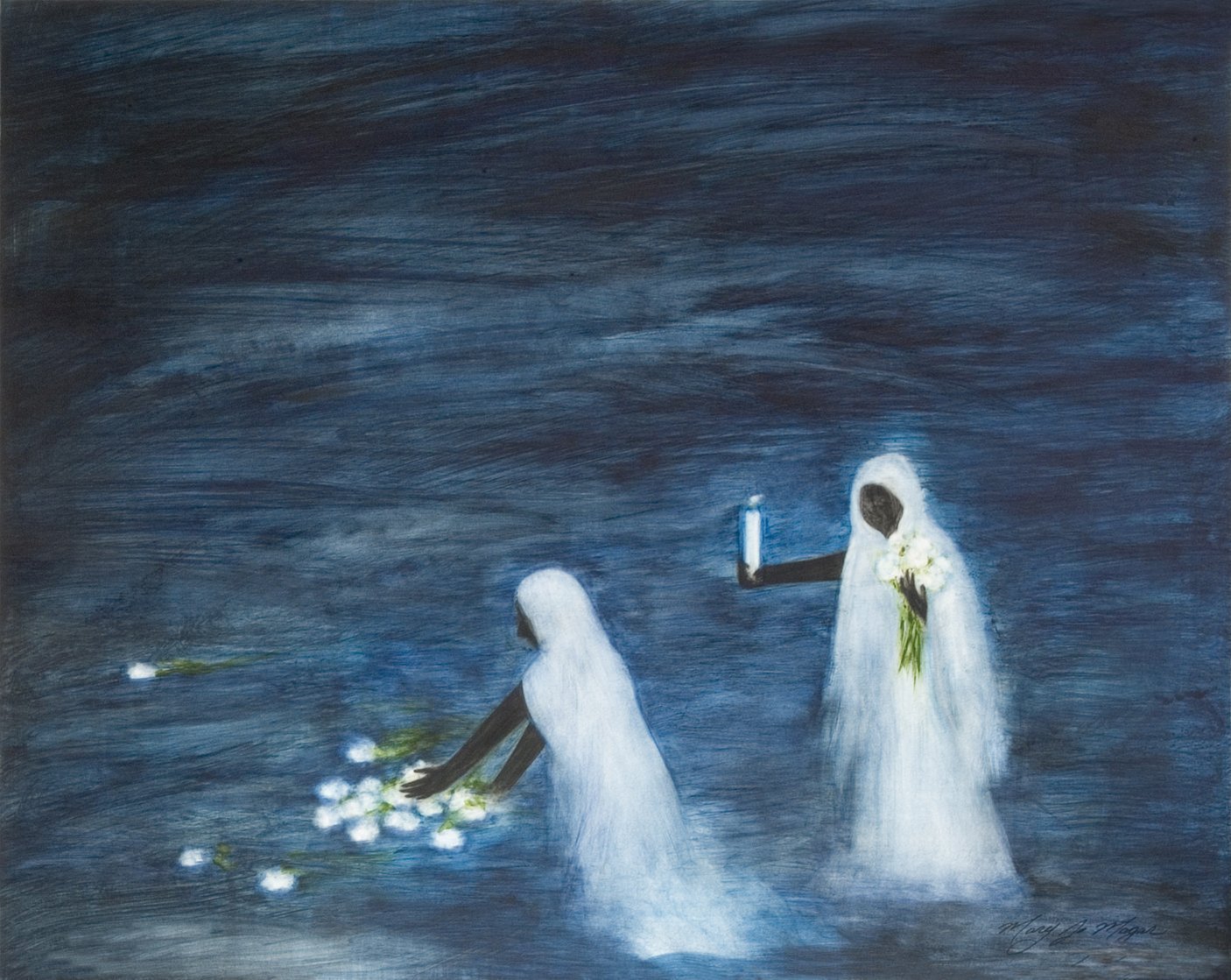
Light candles and throw roses into the sea. (This is done to please Iemanjá, Queen of the Waters and mother of the Orixás. Most Brazilians are, to some degree, spiritualists, and this custom is taken very seriously.)


On the beaches of Copacabana and  Ipanema  hundreds of thousands of people make their offerings at midnight. Some of them also give The Lady perfume, money even jewelry.


Step into the ocean and jump over seven waves in succession. (To help us to overcome physical and spiritual difficulties in the year to come. ) Many family members join hands as they do this, symbolic of the family overcoming those difficulties as a unit.


Make a lot of noise. You can use whistles, drums, beat on pots and pans, whatever it takes – but it has to be exactly at midnight. After which you start shooting off your fireworks. (This, of course, harks back to the ancient peoples who did it to frighten away evil spirits.)


Brazilians are very big on fireworks on New Year’s Eve. This year, there were eleven barges anchored four hundred meters off the beach at Copacabana. Each barge fired off 1,200 huge skyrockets and the pyrotechnics went on for twenty minutes. More than a million people stood on the beach and watched the show.

Sing Adeus Ano Velho, Feliz Ano Novo. It’s our equivalent of your Auld Lang Syne.
 

Brazil’s biggest New Year’s party takes place in Brazil’s largest city. This year, as last, a huge stage was erected on São Paulo’s major thoroughfare, Avenida Paulista.
Big names from the world of Brazilian popular music performed and a huge amount of fireworks lit up the sky. The party started at eight PM, was still going on at 3:00 AM.
More than 2.5 million people attended.


Happy New Year, everybody! I hope you enjoyed your parties as much as we did ours.

Leighton, for all of us – Sunday

Saturday, December 27, 2014

The End Is Near.


I can’t believe 2014 is over in four days.  Where did all the time go?  And why do I have only four days left in my self-imposed deadline to have Kaldis #7 finished by December 31?

The good news about this time of the year is that the Greek Parliament is busily giving me new material for Kaldis #8. I mean, how can one not be appreciative of a government body that gives we writers so much grist for our tales of societal intrigues, self-interest, and threatened revolutionary shakeups.  For example, in two days a vote requiring 180 of the 300 Members of Parliament to elect a new, but totally ceremonial, President of Greece, threatens to bring down the sitting government, force immediate new Parliamentary elections, and fracture Greece’s ties to the European Union. 


It’s a situation that has the world (and local) financial markets betting that the country is headed toward modern day economic oblivion.  Personally, I think short-term personal interests on the part of Greece’s MPs will keep things together for as long as possible; if only so the MPs don’t lose their 6000 euros a month paychecks (plus perqs) when many are booted out of Parliament in the next election and thrown back into the ranks of their 28% unemployed constituency—where 800 euros per month is considered a solid wage. 

As for the country’s long term prospects…

Well, I don’t want to talk about any of that. We’re into the festive Holiday Season. Let’s rejoice, dance, sing, and carry on.


I want to do all the things on New Years Eve that Yrsa will be doing in Reykjavik, Stan and Michael in South Africa, Annamaria in NYC (sorry, EvKa, maybe Portland for her next year), Cara in Paris, Caro in Glasgow, Lisa who knows where, and Zoe anywhere she wants.


I want to be thankful for all the very good things that happened in 2014—at the top of the list being that my children, grandchildren, Barbara and all our extended family are healthy and doing well (puh, puh, puh)—and pray that our world will somehow find its way back to sanity in 2015.


Yes, I’m in a prayerful mood. Perhaps because I’ve retreated to the refuge of my farm, a place for thinking, planning, rebooting, and writing. Here I’m surrounded by nature most basic, not man most basic—unless, of course, I turn on the television, read a newspaper, listen to the radio, or scan the Internet. So why do that?  Except if the Steelers are playing.

Normally the ground around here is covered with snow by now, but rains and a (relatively) warm stretch have chased every bit of white off the landscape.  The sky is wintry gray and plots of green persist of course, but much of the ground lay in naked shades of chocolate, beige and tan.

Not my barn, Or horses, A neighbor's.

My barn remains red, though, and its repairs are almost finished (after a year and a half). Fences around the pasture are falling down. I normally replace posts and rails as soon as they fail, but I’ve decided not to this year. I’m decided to open up the land.  Give it more of a park-like feel, one where the bears, deer, turkeys, coyotes, bobcats, and foxes can wander free…not that any of them respect the fences anyway. But it’s a change.  And change is good.


My barn.

Changes of seasons are good.  Changes of clothes are good.  Changes of governments are good…or so one can hope.


Happy New Year, one and all, and may each of you find true happiness and great joy in 2015 and far, far beyond.


Jeff—Saturday