

This
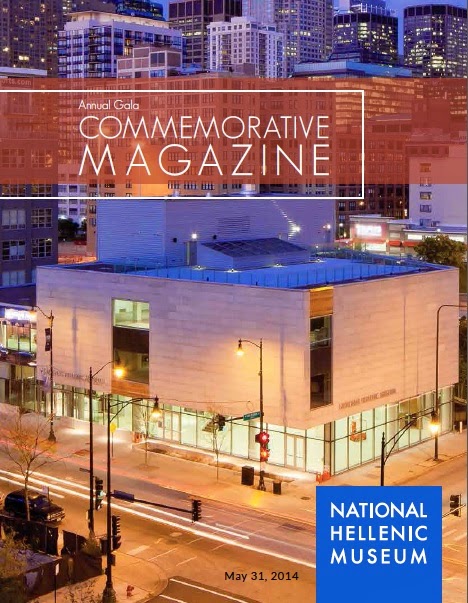
post comes to you courtesy of the Chicago-based National Hellenic Museum, for
it is the essay I prepared for NHM’s Annual Gala Commemorative Magazine,
“Journey to the Greek Islands”—a glitzy first-rate affair, and that’s just the
magazine! The Gala took place May 31st
as the central fundraising event for America’s only national institution
dedicated to preserving, commemorating, and celebrating the enduring
contributions of generations of Greek-Americans to the very fabric of national
life. Thank you, NHM, for this distinct
honor and, thank you, Renee Pappas, for both the opportunity of contributing to
your first rate publication and giving me something to post this week so that I
might play uninterrupted with my visiting grandchildren (their parents in tow) during
their own journey to the Greek islands.
The Muse is always with them;
they live in a place of complete happiness in perpetual sunshine. Those words are derived from the works of two
legendary Greek poets separated by 2500 years: Pindaros, the lyric master of
Greece’s Classic Golden Age, and George Seferis, a 20th Century,
Nobel Prize winning giant.
+.jpg) |
| George Seferis (1900-1971) |
 |
| Pindar (522-443 BCE) |
Each
was speaking of Hyperborea, a mythical land somewhere beyond the north
wind. Sort of like Peter Pan’s Never
Never Land, but different.

It’s
not surprising that they wrote of such a place, for creative types are always
searching for their Muse, and—except among the clinically depressed—for happiness
and sunshine. The artistic process is largely
a solitary quest, lived out among the thoughts, anxieties, and instincts of the
mind, so anything that helps bring about a visit from the Muse is as welcome as
a pardon to the imprisoned.
For writers,
artists, and musicians in search of inspiration who don’t like cooling their
heels waiting for some fickle muse to show up, or simply prefer finding one on
their own, the trick is in knowing where to look. To me the obvious suggestion is the same today
as it was in Pindaros’ time back in 500 B.C.E., “Seek a place of sunshine and
happiness and ye shall find your Muse.”
Translation: Go to Greece—even if it’s not as sunny and
happy a place as it was a couple of millennia ago.

.jpg)
That’s
not novel thinking on my part. It’s been that way practically forever. Foreigners have always come to Greece to find
their destiny. Even Herodotus, “The
Father of History,” who wrote Western literature’s seminal work on much of what
our world knows of Ancient Greece and its times, was not born in Greece, but in
the rival Persian Empire. He did not migrate to Greece until his late thirties
where he composed most of The Histories.
In what some might say was a nod of appreciation to what inspired Herodotus to
create his opus, The Histories are divided into nine volumes, one named after each
Muse.
For
many, the first person that comes to mind when asked to name one among all the
foreign cultural icons drawn to Greece to find their Muse is Lord Byron, the
notorious romantic poet who gave his life to Greece’s War of Independence.
 |
| Lord Byron |
Less
flamboyant, but no less inspired by Greece was Byron’s friend and fellow
Romanticist, Percy Bysshe Shelley, who wrote, “We are all Greeks,” “Our laws,
our literature, our religion, our arts have their roots in Greece.”
 |
| Percy Bysshe Shelley |
Those
roots transplanted well. There is not a place on earth unaffected by the Muse
that is Greece. W.H. Auden, another
legendary English-born poet perhaps put it best, “Had Greek Civilization never
existed…we would never have become fully conscious.”
 |
| W.H. Auden |
But
for most mortals it is not the study of Greek history that brings fire to the
creative experience; for that sort of magic to happen you must experience
Greece first-hand.
I
love sitting on a beach in the early morning taking in the smell of wild
rosemary and thyme scented sea breezes, watching sunlight dance upon the water
casting the sea in hues of silver, rose, and gold, popping distant islands into
sight, and bouncing shades of blue across the sky to fire up a splash of green
along a light-brown hillside, a shot of pink amid oleander green, a beige
lizard against a gray wall, or a cresting wave of white against a deep blue
sea.
But my favorite time of day is late afternoon, as light
ranges across fields of ochre, gray, and black––framed in the stones and
shadows of ancient walls lumbering up onto hillsides or sliding down toward the
sea. Those moments never fail to make me
wonder how akin my own thoughts might be to those of ancients who looked out
upon those same hills, seas, and sunsets so many thousands of years before.
How can one not find inspiration in such moments? And many
have.

Among the world’s literary masters, John Fowles wrote and
set The Magus on Spetses; Lawrence
Durrell’s life on Corfu, Rhodes, and Cyprus profoundly influenced all of his
writing; Henry Miller, during a visit to his friend Durrell on Corfu, wrote
“The light of Greece opened my eyes, penetrated my pores, expanded my whole
being,” and penned what he considered his finest book, The Colossus of Maroussi; Louis De Bernieres’ Captain Corelli’s Mandolin brought Cephalonia to life for much of
the world; Mark Twain, in The Innocents
Abroad, the best selling travel book of all time, described 1867 Greece in far
less than complimentary terms, but with observations of undoubted interest to
students of Greece today (Chapters 32 and 33); and Patrick Leigh Fermor’s work
showed his deep love and appreciation for all things Greek from before his days
of service as a war hero on Crete through his final ones in Kardamyli close by
his beloved Mani.
Musicians of every genre have found their Muse in Greece. Greek gods, heroes, and legends inspired
operatic classics by the likes of Mozart, Offenbach, Handel, Gluck, Verdi,
Rossini, and Gounod. Others found
musical inspiration though experiencing the Greek life: Classic violinist and conductor Yehudi
Menuhin had his love affair with Mykonos (one which I share), Joni Mitchell wrote
and sang songs of her time spent on Crete, Leonard Cohen found his home on
Hydra influencing his work, as did Rhodes and Pylion home owners Rick Wright
and Roger Waters of Pink Floyd.
And when it comes to artists influenced by Greece, the list
is endless. One from centuries back who
immediately comes to mind, even though he never travelled to Greece, is Eugene
Delecroix for the sheer power of his depiction in The Massacre at Chios of the horror wrought upon that island during
the War of Independence. In the 1950s and 1960s, photographer Henri Cartier
Bresson captured the essence of Greece in black and white photos that give him claim
to rival Apollo for the title god of light. But of all the modern lovers of
Greece, no artist has charmed his Greek Muse more than American artist Thomas
McKnight. His instantly recognizable
work introduced generations of non-Greeks to the land he’s called his spiritual
home for more than forty years. Today, more
artists (including actors) are calling Greece home for at least part of each
year, notably American artist Brice Marden on Hydra, and Tom Hanks and Rita
Wilson of Antiparos.
 |
| Thomas McKnight |
For those of you who don’t think “sunshine and happiness”
are a sufficient explanation for why so many seek their Muse in Greece, I can
offer you this observation by the distinguished psychologist James Hillman, “We
return to Greece in order to rediscover the archetypes of our mind and of our
culture.” But instinctively I think the
answer lay closer to the thinking of baseball philosopher Yogi Berra, “If you
come to a fork in the road, take it.”
After all, that’s just about how author Truman Capote ended
up spending the summer of 1958 on the island of Paros. He was soul
searching. He’d finished writing Breakfast at Tiffany’s earlier that year
and was a year away from beginning work on In
Cold Blood, and as his time on Paros drew to a close he wrote this line in
a letter to his New York publisher, Bennett Cerf, “I’m leaving here in four
days—sad, it has been a wonderful working-place.”
 |
| Truman Capote |
Yes, the answer could be as simple as that. Greece is just a wonderful place to create.
Personally, I’d like to think there’s something deeper of a
draw to this birthplace of the gods where the Iliad and the Odyssey
still serve as travel guides for some. It’s not anything I can put my finger
on, but I sense it’s out there, waiting for the right moment and the right
person. Just look to the Book of
Revelation. Whether you believe it’s a vision from on high or the
inspiration of a man, there’s no denying its impact on the world for nearly two
thousand years.
And it all began with one man sitting in a tiny cave on the
island of Patmos, under a bright blue sky, on a hillside staring out across
green fields and olive trees toward a sapphire sea laced with muted brown-green
islands.
 |
| View from the Cave of Revelation, Patmos |
I guess what I’m getting at is that what draws so many
creative types to Greece is likely a question only God can answer definitively.
All I know is that Greece works just fine as my Muse, and for that I’m
eternally grateful.
Yiasas.
Jeff—Saturday





