Showing posts with label Michael J. Cooper. Show all posts

Sunday, May 11, 2025

Proving Santayana

 Guest Blogger Michael J. Cooper

From Annamaria: Today I am happy to welcome back my fellow historical novelist, who writes riveting mystery-thrillers set in the Middle East.  His current series focuses on World War 1 at a time that provides a distant mirror for the current state of the world, important and - at the same time - entertaining reading.


Take it away, Michael: 

The great Spanish-American philosopher George Santayana famously said “those who don’t remember history are doomed to repeat it.” To avoid such repetitions, we historical novelists seek to bring readers back to the past so that they can learn what not to do.

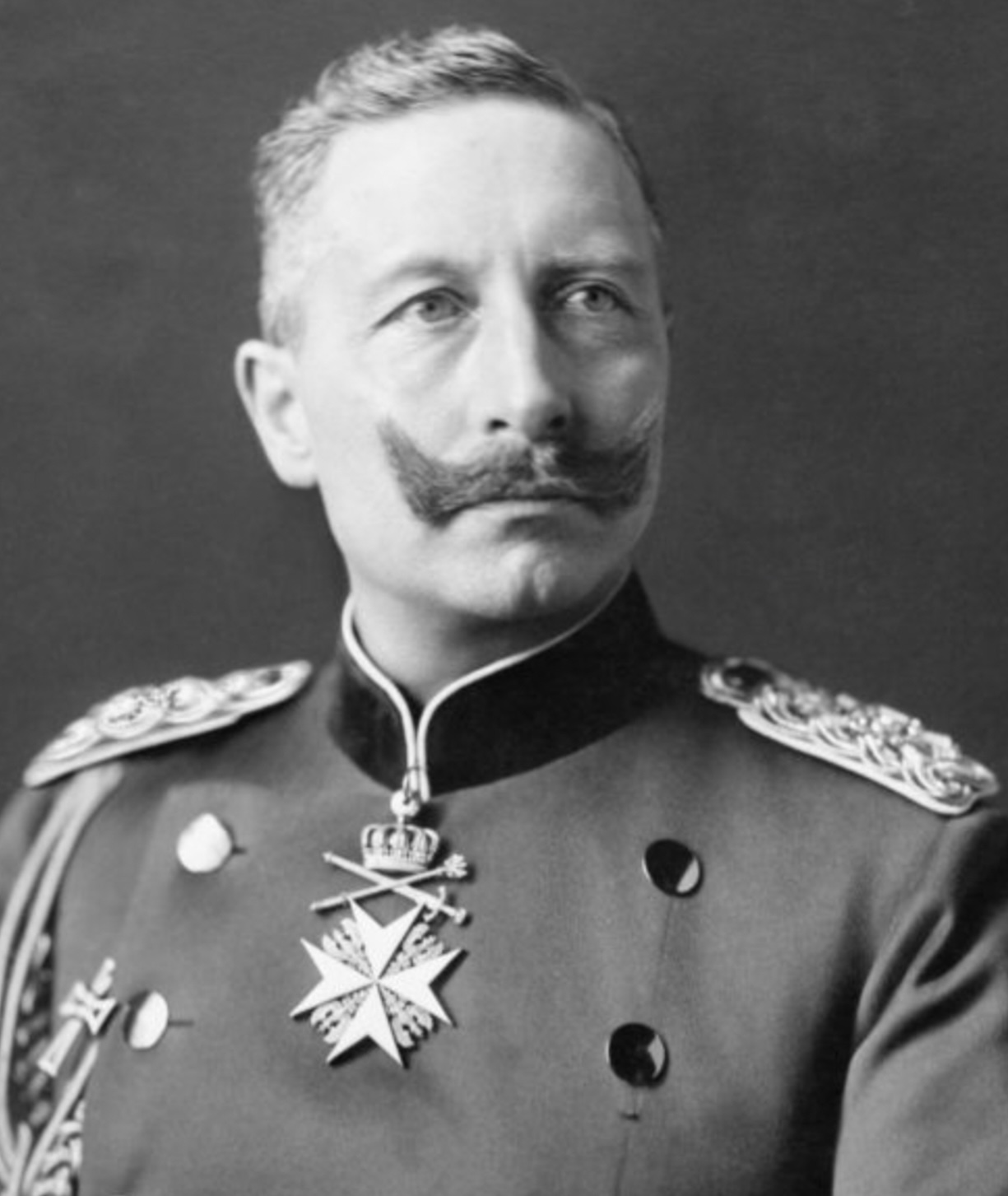
My two latest novels, set at the beginning of the First World War: Wages of Empire and Crossroads of Empire are a case in point. They include prominent historical figures Kaiser Wilhelm II, Gertrude Bell, TE Lawrence, Chaim Weizmann, and Faisal bin Hussein. And they particularly focus on Ottoman Palestine, since it was from Jerusalem where the kaiser dreamed to rule as Holy Roman Emperor and self-crowned King of Jerusalem, with dominion over Arabian oil reserves, control of the Suez Canal, and with an eye toward promoting German-Nordic racial supremacy throughout the world.

I gave Kaiser Wilhelm II of Germany, therefore, prominent role in the books, because many historians believe that his decades’ long scheming and manipulating led directly to the Great War.  He methodically built up a naval force to challenge that of Great Britain, and he established layers of financial, military, commercial, and transportational ties with the Ottoman Empire. By-so-doing, Wilhelm made imperial Germany indispensable to a subservient Ottoman Empire at the beginning of the 20th century, reducing it to a vassal state. 

Apart from these maneuverings, the Kaiser makes for a great character study because of how outrageously strange he was, offering a veritable buffet of the bizarre to historians as well as to writers of historical fiction. To quote a prominent German historian, Thomas Nipperdey:  Wilhelm was superficial, hasty, restless, unable to relax, without any deeper level of seriousness, without any sense of sobriety. He was arrogant, uncontrollablewithout any concern for balance and boundaries, or even for reality and real problems. At the same time, he had a hyperactive sense of grievance, and was desperate for applause and success. He was theatrical, with an exaggerated bravado and desire to show off…”

As we read these descriptions of the German Kaiser, just imagine what it would be like to live in the grip of a head of state untethered by any restraint, who was able to rule by royal decree or by executive privilege.  A monarch motivated only by the need to feed his own monumental ego…

Just imagine.


In Wilhelm’s day, royalty commissioned paintings of themselves to project how they wished to be seen—by their subjects as well as by other nations. Nowadays, art, CGI, and AI serve the same functions. Herewith, some examples:


And a couple more:


 He has even imagined himself as the pope: 

Pope Pompous I
  

But we have at least been saved from that.  We have an American Pope who, given what he has said since his election, will focus on containing the worst impulses of a deranged and dangerous psychopath.


Viva Pope Leo XIV


Monday, November 13, 2023

Introducing Wages of Empire

 Annamaria on Monday 

Today, I am very pleased to introduce you to Wages of Empire by Michael J. Cooper.  Michael has joined us here at MIE several times before, to talk about his previous historical thrillers, all of which are set in the Holy Land.  Chanticleer Book Reviews called his latest "Masterful Storytelling and gave it five stars.


Today, we have a special treat.  Michael has written a scene that does not appear in the book, but it is designed to present to us Evan Sinclair, his young protagonist, who—in the summer of 1914—joined the Great War for Civilization:


Interview with Evan Sinclair


Ten minutes out of Calais and bound for Dover, the HMHS Austrium pitched in the Channel swells on a cold morning in late November. Sixteen-year-old Evan Sinclair stowed his gear on the upper berth of a cramped cabin, and grasping the worn handrail, headed up the narrow steel stairwell to the ship’s deck. He stepped to the side as a deckhand descended the steps and asked, “Y’know where I might find Evan Sinclair?”

“Right here. That’s me.”

The man handed him a piece of paper. “This just arrived for you.”

In the half-light he could make out the words. 


PAT KING WISHES TO INTERVIEW EVAN SINCLAIR PLEASE RESPOND


Evan frowned and thought, “Who the hell is Pat King and what’s this about?

 Seeing that the deckhand was climbing back up the steps, he called out, “Hey! They want me to respond. How am I supposed to do that?”

“At the wireless office. Come with me.”

The deckhand led him up to the bridge, where he nodded at a closed door.

Evan pushed it open and saw a young man reading as he reclined, feet up on a low desk between a typewriter and a burnished brass telegraphy set. Looking up from his copy of The Argosy, he asked,“Are you Evan Sinclair?”


“Yes.” Evan held up the paper. “What do you make of this?”

The young man shrugged. “They want to interview you.”

“About what?”

“I don’t know, but if you’d like, we can find out right now.” The telegraph operator sat forward and readied his hand over the key-type transmitter. “Shall we?”


    Evan drew a deep breath and thought, I don’t even know anyone by that name—Pat King—it sounds like a made-up name. Maybe it’s a German spy. He decided to ask. “How do we know this cable wasn’t sent from Germany?”

“Because we determine the source of every communication. This came from the foreign desk of The London Times.”

Evan frowned. “But what kind of name is that—Pat King? Is that Pat as in Patrick or Pat as in Patricia?”

“What does that matter?” the operator replied sharply. “Look, shall I reply?”

“But do you even have time for this?”

“For now, I do. There’s nothing in the queue, and they’re waiting for your response at the destination station in London—”

“Isn’t that too far away?” 

“Not at all. We’re able to transmit wireless over twice that distance.”

“How?”

“Morse code by radio waves. C’mon! Do you want to do this or not?”

“Sure,” Evan said listlessly and watched as the operator began tapping the brass key. Once he stopped, Evan asked, “What did you transmit?”

“I told them that Evan Sinclair is standing by for an interview with Pat King.” The operator moved his headphones up from his neck to his ears and reached out to bring the typewriter forward. “They’ll get back to us soon enough, and I’ll type out the responses for you—” 

Before he finished speaking, Evan could hear the shrill staccato of the Morse code from the operator’s earphones. As he began typing, Evan leaned down and read the message.


WELCOME HOME HOW DOES IT FEEL TO BE A HERO


         A hero? he thought, and said nothing for a few seconds, then blurted out, “I don’t know what they’re talking about.”

“Shall I ask?”

         Evan nodded. “Tell them that I’m not sure what they mean.”

The operator tapped out the message, and the reply came quickly. He typed it out for Evan to see. 


FLOODING POLDERS KEPT GERMANS FROM TAKING NORTHERN PORTS AND WINNING THE WAR NOW THEY WONT NOT NOW NOT EVER


Images flashed through Evan’s head—the bright moon over the lowlands, the partisans exposed by the sluice gate, the German machinegun firing from within the protecting nest of sandbags, firing and firing, smoke from the gun rising in the air, the desperate and failed attempts by the partisans to silence it, with pistol, with grenade. He remembered crawling over smooth stones in the mud, to reach the dark shelter of the poplars, there the foliage blocked out the moonlight, and he was able to stand and hurl smooth stones with his sling into the machinegun nest, again and again, drawing their attention away from the partisans at the sluice gate. And, finally—moonlight shining on rising water as the polders flooded…

Evan exhaled a sigh as the images gave way to the affirming thought, And it worked! Everyone knew that the key to a quick German victory would have been for them to seize the port cities of northern France and Belgium, but with the flooding of the lowlands, their progress was stopped, and without a quick victory, Germany would have none. Sure, the trench warfare is horrible, but it’s contained them, and a longer war will end in their defeat. Evan drew a deep breath with the final thought, That’s why I left home to join up, to make a difference. And I did.

Leaning forward, Evan spoke a shortened version of these thoughts to the operator who tapped them into the wireless radio waves bound for London. After a few minutes the next question came.


THERES TALK OF YOU RECEIVING THE VC


 The Victoria Cross? Evan shook his head in disbelief. Britain’s highest decoration? They’d give it to me for throwing rocks at Germans? The ones who really deserve a medal are the Flemish partisans who died at the sluice gate, the ones who actually flooded the polders—Emile Peeters and Hendrik Geeraert.

Evan proceeded to dictate these thoughts to the operator who tapped them out. Evan made sure that the operator got the spelling of their names right.

After a few minutes the next question came, the shrillness of the code less jarring as Evan was getting used to it. He read the typed transcription.


WHAT DO YOU PLAN TO DO ONCE YOU GET BACK TO ENGLAND


Before speaking, Evan considered how to reply. I’m pretty sure dad left Utah to look for me in England. He’s probably back at our old house in Oxford now. I definitely want to spend some time with him—to mend fences after the way I ran off. And once I’m fit for service I want to get back to the fight, that is, if the war is still going on. But not on the Western Front—I’ll request to be sent to Cairo. 

         Dictating these final thoughts to the operator, Evan hoped that his father might hear the news before he arrived at the front door in Oxford. As he waited for the tapping to stop, his thoughts turned to a beautiful young nurse he had met while hospitalized in France. I’d really like to get back to France for a quick visit—to see her again—


         “Uh-oh!” the operator cut into his thoughts. “I’ve got someone in the queue now. It’s the War Office at Whitehall,” he added, his voice rising. “I’m signing out to take this.”

         “No problem. I’m glad we’re done,” Evan said as he watched the operator hunch over listening as he typed out the incoming message.


GERMAN U BOATS SIGHTED IN CHANNEL BEGIN EVASIVE MANEUVERS


Evan’s breath caught as the operator grabbed the message off the typewriter and ran out to the bridge, yelling for the captain.


***


Where to find the full story of Wages of Empire, and more about Michael and his books: https://michaeljcooper.net/


With the publication date of November 30, 2023, Wages of Empire is available now for pre-sale on Amazon: 

https://www.amazon.com/Wages-Empire-Michael-J-Cooper/dp/B0CJYJCRR8/ref=tmm_pap_swatch_0?_encoding=UTF8&qid=1696005774&sr=1-1


 BOOK GIVE AWAY

The beautiful nurse pictured above is a real historical person. If you can identify her, you can win a free, hardcover copy of Wages of Empire. Please don't identify her in the comment section here. To win, go to Michael's website. Use the contact page to tell him who you think it is.  The first 8 people to do so will receive a free book

Monday, June 28, 2021

Historical Novel Society Conference Report

Annamaria on Monday


This past week, the Historical Novel Society of North America staged its biennial conference, virtually.  Unlike the mystery conferences most of us are used to, this one is organized along the lines of an academic symposium.  Those who want to present submit proposals, which require a rigorous amount of information.  As with our mystery conference, decisions are made behind the scenes, using undisclosed criteria.

At mystery conferences, authors pretty much always get a chance to be on a panel, so we all get a crack at hawking our wares,  But the topic and the panel-mates are pot luck.  With HNS, a group may jump through the many hoops to submit a complete proposal and still be turned down.  (One consolation here is that one does not have to buy a ticket to the event until after that acceptance decision is published.)  The big advantage with HNS is that authors get to pick their own topic, the questions they want to answer, most important who will be presenting with them.

This year, I was very pleased to present with three of my very favorite historical novelists.  HNS also provided us with a moderator, Mary Tod and  a tech support volunteer, Jodi McMaster, both of whom made top-notch contributions and allowed us to shine.

Regular MIE readers will recognize my fellow panelists from their previous visits to these precincts.  Here they are in alphabetical order, along with the bios we submitted with our conference proposal.  I am also including snippets of reviews of some of my favorites of their books.  The reviews all come from the Historical Novel Society Journal. 


 James R. Benn is the Dilys and Barry award nominated author of the popular Billy Boyle WWII mystery series—fifteen books to date—as well as two stand-alone books. His novel The Blind Goddess was long listed for the 2015 Dublin IMPAC Literary Award, and his works have garnered numerous starred reviews from major review publications. Benn is a graduate of the University of Connecticut and has a Master’s in Library Science degree from Southern Connecticut State University. He worked in the library and information technology fields for over thirty-five years before leaving to write full-time. 


"If you love a good mystery that’s full of facts about WWII history, you can’t go wrong with a Billy Boyle book. A Blind Goddess takes place in 1944 in Hungerford, just outside of London. Capt. Boyle is called in on a MI5 case in which a local was found dead outside of his boardinghouse. He boards with a German couple who had fled to England and is told by his superiors not to question them regarding the murder. An estranged friend from Boston also has asked Billy to look into the murder of another local, a constable, who was found on top of his father’s grave with his head smashed in. Tree is part of the colored tank crew stationed nearby, and his comrade is being accused by the Army of this murder because he was dating the deceased man’s sister, and also because he is black. This is only part of the injustice and prejudice shown to our black American soldiers by their own while the locals welcome the soldiers into their businesses and homes. When a young girl disappears, racial tensions rise between the black and white troops as the detectives try to discover if there is any connection to the murders.

I really enjoyed this book; the mystery drew me in and kept me on my toes. Billy Boyle is a believable and likable guy, and his friends who work with him on cases add another level of mystery to the novel.”


Nancy Bilyeau is the author of five published historical novels: the Joanna Stafford series set in Tudor England titled The Crown, The Chalice and The Tapestry, published by Simon & Schuster; an 18th century thriller set in Europe’s art and porcelain world titled The Blue, published in 2018; and an early 20th century mystery set in Coney Island titled Dreamland, published in 2020. Publishers Weekly gave Dreamland a starred review, saying, “This fascinating portrait of the end of the Gilded Age deserves a wide audience.” She is now writing a sequel to The Blue, scheduled for publication in 2022.


A former magazine editor with staff positions at Rolling Stone and InStyle, Nancy is currently the deputy editor of The Crime Report at the Center on Media, Crime and Justice at John Jay College. She lives with her family in Woodstock New York.


"Bilyeau takes us on a rollercoaster ride through the history of porcelain making and through the world of 18th-century French and British espionage. On that ride, we meet Madame Pompadour at Versailles, walk the halls of the British Museum, and stroll the streets of 18th-century London. On that journey, too, Bilyeau introduces us to a memorable cast: Genevieve, who is faced with seemingly impossible choices which test her resolve and her faith; slick and despicable Courtenay; Sturbridge, clever, funny and always with something up his sleeve. Bilyeau’s research is impeccable, taking what might have been a dreary industrial novel and making it into a living, breathing drama. Kudos and highly recommended!"


 Michael Cooper arrived in Jerusalem in 1966, lived in Israel for eleven years, studied at Hebrew University in Jerusalem and graduated from Tel Aviv University Medical School. Now a pediatric cardiologist in Northern California he volunteers for medical missions twice a year serving Palestinian children who lack access to care. Foxes in the Vineyard, set in 1948 Jerusalem, won the 2011 Indie Publishing Contest grand prize. The Rabbi’s Knight, finalist for the 2014 Chaucer Award for historical fiction is set in the Holy Land in 1290. Soon to be published, Sins of the Fathers, is set in Jerusalem during WWI.


"Cooper does a masterful job of building suspense and telling a riveting story. While there is a great deal here of historical significance—the fall of Acre, the role of the Templars, the warring Moslem factions—the conjoining of St. Clair and Samuel, two such disparate souls is, in and of itself, worth the read. Not coincidentally, it is Samuel and his Moslem “brother,” al-Hasani—again, so dramatically different in their religions, approaches and beliefs—who decipher the inscription. The message beyond this wonderful story is clear: with a common goal, all people of good faith can work together to find solutions."

Monday, November 13, 2017

In the Aftermath of a Murder

Michael J. Cooper, in place of Annamaria on Monday


This past November 4th marked the 22nd anniversary of Yitzhak Rabin's assassination, and a time to remember his unfinished quest for peace.  Rabin had spent his entire adult life in the service of Israel's security, but he came to believe that only peace between Israel and her neighbors would guarantee that security.  He died trying to make that vision a reality.
“I decided to kill him, to neutralize him politically,” calmly stated the Orthodox Jew who murdered Yitzhak Rabin, according to a recently released interview. When asked if he regretted killing the Prime Minister, he said, “Heaven forbid! I don't regret it.”

Rabin now occupies a grave in the national cemetery on Mt. Herzl in Jerusalem next to his wife Leah. Surrounded by cedar and pine trees, their graves are marked by two curving, almost intertwining headstones – his black, hers white.


I had visited the cemetery in the late summer of 1966 soon after I arrived in Israel. It was new then. I remember the oppressive heat and light, the newly- planted trees offering little shade. At that time, about nine months before the 1967 War, Rabin was commander of the Israeli Army. Now he is buried there, where the air is cool, and the trees have grown tall.

Three years ago, I visited the gravesite the day after Vice President Joe Biden had come to pay his respects to the assassinated Prime Minister. Representing the Obama administration, Biden hoped to revive the moribund peace process – the process that Rabin championed. Accompanied by Rabin’s adult children, Yuval and Dalia, the vice president laid a wreath of red and white flowers on the grave. A banner on the wreath read, “The cause of peace for which you fought has become our own.”

When I sat the the gravesite the next day as the wind keened through the trees, I could almost hear the three gunshots that ended Rabin’s life. Looking at the headstones, I thought of the passage in the Babylonian Talmud; “Whoever destroys a soul, it is considered as if he destroyed an entire world.” I thought about the extent of that destruction and closed my eyes, feeling the weight of that loss – what might have been.


Since Trump became president last year, it has often seemed that the new administration rejects the cause of peace.  In response, some among the hawks in Israel depicted Trump’s victory as a “miracle” prompted by divine intervention.

There are, of course two ways of looking at Rabin's legacy, two sides to the story:
On one side there is an extremist Israel characterized by a combination of jingoistic nationalism and religious conservatism, by ethnocentrism and xenophobia, by intolerance of dissent and disrespect for basic democratic principles. Many in this camp in Israel are motivated by a messianic vision, which hinges on the establishment of a Greater Israel that is defined both by borders and by Jewish law. Many in this camp believed that Rabin betrayed the vision of the Greater Israel.  They celebrated his death.
On the other side, there are Israelis who supported Rabin's efforts, realizing that genuine security is best achieved through peace agreements, and that a peace agreement with the Palestinians is vital for Israel if it is to maintain its character as a democracy and a Jewish state. This Israel sanctifies life over land, puts peace and security before settlements, and yearns for Israel to be a respectable member of the family of nations.
The current status quo in the absence of peace comes at a terrible price, and the dead are filling up Mount Herzl cemetery as well as cemeteries in the Arab world.  The murder of Yitzhak Rabin is a murder that keeps on killing—killing Arabs and Jews, killing peace, killing hope, and with collateral hatred, killing innocent people around the world—from London to San Bernardino, from Bombay to New York.
Counter to that is Rabin’s vision of peace, which was shared by over 60% of both Israelis and Palestinians at the time.  On the night of November 4, 1995, as the peace process in the form of “Oslo II” was moving forward, there was a massive rally in support of peace in Tel Aviv, lighting up the night sky. Over 100,000 people gathered to cheer Rabin and other speakers. (And while 100,000 may seem modest by American standards, in Israel with a population of five and a half million people, an equivalent number with the US population would be a demonstration of 6 million!)
 

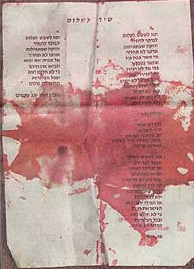
The rally concluded with Rabin and others on stage leading the crowd in singing Shir Shel Shalom – a song of peace. Afterwards, Rabin folded the paper with the song’s lyrics and placed it in the pocket of his suit jacket. Five minutes later, Rabin was dead, and the song sheet was retrieved blood-stained from his jacket.


The world stood at a crossroads that night, and it took a turn into darkness.   But there are still millions of people in Israel, Palestine and around the world who support the light of peace.
As Americans who collectively contribute to Israel's security and economy to the tune of $3.8 billion a year, (roughly $10 million a day) we deserve to have an opinion about which vision of Israel we prefer. We have the right and responsibility to express a preference, a choice. Rabin made his choice—peace—and he paid dearly for it. If we agree with that choice, we can honor his legacy by doing all we can to make Rabin's vision a reality.

PS: From Annamaria:
As this blog goes up, Michael is on his way on a medical mission to Palestine.  He told me that Rabin's murder was the reason he started writing in the mid-90s, to fulfill a need to convert the anger, sadness and despair of that moment into something else, something that might promote coexistence under cover of fiction.  You can learn about his splendid, “subversive” historical thrillers here: