Showing posts with label Matheran. Show all posts

Wednesday, October 5, 2022

Rainy Season Redux

 Sujata Massey


It's been raining for approximately one week in Maryland. First came the side-effects from Hurricane Ian, and now we are in the windy grip of a Nor' Easter. So much rain is tedious, but  getting my head wet on a dog walk is nothing compared to the situations suffered by those farther south in the US, and in Pakistan, where thirty percent of the landmass has been swallowed by water. All this rain got me thinking about my own experiences with monsoons in India. Therefore, I'm sharing (and updating) a blogpost from 2016, when I visited India in the rainy season for book research.


It's raining all the time, but the monkeys don't seem to care.

From the trees and on the ground, they were clearly on the job, watching the comings and goings of people like me to the hill towns of the Sahyadri mountains southeast of Mumbai. Slowly, I ate a piece of the peanut brittle, taking note of how these bonnet macaques seem to be working in teams to keep the local stray dogs from getting close to me--and my food. A friend warned me that monkeys can get mad enough to grab things out of your hand--even non-edible things, like camera and cell phones. This was the reason my shots are a bit distant. 


It was necessary to come here because of my book-in--progress The Satapur Moonstone, a 1921 mystery set in a princely state in the Sahyadri Mountains. To understand the setting, I  planned an excursion to visit hill stations, the elevated areas that offered cool respite to the British administration during India's hottest months. I was happy to get a reservation at Veranda in the Forest (now known as Dune-Barr House) a historic British hotel almost 170 years old. It's the oldest hotel in Matheran, a hill station that still doesn't have paved roads and thus has escaped much modern tourist development. I'd heard it would be a five-kilometer trek from the car park to my lodgings.   Because of it being uphill, going on horseback was recommended.  


The horseback ride was slow and waterlogged, but Namdev, my driver from Mumbai, was kind enough to accompany me. A male guide lead us and two teenage boys held the horse's reins--either to reassure us, or because the horses really didn't want to make the trip. It was over an hour of slow, careful plodding through a jungle of twisted trees and thick-hanging mist. I have seen enough Indian horror movies since this trip to realize that a demon could have dropped from a tree at any moment. 


It felt reassuring to reach the former home of retired British Army Captain Harry Barr. Going through the impressive gate, I found there were only a few other guests, due to the weather--and they were not chatty like the characters in Agatha Christie novels. My most frequent communication was with  a red-beige stray who haunted the grounds, always begging for something to eat.


The veranda was wrapped in plastic to help protect the furniture


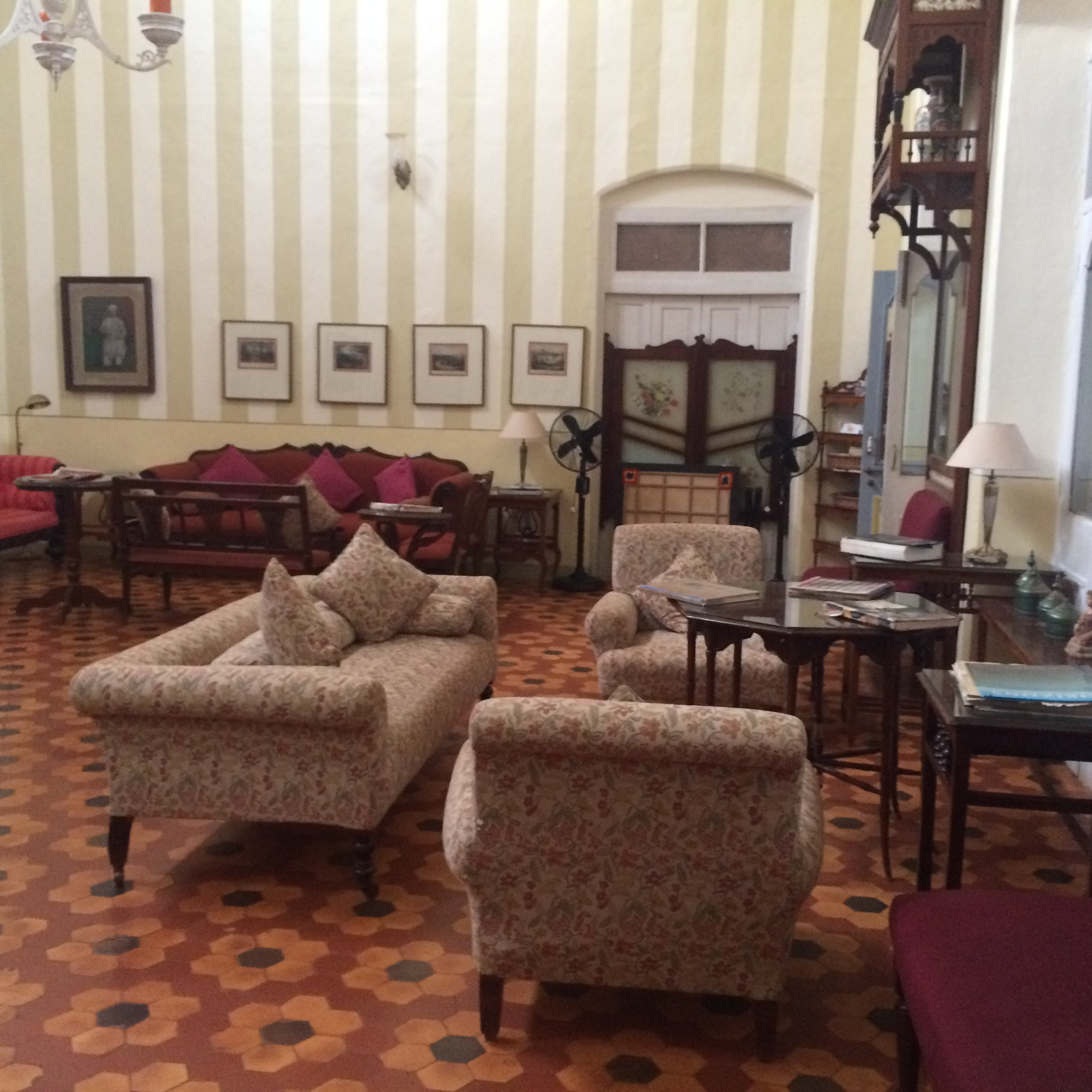
The house, which features a thirty-foot ceiling in the sitting room, and only slightly lower ceilings in the rest, was constructed to lessen the impact of torrential rain.  


The deluge made it a very inside kind of holiday--albeit one without any television, radio or wi-fi. The furniture didn't look like it had been updated in decades, and in this case, it was a good thing. I wanted to sleep on the same kind of bed that my heroine, Perveen Mistry would have done. What a delight the masterfully hand-crafted furnishings were: left over from the Victorian and Edwardian eras. In the drawing room, I sat briefly on tallest bench I ever encountered--and with such a grand mirror and top to it. In the end, I thought the piece was a carpenter's desire to try to have his work live up to the scale of the place.


After my first twenty-four hours in Matheran, the rain fell so hard and constantly that it soon became the most irritating noise. But at least I could while away the hours in the old hotel, drawing out an architectural layout that would become the plan for my fictitious Circuit House, the place occupied by a British civil servant where Perveen Mistry visits and learns about the area--while rain falls.  


The rain stopped for only about 2 hours during my four-day stay in Matheran. To take advantage, I rushed out with another woman staying at the bungalow. Still, the mists did not left--and because of the plateau-like structure of the hill station, you can't really roam around without danger of slipping, or maybe even  falling over the edge into a dam. 


A friendly local man was working at tightening up the wall of the dam with extra stones. H told us that stones are taken out of the dam wall during every rainy season to allow water to spill into the lake and not flood the land. Because rainy season was drawing to an end, he was returning the wall to its normal state and happy about the coming change. 


But this wasn't happening anytime fast. In the half-week I spent in Matheran, 
I always fell asleep listening to the relentless rain only to be jarred awake by thunder, then get back to dreaming, and ultimately awaken to another rainy day. As I wandered the hotel, I understood what it might mean to be confined to a place to months on end because rain meant that the paths down the mountain were washed out. At least there was electricity, so I could sit in my dreamy nineteenth century bed, working away at my draft. I had a dry roof over my head. And one misty morning, the horse and his groom arrived at the hotel, and it was time to descend the hill, meet Namdev, and get back to Mumbai. 


And although the rain was still falling, I didn't feel quite as wet behind the ears.  


Wednesday, November 23, 2016

Into the Rainy Jungle

Sujata Massey


It's been raining for a week solid in Baltimore. First we got the side-effects from Hurricane Ian, and now we are in the windy grip of a Nor' Easter. A constant deluge can be annoying, but I know that my wet socks are nothing compared to the situations suffered by those farther south in the US, and in Pakistan, where thirty percent of the landmass has been swallowed by water. At the same time I cannot forget the drought in East Africa so poignantly described by Annamaria Alfieri last Monday. Global warming is a literal disaster, and some people still don't believe in it!  I'm sharing a blogpost dating 2016, when I visited India late in the rainy season to research THE SATAPUR MOONSTONE.


Even though it's raining all the time, monkeys are on it.
Specifically, they are on the job, watching the comings and goings of people like me to the hill towns of Lonavala and Matheran, hill stations in the Sahyadri mountains southeast of Mumbai. Slowly, I eat a piece of the local peanut brittle, taking note of how these bonnet macaques seem to be working in teams to keep the local stray dogs from getting close to me--and my food. A friend warned me that monkeys who think you're teasing them can get mad enough to grab things out of your hand--even non-edible things, like camera and cell phones.


Even though it can still be rainy in October, the fall is a great time to visit India; there are plenty of seats on the plane, and while the weather isn't winter-wonderful as in winter, it isn't insanely hot. Therefore, I have slipped out of my ordinary life in Baltimore and traveled solo to India for some necessary book research.

I based my research in Maharashtra, the beautiful southwestern state with mountains and sea and the country's artistic heart. during British rule, Maharashtra was part of Bombay Presidency, a collection of several provinces overseen by a British governor based in  Bombay. My next book features a young woman lawyer leaving her hometown of Bombay for special assignment into these hills. She likes monkeys all right--but she's not interested in getting close to leopards and tigers.

The Sahyadri Mountain range isn't a difficult journey I planned out a visit to include the hill towns of Lonavala, Khandala, and staying for a few nights at a historic hotel in Matheran, a hill station that had never built actual roads. I'd heard it would be a five-kilometer trek from the car park to my lodgings.   Because of it being uphill, going on horseback was recommended.  


At  Lonavala, and the sky cleared enough to show some detail of the striation of the hills. 


 I'd planned to take a regular train from Mumbai and switch to the historic narrow-gauge railway that ran up the steep hill to Matheran, a famous old British hill station. Fortunately, I checked in with a travel agent before getting on the train. A few months earlier, the toy train had been washed off the tracks during rainy season and was still out of commission.  However, the driver I'd hired to help me in Mumbai said he'd bring me as far as his car was allowed, and he would meet me on the day I was ready to leave. 


Once my driver, Namdev, brought me up the steep misty roads to Matheran, I realized it could be very easy to get lost among the thousands of twisty trees and thick mists. It resembled the set for a horror film. Still, I kept going. This was a part of India not ruined by tourism. But I decided not to walk or ride alone to the inn. I would get there, paying for local assistance. 

My driver and interpreter, Namdev was a good sport about riding a horse

The horseback ride was slow and waterlogged, but Namdev went with me as well, due to my nerves. A male guide lead the party and two teenage boys held the horse's reins--either to reassure us, or because the horses really didn't want to make the trip. It was over an hour of slow, careful plodding until we reached a place called Verandah in the Forest,  heritage hotel occupying the home of Captain Harry Barr. He's the Englishman who built the second bungalow in Matheran. The house, which features a thirty-foot ceiling in the sitting room, is a period model of elegance and function.

My hope had been to explore Matheran and see gorgeous hill views from specific points. And according to everything I'd read, October was not rainy season anymore; it was supposed to be a shoulder season between rain and winter. Yet during the time in  October that I traveled, Matheran was still gripped in late monsoon season. Perfectly normal, everyone said. After my first twenty-four hours in Matheran, the rain fell so hard and constantly that it soon became the most irritating noise. But at least I could while away the hours in the old hotel, drawing out an architectural layout that would become the plan for Circuit House, the place where Perveen first stays when she's visiting Satapur.


Waterfalls are everywhere in these mountains that spill over with rains.  


The historic gates to Verandah in the Forest


Another view of the bungalow amid constant rain 


Hundreds of different kinds of trees and reptiles in the Maharashtran forest. There was a delightful rain forest feeling everywhere.


The actual verandah where one can sit and watch the rains


Verandah in the Forest is furnished with Victorian and Edwardian Indian furniture with a Parsi aesthetic based on its many years of ownership by a Parsi family. This was the tallest bench I ever encountered--and with such a grand mirror and top to it. In the end, I thought the piece was a carpenter's desire to try to live up to the scale of the place.


The rain stopped for only about 2 hours during my three day stay in Matheran. To take advantage, I rushed out with another woman staying at the bungalow. Still, the mists did not left--and because of the plateau-like structure of the hill station, you can't really roam around without danger of slipping, or maybe even  falling over the edge into a dam. 


A friendly local  man explained that stones are taken out of the dam wall during rainy season to allow water to spill into the lake and not flood the land. Because rainy season was drawing to an end, he was tightening up the wall with missing stones. He was happy about the change of season.

And I was melancholy. What do you do at a romantic historic resort, when you are one person and it is keeps raining? The only other guests were couples on anniversaries who were lost in their planned event.

The hotel had no wifi or telephone. The sum total of reading material were three books on a table in the sitting room--and they were books of photographs, not novels or memoirs or histories. I felt sincere regret I hadn't brought some books to leave for others. And the only book I had with me was the one I was editing on my laptop. 

So: I wrote. I took overly long naps where I fell asleep listening to the relentless rain and would be jarred awake by thunder. I understood what it might mean to be confined to a place to months on end because rain meant that the paths down the mountain were washed out. 

I got an excellent sense of my next book.