
No, this is not about a FIFA football match. It’s about a rivalry that goes back nearly a millennium. The sort of rivalry so pervasive in human
experience that Rogers and Hammerstein wrote a song preaching against it:
“The farmer and the cowman should be friends,
Oh, the farmer and the cowman should be friends.
One man likes to push a plough, the other likes to chase a
cow,
But that's no reason why they cain't be friends.”
Sadly the two dominant tribes in East Africa had great
difficulty finding a way to heed this advice.
Here is a very quick overview:
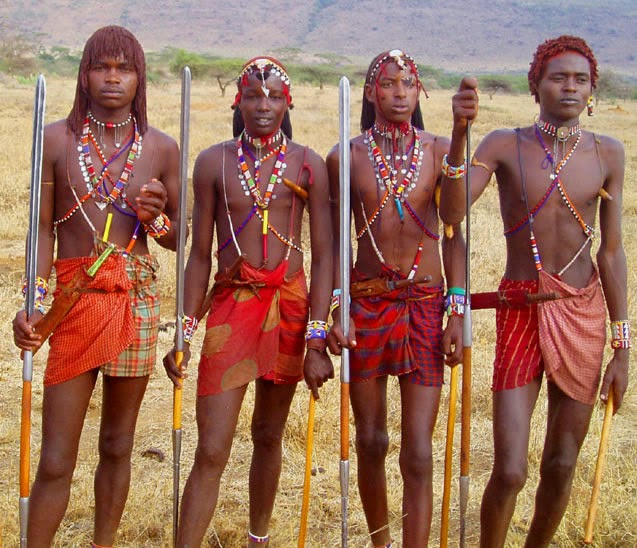 |
| Maasai |
The Maasai, one of the most famous African tribes, are also
one of the most enduring culturally.
They are semi-nomadic pastoralists, whose society is ruled more by
tradition and their customs than by law.
“Dignified” is the word most often used to describe them. Their chic clothing is much what it was 150
years ago. Their life style is strongly
ingrained and assiduously defended, sometimes violently in the past, against
any intruder who tries to get them to move over or to force them to change
their ways.
Their oral tradition says they moved into what is now Kenya
and Tanzania from the Nile valley. These
days their strongly patriarchal society is the target of much criticism because
of their stance against the education and self-determination of women. On the other hand, there are things about
their culture that are much admired. The
governments of the adjoining countries where they live have been trying to get
them to abandon their age-old ways and live more like modern citizens, but no
less an organization than Oxfam has taken their part, saying that in the face
of climate change, the Maasai ability to feed themselves out of desert and
scrubland is a way of life to be preserved.
 |
| Kikuyu |
The Kikuyu are the farmers in our story. They were, and still are the largest ethnic
group in Kenya. They are a Bantu people,
whose origins are uncertain. Their
reputation has long been as an attractive, cheerful people, who welcome any
reason to laugh or dance. Before the
arrival of the British, they fought off Arab slavers and were in a constant
state of enlarging their settlements in the area around Mount Kenya.
They had been the traditional enemies of the Maasai. The bone of contention was, as ever,
territory. The Maasai took umbrage when
Kikuyu settlements popped up in their pastureland and exacted revenge by
stealing the Kikuyu’s cattle and goats. The
two tribes battled back and forth for eons until Her Majesty’s subjects showed
up to impose the Pax Brittanica. The bad
feelings, of course, persisted.
One of the main characters in my upcoming book is Kwai
Libazo, a half-Maasai, half-Kikuyu tribal policeman. I gave him that identity to keep in a
no-man’s land in terms of his allegiance.
In solving the mystery of Strange
Gods, his background gives him an advantage. The victim is murdered with a tribesman’s
weapon. Kwai readily identifies it as a
Maasai spear. But the immediate suspect
is a Kikuyu medicine man, who may have killed to protect his honor. Kwai knows that such a person would never use
a Maasai spear to commit such an act.
I carefully described the difference in design in the text,
but here I can show you examples.
 |
| A Maasai warrior with his spear. The blade curves abruptly into the shaft. |
 |
| A Kikuyu medicine man with his spear. The blade tapers into the shaft. |
And here is the cover of the book. Kudos to the designer who got the difference
right. The man you see in the jacket photo
is a Maasai herdsman. And the spear he
carries is exactly the right shape for the man pictured.

I will have LOTS to say about my story next Monday—the day
before the book launches.
Annamaria – Monday.





