Annamaria on Monday
On 21 August 1911, Lisa Gherardini was kidnapped from her
Paris home. She was not missed until
twenty-four hours later. Then, despite
frantic efforts by the Paris Prefecture of Police and La Sûreté and
a world-wide hunt for her abductor, with her picture blazoned over front pages
of newspapers everywhere, nothing was heard of her whereabouts until December
of 1913. Here is the photo that the
police used to try to locate her:
Lisa, nicknamed Mona, was already famous before she
disappeared. Once the dragnet went out
to try to find her, hers became the most famous face on the planet.
Lisa was, as her name indicates, Italian—yet she was
ensconced in the Louvre when she disappeared.
Leonardo da Vinci, unable to part with her and give her to her husband
Francesco del Giocondo, a wealthy Florentine silk merchant, took her with him
to France around 1517. After Leonardo’s
death, she lived in splendor with King Louis XIV. Louis XV didn’t much like her looks, so he
relegated her to the office of one of his minions. She went to live in the new art museum in the
Louvre in 1797.
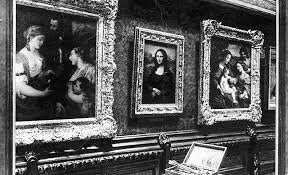
Once her disappearance was noticed on 22 August 1911, a hue and cry went up
from the citizenry of Paris. How could
the administration of the Louvre have been so careless as to lose her? And how could the Paris police and the French
National Criminal Investigations Department be so clueless when it came to
getting her back? Some wags posited
that the disappearance was a set-up—to boost attendance at the museum. Had that been the case, it would have
worked. As it happened, people lined up
to get in to see the empty wall where the painting had hung.
Jokes circulated: The Eiffel Tower will be next to be
taken. Cancan girls danced dressed as
topless Mona Lisas.
Directors and investigators lost their jobs.
Despite every stone being turned, every vehicle being
searched, every museum employee being investigated, the trail went cold.
Little did the flics know
that the lady was ensconced for the next two years just a few blocks from her
former home, in the humble apartment of Vincenzo (ne’ Pietro) Peruggia, who had
worked at the Louvre as a carpenter.
He kept the painting hidden for two years, at which point he
contacted a Florentine antiquarian art dealer—Alfredo Geri—and the Director of
the Uffizi—Giovanni Poggi. He told them
that he (mistakenly) believed that the masterpiece had—as so many others
had—been looted by Napoleon. He claimed
to have taken it because it was Italian and belonged in Italy. He wanted the government to give him a reward
for his patriotic caper. Those Florentine
gentlemen, handling the delicate situation with great aplomb and cleverness,
got Peruggia to turn the painting over to them.
Once he went back to his hotel room, he was arrested.
 |
| Then the Hotel Tripoli-Italia, now the Hotel La Gioconda |
In the course of Peruggia's trial, the story of how he managed the
theft emerged. Dressed in the typical
white smock of a museum skilled worker, he entered on a Sunday and hid in a
storage room overnight. The next day,
when the museum was closed and only staff members were about, he took the
picture into a stairwell and removed it from the protective box in which it had
been displayed. The Mona
Lisa is painted, as many Renaissance works were, on a board. He took it out of its frame, wrapped it in
his smock, and for all intents and purposes, walked out of the building with it
under his arm.
Once the director of the Uffizi had authenticated it, he declared
that it would be returned to France.
Mona Lisa made a triumphal tour of her true homeland before she went back
to her place in the Louvre.
Peruggia, because of his patriotic claims, got off with a
light sentence of one year and fifteen days.
He served seven months.
These are the facts as far as I can tell. There is a lot of other conjecture about the
affair, but I take it with a grain of salt.
Especially, the long article in the May 2009 edition of Vanity Fair—a first
serial printing of a chapter of a book, The
Crimes of Paris by Dorothy and Thomas Hoobler. For one thing, those authors—throughout their
recounting of the story—misspelled Peruggia’s name.
Some authors say that it was this theft that made the Mona Lisa the most famous painted work
of art in the world. Art historians,
though, say that it is a surpassingly wonderful work.
The last time I saw it, I was appalled by how it is treated
as a celebrity, rather than as a work of genius. Camera flashes are going off, several a
second, right in poor Lisa’s face.
Ugh! On top of which, another
Leonardo masterpiece, his The Virgin of
the Rocks hangs nearby, and none of the philistines that are taking selfies
with Mona even give it glance. Here it
is.
If you show up in the Louvre, of course you should try to
see Mona in person. But spend a few
minutes with this one too.





