Showing posts with label Kenyan History. Show all posts

Monday, July 8, 2024

The Importance of Time and Place in Strange Gods by Annamaria Alfieri

Annamaria Bragging on Monday

This Sunday morning just as I was leafing through my list of possible blog topics, I learned that the following article had just been published in the Journal of the Historical Novel Society, under the title above.  Its author, Marilyn Pemberton had interviewed me a few weeks ago.  I did not know that this would be the result.  I am, of course, delighted. First let me introduce the author of the article. (It seems to me that, like the founder of the Historical Novel Society, she is British. Can you see the evidence for that below?)

Marilyn Pemberton has a passion for fairy tales that subvert and challenge social mores. Victorian fairy-tale writer Mary De Morgan was the subject first of a biography, then a fictionalised life in The Jewel Garden. Her historical trilogy, Grandmother’s Footsteps, will be complemented by a fourth book, A Bearer of Tales, due to be published later in 2024.


After the publication of her third historical novel set in South America, Annamaria Alfieri’s agent and editor thought it was time for her to write a series. With this challenge set before her, Alfieri knew that she would have to find a place and a time that would allow her to write many stories.

“I had taken a couple of trips to Africa by then and had fallen in love with being there,’ she relates. ‘As with my other books, once I had an interesting place, I looked for the most dramatic time in its history. Once my imagination landed in that place at that time, I knew that there was enough grist for the story mill to last through a series.’

Alfieri has decided to write a ten-book series, based on a theme inspired by her late father. She remembers that, ‘Among his possessions, I found a leather bookmark inscribed with the Ten Commandments,’ she remembers. ‘It was like a message from Dad—to base a book on each of the commandments. So, for each book, one theme is the sin of the commandment. Another is a different evil that has no commandment, and I have the audacity to suggest it should have one.’

Strange Gods (Stonesong, 2023), the first book in the series, is set in the former British East Africa and based on the first commandment, which forbids worship of any but the one true God. ‘This brings up the clash of cultures between what the Europeans believe and what the Africans believe,’ Alfieri says. ‘The sin that has no commandment is the audacity of the colonizers, who move in and take over the territory where the indigenous people have lived for millennia.’


Each of the ten books will be set in sequential years of a decade, starting in 1911, a time frame Alfieri chose after ‘doing TONS! of research.’ She says that ‘All of the good ideas I get for my stories come right out of my research. The best sources for me are always the writings of people who had feet on the ground at the time. Also, there were books written about life in the Protectorate of British East Africa that were meant to attract settlers to the place. I have a copy of one, thanks to reprints by the University of Michigan Library. What a treasure trove! It even has the railway schedule, so that when my characters travel by train, I know what time the train is supposed to come and what time it’s supposed to get to their destination. All my research is aimed at helping me to feel as if I am there. Research is my time machine. Once I am there in my imagination, I can hang out with my characters, hear what they say, and I write down what they do.

Alfieri chose the 1910s in particular because it ‘brings readers to a time fraught with conflict. Colonialism was just really getting going. Missionaries from Britain had been moving into the area for about 20 years. The British government had taken control over the previous 15 years and even built a railroad from the coast to the shores of Lake Victoria and the center of the continent. And the British government had begun a campaign of recruiting settlers who were beginning to move in and establishing farms along that railroad. Also, the tribal people who had lived there for centuries were often in conflict with one another.’

This conflict, she explains, was evident from the outset, when ‘the missionaries and the King’s faithful empire builders of the administration were at odds over how the indigenous people should be treated. The arriving settlers were largely British aristocrats, often second sons, who were no longer guaranteed a cushy life back home and looking to find a place where the cost of living luxuriously was cheaper. Being of the upper class, they looked down upon both the “tin-god” administrators and the “shopkeepers’ sons” among the clergy. With all this conflict, there would be—in that place and time—lots of drama and many reasons for people to want to kill each other.’

There are three main storytellers in Strange Gods, each one representing different groups, and it is their stories that Alfieri tells in this first book. ‘Vera McIntosh is the daughter of Scottish missionaries. She was born and grew up in British East Africa, and her playmates were Kikuyu children. Because of this, she has a foot in two worlds. She knows her parents’ culture and its requirements, but she also knows the world as well as the language of her playmates.


‘Justin Tolliver is the second son of an earl. But his family has no money to bankroll an upper-class lifestyle for him. Like most second sons, he is serving in the British military. His regiment was posted to South Africa in the aftermath of the Boer War. While there, he visited British East Africa and has fallen in love with its beauty. He wants to stay there, but without financial support from his family, he cannot afford to do what people of his class did – take a farm. In order to stay, he takes the drastic step of joining the police force. So, Justin too has a foot in two worlds.

‘Kwai Libazo,’ – arguably the most interesting character in the book – ‘is an askari, a police constable, who is half-Maasai and half-Kikuyu. Growing up, neither tribe accepted him. He is a young man who belongs nowhere. Then, serving in the police force, he meets and begins to work for Justin Tolliver, who holds justice as their goal as policemen. Kwai is now working for the white people, but he is not one of them. Having been rejected by the tribal people, he attaches himself to the idea of justice. Kwai too inhabits the liminal space between two worlds.’

Alfieri would like readers of Strange Gods to ‘feel as if they are there. I want my books to be their time machine that takes them to that fascinating time and place, where they learn what life was like and especially how wondrous, how beautiful is the place that is, after all, the cradle of humanity. Thirty-two of the thirty-three known remains of our hominid ancestors were found in the Rift Valley. To me, when I am in the Kenyan wilderness, on a cellular level, I feel as if I am home. Hopefully, armchair travelers who read my stories will join in and experience vicariously the majesty, the wonder of our ancestral birthplace.’


Monday, April 29, 2024

Fuel for the Time Machine

 Annamaria on Monday

To make my time-machine stories work, I have to get myself to the point were I feel l]as if I am there with my characters in their historical lives.  Fortunately, when it comes to East Africa at the beginning of the 20th Century, I have found lots of tickets to get me there.  


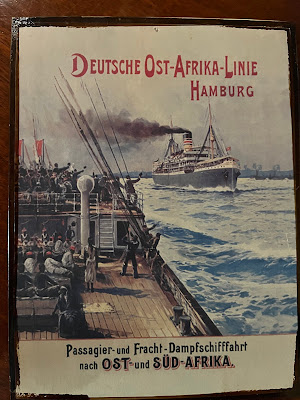
Sometimes, they just show up in my life - like magical gifts.  For instance, the metal placard pictured above.  It's a 7x9 inch reproduction of a travel poster from around 1910.  Since I acquired it, it has sat on the bookshelf about my computer.  I bought it during a visit to Rome.  At the time, I was working on the beginning of Idol of Mombasa. which takes place in the port city of British East Africa in 1912. I had researched how people went from Europe to BEA, so I knew what shipping and passenger lines plied those waters.  I had already drafted the first scene.  In it, my Vera and Tolliver are returning from their honeymoon.

    "...On shore, a military band, augmented by native drummers, struck up a tune that Vera did not recognize.

    "Oh, look," Justin exclaimed, "someone of note is arriving on that Deutsche Ost-Afrika boat..."

Then, on a sunny afternoon in Rome, when I was not thinking about that scene, while strolling on a favorite street from Piazza Navona to Ponte Sant'Angelo, suddenly, there it was.  On rack outside a stationery and gift shop.The very ship, black smoke from the coal boilers and all.  My next sentence to my fellow travelers began, "Oh, look..."

These days, I am putting the finishing touches on A Death on the Lord's Day, due out in late August.  My favorite source of information on everyday life in BEA is close at hand. 

I first found this goldmine in the indispensable collection of the New York Public Library. Thanks to the University of Michigan Library, I now have my own reprint.

So, for instance,  when my characters take the train, I can look up when they will depart and when they will arrive at their destination.  That is, unless the track has been bent out of shape by crossing elephants or dug up by a rhino.

I can easily look at the organization of the Brits in charge, and even know their actual names.  


In the upcoming book, Vera and Tolliver are establishing their farm, part of which is going to be pasture for cows.  The Handbook of BEA tells what a settler needs to do to succeed.  Among the pages of advice, the experts highly recommend Paspalum Dilatatum for dairy farms.


In those days, pastures were cleared and planted with the a native grass of Ceylon.  Seeds were availalbe from Australia.  Once the introduced plant took hold, it would provide fodder for the large herds needed for a highly profitable dairy farm.

Of course, I looked it up, to see what its common name might be today. It is now called Dallis Grass.  And it is condemned as a highly invasive species in the USA.  In my research, I haven't found any similar contemporary complaints about it in Kenya.  Perhaps, someone out there will who knows about it, will clue me in.

In the meanwhile, my characters are taking the advice of the 1913
"experts," and they are planting the recommended species for their cows.   

Monday, October 1, 2018

Pioneer Automobiling in Kenya

Annamaria on Monday


In the first scene of my historical mystery The Idol of Mombasa, Vera and Tolliver are arriving back in Africa after their honeymoon in Britain and Italy.  Among the things they see in the bustling port are Model T Fords being off-loaded from a tramp steamer.  It took quite a bit of research to get that one paragraph to speak with authenticity.    For one thing, the text cites the Mombasa Motor Garage.  There was such an establishment in 1912.  But truth be told, they mostly serviced motorcycles.  Tin Lizzies were the newest thing in 1912, and there weren't all that many of them to begin with.  And they were not the first motor cars in the Protectorate of British East Africa.

That distinction belongs to this French beauty:


This blonde is a De Dion-Bouton, made in France by a company that also manufactured both steam powered cars and tricycles.  (All with tires by Michelin!)  One of the experimental DeD-B vehicles had a one cylinder engine and the passengers sitting in front, facing the driver who sat in the rear seat.

The very first automobile in British East Africa arrived by steamship in December 1903 on order for one George Wilson, a road engineer from Australia.

I don't know about you, but until I began researching the first cars in BEA, I had never hear of this brand.  In 1900. however, it was the best selling automobile on the planet, with four hundred automobiles and 3,200 engines made in a single year.

A crowd on the Mombasa dock applauded as it was off-loaded onto the jetty, but the machine itself could not yet move under its own (you should pardon the expression, for it had an internal combustion engine) steam.

To run it, Wilson had to wait a couple of days for the four-gallon tins of petrol to be delivered from the ship.  Yup!  The only gas for the buggy had to be imported with the car!  That delay came in handy for Wilson, who spent the time reading the manual, which was the only way for him to learn how to operate the car.  He and his wife, working together, finally figured out where to put the oil and how to adjust the levers on the steering column to pinpoint exactly how to get the fuel and spark to combine and start the finicky flivver.  At which point, they might take it for a spin.  But where, there were no proper roads anywhere.  Only "glorified oxcarts."

There were no garages.  And the 1903 De Dion was, according to one source, "notoriously unreliable, breaking down with unparalleled frequency."


Despite the inherent hardships, motoring caught on in BEA.  By the time Vera and Tolliver are setting up their farm and the WWI has broken out, Model T Fords, as seen here above, are being imported.  Even still, it took another twenty-three years after Willson's acquisition for an automobile to make the journey from Mombasa to Nairobi.  Not to say, things were easy in 1926, as evidenced by this photo, taken on the actual trip.


The number of motors - as they were called increased tremendously during the Twenties, which in Kenya were particularly roaring.  People wanted a speedy way to get to the orgies of fastest fast crowd on the planet.  

Speaking of speed.  They even had car races, where the track was plausibly smooth.  Lionel Douglas Galton-Fenzi, left above, became a pioneer of motoring in Kenya.  There is even a monument to him in Nairobi.


On the subject of cars in Africa, here is a progress report on my effort to provide reliable transportation for girls in Tanzania who are being saved from circumcision and early marriage.

We are about 25% there.


If you want to help, you can read about the effort here.

And you can donate by following these instructions:

The link: https://www.maryknollsisters.org/featured-stories/emusoi-centre/

Note: In the "Prayer intentions/notes"  field, write "Emusoi Centre-vehicle/Sr. Mary Vertucci"*

To make your donations in the form of a check or money order, send to:

Maryknoll Sisters
Box 317
Maryknoll, NY 10545-0311
U.S.A

Please make checks payable to Maryknoll Sisters, New York with “Emusoi Center-vehicle” on the memo line. *

*Be sure to write in this notation, so that I can identify your donation and contribute another 50% in your name.
THANK YOU!
