Showing posts with label Historical Novel Research. Show all posts

Thursday, August 8, 2024

Torn Between Four Novels

 Wendall -- every other Thursday

I’m stuck.


For 35 years, I’ve believed that you have to write every day. And I have. Not always well, but I realized early on that if I showed up every day, then every third or fourth day I might write something worthwhile. I couldn’t just wait for the worthwhile days—they didn’t come without the worthless ones.


I even wrote every morning while I was traveling. Here's my favorite spot in Brisbane.
 

I’ve always tried to start every morning, early, to be sure I got my writing done before I started in on my full time job—teaching and lecturing on screenwriting and helping other writers figure out their voices and their stories.


Finally, I guess the burden of trying to think for myself and help so many others at the same time has gotten the better of me.


It feels a little bit like being on the tea cups ride at Disneyland, spinning around and dizzy in the same place. . .
 

I seem to be paralyzed with indecision about what to write next. So, I am trying to get my mojo back by doing my favorite part of the writing process—research. Of course, since I am researching four projects at once, it’s also possible I’m making the problem worse.


I love research, probably too much. I remember doing my first research project ever, in fourth grade, on the history of Hawai’i. I can still remember how much I loved learning about Queen Liliʻuokalani and, as my education continued, and the libraries got bigger and more beautiful, the delights of learning about things and places that were new to me has never really gotten old.


The Wilson Library and Archive at my alma mater, The University of North Carolina.
 

I can honestly say I have spent some of my happiest days ever in libraries, and my particular delight in working in the Humanities Reading Room in the British Library wound up informing two major subplots in my novel, Fogged Off.


The exterior of the "new" British Library.

 
The Humanities Reading Room.

Even though we are lucky to have the internet for research, I still prefer doing it in person, with primary sources, surrounded by real books, documents, and photos and making at least some of my notes by hand, in a proper notebook. Of course, all my old notebooks don’t have a convenient “search” function, but I always learn something by going back through them.


Some of my favorite Edwardian headlines.

 
A real life trial I'm drawing from.


My "inspired by" real life advocate's office in the Inns of Court.


Here are a few more documents, books, and photos for my current(?) projects.


My aunt at NBC Radio City in Los Angeles in 1942.

And at the Brown Derby.


One of my favorite books on 40s LA.

Something else that's bubbling.

I'm doing research on Paris, both on 19th century ex-pats. . .

 
And in 2006/2007. . .


Aquarium de Paris.

And, of course, on some of its inhabitants.
Wish me luck!!!

---Wendall

Monday, April 29, 2024

Fuel for the Time Machine

 Annamaria on Monday

To make my time-machine stories work, I have to get myself to the point were I feel l]as if I am there with my characters in their historical lives.  Fortunately, when it comes to East Africa at the beginning of the 20th Century, I have found lots of tickets to get me there.  


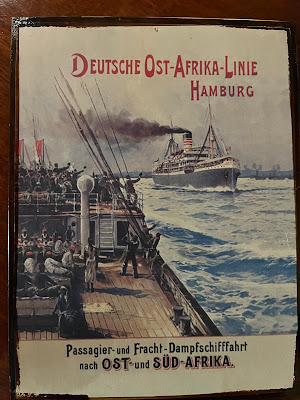
Sometimes, they just show up in my life - like magical gifts.  For instance, the metal placard pictured above.  It's a 7x9 inch reproduction of a travel poster from around 1910.  Since I acquired it, it has sat on the bookshelf about my computer.  I bought it during a visit to Rome.  At the time, I was working on the beginning of Idol of Mombasa. which takes place in the port city of British East Africa in 1912. I had researched how people went from Europe to BEA, so I knew what shipping and passenger lines plied those waters.  I had already drafted the first scene.  In it, my Vera and Tolliver are returning from their honeymoon.

    "...On shore, a military band, augmented by native drummers, struck up a tune that Vera did not recognize.

    "Oh, look," Justin exclaimed, "someone of note is arriving on that Deutsche Ost-Afrika boat..."

Then, on a sunny afternoon in Rome, when I was not thinking about that scene, while strolling on a favorite street from Piazza Navona to Ponte Sant'Angelo, suddenly, there it was.  On rack outside a stationery and gift shop.The very ship, black smoke from the coal boilers and all.  My next sentence to my fellow travelers began, "Oh, look..."

These days, I am putting the finishing touches on A Death on the Lord's Day, due out in late August.  My favorite source of information on everyday life in BEA is close at hand. 

I first found this goldmine in the indispensable collection of the New York Public Library. Thanks to the University of Michigan Library, I now have my own reprint.

So, for instance,  when my characters take the train, I can look up when they will depart and when they will arrive at their destination.  That is, unless the track has been bent out of shape by crossing elephants or dug up by a rhino.

I can easily look at the organization of the Brits in charge, and even know their actual names.  


In the upcoming book, Vera and Tolliver are establishing their farm, part of which is going to be pasture for cows.  The Handbook of BEA tells what a settler needs to do to succeed.  Among the pages of advice, the experts highly recommend Paspalum Dilatatum for dairy farms.


In those days, pastures were cleared and planted with the a native grass of Ceylon.  Seeds were availalbe from Australia.  Once the introduced plant took hold, it would provide fodder for the large herds needed for a highly profitable dairy farm.

Of course, I looked it up, to see what its common name might be today. It is now called Dallis Grass.  And it is condemned as a highly invasive species in the USA.  In my research, I haven't found any similar contemporary complaints about it in Kenya.  Perhaps, someone out there will who knows about it, will clue me in.

In the meanwhile, my characters are taking the advice of the 1913
"experts," and they are planting the recommended species for their cows.