Showing posts with label Historical Mystery. Leighton Gage. Show all posts

Monday, June 9, 2014

FIFA in Brazil: Time to read A VINE IN THE BLOOD


President Dilma Rousseff takes first kick-off at the Dunas Arena

The FIFA World Cup hosted by Brazil is about to kick off.   I am taking this opportunity to bring everyone’s attention to our dear Leighton Gage’s book dealing with the world of Brazil’s soccer players.  Here is what Leighton himself had to say about his story Vine in the Blood. It is a wonderful book.  Now would be a great time to read or reread one of our blog's  founder’s wonderfully crafted and riveting stories.

Annamaria - Monday  VIVA LEIGHTON!

FROM 18 April 2011:

Once a year, each of us gets a chance to toot his/her own horn.
Normally, we do that when we launch a new book in the United States and Canada.
This time, I'm going to do it differently.

This is the North American cover for A Vine in the Blood:


I love that cover, and I'm anxious to see it on the shelves of bookshops, but it won't be launched in North America until the 27th of December.

This is the cover for the English-language Kindle version elsewhere in the world:


And it's up for purchase, on Kindle, as of today, as long as you don't live in the United States, Canada, the Philippines, the American possessions and a couple of other places.

In the UK, here's the link to the Kindle store:

http://tinyurl.com/AVineInTheBloodUKlink


If you live anywhere else, I can't give you a link, because the URLs vary from country-to-country.
I don't know them all. But, even if I did, there wouldn't be space to list them. They number over two hundred.

Which is how it's possible to put books up on Kindle at different times, and in different places, without violating copyright arrangements with publishers.

I suppose you know that, if you don't have a Kindle, you can download a free application from Amazon that enables you to read Kindle books on your computer or smart phone.

It's not my preferred way of reading, and I suspect it isn't yours, but it's possible.

And it will save you eight months of waiting for the next installment of the adventures of Chief Inspector Silva.

Here's the synopsis, extracted from the copy on the book's jacket:

It is the eve of the FIFA World Cup, the globe’s premier sporting event. The host country is Brazil. A victory for the home team is inextricably linked to the skills of the country’s principal striker, Tico “The Artist” Santos, the greatest player in the history of the sport. All the politicians in Brasilia, from the President of the Republic on down, have their seats squared-away for the finale, when they hope to see Argentina, Brazil’s bitterest rival, humbled by the Brazilian eleven. But then, just three weeks before the first game, Juraci Santos, Tico’s mother, is kidnapped. The star is distraught. The public is appalled. The politicians are outraged. And the pressure is on Chief Inspector Mario Silva to get her back.

Suspects aren’t lacking. Among them, are a cabal of Argentineans, suspected of having spirited the lady away to put Tico off his game, the star’s gold-digging, top-model girlfriend, whom his mother dislikes and has been trying to get out of his life, his principal rival, who wants to play in the World Cup in Tico’s place, and the man whose leg Tico broke during a match, thereby destroying his career. In the end, Silva and his crew discover that the solution to the mystery is less complex - but entirely unexpected.


The book is no cozy, but it's not very violent, either. And there's humor from the wisecracking Arnaldo Nunes to break up the action.

Which is, otherwise, pretty non-stop.

Thanks, Dear Readers, for putting up with this blatant self-promotion.

Like I said, it's only once a year for each of us.

Leighton - Monday

Monday, May 2, 2011

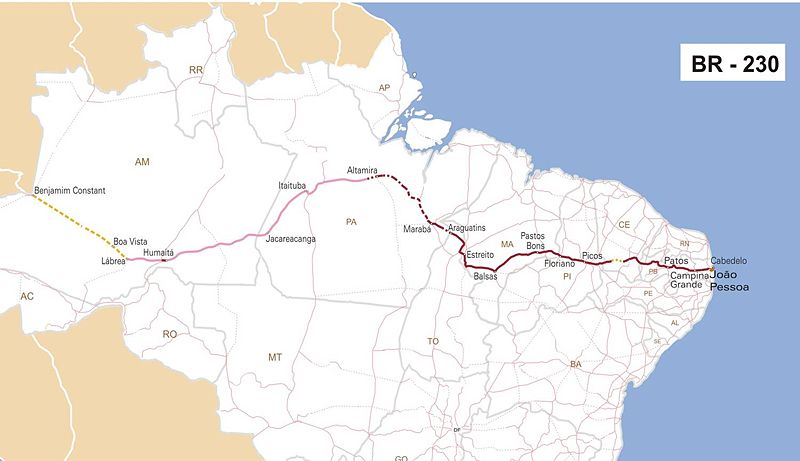
The Trans- Amazonian Highway


In the summer of 1970, the northeast of Brazil was suffering under one of its periodic droughts. Tens of thousands of small farmers were being driven off their land. Hundreds of children were dying of starvation.

General Emílio Garrastazu Médici, military ruler of Brazil, visited the area to study what might be done. “Nothing in my life,” he later wrote, “has ever shocked and upset me so deeply. Never have I faced such a challenge.” Land reform, the obvious solution to the peasants’ plight, was out of the question. The military who ruled the country relied too much on the support of the wealthy fazendeiros. And there was no way to convince those great landowners that they should make presents of even the smallest fraction of their lands to the rural poor.

But the general wanted a solution. And being a general, and in charge of the country, a solution he got. It was the Trans-Amazonian Highway, one of the most ambitious Brazilian government programs ever attempted, and one of the greatest failures.


The idea was to bisect the country with a 5,000 kilometer road, joining the Atlantic coast on the east, to the border with Peru on the west, thereby opening up the rainforest to economic development.


Settlers would be given 250 acre plots of land, six months’ salary, and easy access to agricultural loans, in exchange for settling along the highway and converting the surrounding rainforest into agricultural land.


The project was begun with great enthusiasm. On the 9th of October, 1970, a bronze plaque, nailed to the trunk of a mighty castaneira tree, cut down on the previous day by Médici himself, was unveiled.


The legend on the plaque read: On these banks of the Xingu, in the midst of the Amazon jungle, the President of the Republic began the construction of the Trans-Amazonian Highway, a historic start to the conquest of this gigantic green world.


But the reality turned out to be something quite different. The soil of the Amazon basin consists mostly of sediments, which make the roadbed unstable and subject to inundation during heavy rains.


It soon became apparent that the road would be unusable during six months out of every year, causing the settlers to be cut off and leaving the products of their labors to rot.


Natural nutrients in the region are few, resulting in low crop yields. New forest had to be cleared for each year’s planting, and after every clearing, rampant erosion occurred. Logging was difficult due to the widespread distribution of commercially valuable trees. Colonists, unfamiliar with banking, and lured by easy credit, went deeply into debt.


Indians, living in the forest, were exposed (many for the first time) to the white man and his diseases. Those diseases killed them by the thousands.


 And then there were the long-term environmental costs. After the construction of the highway, rampant deforestation soared to new heights.


Within five years, the government withdrew their support, leaving the settlers in abject misery.


These days, the road has little traffic. The thin layer of fine gravel that was used in the original construction was unable to withstand the torrential downpours that occur from November to April. A heavy outlay is required, each May, to repair the wooden bridges, fill in the potholes and replace the broken drainage pipes.
At points further west of the little town of Itaituba, and all the way to the Peruvian border, there are stretches where the “highway” is less than two meters wide. 


But all is not yet lost. An effort is now underway to pave the entire length of it. Some estimates are that it will take ten years and cost more than a billion US dollars.


A lot of money, as one Brazilian journalist remarked, for a road that links nothing to nowhere.

Leighton - Monday

Monday, February 21, 2011

Rio - The Movie

Rio – The Movie

It’s been a long time since the city of Rio de Janeiro formed the backdrop for a major work of feature film animation.


The last time was when Walt Disney released The Three Caballeros, back in 1944.

That’s about to change.

Carlos Saldanha’s Rio will be debuting in April.

Saldanha is a Brazilian animation director, a native of Rio de Janeiro, who’s been working in the United States since 1991.

You might not know his name, but the odds are you’ve been exposed to his work.


Like the scrat.

The scrat is Saldanha’s saber-toothed squirrel from the Ice Age series.

The one that loves acorns even more than he does the scratte, his female counterpart.

Now, Saldanha is hoping that Blu will become equally well-known to the movie-going public.

Blu is nerdy “flight challenged” macaw who, as the film begins, is living happily in his cage in Minnesota.
Happily, except for one thing: he believes he’s the last of his kind.
But then it’s discovered that there is another surviving bird of the same species.
She’s a female, and she lives in Rio de Janeiro.
Where he goes to find love.

To get the visuals right, Saldana brought a gang of animators, writers and artists to Brazil.


Where he put them through an intensive course of study in one of the most photogenic and three-dimensional cities in the world.

They flew over the city by helicopter.


They participated in a rehearsal of a samba school.


They went up to Pedra Bonita and risked flights on the hang gliders. (This is work?)

 You can’t tell a story about Rio without music, so there’s a lot of that, too.  And, to execute it, Saldanha was able to count upon the collaboration of one of Brazil’s musical greats, Sergio Mendes.

The movie looks like it’s going to be great fun, but under it all is a serious message, one with which I’ll be dealing in my December release, A Vine in the Blood.


It’s the trafficking of exotic animals.
And by the time I launch the book, no one will ever believe I wasn’t inspired by the movie.

The world premiere of the movie will be in Rio de Janeiro on March 22nd with the full cast. Here's one of the trailers:


Leighton - Monday

Monday, August 16, 2010

The Churches of Salvador


Salvador is the capital of the Brazilian State of Bahia.
And has the distinction of having been the capital of the nation for many more years than either Brasilia or Rio de Janeiro.
Back then, the Portuguese empire was nominally, and almost exclusively, Catholic.
A fact which led to the construction of many, many churches.
In the old city of Salvador, the residents say, there was a different one for every day in the year.
Let me show you a few of them.
In the archives of this blog, you’ll find an article about Brazilian Wish Ribbons and how they are linked to a certain statue.

The statue is to be found here, in the Basilica of Our Lord of Bomfim. It’s the most popular church in the city, but it is, by no means, the oldest, or the most beautiful.
The Monastery of Our Lady of Mont Serrat is located on a peninsula extending into the sea and contains some splendid seventeenth century woodcarvings.
(c) 2009 Tito Garcez
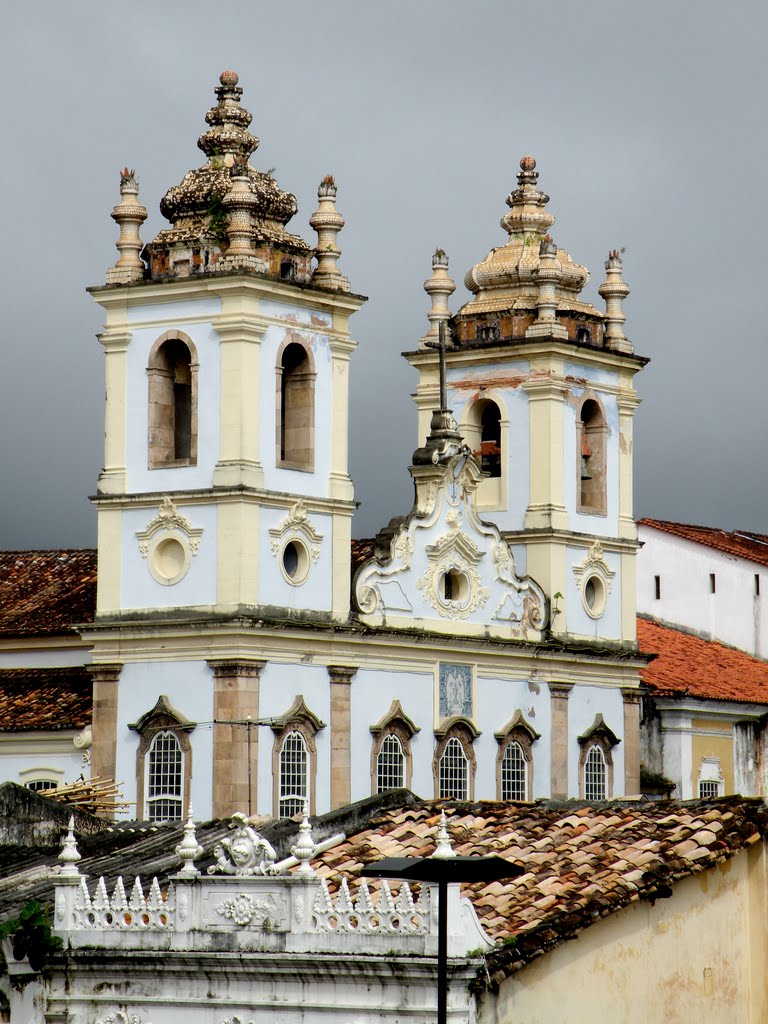
The Church of Lady of Rosário of the Blacks is in the historical heart of the city on Pelourinho Square. Pelourinho means pillory and it was here, right in front of the church, that slaves were publicly whipped and subjected to other punishments. 
(c) 2009 Tito Garcez
The construction of the building was carried on at night by slaves and free blacks. The black priests of Bahia are always ordained in this church.
The Church of Our Lady of Victory was founded in 1531.
The Church and Convent of São Francisco is considered to be (literally) the jewel of all of the churches in the city. Not so much for the outside…
…as for the interior. The “Church of Gold”, as it’s sometimes called, is considered to be the most magnificent example of baroque art in all of the Americas. That’s the real stuff you’re looking at. It’s on the walls, the columns, the roof and the altars. It’s everywhere. And the gold isn’t all. Numerous tiles adorn the corridors. They depict the entire Bible – both the new and old testaments.
Finally, if you want a great façade, it’s got to be this one:
The Church of the Third Order of São Francisco.
All of these carvings were, for many years, covered with a layer of smoothed stucco.
People had forgotten about what lay beneath.
Then, one day, an electrician was called-in to install some wiring.
Turns out he was drunk, and he had a sledgehammer.
He hit the façade much harder than he’d intended to.
And part of the stucco crumbled away.
I have often lifted a glass in his honor.

Leighton – Monday

Monday, June 21, 2010

Cala Boca Galvão – Brazilian Inside Joke


Explaining Brazilian humor sometimes challenges this writer.
But I’m going to give it a go.


Before you read any further, please look at the video that I've embedded above.
And, if your browser doesn’t show it embedded, click here to see it:
As a matter of fact, you might want to do that anyway.
Because the embedding cuts off the right side of the image.

Okay, you’ve seen the video?

Now admire the poster.
Think you now know what the cala boca galvão movement is all about?
Well, you don’t.

Here’s the real Galvão.
That’s right, a person, not a parrot.
Galvão Bueno is Brazil’s leading sports commentator.
He does play-by-play on all sorts of sports.
Especially football (soccer).
The thing about Galvão is that he talks a lot.
Some people like it.
Others go as far as accusing him of being a bombastic cliché machine and wish he’d shut up and let them enjoy the games.

The World Cup, as I don’t have to tell you, is being played out.
Galvão is calling most of the games.
We’re all hearing him a lot.
And, if you go into a Brazilian bar, or other public place, when a game is on, you’ll often hear someone say “cala boca, Galvão”, the literal meaning of which is “shut up Galvão”.
And, now, in a typical manifestation of Brazilian humor, non-Portuguese speakers around the world are being enlisted to participate.
Under false pretenses.
What they think they’re doing is supporting a movement to save a nonexistent parrot called the galvão.
What they’re actually doing is signing an electronic petition telling Galvão Bueno to shut up.
And over one million of them have already done it.
And, now, there’s this:


If you don’t see it embedded, go here:


As a footnote to the main event, other Brazilians have plugged in phony subtitles to this YouTube video. They purport to show Hitler reacting to the phenomenon. The Lady Gaga comment refers to a secondary hoax, now being spread, that Cala Boca Galvão is actually the title of a new song recorded by Lady Gaga. (The large titles are in Portuguese, but there are small ones, in English, above the image.)

Leighton - Monday

Saturday, June 19, 2010

Guest Author Annamaria Alfieri


Today we're pleased to welcome Annamaria Alfieri.
Deadly Pleasures Magazine called her book, City of Silver, one of the best first novels of the year.
The Washington Post said, “As both history and mystery, City of Silver glitters.”
And I couldn't agree more.


One of the secrets about Annamaria is that she isn't Annamaria. 
As Patricia King, her real name, she has authored five books on business subjects including Never Work for a Jerk, which was featured on the Oprah Winfrey Show, and the current Monster Boss. 
Annamaria/Patricia lives in New York City, and writes today about the place where her novel is set:


The Richest City in the World


Picture the most powerful city in the Western Hemisphere, the same size as London, a place that has dominated the economic life of the planet for a century.  Its upper classes are mostly white, consumed with displaying their wealth in the form of the latest in luxury goods and sumptuous parties.  The thankless or dangerous work is done by a brown underclass of people largely of South American Indian or mixed Indian and Spanish blood.  At the moment, the city is on the brink of economic ruin, because its dominant men have manipulated the financial system in a way that will affect the economies of countries around the world.  The troubled among its citizens console themselves with strong drink or fundamentalist religion.
Sound familiar?  New York City in 2010, right?
Well, yes, but it is also Potosi, in the Spanish Viceroyalty of Peru in 1650.

The most fundamental thing about Potosi is its position.  At 13,500 feet, it was then and is now the highest city on earth.  What could possibly have brought 160,000 souls—noblemen and beggars, the covetous and zealous—to live in a remote and desolate land where not a blade of grass grew, in thin,  icy air, buffeted by awesome storms and bitter winds?  Only one thing: Money.  Literally, tons of it.

In April of 1545, the Spanish arrived and claimed a red canonical mountain that turned out to be the richest silver lode ever discovered.  Despite the hostile natural environment, over the next century, the city attracted Indian and Spanish miners from all over the Altiplano and western South America.
At first, silver was so close to the surface that it had been exposed by erosion, and so pure that it hardly required refining.  And the riches were shared among all—Indian or Spanish—who worked the Cerro Rico (rich mountain).  Twenty percent of all that was taken was loaded on mules and llamas to make the three-week trip to the coast at Arica, where it was sent to the King of Spain. 

The city that grew up at the base of the mountain became a lovely Spanish place with a cathedral, monasteries and convents, palaces of noble (actual or pretended) Spaniards and their wives, a theater, and a mint to stamp coins, which came to be known as doubloons in the pirate adventure stories of our childhoods. 
The buildings were decorated by native artisans in a style called Mestizo Baroque: as ornate, complex and beautiful as Baroque churches in Rome or Vienna, but with motifs of jungle animals, exotic plants, and Indian faces. 
By 1650, however, the veins being exploited were deep in the mountain, and the mine owners required mercury to purify the silver.  To maintain the flow of wealth, the Spanish instituted a system of enforced labor called the mita, little different from, some say with no difference from slavery.  The work was so dangerous that tradition says, in the villages where men were impressed into the mita, their relatives played dirges for them as they marched away.
Potosí still exists as a city of 105,000.  In 1986, UNESCO declared it part of the Patrimony of Humanity.  Its architectural masterpieces have largely been restored and can be enjoyed by visitors.

Miners still work the Cerro Rico.  Until recently, they have taken mostly tin and copper from the mountain.  But the media have reported that lithium, perhaps the metal of the Twenty-first Century , has been discovered there.
The life of Potosí is about to change again.

Leighton for Annamaria - Saturday
Check out her web page here: http://www.annamariaalfieri.com/