Annamaria on Monday

Ordinarily, when I write about here about the history of Kenya, I am harkening back to the early Twentieth Century, when it was still the Protectorate of British East Africa. Today, I am reporting on very recent history that I have had the enormous privilege to participate in. The picture above documents the moment when a pastoralist man gave a cow to a woman.
What’s the big deal, you might ask. Well, I’ll tell you. But the beginning of the story is hard to talk about. Bear with me. I promise you it has a very happy ending.
In the millennia-old culture of Samburu in Northern Kenya, girls have always been treated as chattel. They belong to their fathers. Ordinarily, at the age of 9 or so, they are offered as toys to men of the warrior class (males of about 15 till mid-to-late 20s). This practice is called beading. Then, once the girls show signs of puberty, they are cut (subjected to FGM), and their fathers sell them into marriage, usually to a man 3, 4, or 5 times their age. This was the fate of all the local girls until…

Enter Sarah Lesiamito, a Samburu girl who—years ago—emerged from that fate. But then her best friend, a cousin, died in the aftermath of being cut. Sarah, who was then still a child by current American standards, vowed to herself that she would change that part of her culture. She grew up to be a teacher and in 2012 began by saving local girls from that awful fate by taking them into her home, keeping them in school, and supporting them through secondary school and further training.
As you can imagine, the fathers of those girls often became enraged, demanded to have their daughters back so that they could “prepare them for marriage” and sell them for cows and goats. One such father was this man: Lparasan Leparsha

His daughter Sonia went to live with Sarah so she could evade a girl’s typical fate. He went to Sarah to complain about his loss. Sarah calmly told him, “I am helping you raise your daughter.” Since the traditional practices are against Kenyan law, he had no way of the seizing “his property.” He went away mad.
But, eventually, just about a year and half ago, Sonia graduated first in her class from secondary school. Sarah threw a party and feted her protégé. At which point Lparasan Leparsha went to Sarah and admitted that she had indeed helped him raise his child.
In the interim, Sarah and I had met, and I had begun to support her efforts with advice and by raising donations to help her expand.
After the party celebartin Sonia, Leparsha pointed to the dormitory, the small library, the kitchen from which the girls were fed. “How are you doing all this,” he wanted to know.
“There is this woman in New York,” Sarah said.
“When that woman comes to Samburu,” Leparsha said “I am going to give her a cow.”
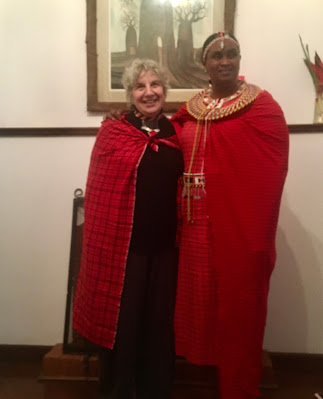
And so we made history this past February 17th! Lparasan Leparsha, Sarah Lesiamito, Michael Lenaimado (Sarah’s gold-star supportive husband), and I. For the first time ever, a pastoralist man gave a cow to a woman.

Leparsha opened his mind and heart and saw the achievements of his brilliant young daughter as the greater good. Remarkable!
The Sidai Resource Centre is now home to forty-eight girls who are safe from harm. One of Sarah’s early recues, a girl name Shaa, has already come back to her community as registered nurse. Sonia is in college and studying community medicine.

My cow is just a heifer at this point, but she is nearby to the Centre and will be bred one day soon. After she gives birth to her calf, she will become a source of milk to nourish the Sidai girls as they pursue their dreams.