Showing posts with label Gian Lorenzo Bernini. Show all posts

Monday, October 23, 2023

Theater Art and Art of Theater

Annamaria on Monday

Once again, I am hiding out from the topic of current events.  So you will not be reading the pacifist sermon that has been playing in my head all week.  Nor the prayer I'd wanted to say.  Today I am going to hide out behind what I consider a timeless topic:experiences of the arts of sculpture and theater.


I have written a few blogs over the years about Hudson Valley Shakespeare.  Fifty miles north of Times Square, surrounded by green hills and over looking the majestic Hudson River, for the past thirty-five years, HVS has brought us fans the joy of live theater performed in repertory under a tent.  To me, the most beautiful thing about the HVS productions is the simplicity of the circumstances.  Actors perform at ground level to audiences of just over 500, sitting bleacher-style on three sides.  The stage is in open air; the productions almost always employ few props and practically no sets.


The magical intimacy of the performances is about the night, the playwright's words, the actors' voices, and the audience's responses. People in the chairs are participants who share in the captivating story, laugh together - often at 450-year-old jokes.  Are moved by the fear, the anger, the hope, the confusion... that the actors portray.

It's glorious.


I have also written here about my admiration for the sculptor GianLorenzo Bernini, especially about his ability to captivate viewers of his work by presenting his subjects in action: his David about the launch the rock at Goliath.  Or something as simple as a cardinal about to speak.  Viewing a Bernini is a bit like watching a play.  With him, one feels involved with something going on.  Something like what happens to audiences at HVSF. It's not a passive experience.
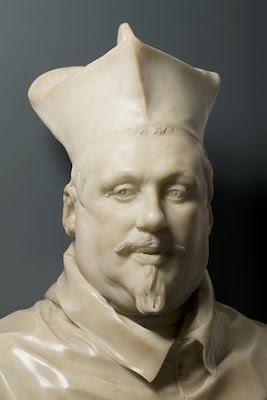

I just recently learned that besides being a great sculptor, painter, and architect, Bernini also wrote and produced plays. And then some!  In his theater pieces, he went to great lengths to involve the audiennces.  One source described his Inundation of the Tiber like this: "He enjoyed seeing his guests caught up in the action. The stage seems to have contained a number of dams or dikes, arranged so that the water could be seen bursting through as it advanced toward the spectators. When the water broke through the last dike facing the audience, it flowed forward with such a rush, and spread so much terror among the spectators that there was no one, not even among the most knowledgeable, who did not quickly get up to leave in fear of an actual flood. Then, suddenly, with the opening of a sluice gate, all the water was drained away." 

Imagine that!

In another production, Bernini's stage fire became so realistic that , "There was such terror among the spectators that it was necessary to reveal the trick to keep them from fleeing."

Gives new meaning to the old rule about crying "Fire" in a theater, don't you think?

The closest HVS ever came such a performance, for me anyway, was the summer of last year. The play, Mr. Burns, had a scene of a violent storm. There were, of course in the 21st Century, sound effects and light effects to create the illusion. But as it happened, on the night I saw that play, an actual thunderstorm descended on the tent at exactly the right moment. The thunder, at one point, became so loud that the audience could not hear the actors.  They had to stop the performance and wait until the storm passed. After about 15 minutes, when the play resumed, the very next line an actors had to say was "The storm is over."  The audience, as you can imagine, burst into peals of laughter.  Not even the hyper-brilliant Gian Lorenzo Bernini could have managed that!

Monday, February 27, 2023

Madrid: First Glance

Annamaria on Monday

These five days in Madrid were inspired by an opportunity to meet up with my life-long friends Francoise and Jean-Claude, who planned to be here to attend a contemporary art fair.  My friend Nicoletta and I jumped on the band wagon.  


We are enjoying cold, but sunny weather.  With lots of long walks to admire the grand and glorious architecture.  Here are some highlights of our first couple of days.


Many European churches have bronze doors, but these on
the main cathedral of Madrid were not created until the 
1980s, the the finishing touches were added to the structure.

I loved the bronze image of the Bishop in his specs


Some of the stained glass is ancient and some is very 80s!


\


Two of my top picks from the Thyssen Collection:

Caravaggio!

Thyssen owned his own Bernini!?!?


Blue skies, smiling on me!  More Madrid next week!

Monday, January 26, 2015

Telling a Story in Stone: Bernini in the Galleria Borghese

Youthful Self-Portrait


This past Thursday, for the second time in two years, I visited Rome’s Galleria Borghese to worship the works of Gian Lorenzo Bernini.  Here is the text of an email I sent to an Italian friend while I was there.  “All well here.  Hotel very nice.  Bernini is God.”

By now, you are sure I am exaggerating.  I hope to convince you otherwise.  Sort of.

A little background


Gian Lorenzo Bernini was born in Naples in 1598.  His sculptor father got work on some important Papal projects and took the family to Rome when Gian Lorenzo was eight years old.  Inspired by the classical sculptures of antiquity, he was soon earning commissions of his own.  At the age of just 23, he was knighted by Pope Gregory XV for his artistic genius.  Over his lifetime, besides great sculptures, he produced paintings, wrote plays, created surpassingly wonderful buildings and outdoor spaces, and designed theater sets.

The whole story in one moment


Bernini began his sculptures with one intention.  For his portrait busts, he chose to portray the exact second when the subject was about to speak.  You see it immediately in their faces—their eyes, their mouths.
Cardinal Scipione Borghese

Constanza, more about which anon 


For his magnificent monumental sculptures, he chose the most dramatic vision of classic or biblical stories, chiseling into the faces and the bodies all the energy and emotional intensity of his characters.


In his Rape of Proserpina, he gives us the very moment Hades gets hold of her, at the peak of her struggle to get free.


See how tightly he grasps her.  This is stone!


His David is not like Michelangelo’s contemplating his battle with fear, determination, and strategy (for which my admiration does not wane for a nanosecond).  Nor is it Donatello’s, at the moment of triumph.  Bernini’s is in the act of launching the stone.


How does one get rid of everything but the open rope!!


Then there is the work that made me fall in love—Apollo and Daphne at the point where he catches her, but she is already turning into a tree.


Those leaves!
Those fingers!
That extended leg!

My blogmates here and I have often been asked at conferences and book presentations to describe our process.  “How do you go about it?” people ask.  Most of us find the question a bit daunting, because the steps we follow, how we talk to ourselves about the act of creativity seems so shallow compared to one’s experience of doing it.  But looking at Apollo and Daphne, I found myself wondering the same thing, because I was stupefied by how Bernini could have done it.  I wish I could have watched or asked him.  Faced with a block of one the hardest substances appearing in nature, where does one put his chisel first?  Oh, he must have made drawings and likely a clay model to work from, but really?  How does one even contemplate achieving such perfection when there is no possible way to revise, to correct one’s mistakes?  Once the hammer strikes the chisel, there is no delete key!  It fills me with awe that he could do it at all.  Getting to his level of achievement seems positively divine.

A couple of days after this recent visit to Rome, at dinner, a friend and I were talking about the facts of Bernini’s life.  His most reliable biographer was his son Domenico, but according to what I could discover, Domenico sanitized some of his father’s activities. For instance, I imagine he would have wanted to leave out the more scandalous details of his father’s youthful love affair with a married woman, inaptly named Constanza.  When she threw Gian Lorenzo over for his younger bother Luigi, the great man’s behavior was anything but god-like.

Mature Self-Portrait

This got me to thinking about one of my pet peeves—that some people deny the worth of artists’ work because they don’t like the way they conducted themselves privately.  My conclusion is this: When an artist’s output inspires awe, we should embrace their real-life flaws.  It is only because of their human frailties that we can be sure that mere humans have achieved such wonders.  There’s a lot to celebrate in that.

I still have the feeling, though, that my next visit to the Galleria Borghese will inspire nothing short of worship.


Annamaria - Monday
