Showing posts with label Ebooks. Show all posts

Tuesday, September 9, 2025

Books, Books, Books and Book Space

Ovidia--every other Tuesday

I’ve kind of been struggling with books lately—not just the ones I’m writing, but the ones I’ve been living with. I have shelves and stacks and cupboards full of books. Some of them books I haven’t opened in years,some that I've never opened--period. And that's the big problem; I’m not reading them. And they're sitting there judging me and my weak eyesight or weak will power or just lack of energy... and that’s not fair to the books—or to me.

Yet it feels wrong to give them away because many/ most/ all of these books feel like a part of myself. If I let them go, would I be losing the person I was when I first bought them? When I first fell in love with them?

Because isn't my whole identity that of someone who reads?
But why?
I want to read for enjoyment, of course. That's how I first started reading, and that still holds. But I realise the primary way I take in the world around me is through reading. It's what feeds me. And lately, I've been reading less than any other time in life. Reading over lunch or dinner or for an hour before bed... quite pathetic, really. But I wasn't doing anything about it because it only came up when I was too tired to deal with it.

But recently I was 'forced' to confront this.
I’ve signed up for something called the 5X5 'Flow Prone' course by the Flow Lab, which is designed to help you reliably achieve flow state in your work--in my case, writing.

(This isn't an ad--I'm just starting the 3rd week, but I'll let you know how it goes!)

The idea is take action, however small, in the 5 key areas, 5 days a week. PRONE an acronym for Physiology/Regulation (mental)/Optimisation(work smarter)/ Nutrition / Environment.

The first 4 categories were pretty easy, once I got organised.

Physical: I get 60 to 90 min of pilates or yoga in the morning and walking, slow jogging and swimming in the evening.
Mental Regulation: I do my morning pages, including noting things I’m grateful for, what can be improved, and pick the day's steps towards my weekly, monthly and long-term goals.
Optimisation: I've downloaded the Freedom app, which blocks apps and distractions on all my devices during my work hours (9–11 a.m. and 2–5 p.m.).
Nutrition: We're happy with our meal plan.
But the fifth one—environment—is where I’ve fallen down most badly--and it's mostly because of all my books.

One step I have taken is exiling my “writing buddies” from my desktop to the shelf above...


I need them nearby, because they're the ones who play roles when I'm trying to figure things out.


And these are the editors who listen (and sit in judgement) when I read passages out loud to see how they sound!

But the big step, that's much harder but I'm determined to take, is giving away some of the books I know I’ll never read again. And that is really painful.


I am still reading, but moving from paper to ebooks and audiobooks feels a little like betraying a first love. But then I remind myself: people probably once said the same about hand scripted parchment manuscripts when Gutenberg’s press came along. Weren't early printers were accused of destroying tradition? And before that, perhaps stone carvers sneered at the newfangled feather quills—would the Ten Commandments have counted if they’d been written on treated rawhide instead of chiseled in stone?
And even the act of writing something down was a step away from the stories we used to share around the campfire after a day of hunting wasn't it?
Because in the end, it’s not about the medium but the stories we share, the chance they give us to look at ourselves, our lives and the wonderful, unbelievable potential of being alive in time and space.
And my precious paper books? One day they may feel like those tiny lotus shoes once worn by women with bound feet—treasured relics and part of heritage while being too impossibly constricting to be worn. I marvel at them even as I walk everywhere freely and easily in my huge Sketchers.
Because yes, a big advantage of e-readers is that I can zoom in and increase font size, and contrast, making reading much easier on the eyes.
And yes, I still treasure my paper books. They will always be a precious part of me and of the life I crafted around my love of reading.
So yes, some of my books are going new homes--via book exchange shelves and the library's Big Book Giveaway (September 13-14, 2025, from 10am to 4pm at The Plaza, National Library Building, Singapore if anyone's interested). The biggest risk is of course that I might come home with more books than I leave there! I still own more physical books than I will ever finish reading and I'm still buying them... I'd really like to know how everyone else is managing their libraries. I'm guessing it's easier in less humid climes.

Tuesday, April 23, 2024

Culling My Life--or at least some Old Books...

 Ovidia--every other Tuesday

These were some of my 'best friends' when growing up--


In the old days before ebooks and library access (back then I only got to go to the national library on Stamford Road during the school holidays. The rest of the year there were only the two Primary School Library bookshelves and the Sunday School library... offerings were kind of limited).

The good thing about having only a few books is that reading and re-reading them got me knowing them almost by heart. 

Other favourites were The Diary of Anne Frank, The Bell Jar and Heidi, and J.D. Salinger's stories about the Glass family (much more so than The Catcher in the Rye), which became my fantasy family.

But it was this book (though I didn't love Nancy Drew as much as I did Tarzan or the Hardy Boys) that gave me my first reading/writing wake-up moment:


I didn't notice the hidden racism people talk about these days because it seemed normal that all the people in English books were white just like all the people in Chinese books were Chinese. But in Nancy Drew's Mystery of the Fire Dragon, I met Song Chi Che (Or Chi Che Song as she's called in the book), a gutsy Chinese girl who's kidnapped and rescued and survives (with the help of Nancy and George--who was another favourite). 

That's pretty much all I remember about the story--that Chi Che, a Chinese girl like me, could have adventures in stories that didn't end in a morality reminder to respect your parents/ eat every grain of rice on your plate/ not litter on the street.

After that I wrote some comic stories featuring Chi Che which have (fortunately) been lost.

Triggered by the renovations, I've been trying to cull my books. Not only because of the space crunch but because it made me realise how long it's been since I've picked up (let alone read through) some of these books.

These days I'm reading more on Kindle and Kobo than on paper. I'll always love physical books but it's often easier to increase the font on an e-reader than find my reading glasses. Plus I can mark pages, highlight passages and scribble notes to myself without feeling like a vandal.

But even if I'm okay buying ebooks, what about all my old books? Like all our old Calvin and Hobbes--


I loved these comics so much. Not just for Bill Watterson's brilliant depiction of the fantasy/real Hobbes but maybe even more for the family around Calvin that loved and supported without fully understanding him.

Calvin's parents would say, in logical, rational and practical terms, that I should only keep books that I intend to re-read, right? 

Besides, given I now have access to more books than I'll have time to read, it's time to let some the old ones go, right? 

I looked up several places to donate books to, though it's so sad that most of my beloved second hand bookshops are gone.

Mine aren't books that would be worth anything to anyone else.
But it feels wrong to give away books that feel more like close childhood friends/ teen buddies (Sylvia Plath, Joe Orton, JD Salinger) or respected elders (Agatha Christie, Nancy Mitford, MFK Fisher, Lawrence Block) who shaped what I am today even if we no longer spend as much time together.

I'll be keeping my Agatha Christies and Rex Stouts--even though I now have e-copies of most of these books. 


Unlike many other homes, we don't have an ancestral shrine here, so this bookshelf might serve the same purpose. A place that reminds us of who we are and where we come from and who we will always be grateful to.

I remember discovering and devouring Ovid's Metamorphosis--I found a copy (plastic bound--no browsing) in the MPH bookshop and insisted on getting it as that year's 'good results' book.

My mum said no. She told me it was a 'bad' book without being able to explain why. I realise now that she (incidentally also named 'Ovidia') must have been told Ovid wrote Ars Amatoria--a 'bad' book and--unlike me--accepted that.

I got my way on the condition I never brought it to school and never told anyone I had it. Yes, I'm telling you now, but my mother's passed on and won't read this.

And I really loved it The Metamorphosis. It's pretty much a run through of most of the stories in Roman Mythology with 'Amor' / Cupid wisely/ wittily/ naughtily triumphing over all the other Roman gods. I still have the fraying, falling apart, scotch-taped copy I got then. It's almost impossible to read (print too small, eyes too old) but that book's become a sentimental object for me-- I admit that even as I know that's Not what a book should be.

I know it's not just about letting go of that or any other copy of a physical book (thought would be a big step for me) but needing to figure out what 'writing books' or even 'reading' means to me in our digital age.

I'm not giving up on books--Amazon birthday vouchers are being Very carefully assessed and assigned--but what about the physical books I already have?

In some cases, even though I own ebook copies, I'm keeping my hardcover copies of Larousse Gastronomique and Tools of Titans because they are browsing friendly. Likewise all my Sherlock Holmes and Nero Wolfes... these work for me more like tarot cards. I don't think I'll ever sit down and read them cover to cover, but like tarot cards or how (some) people read the Bible, I can flip through the pages, let them fall open at random and know them well enough to read any passage or page in context. They are like old family photos for me.

But what about books that I read, learned from, respect and am in awe of but don't love?


(Okay, writing this makes me realise Haruki Murakami's probably going to stay)

Balanced with those I respect less but love more--


--even though I'm likely never going to cook out of these books I've created and enjoyed so many experiences while in their pages.

I've already packed up, given away/ donated four huge bags of books... (though there's no guarantee I won't head down to the charity store and buy them back next week!) as I realise this isn't just a shelf space issue.

It's so difficult because it's about trying to figure out why we write and what we want our writing to do and be. And how we can make that happen. Once upon a time it was all about holding a published book in your hand, feeling and weight and reality of it. If you wanted to share your life/story/soul with someone, you handed them a copy of your book.

But going even further back than books, it was all about telling stories, writing letters and recording journals in cipher. 

It was about serial stories in penny weekly magazines and storytellers entertaining homesick labourers with stories of home and dreams of happy futures and players enacting ghost month dramas to entertain spirits and their human descendants.

That's our lineage. We are still the music makers, we're still called to wake people to be 'the dreamers of dreams'. We just need to figure out what form we work in next. After all, we're descended from the inventors and adopters of the printing press (as well as those who feared not copying out scrolls or carving out tablets by hand signalled the downfall of humankind).

But how? Every generation's tried to answer this for themselves--another reason I've always loved reading letters and diaries.


(just a few more books I won't be giving away!)

And we will too!


Thursday, October 3, 2019

Self-printing


Michael - Thursday

Courtesy Authors Guild
All the writers on this blog are “traditionally published,” that is their books are published in paper and as ebooks by a professional publishing house that makes its living as an intermediary between the author and the reader. Their role includes detailed editing and copy editing of the manuscript, cover design, marketing and distributing the finished books to booksellers, and, to a varying extent, publicising the book to the readers. The idea is that the authors can concentrate on writing the best possible books and the publisher (and the author’s agent if s/he has one) deal with everything else. Stan discussed here a couple of weeks ago that this isn’t quite how it works out in practice!

Self publishing has moved on from here!
Mainly as a marketing exercise to introduce Detective Kubu to readers who would like a taste and didn’t want to pay for it, we published a small collection of short stories called Detective Kubu Investigates as an ebook in 2013. We were in for some surprises. We wanted to give the book away, but Amazon wants a minimum of 99c. (Even 66% of nothing is nothing and Amazon doesn’t find that attractive.) However, we also offered the book for free from our website. The first surprise was that no one was interested in the free book. They wanted the convenience of having the book downloaded to their Kindles immediately and were willing to pay 99c for that. The second surprise was that what seemed like a straightforward process to get the book on Amazon turned out to be quite complicated and it all had to be repeated from scratch to make the book available through other ebook distributers. The layout, formatting, typesetting, and cover upload in terms of size and shape and a variety of other irritations meant that it took several days to learn what to do and get it done. Even then, the result wasn’t really something a professional publisher would regard as acceptable. It also took multiple iterations to get it right. We were glad we did it (in view of the last surprise), but also glad when it was done. The final surprise was that we sold several thousand books and are still selling them.

In the meanwhile we’ve written several more short stories and we quite like them, so we thought it would be fun to put together another collection to follow on—Detective Kubu Investigates 2. So I dug out my Kindle Direct Publishing manual and got to work. Another surprise. Amazon has a completely new program - Kindle Create - to do this. It took a few minutes to learn how it worked, and after that about an hour to upload the manuscript and get it into a professional format. I’m not sure why I was surprised because it seems reasonable that Amazon would have done a lot of development in five years. I just assumed that, like most software upgrades, they would have made it still more complicated in order to permit me to do a whole lot of things I didn’t want to do in any case. Amazon has gone another route. The format is still pretty rigid, only allowing the choice of a few styles and layouts. They point out that readers have their own preferences and that they can reset font size and style themselves, so the body of the book needs to be in a standard font. Still, you are offered enough layout and style options to make the book look professional. So much so, that I actually redid the original collection using the same software to make it consistent and upgrade its style and format. In a couple of hours. And there is a previewer that allows you to see the result as if you were using a Kindle or a tablet or even a phone to read it.

KDP Cover Creator
I was sufficiently intrigued by all this to try the paper book version. Why not make a joint collection from the two short story collections available in paper? I imagined that this would be much harder. Well, it is a bit harder because now you can’t actually see the final paper copy and you have to make the cover wrap around the book. But Amazon has Cover Creator. It enables you to set up the cover, using your own picture or offering you a variety of set templates or open source pictures, and various styles for the title text. You can upload an author picture. You can fill in the blurb on the back of the book. And then it tells you what problems it’s found and simulates the paper book for you to view and correct. Once more a few hours was all that was needed. But a warning here is that the Amazon version expects you to sell the books through them. Not so good if you want to print some copies and hawk them around. The bookstores will be expecting a big discount and Amazon isn’t going to pass that on. My advice on this would be to print yourself a couple of copies and look at the result. The beauty of print on demand is that it’s easy to correct text and layout at any time.

I came away impressed. But this was only the first step in the process. I also wanted to make the book available in Nook, Apple, and Kobo formats. We published the first book in those formats through a company called Draft2Digital. (There are multiple options now—SmashWords is another one.) I remember that as being yet another learning curve. But again I was pleasantly surprised. Not only was their software just as user friendly as the Kindle one, but it was just like the Kindle one. Well, imitation is the sincerest form of flattery. So, once again, the process was quick and painless. I haven’t tried the paper version yet, because it’s still in beta testing and I’m awaiting my “test slot.”

The moral of all this is that it’s really easy to make something like a collection of short stories or a novella available as an ebook and print on demand paper, and I recommend anyone to who wants to do so to give it a go. BUT. There’s a reason I called this “Self-printing.” These systems do not do the other things traditional publishers do for you. You design your own cover, and if you use their templates it’ll be pretty generic. Perhaps okay for ebooks, but not great for paper—especially if you're trying to get a book store to carry it. Speaking of bookstores, they will expect you to supply the books and take them back if they’re not sold—like the publishers do. Then there is the editing. The self-published ebooks I’ve read look nice but tend to need a lot of editing. The best these ebook systems will do is highlight spelling and basic grammar—but you get that in Word or the like anyway.

Then there is the issue of marketing. Nowadays, authors are expected to do a lot of that themselves anyway, but the publishers do help, and some help a lot. I do know authors with successful, well-edited and well-presented self-published books with great covers that sell a lot of copies. But it’s comparatively rare and lots of hard work.

If you intend to self-publish, my advice—for what it’s worth—is spend your money on a good editor and cover designer. There’s simply no need to pay someone else to set up the book for you. There's really no reason to worry about the physical or electronic nature of the book anymore.

____________________________________________

MICHAEL STANLEY EVENTS
           
Tuesday, October 29: 6:30 pm Murder by the Book, Houston, Texas. Michael joins Yrsa Sigurdardottir for a discussion and signing.

We’ll be at BOUCHERCON in Dallas at the end of the month. It looks like an exciting meeting and we’re looking forward to these panels!

Thursday, October 31:

11:00 – 12:00 Panel: The Novel Stands Alone
  Kendra Elliot, JT Ellison, LS Hawker, Stanley Trollip, Sheri Lewis Wohl
  Participating Moderator: Laura Benedict

Sunday, November 3:

8:30 – 9:30 Panel: Detectives Overseas
  Ian Hamilton, Ragnar Jonasson, Michael Sears, Jeffrey Siger
  Moderator: Nancy Tingley

After Bouchercon we’re on tour. Please join us somewhere if you can!

Tuesday, November 5: 7:00 pm Poisoned Pen Bookstore, Scottsdale, Arizona, with Solari Gentill and Tim Maleeny

Wednesday, November 6: 4:30 pm Totally Criminal Cocktail Hour, Stillwater, Minnesota. Contact Valley Booksellers at (651) 430-3385 for tickets

Saturday, November 9: 10:00 Private book club event

Saturday, November 9: 1:00 pm Barnes and Noble, HarMar, St Paul, Minnesota

Tuesday, November 12: 7:00 pm Mystery to Me, Madison, Wisconsin

Wednesday, November 13: 7:00 pm Centuries and Sleuths, Forest Park, Illinois

Saturday, November 16: 10:00 Nokomis Public Library, Minneapolis, Minnesota

Monday, November 18: 7:00 pm Barnes and Noble, Galleria, Minneapolis, Minnesota. More details to follow.

Sunday, April 8, 2018

Matters Related: What else do you put in a book besides the story?

Zoƫ Sharp

The eBook revolution was a burst of sudden freedom for the content of books of all types, but especially for novels. Suddenly, there was almost no limit to how much you could include alongside the actual story. A bit like when DVD replaced videotape as the movie medium of choice. Now you had ‘making of’ documentaries, directors’ commentaries, deleted scenes, interviews, stunt reels, and alternative endings, alongside the main event.


Those are the bonus features that fascinate me as a movie viewer. I’ve even been known to buy again a movie I already owned on DVD if the new edition had all those kind of extras on it. Why not the same with novels?

If your story is set in a particular (real) location, would maps of the area add to the feel of it, or provide an unnecessary distraction? Or perhaps it is more of a requirement if your story is set in a fictional locale like GAME OF THRONES.


If you write a series where the books come out at intervals, wouldn’t it be a good idea to remind the reader of the story so far, or would new readers use that to catch up and no longer need to buy/borrow the backlist?

The question is how much information do you include? The jacket copy synopsis? Or simply a couple of lines to tempt the new reader and remind the existing fans? Do you include an excerpt from the next book at the end of this, as further encouragement to keep reading?

When you read a novel, are you interested in what inspired the story, where the author got the idea from, or how they dropped on the perfect ending by some random set of circumstances? How much do you want to see behind the scenes, or will it entirely spoil the magic for you?


Do you want to read an interview with the author about the art of writing, the inspiration behind the series, or how they’ve developed the character?

Or how about extras in the form of a short story? I’ve always thought that what brings readers back to an author is because they like the sound of that author’s voice. What better way to keep talking to your reader than to give them a bonus in the form of another complete example, and one that’s easily digested in a short sitting?


The downside, of course, is the expectation factor. By this, I mean that as you read a digital book you’re told what percentage of the story is still to come. If there are a lot of extras at the end, the actual body copy of the novel could end at 80-90%, leaving the reader feeling somehow let down having thought there was at least another chapter or two to go.


So, I’m left in a quandary, hence all these questions. Once you’ve read a story, how much more story do you want to read?

This week’s Word of the Week is Barmecide, meaning someone who offers something that’s disappointing or an illusion. The word comes from the Arabic BarmakÄ«, who was a prince in the Arabian Nights tales, who offered a beggar a banquet which consisted of decorative but empty dishes.

Wednesday, April 20, 2016

Booking India

Sujata Massey


Chiki Sarkar, co-founder of Juggernaut Publishing/photo by Vogue India


This post is a tribute to a young democracy that has brought the world great writers--and a fantastical amount of readers.

India's population of 1.2 billion boasts a literacy rate of 86% in cities and 71% in rural areas.
Inside India, twenty major languages are spoken and read, and a few hundred more languages are used in rural communities. About 125 million Indians speak and read English, making it the second largest English-speaking country in the world.

Indian kids selling pirated books to car passengers
Yet despite the vast numbers of Indians educated in  schools, book sales are paltry--out of proportion for a nation with the largest middle class in the world and a plethora of talented writers in those twenty-plus languages. Why is this?

Many urban people are exposed to pirated books every day. An estimated 25% of books sold in India are proferred by slum dwellers who work under the supervision of gang bosses who distribute reprinted versions of Indian bestsellers on paper thin as tissue. During recent travels in Kolkata and Mumbai, I kept running into kids selling pirated Slumdog Millionare books...such an irony! If you got stuck on a street for a half-hour every day, and the same friendly youth offered you a bestseller for less than half of its cover cost, why wouldn't you buy--especially if you thought it would help the child?


College Street bookseller/photo by Rishi Bandopadhyay


Another blow against literary commerce are  time-honored, used-book stalls in all cities. Used book shopping at book corners loaded with thousands of traded-in books is one of the joys of visiting Kolkata's College Street. However, these places don't earn a rupee for the author or publisher.


The efforts of India's biggest publishers tosell e-books haven't helped. I have a novel published in India, City of Palaces. The beautifully designed trade paperback has a list price of 499 rupees, but the reality is that the trade paperback is sold at Amazon for 310 rupees, while the ebook is 299. We are talking about $4.68 US versus $4.51. Many Indians buy e-reader devices are sucked into the free ebook and get so much content loaded up they have no interest in adding books that aren't free.


A young woman publisher, Chiki Sarkar, is trying to change that. (Full disclosure: Chiki bought and published my book, City of Palaces, during her time at Penguin). I was stunned that shortly after her promotion to becoming publisher for the newly joined PenguinIndia/Random House, she departed to create her own start-up venture. Juggernaut launched this month with an amazing author list.

In several articles I've read, Chiki has mentioned that publishers can't expect distributors to pay them on time, and there aren't a lot of great independent and chain bookstores in India investing in new authors. She joined hands with with Durga Raghunath, a tech entrepreneur. They are launching Juggernaut, a publishing house unlike anything India's ever experienced.

Jagannath celebration in Puri

 Juggernaut is a very old, yet modern-sounding word. British administrators during the colonial era were stunned by the energy of the Rath Yatra Hindu festival held in Puri, Orissa every year in honor of the god Jagganath. To them, the Jagannath gathering was a wild melee of people and massive, heavy carts--the 18th-century precursor of rush hour traffic. Frequently, religious pilgrims were crushed in the throngs of Jagannath--yet the carts and people pressed on. The British colonials began using the term "Juggernaut" to describe  a powerful force or institution that cannot be halted.

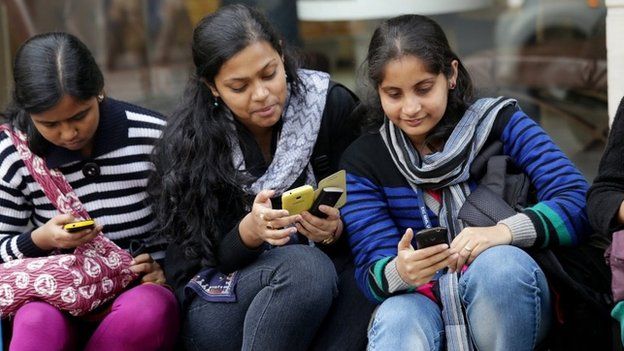
 Juggernaut Publishing's push is embracing the shift of reading on mobiles phone. The publisher plans to release more books as digital exclusives, although about 50  books per year will also be released in paper. The lynchpin of the publisher's debut will be the memoir of Rajat Gupta, a business scion who was convicted of insider trading and jailed. More details are here in some interviews Chiki Sarkar did at the recent  London Book Fair and with Vogue India.


Mobile users in India/photo by BBC


Many people worldwide read novels on our phones and tablets, using apps from Amazon and Apple. I do it to keep myself busy when I'm waiting somewhere. I own a Nook e-reader and a Kindle Fire, but I confess both need to be charged, because I use them only on the treadmill or when traveling.

Here's the other side of the story. Remember how I mentioned people speaking so many languages in India?

Penguin/Random House has decided to go big guns and  translate quality regional language fiction into English. One example of this new pubs is one of the most powerful thrillers I'd ever read, Hangwoman, by KR Meera and translated by J. Devika.


I would not have ever known about this haunting novel, originally written in Malayalam, if it hadn't been for this publishing risk taken. The past and the future, interwoven. That's why I love India.


Thursday, February 17, 2011

Bye Bye Borders


Yesterday Borders bookstores filed for Chapter 11 bankruptcy protection.  (This is an arcane procedure which Jeff would need to explain to anyone outside the United States.  As far as I can understand it, it means that the company goes on operating and its creditors write off their money.)  Nevertheless, as Jack Quick wrote on 4MA today: “First 10 chapters so-so. Don't really expect a strong ending....”  And the process will be far from painless.  200 of the 650 Borders stores are to close and the staff – already down by nearly half from the good days – face steep cuts in the same proportion.  The news was not unexpected, but it leaves publishers holding fistfuls of dud checks and tasting ashes in a market which has had little cause for celebration for quite some time. This comes hard on the heels of the demise of The Mystery Bookstore in Los Angeles.  Jeff wrote about it last week (and I stole the picture from him) but it’s poignant that the big chains and the specialist independents are crashing together.  

So where does that leave us as readers and authors?  “Avante!” we cry.  “On to the e-book future!”  So we shrug off Borders and, having paid nostalgic respects to the mystery independents as they close one by one, we order what we want on Amazon, downloaded to our Nooks and Kindles and IPads and laptops at the convenience of a mouse click or two.  Google stands ready to make it easier to pay (10% for them); Apple and Amazon want 30%.  That’s lots more money for authors and much cheaper prices for readers, right?  The ultimate win-win.  And the middle people – agents, publishers and booksellers – move on to other things.

So let's imagine an e-book world - a world where all books are e-books (except perhaps a few superstars that remain available in hard copy and sold through the online retailers).  I’m not as sanguine about this outcome as some.  I’m aware that other authors have had varied experiences ranging from brilliant to horrendous, but our editors have done a great job improving our books.  I’d be very sorry to lose that input.  We have just been through the copy edits of our third book.  Perhaps it’s not changed dramatically as a result, but it has a gloss now which comes from the expert reading of English.  And the copy editor caught some inconsistencies and even a couple of howlers.  Who would believe that after the number of times we and others have read the book, it still contained: ‘Kubu leant back in his chair causing a loud creek’?  Okay, so no readers will imagine white water gushing from the seat, but it’s embarrassing!  I know of someone who was retrenched from a South African book publisher and decided to choose the niche activity of editing e-books for authors.  He had lots of enquiries, but few takers.  It’s a painstaking process and it comes at a price.  If the author is unknown, and paying from his or her own pocket, there is a strong motivation to throw the book at the internet as it is and see what happens. 

That’s another issue.  How will the strong new voices stand out in the cacophony?  How will they be distinguished from the other 749,999 new e-books that come out each year?  We’ve all heard the stories of unknown authors selling books from the trunks of their cars and becoming best sellers, or writing cooking blogs that become books and films, but how many of those are there actually?  Pretty much the same as winning a lottery, I’d guess.
Libraries are another critical area.  There is talk (perhaps it is already reality in some places) of lending Kindles rather than books.  Yes, they are more expensive, but the libraries will get bulk discounts and, of course, can store multiple books on each device.  Much space, and perhaps even some cost, is saved.  But I think this is trying to fit the new technology into the old thinking.  Isn’t the reality in the days of cost cutting and budget deficit shrinking, that we will be told one only needs a single electronic copy sitting, say, at the Library of Congress.  Everyone can download it from there.  Of course, delete after two weeks, don’t copy, don’t lend on...   

As Jeff pointed out last week the music industry is at 10% of the revenues they might have had in the bad old hard copy days.  We haven't even mentioned the pirate sites where you can download for free or almost nothing.  No solution to this one.  If the CIA can’t keep their stuff off the net, what hope have the rest of us?
Certainly someone will be making lots more money in the e-book world, but I rather doubt it will be the authors!

Michael – Thursday.

Monday, November 15, 2010

All Over the Map


The folks who contribute posts to this blog have access to a cool feature: Down at the very bottom of this page there’s a little oblong box surrounding the word “sitemeter”.

If you, as a visitor, click on it, all you’ll get is an ad for the service.

But when I, and the other registered administrators of this blog click on it, we get information about our readers.
We don’t get email addresses, or anything confidential like that.
We get general information.
Information like how you got here.  (Did you have us bookmarked? Did you find us through Google? Did you access us via a link from someone else’s site?)
Like how many visits we got in the past hour, past day, past week, past year.
Like which of our posts were most popular, most read, most stood the test of time.
But coolest of all, I think, is the map feature.
When I click on that one, I get a world map.
I can zoom in on a particular area, or I can choose to look at it by continent.
I can choose the last ten visits, twenty, or fifty, or a hundred.
And every visit is indicated by a little dot on the map.
For the last three days, I’ve been doing regular checks to see where you, our readers, dropped in from.
Turns out, it’s all over the map.
You’re on every continent and a lot of islands in between.
Just in the last seventy-two hours you’ve been checking-in from Korea, Thailand, India, Sri Lanka, Pakistan, Malaysia, Singapore, The Philippines, Australia, New Zealand, Brazil, Chile, Argentina, Mexico, Colombia, Peru, The United States, Canada, Puerto Rico, Anguilla, Antigua, Hungary, Norway, Denmark, Sweden, Finland, Russia, Iceland, Greece, Turkey, Israel, Italy, Spain, Portugal, the UK, France (including one visitor from Corsica), Switzerland, the Czech Republic, Tunisia, Cyprus, The United Arab Emirates, South Africa, Jamaica, The Netherlands Antilles and Vanuatu.
Vanuatu?
Yeah,  Vanuatu.
Honest.

Murder is Everywhere is…well…truly everywhere.
Our books, alas, are not.
The two great impediments to that are language (translations) and availability.
If you’re reading this, you obviously don’t have much of a problem with English.
But, if you’re our reader on Vanuatu (I’d find it hard to believe there’s more than one) you might find it difficult to get your hooks into a copy of Yrsa’s latest, even in English.
That’s changing.
And what’s changing it is ebooks.
Ebooks are exploding.
I just got a royalty statement from my publisher and discovered that my ebook sales doubled in 2009 over 2008, and, to date, have more than tripled in 2010 over 2009.
These days, it doesn’t matter where you live – as long as you own an ebook reading device, you can get Yrsa’s latest.
Last week, I did something I should have done earlier.
I digitalized my first book, Blood of the Wicked, and put it up on Amazon everywhere in the world where Kindle Books are sold, and where I hadn’t already sold the rights to a local publisher.
And I’m going to do the same with my other books at the rate of one book a month.
The cover image, because of copyright restrictions, is very different from the versions sold in places where the book has already been available. Here's what it looks like:
And, if you’re a reader of this blog, you can get it for free.
Not forever, but absolutely free until the end of this month.
Own an ebook reader?
Haven’t yet read Blood of the Wicked?
Live outside of North America, the U.S. Possessions and the Philippines?
If the answer to all three of those questions is “Yes”, then all you have to do is contact me.
Write to me through my website (you can get there by clicking on my photo over there on the right).
In your email, simply specify whether you’d like to have the book in Kindle or epub format.
And I’ll write back, attaching a free ebook.
Again, because of copyright restrictions, the deal isn't available to residents of the United States, Canada, the U.S. possessions and the Philippines - and it expries at the end of the month.
Write now.
Wherever you are in the world, it'll take you less than a minute to ask for it.
And only seconds to download it once you receive my reply.

 Leighton - Monday